Small Town, Big Heart premier

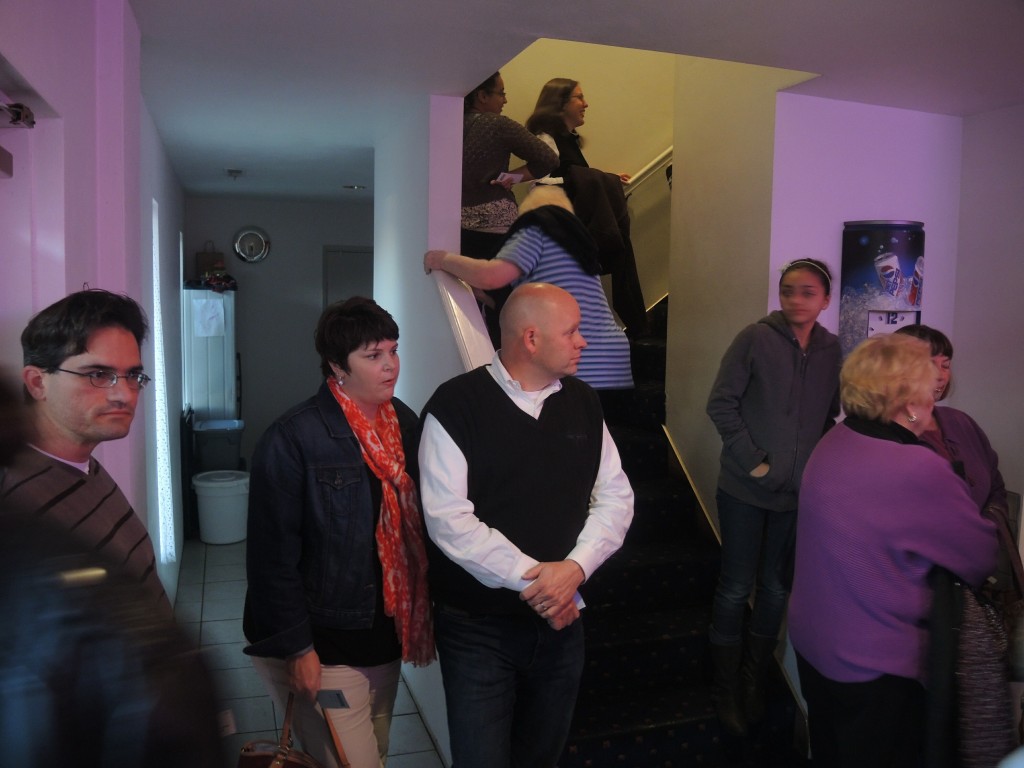
A Norman Rockwell version of Mr. Smith goes to Washington premiered at the Shelton Cinema in the form of a homespun documentary, Small Town, Huge Heart, Big Apple by Mark and Linda Woytowich on 9-26-13. It is the story of how a small rural community choir in Mason County, through the cajoling of its director, Matthew Blegen, rose to heights necessary to perform Handel’s ‘The Messiah’ in Lincoln Center’s Avery-Fischer Hall and New York’s Radio City Music Hall. The movie was quintessentially Mason County in mood, scenery, humor, and format.

Small Town, Small Venue

Small Town, Small Venue

Watching us watching them

Watching us watching them

Rep. Drew MacEwen & wife,  35th dist.

Rep. Drew MacEwen & wife, 35th dist.

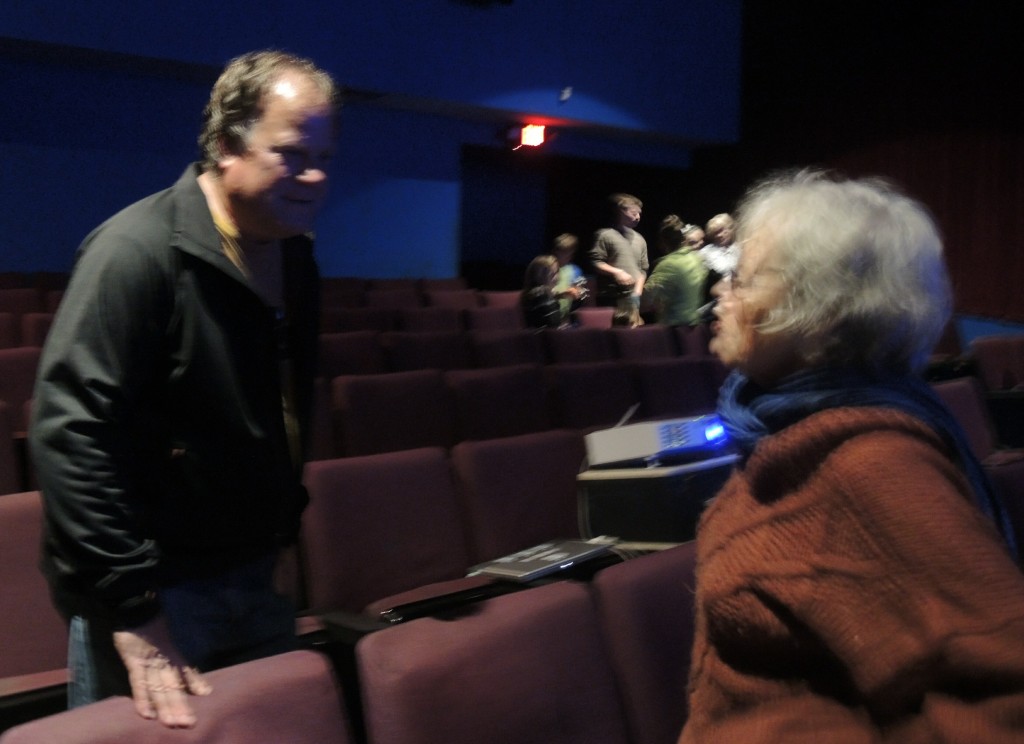
To begin with, the crowd (approaching 200) was squeezed into a lobby much too small to serve as a host for such local excitement.  The air was becoming warm, fetid, and there was entirely too much togetherness to the point one could not move further in or out.  There was an abundance of schmoozing, small town chatter, and plenty of smiles all around. While only 24-hours prior to the event, only 50 tickets ($8-$10 ea.) had been sold, they were virtually sold out within the last 24 hours and at the door for the 200 seat theater.  Dr. Busacca, a local dentist, and his wife, both ardent patrons/supporters of Anna’s Bay had to be turned away at the door for not having purchased tickets earlier. Drew MacEwan from the 35th District and his wife were seen in attendance along with any number of choir members.

Laptop Matinee

Laptop Matinee

Threading the ditch, their heads bent low...

Threading the ditch, their heads bent low…

Producer Woytowich announces his selection

Producer Woytowich announces his selection

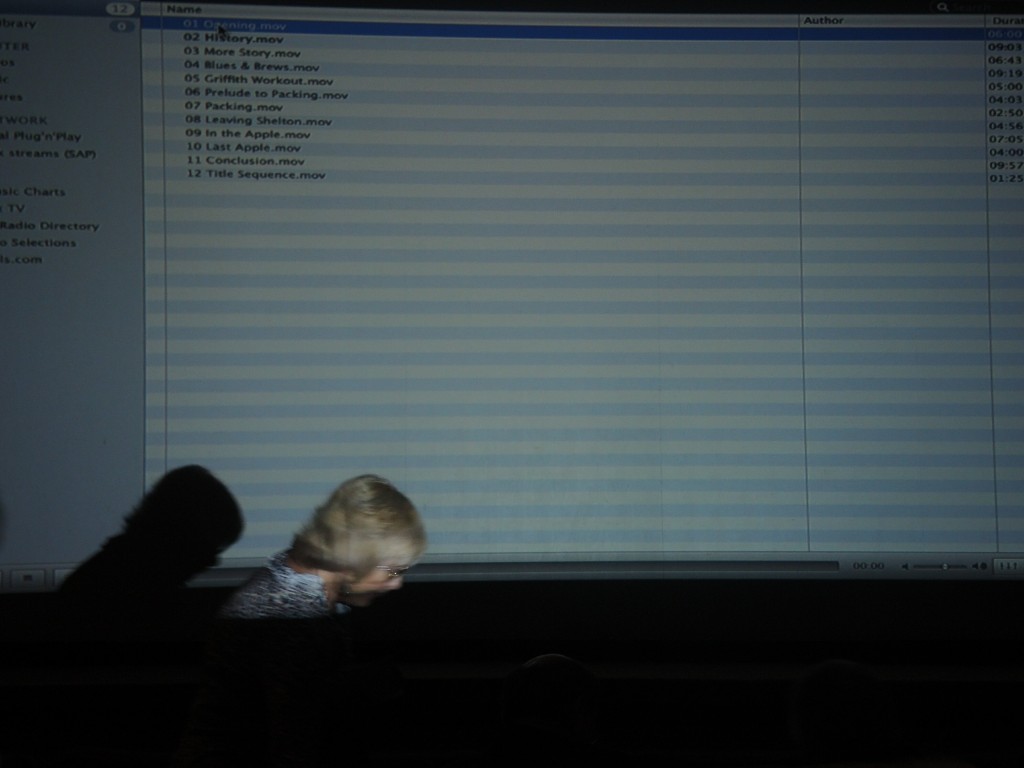
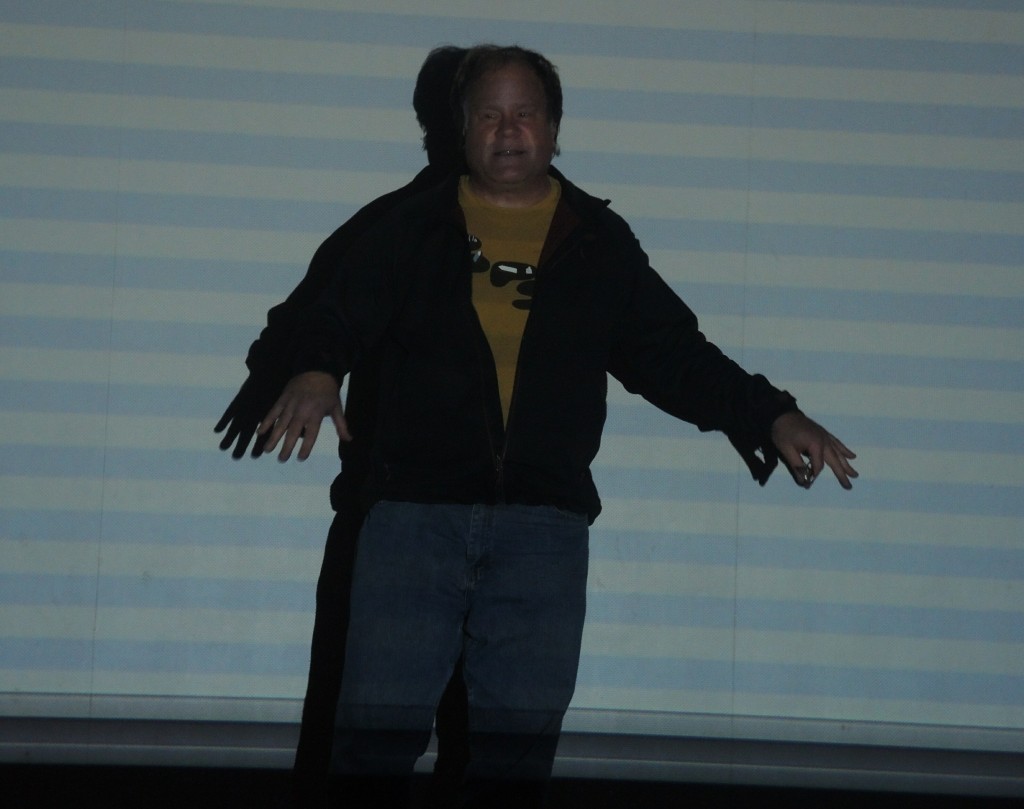
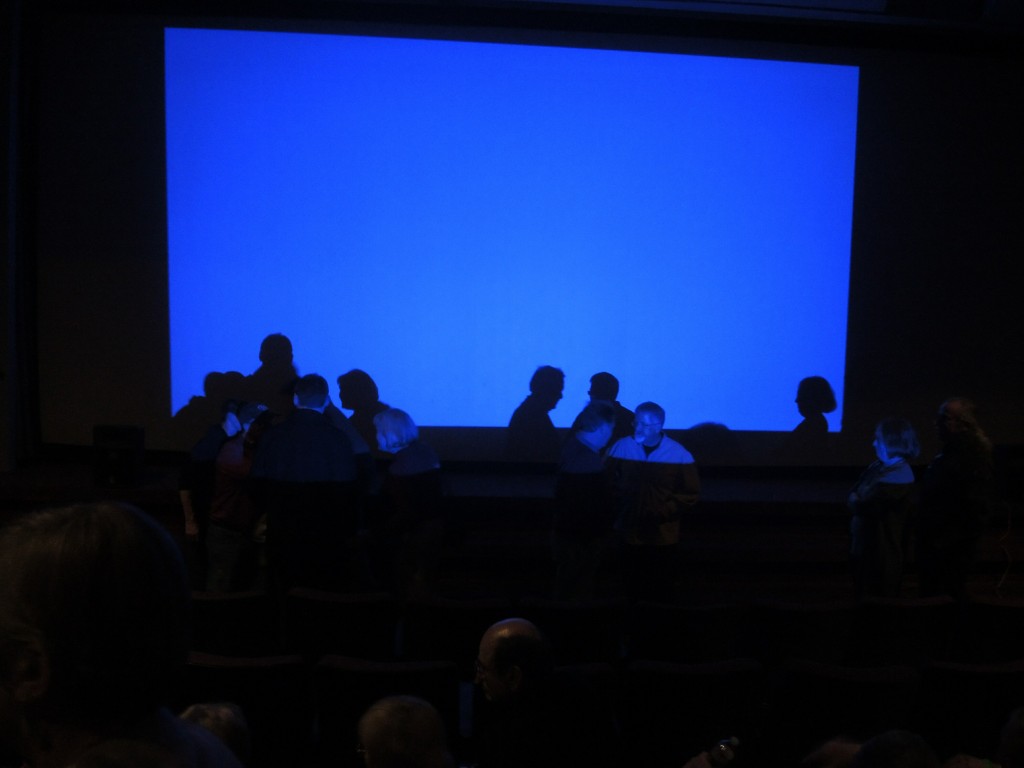
Rumor had it the doors to the silver screen remained closed because an earlier matinee had caused some delay.  As it turned out, the bulb to the  theater’s projector had burned out with no replacement in sight.  The producer (Mark) had to set up an ad hoc laptop and home projector to show the film to ticket holders.  He had a couple of sizable stereo speakers on stage connected to his PC with coaxial cables snaking their way under the seats to a connection on a small card table set up on the seats in front of his projector.  One patron, not knowing what to expect, asked if it was to be a slide show.  She was reassured it would be a video and the crowd accepted the forum’s lack of expected amenities with good humor. A small number of hand silhouettes on the screen preceded the film.

After the Gold Rush

After the Gold Rush

Seeing the Blues

Seeing the Blues

Mr. Woytowich took to the stage to announce his production before the desktop display from his laptop. The film itself was good though uneven in spots where a shaky camera became annoying.  The sound ambiance changed dramatically from one scene to the next in a disconcerting fashion.  Many scenes were spontaneous and had to do as they were unrehearsed.  In general, there was a lot of well received humor in the editing and the audience loved seeing themselves along with their town on the big screen. New York City, itself, looked intimidating.

Producer Woytowich greet patron

Producer Woytowich greets patron

The performance itself was held at Lincoln Center’s Avery-Fisher Hall, a prestigious world class artistic venue.  But, the cost to choir members wishing to perform was $1600 with a limited number of ‘scholarships’ reducing that to $1000 for airfare and lodging.  The producer found he was forbidden to film the performance unless he has $80,000 to fork over as a fee to the venue.  Without this large fee, he was limited to telling the story surrounding the bringing of that performance to the Big Apple…and he nailed it.  Lincoln Center has the archive of the performance, but Shelton residents have the story.

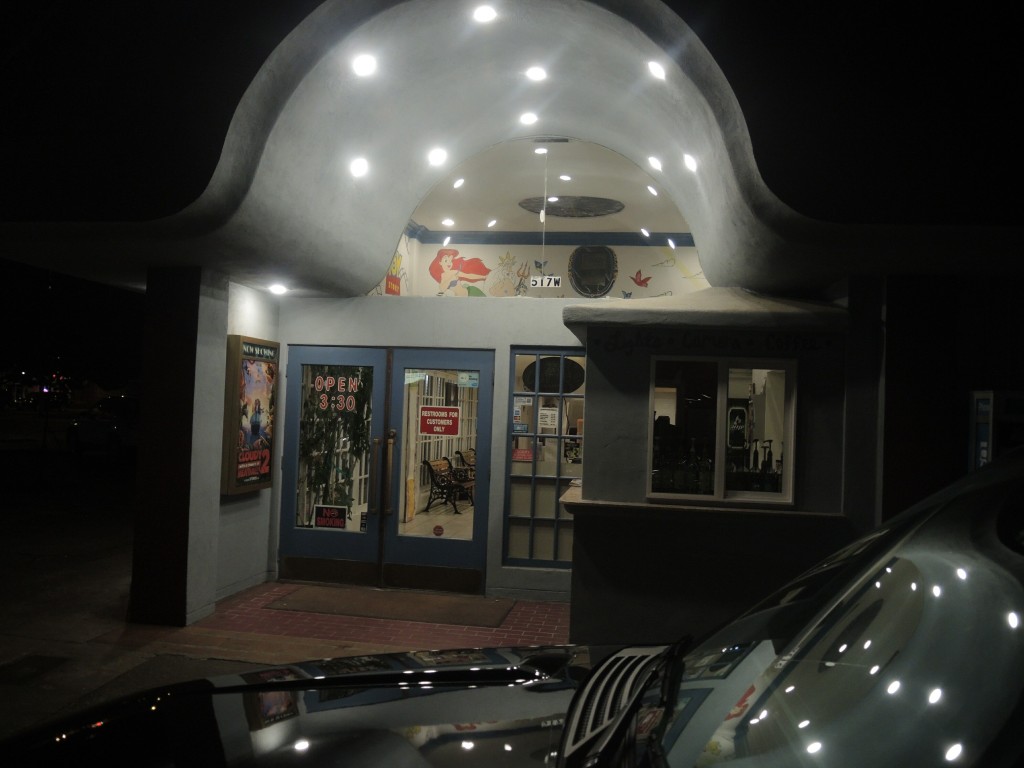
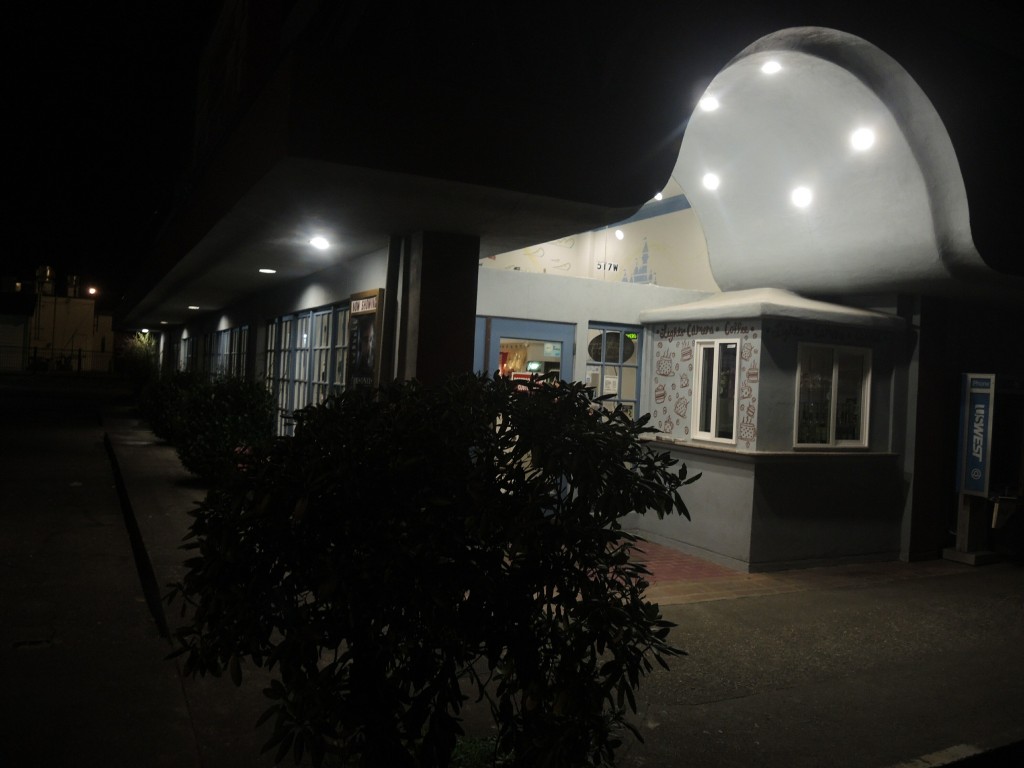
Shelton Cinema after dark

Shelton Cinema after dark

DSCN1710

Opening Night

The film is worth the price of admission to see. Mr. Woytowich is a talented producer with a limited budget which he does not allow to dampen his vision.  Sadly, Matthew Blegen, the talented director who brought the choir to a level of excellence equal to the challenge of performing The Messiah, resigned last spring to pursue his doctoral studies.

It’s hard to believe Matthew Blegen wasn’t disappointed, despite his professionalism and diplomacy, to be unable to dance with the girl he brought to the party.  Jonathan Griffith, a renown director in his own right and part of the organization tied in with Avery-Fischer Hall, directed Anna’s Bay Chorale (along with 4 other choirs) during its stay in NYC.  It’s uncertain who directed their performance at New York’s Radio City Music Hall. The choir members had to raise their own funds and pay their own way ($1600/ea.) to perform at the prestigious venue under Mr. Griffith’s direction. Matthew’s unique blend of inspiration and professionalism will be missed, its absence will be felt.  Whether Suzanne Montgomery’s direction will serve as an adequate substitute remains to be seen.

Posted in Uncategorized | 1 Comment

Why US Health Care Costs Are So High:

John discusses the complicated reasons why the United States spends so much more on health care than any other country in the world, and along the way reveals some surprising information, including that Americans spend more of their tax dollars on public health care than people in Canada, the UK, or Australia. Who’s at fault? Insurance companies? Drug companies? Malpractice lawyers? Hospitals? Or is it more complicated than a simple blame game? (Hint: It’s that one.)

This is the first part in what will be a periodic series on health care costs and reforms leading up to the introduction of the Affordable Care Act, aka Obamacare, in 2014.

Posted in Uncategorized | Leave a comment

LIFE

“Life is a highway. I wanna ride it all night long”

“Come hear the music play. Life is a cabaret, old chum.”

“Life is like a box of chocolates. You never know what you’re gonna get.”

“Life is like a card game. It’s not what you’re dealt, it’s how you play.”

“Life is like riding a bicycle. To keep your balance, you must keep moving.”

“Life is like a taxi. The meter just keep a-ticking regardless of progress.”

“Life is like a camera. Focus on what’s important.”

“Life is like walking through snow. Every step shows.”

“Life is like a maze in which you try to avoid the exit.”

“Life is like photography. We develop from the negatives.”

Posted in Uncategorized | Leave a comment

Sons of (A)narchy

Men of Mayhem, Heirs of Anarchy

From LA Review of Books – by Diarmuid Hester

TONIGHT, SONS OF ANARCHY, FX’s popular TV series about a fictional Californian biker gang, enters its sixth and penultimate season. Fans of the show will no doubt be looking forward to more beards, guns, and gasoline, as the Sons of Anarchy Motorcycle Club fights its way tooth and nailbat through ever more sensational and fractious storylines. And it looks like they’ll get their wish: the FX promo released in July shows the central characters amid a violent, slo-mo melee, in a kind of Hobbesian war of all against all — anarchy as usual then.

But it wasn’t always like this. The show’s opening season explored a more politically and historically engaged notion of anarchy than the chaotic, prurient representation that’s taken hold in the last four years. Before we’re plunged back into the new season and its characteristic maelstrom of violence and melodrama, it’s worth reflecting on the show’s initial exploration of radical politics, to see how Sons of Anarchy lost its way.

¤

MUCH HAS BEEN MADE of the series’ indebtedness to Shakespeare’s Hamlet, and the Bard does lend some cultural heft to a setup reminiscent of trashy biker movies of the 1960s: the eponymous Sons of Anarchy (SOA), a gang of bikers based in the fictional town of Charming, spend their time drinking, fighting, illegally running guns, and riding obsidian Harleys through the winding wastes of sun-drenched California. The pilot episode, however, impresses Shakespearean coordinates onto the show, and it’s pretty deftly done. Jackson “Jax” Teller (Charlie Hunnam), the vice president of the SOA, is a kind of tortured Hamlet, whose customary suit of black is here a leather kutte (or vest) bearing the club’s patch: a grim reaper holding an M16 rifle-cum-scythe and a crystal ball in which the anarchy “A” appears. Rummaging through a pile of dusty old boxes, Jax unleashes the “ghost” of his dead father, SOA co-founder John Teller, in the form of a book written by him called The Life and Death of Sam Crow: How the Sons of Anarchy Lost Their Way. During the first season, Jax routinely takes time out from the killings and occasional castrations to pore over his father’s words, intoned in a gloomy, ponderous voiceover as the sun sinks over the SOA clubhouse. The SOA president Clay Morrow, played by a mean, grizzled Ron Perlman, is the treacherous Claudius, while Gemma Teller (Katy Segal), widow of John and now wife of Clay, is a powerful and vindictive version of Gertrude.

Everyone remembers Hamlet’s private vengeance theme: the foul and unnatural murder of the father and the procrastination of the son. However, when Jax picked up his father’s mouldering manifesto, the public theme of Shakespeare’s play — that of Hamlet’s responsibility to Denmark, his duty to root out rot in the state and set the divine order to right — became one of the show’s immediate concerns, albeit viewed somewhat askew. Reading his father’s words, seeing what the club once was and could be once more, Jax is convinced the old order must be restored. Its order, however, is not one of kings but of anarchists.

Premiering in the fall of 2008 in the immediate aftermath of the US subprime mortgage crisis and three years before the birth of the Occupy movement, Sons of Anarchy’s initial 13 episodes ran another storyline underneath the Hamlet one. Using John Teller’s book as a diegetic foothold, it sought to locate the origins of the gang within the context of 1960s counterculture and an avowedly anarchist ideology. Referencing the work of anarchist writers like Emma Goldman and gesturing towards anarchist debates about liberty, the law, and so on, Teller’s book allowed the show to juxtapose the original vision of the SOA with the gang’s contemporary incarnation, plainly corrupted by power and paranoia. The first season seemed to lament the passing of a more egalitarian, noncoercive social order, and hinted that future seasons would see the pull towards a pure past in conflict with the drag of a more sullied present. If the Hamlet storyline riffed on the Sons of the show’s title (“I am too much in the sun,” Hamlet spits at Claudius), this one explored its anarchy in a specifically American context, beyond a pejorative definition of mere chaos:

Jax: When you and Dad hooked up — he ever talk to you about his vision? About what he wanted from the club?

Gemma: His vision was — you know … what it is. A brotherhood. Family.

Jax: And running guns? He want that? Seems like his original idea for the MC was something simpler — you know, social rebellion. He called it “a Harley commune.” It wasn’t outlaw; it was real hippie shit.

Gemma: We had a lot of bright ideas back then. We were kids.

Initially, Jax’s study of The Life and Death of Sam Crow features in the final minutes of each episode and works as a kind of weighty reflection on the week’s action. In episode two (“Seeds”) Jax reads his father’s notes on living beyond the reassuring bonds of society: without the social regulation of violence, freedom of the outside has its own problems. “Most of us were not violent by nature,” Teller remarks with foreboding; “We had our problems with authority but none of us were sociopaths. We came to realize that when you move your life off the social grid, you give up the safety that society provides.” These wistful thoughts stand in stark contrast to the various unfettered acts of brutality committed by Jax and the others earlier in the episode (one particularly bloody scene has a victim taking an axe to the head).

Later, in episode four (“The Patch-Over”) the anarchist foundation of Teller’s remarks is made explicit. On the wall of a cave somewhere in the Nevada hills, scrawled in red, Jax finds abridged lines from anarchist Emma Goldman’s 1917 essay “Anarchism: What It Really Stands For,” and reads them aloud:

Anarchism stands for the liberation of the human mind from the dominion of religion; the liberation of the human body from the dominion of property; liberation from the shackles and restraint of government. Anarchism stands for a social order based on the free grouping of individuals.

“When I saw those words,” John Teller’s voiceover tells us, as his son reads his book, “it was like someone ripped them from the inside of my head. […] The concept was pure, simple, true. It inspired me, lit a rebellious fire.” Anarchism is the restless, beating heart of the original Sons of Anarchy. Before being usurped by the ideologically vacuous notion of mayhem and disorder, the word meant social revolution, political dissent, freedom. It was an ethos.

Goldman’s simple anarchist principles form the basis of Teller’s original vision: the rejection of religion, property, and government and the production of a noncoercive collective. However, as he later remarks, “[U]ltimately I learned the lesson that Goldman, [Pierre Joseph] Proudhon and the others learned. […] Most human beings only think they want freedom; in truth they yearn for the bondage of social order, rigid laws, materialism”: the schism between the SOA’s founding principles and their systematic weekly violation by Clay and his boys generates a dramatic tension that falls, finally, on the shoulders of Jax Teller.

Religion is rarely addressed in the show so it’s unclear how much Goldman’s first principle is transgressed; however, not only do the Sons plainly believe in personal property (a notion abhorrent to Proudhon), they cleave to it, orient their lives around it, and seem to derive all satisfaction from ensuring an accumulation of it in the form of illegal firearms. Similarly, though they’re frequently at odds with some kind of federal organization that’s out to get them (usually the ATF), the SOA’s own laws and customs are often shown to be every bit as restrictive and repressive as that of the US government, if not more so. In “The Patch-Over,” avenging an ill-chosen comment about Gemma made by Kip, Clay taunts him and beds his romantic interest, Cherry. This whole scene not only foregrounds the rigid, unjust hierarchy of the club’s structure that finds Clay (the king) at its apex and Kip (a “prospect” or rookie) at the bottom, but illustrates the lowly status of women in this sclerotic macho society. Finally, though the SOA regularly vote on matters pertaining to the club, which would appear to suggest the club’s noncoercive organization, members are frequently abused, threatened, and cajoled into sacrificing their better judgment so that the club (perhaps better named Sons of Bureaucracy) may prevail.

¤

There’s an obvious correlation to be made here between the respective fates of the Sons of Anarchy Motorcycle Club and Sons of Anarchy the TV show. On the one hand we find a once anarchistic club, which sees its radical ideas eroded as it progressively capitulates to easy money and a prevailing capitalist culture. On the other, a politically engaged TV program similarly loses its radical timbre by bowing to the demands of a culture of sensationalized televisual violence. In both cases an ephemeral spark of radical thought is quickly smothered by mainstream forces.

Although I’m tempted to lament the disappearance of anarchism as an explicit theme, I think it’s important to note that by making manifest (albeit unwittingly) this very process of ideological erosion, Sons of Anarchy also invokes the historical trajectory of anarchism in the United States. In other words, not merely a representation of radical social forms but also representing the progressive dissolution of these forms, Sons of Anarchy recalls the fortunes of numerous other movements in the history of American anarchism. A recent instance of this might be the coalescence and subsequent dispersal of Occupy Wall Street’s quasi-anarchist collective in Manhattan’s Zuccotti Park. Before that, groups like the Youth International Party’s (“Yippies”) idea of an anarchistic New Nation (“based on cooperation not competition”) also bloomed and withered in the late 1960s. In fact, if we go right back to the beginning of anarchism’s appearance in America we see the same pattern of upsurge and collapse.

In the 19th century, the so-called “golden age” of anarchism dawned in the US, accompanied by massive amounts of dissident tracts and newspapers promoting anarchist ideas. In contrast to their counterparts in Europe (but like the original Sons — men “not violent by nature”), the writers of these works largely supported a nonviolent agenda and concerned themselves more with “propaganda of the word” than “propaganda of the deed.” These ideas then took physical shape in the form of independent anarchist communities that look like John Teller’s “Harley commune,” being similarly horizontal in arrangement and founded on the notion of individual sovereignty. The mid-1800s saw colonies spring up around the United States in places like New York, Ohio, and Washington, offering anarchists liveable alternatives to coercive social forms. Anarchism was palatable to a lot of Americans at this time and in some quarters it was even affirmed as a version of the legendary pioneer spirit, upon which the nation was founded.

The “golden age” was brought to a swift end, however, by the waves of anti-anarchist sentiment and anti-anarchy laws that followed the 1886 Haymarket bombing in Chicago (for which four anarchists were controversially hanged) and the 1901 assassination of President McKinley by anarchist Leon Czolgosz. Popular support for anarchism dwindled as the movement found itself the focus of Theodore Roosevelt’s “war on anarchists.” Its mouthpieces were censored and its enclaves were scattered to the wind. Individualist anarchist communities folded from internal or external pressures and their residents moved back into the American mainstream and out of history. Nevertheless, though none of these communities lasted more than a decade, as historian James J. Martin remarks in his excellent study Men Against the State (1957), their objective was not longevity but rather temporary livability. In other words, the durability of the community itself was less important than its duration, during which equity and free-will prevailed. I’m inclined to see this as a recurring feature of anarchist social arrangements and, as the fate of the SOA demonstrates, an anarchist ideal is eclipsed when the survival of the community takes precedence over the individual voices of its members.

Viewed negatively, this history of anarchism in the United States seems to suggest that the status quo must always be reconstituted following an anarchist eruption: just as Fortinbras must return at the end of Hamlet to ensure the monarchy is set right, Sons of Anarchy must become the overblown enterprise it is now, and Jax must forsake his anarchist pretensions and become the tyrannical president Gemma wants him to be. The consistency with which we find this waxing and waning, efflorescence and decay, however, also attests to the persistence of anarchist ideas in the American political and cultural imaginary: though anarchist events may not last long, a longing for the duration of livability endures.

¤

Diarmuid Hester is a doctoral researcher in English at the University of Sussex and holds a John W. Kluge Center fellowship at the Library of Congress.

Posted in Uncategorized | Leave a comment

Ag-Gag Laws Target Photojournalists

On February 8, a 25-year-old animal rescue worker named Amy Meyer and a colleague pulled into a parking lot across the street from the Dale T. Smith and Sons Meat Packing Company in Draper, Utah, a suburb south of Salt Lake City. They crossed the street and stepped onto a strip of public land on the roadside, stopping short of a barbed wire fence that demarcated the boundary of the property of the slaughterhouse.

Across a small field, the building housing the killing floor stood in plain sight. Through two large open doors facing the road they stood on, they could see cows being led onto the plant’s disassembly line. Outside the building, a forklift was pushing a live cow—possibly a sick, “downer” cow, which are illegal to slaughter. Despite the fact that she stood firmly on public property and was not an employee of the slaughterhouse, when Meyer took out her camera and began to film, she set herself up to become the agricultural industry’s first-ever “Ag Gag” criminal.

“Ag Gag” laws are a species of state-level legislation that has been vigorously pushed by lobbyists over the last several years to criminalize and suppress the exposure of inhumane practices in animal agricultural operations. In essence, the laws protect the industry by making whistleblowers into outlaws.

Ag Gag laws take aim at camera-wielding undercover whistleblowers, whose videos have provided some of the few unvarnished glimpses the public has seen of where their food comes from—and it’s not a pretty sight. Over the last half century, intensive, mechanized, indoor factory-style animal feeding operations have almost entirely supplanted the grazing pastures of traditional livestock farms. In processing plants, ever-increasing disassembly line speeds have increased the risks of injury to knife-wielding slaughterhouse workers, who tend to be poor, often undocumented migrants from Mexico and Central America, while compounding the risk of some animals being skinned and dismembered while still alive.

Undercover videos have exposed the ugly realities concealed behind the walls and locked gates of animal agriculture facilities and put them on the evening news. The footage is graphic; the impressions they leave are haunting and indelible. Images from past undercover investigations include unwanted male chicks on an egg farm being casually tossed into a grinder alive, workers swinging sick or runty piglets by their legs and smashing their heads on concrete, and cows and calves being beaten in the head with crowbars (the first two abuses are standard industry practice). “Once you see them, you can’t unsee them,” says Matt Rice, Director of Investigations for Mercy For Animals, who traces his own conversion to animal advocacy to undercover videos he watched over a decade ago.

Their impact on a political level can be just as powerful as on a personal one: in the last decade, videos shot by undercover investigators and broadcast on national TV news stations have contributed to the phasing-out of the use of immobilizing “gestation crates” for pregnant sows in the supply chains of several major restaurants and retailers and their outright ban in nine states; the passage of a ballot initiative outlawing the use of highly constrictive battery cages for egg-laying hens in California; the passage of a separate California law banning the force-feeding of ducks to produce foie gras; a ban on veal crates in Arizona and moves toward their elimination in Ohio; and the exposure of the routine slaughter and processing of sick cows for beef, which led to the largest meat recall in US history.

The agricultural industry’s response to this intractable public relations threat couldn’t be more straightforward: make it illegal.

The first generation of what would later be known as Ag Gag laws emerged in the early 1990s in response to a much different threat posed by underground activists with the Animal Liberation Front movement. In Kansas, Montana and North Dakota, state legislators made it a crime to take pictures or shoot video in an animal facility without the consent of the facility’s owner.

In 2002, the American Legislative Exchange Council—the conservative law-drafting organization behind Florida’s “Stand Your Ground” law and Arizona’s anti-immigrant SB1070—took the approach one step further. ALEC drafted a piece of “model legislation” for distribution to lobbyists and state lawmakers across the country in an effort to make Ag Gag into a national phenomenon. The model bill, called The Animal and Ecological Terrorism Act, proposed prohibiting activists from, among other things, “entering an animal or research facility to take pictures by photograph, video camera, or other means with the intent to commit criminal activities or defame the facility or its owner.” It also proposed the creation of a “terrorist registry” that would contain the names, addresses and photographs of those convicted under the proposed law.

In the last year and a half, at the behest of animal agriculture interests, ALEC’s model bill—minus the registry—has been taken up as a template and passed in various iterations in Iowa, Utah, Missouri, Arkansas and South Carolina.

“The animal agriculture industry has nothing to hide,” says Emily Meredith, Communications Director for the Animal Agriculture Alliance, an industry group that refers to organizations like the Humane Society as “extreme animal rights organizations.” “But there’s a difference between having nothing to hide and allowing activists—with a blatant agenda to put an end to the consumption of meat, milk and eggs—to gain access to family farms in illicit and fraudulent ways, take video, and then cut and run to later release that video under a big donate now button.”

Some versions of ALEC’s bill criminalize documenting abuses outright. Some make it a crime to lie about one’s associations with animal advocacy groups on job applications for farm employment. Others require those who document abuses to turn any evidence over to law enforcement within 24-48 hours of recording it—a clever way of preventing activists from engaging in the weeks- or months-long investigations required to demonstrate systemic abuses.

Though the rules target animal advocates, the potential ramifications for civil liberties are broader. Ag Gag rules can as easily be used to inhibit agricultural employees from exposing unsafe or illegal working conditions as it can to silence animal advocates. And other industries are likely to lobby for similar protections against their own whistleblowers-in-the-making. Already, North Carolina’s bill makes the falsification of employment application information for the purposes of whistle blowing a crime in any industry.

“Union members know firsthand how important it is for these workers to be able to document unsafe working conditions and other threats to workplace and food safety,” says Mark Lauritsen, International Vice President and Director of the Packing Division for the United Food and Commercial Workers union, which represents many slaughterhouse employees. “We are opposed to any government intervention that seeks to intimidate workers and investigators from shining a spotlight on the true conditions of America’s food manufacturing facilities.”

“The laws are clearly directed at animal rights activists who threaten the profitability of factory farms and slaughterhouses, but their reach doesn’t stop there,” says Rachel Meeropol, Senior Staff Attorney for the Center for Constitutional Rights. For example, the North Carolina bill, she notes, “would criminalize not only animal rights investigations, but also an undercover journalist who applies for a job at a suspect plant in order to expose human trafficking or work safety violations.”

As its public profile has increased, public opposition to Ag Gag legislation has grown, and the agricultural industry’s path to enacting Ag Gag rules throughout the country has become more daunting. A February 2012 national poll commissioned by the ASPCA showed public opposition to the criminalization of animal abuse whistleblowers standing at almost two in three Americans. Ag Gag bills have been rejected or failed to gain traction in a raft of states in every region of the country from California to Wyoming to Tennessee. The term “overreach” comes to mind.

Amy Meyer’s experience has become something of a symbol of that overreach, and an indicator of the limits of the agricultural industry’s ability to suppress free speech. A few minutes after Meyer hit “record” on her camera, a truck pulled up in front of her. Meyer’s colleague hastily departed. Bret Smith, the facility’s operator and brother of Darrell Smith, the slaughterhouse owner who is also Draper’s mayor, leaned over from the driver’s seat, filming her with a phone camera as she filmed him back. At first, he accused Meyer of trespassing, though she was plainly standing on the outside of the plant’s fence. Then he shifted tactics. “You cannot videotape my property from public property,” he said (this is in fact not what the law says). “If you read the rights here and the laws of Utah, you can’t film an agricultural property without my consent,” he continued. Smith called the police.

Within just a few minutes, seven squad cars pulled up. “The officers would all go to Brett Smith first and shake his hand,” Meyer recounts. “And then they would come over to me and treat me like a criminal.”

An officer questioned Meyer about her identity and what she was doing there, even after affirming that she was not being detained and after she told him she did not wish to answer his questions. After some arguing over the legal basis for his questioning, according to Meyer, the officer claimed that a worker at the slaughterhouse had reported witnessing her and her colleague crossing over the fence, trespassing onto private property—a description at odds with the footage she shot that day. The officer told her she was free to leave, but that he would “screen charges of criminal trespass” on her.

Eleven days later, prosecutors filed charges against her for “agricultural operation interference,” a Class B misdemeanor that carries a maximum six-month jail term.

At the end of April, Will Potter, a journalist who tracks government suppression of environmental and animal rights activists, broke the story of “the first prosecution in the country” under an Ag Gag law. The story was picked up by local and national media outlets, bringing just the kind of public attention to the agricultural industry that ALEC’s model legislation was designed to prevent. Within 24 hours, the charges were dropped.

Without the media attention the story garnered, Meyer may have been forced to defend herself in court. Had prosecutors pressed the case, the video footage, which is clearly shot from outside of the property line, may well have exonerated her. But future cases may have different, less favorable conditions.

On July 22, Meyer, Potter and several other groups and individuals filed a lawsuit challenging the constitutionality of Utah’s Ag Gag law, which Meyer calls “a blatant violation of free speech and freedom of the press.”

In implementing Ag Gag laws, the agricultural industry has set a highly restrictive example that other industries may soon follow. With the precedent already set, lawmakers will see little reason to extend favorable treatment to one sector and not to every other. By then, prosecuting whistleblowers on behalf of corporations will be business as usual.

Posted in Uncategorized | Leave a comment

Why ELF, (A)LF, and Vegans Flip Out:

Ever wonder where your shrink wrapped pound of flesh at the grocery store comes from? Do you genuinely appreciate you’ve commodified a living being which experiences pain, suffering, malaise, depression?

A measure of Man’s fate correlates to the humanity we show our animal cousins.  It has always been true the more brutal our behavior toward them, the more we brutalize each other. This simple paradigm may hold the key to the mystery of why America is one of the most brutal societies on earth. It also has the most fast food joints and largest factory farms.  Is it gun ownership…or hamburger consumption?  Yeah, Hitler was a vegetarian, but could there be a connection between TV/Holywood violence, over the barrel video games, and the amount of meat we thoughtlessly consume?

Posted in Uncategorized | Leave a comment

Shelton’s Toxic Landfill Abatement Urgently Needed


View Larger Map

Dear Friend,

Local concerned citizens has been researching the City of Shelton Landfill for over a year and have found that we may have public health risks associated with this historical landfill site. We must take immediate action and need your help.

History:

* The City of Shelton Landfill, at the end of C Street west of Highway 101, began operation in 1928.
* Over the years, all municipal waste was taken, dumped and burned there. This waste included most everything from cars, appliances, medical wastes, paints, chemicals and possible WWII military waste.
* From 1974 through the 1980s, it became the dumping ground of dioxin-laden baghouse ash mixed with sewage sludge from the Shelton Treatment Plant. Of the sites studied in the 1987 EPA Superfund Dioxin Study the Shelton Landfill ended up being the “most concerning”. Many documents have statements regarding ‘public health risks’. Also, dioxins are presently known to be a more cancer causing substance than they were in the 1980s.
* Furthermore, during that period of time, toxic sediment was dredged from Oakland Bay and deposited in this landfill. Oakland Bay sediment contained a great deal of harmful chemicals from historical discharges. Additionally, other debris such as creosote treated logs, and debris from a hardware store fire.
* A great many Public Record Requests, made it clear that the Shelton Landfill was:
1) Never lined
2) Possibly leaching into shallow groundwater
3) Did not have the required Solid Waste permit
4) Never went through formal closure according to WA state law
5) WA state law requires ground water testing and monitoring; no testing and monitoring has occurred at the landfill. It was documented that no water tests were even taken during the EPA Dioxin Study.
6) The landfill parcel was never listed properly in county property records, therefore SEPA permits were granted to a gravel mining operation at the toe of the landfill risking excavating of dioxins and other hazardous materials; possibly spreading them throughout the county.
7) The north fork of Goldsborough Creek may be receiving toxic runoff from the landfill.

How you can help: We need as many community members as possible to request that the Dept. of Ecology’s Toxic Cleanup Program assess, test and rank the Shelton Landfill. A letter is attached to this email with the contact person, an address for snail mail and an email address. Preferably, construct your own letter in your own words, but we have also attached a letter that you may use. Open the attachment, enter the date and type in your name, address and email. Save your changes. Copy and paste this new letter into a new email, and send to the email address given. Printing it and snail mailing is also good. Please do so as soon as possible before 9/23/13.

We need this to be a successful email campaign. Together, our citizen voices will be heard. Thank you for participating. Please send notification of your actions to mwtat@hctc.com to keep track of the letters being sent.

Please send this request on to at least more five people that reside in Mason County and ask them to do the same.

Thanks again.

PS…For those of you that have difficulty opening attachments, I have copied the letter below.

To use: Cut and paste the letter below to an new email message…add date, name, address and email and then email or print and send it to Rebecca Lawson with the Toxics Cleanup Program, Ecology.

____________________________________________________________

DATE

Rebecca S. Lawson, P.E., LHG, Section Manager
Toxics Cleanup Program, Southwest Regional Office
PO Box 47775
rlaw461@ecy.wa.gov
Olympia, WA 98504-7775

RE: Need for Site Hazard Assessment and Ranking for City of Shelton C Street Landfill

There has been recent gravel mining below the old City of Shelton Landfill near a salmon bearing stream. Additionally, a proposed school site abuts this landfill in the Shelton Hills Planned Action Development (see EIS draft – comments due by 9/23/13). This is a non-permitted, unlined, no formal closure municipal landfill, that was active for over sixty years. This now has the attention of the community.

This landfill was the central dumping site for ordinary household materials and appliances, cars and refrigerators, dioxin laden bag house fly-ash, sewage sludge from Shelton Waste Water Treatment Plant, chemicals and debris from Rayonier (before it starting using Goose Lake (a recognized toxic clean-up site on the National Priority List), contaminated sediment dredged from Oakland Bay (everything and anything was dumped into this landfill over the years). It is my understanding that no groundwater or surface water monitoring or testing has been done to determine if contamination from this site has leached into the aquifer and/or Goldsborough Creek.

I believe that this old dumpsite is a risk to public health. I am asking Washington State Department Ecology to immediately conduct an assessment and ranking that includes groundwater and surface water testing.

Thank you for taking action on this landfill site.

Sincerely,

Name
Address
Email

Posted in Uncategorized | Leave a comment

Is Privacy Dead?

Revealed: how US and UK spy agencies defeat internet privacy and security

• NSA and GCHQ unlock encryption used to protect emails, banking and medical records
• $250m/yr: US works covertly with tech companies to insert weaknesses into products
• Security experts say programs ‘undermine the fabric of the internet’

With 'friends' like these

With ‘friends’ like these…

by James Ball, Julian Borger, Glenn Greenwald, Nicole Perlroth, Scott Shane, & Jeff Larson

US and British intelligence agencies have successfully cracked much of the online encryption relied upon by hundreds of millions of people to protect the privacy of their personal data, online transactions and emails, according to top-secret documents revealed by former contractor Edward Snowden.

The files show that the National Security Agency and its UK counterpart GCHQ have broadly compromised the guarantees that internet companies have given consumers to reassure them that their communications, online banking and medical records would be indecipherable to criminals or governments.

The agencies, the documents reveal, have adopted a battery of methods in their systematic and ongoing assault on what they see as one of the biggest threats to their ability to access huge swathes of internet traffic – “the use of ubiquitous encryption across the internet”.

Those methods include covert measures to ensure NSA control over setting of international encryption standards, the use of supercomputers to break encryption with “brute force”, and – the most closely guarded secret of all – collaboration with technology companies and internet service providers themselves.

Through these covert partnerships, the agencies have inserted secret vulnerabilities – known as backdoors or trapdoors – into commercial encryption software.

The files, from both the NSA and GCHQ, were obtained by the Guardian, and the details are being published today in partnership with the New York Times and ProPublica. They reveal:

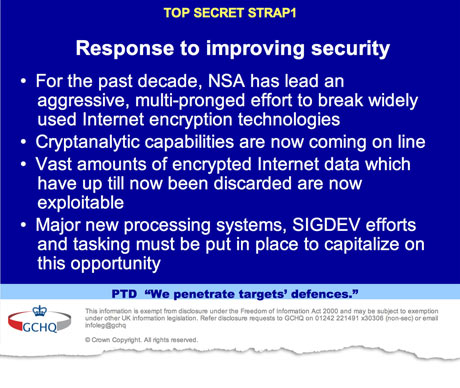
• A 10-year NSA program against encryption technologies made a breakthrough in 2010 which made “vast amounts” of data collected through internet cable taps newly “exploitable”.

• The NSA spends $250m a year on a program which, among other goals, works with technology companies to “covertly influence” their product designs.

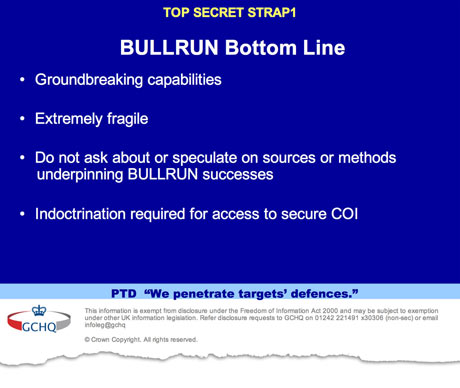
• The secrecy of their capabilities against encryption is closely guarded, with analysts warned: “Do not ask about or speculate on sources or methods.”

• The NSA describes strong decryption programs as the “price of admission for the US to maintain unrestricted access to and use of cyberspace”.

• A GCHQ team has been working to develop ways into encrypted traffic on the “big four” service providers, named as Hotmail, Google, Yahoo and Facebook.
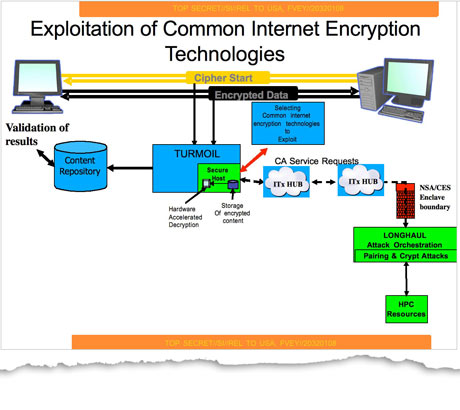
NSA diagram

The agencies insist that the ability to defeat encryption is vital to their core missions of counter-terrorism and foreign intelligence gathering.

But security experts accused them of attacking the internet itself and the privacy of all users. “Cryptography forms the basis for trust online,” said Bruce Schneier, an encryption specialist and fellow at Harvard’s Berkman Center for Internet and Society. “By deliberately undermining online security in a short-sighted effort to eavesdrop, the NSA is undermining the very fabric of the internet.” Classified briefings between the agencies celebrate their success at “defeating network security and privacy”.

“For the past decade, NSA has lead [sic] an aggressive, multi-pronged effort to break widely used internet encryption technologies,” stated a 2010 GCHQ document. “Vast amounts of encrypted internet data which have up till now been discarded are now exploitable.”

An internal agency memo noted that among British analysts shown a presentation on the NSA’s progress: “Those not already briefed were gobsmacked!”

The breakthrough, which was not described in detail in the documents, meant the intelligence agencies were able to monitor “large amounts” of data flowing through the world’s fibre-optic cables and break its encryption, despite assurances from internet company executives that this data was beyond the reach of government.

The key component of the NSA’s battle against encryption, its collaboration with technology companies, is detailed in the US intelligence community’s top-secret 2013 budget request under the heading “Sigint [signals intelligence] enabling”.
NSA Bullrun 1

Funding for the program – $254.9m for this year – dwarfs that of the Prism program, which operates at a cost of $20m a year, according to previous NSA documents. Since 2011, the total spending on Sigint enabling has topped $800m. The program “actively engages US and foreign IT industries to covertly influence and/or overtly leverage their commercial products’ designs”, the document states. None of the companies involved in such partnerships are named; these details are guarded by still higher levels of classification.

Among other things, the program is designed to “insert vulnerabilities into commercial encryption systems”. These would be known to the NSA, but to no one else, including ordinary customers, who are tellingly referred to in the document as “adversaries”.

“These design changes make the systems in question exploitable through Sigint collection … with foreknowledge of the modification. To the consumer and other adversaries, however, the systems’ security remains intact.”

The document sets out in clear terms the program’s broad aims, including making commercial encryption software “more tractable” to NSA attacks by “shaping” the worldwide marketplace and continuing efforts to break into the encryption used by the next generation of 4G phones.

Among the specific accomplishments for 2013, the NSA expects the program to obtain access to “data flowing through a hub for a major communications provider” and to a “major internet peer-to-peer voice and text communications system”.

Technology companies maintain that they work with the intelligence agencies only when legally compelled to do so. The Guardian has previously reported that Microsoft co-operated with the NSA to circumvent encryption on the Outlook.com email and chat services. The company insisted that it was obliged to comply with “existing or future lawful demands” when designing its products.

The documents show that the agency has already achieved another of the goals laid out in the budget request: to influence the international standards upon which encryption systems rely.

Independent security experts have long suspected that the NSA has been introducing weaknesses into security standards, a fact confirmed for the first time by another secret document. It shows the agency worked covertly to get its own version of a draft security standard issued by the US National Institute of Standards and Technology approved for worldwide use in 2006.

“Eventually, NSA became the sole editor,” the document states.

The NSA’s codeword for its decryption program, Bullrun, is taken from a major battle of the American civil war. Its British counterpart, Edgehill, is named after the first major engagement of the English civil war, more than 200 years earlier.

A classification guide for NSA employees and contractors on Bullrun outlines in broad terms its goals.

“Project Bullrun deals with NSA’s abilities to defeat the encryption used in specific network communication technologies. Bullrun involves multiple sources, all of which are extremely sensitive.” The document reveals that the agency has capabilities against widely used online protocols, such as HTTPS, voice-over-IP and Secure Sockets Layer (SSL), used to protect online shopping and banking.

The document also shows that the NSA’s Commercial Solutions Center, ostensibly the body through which technology companies can have their security products assessed and presented to prospective government buyers, has another, more clandestine role.

It is used by the NSA to “to leverage sensitive, co-operative relationships with specific industry partners” to insert vulnerabilities into security products. Operatives were warned that this information must be kept top secret “at a minimum”.

A more general NSA classification guide reveals more detail on the agency’s deep partnerships with industry, and its ability to modify products. It cautions analysts that two facts must remain top secret: that NSA makes modifications to commercial encryption software and devices “to make them exploitable”, and that NSA “obtains cryptographic details of commercial cryptographic information security systems through industry relationships”.

The agencies have not yet cracked all encryption technologies, however, the documents suggest. Snowden appeared to confirm this during a live Q&A with Guardian readers in June. “Encryption works. Properly implemented strong crypto systems are one of the few things that you can rely on,” he said before warning that NSA can frequently find ways around it as a result of weak security on the computers at either end of the communication.

The documents are scattered with warnings over the importance of maintaining absolute secrecy around decryption capabilities.
NSA Bullrun 2

Strict guidelines were laid down at the GCHQ complex in Cheltenham, Gloucestershire, on how to discuss projects relating to decryption. Analysts were instructed: “Do not ask about or speculate on sources or methods underpinning Bullrun.” This informaton was so closely guarded, according to one document, that even those with access to aspects of the program were warned: “There will be no ‘need to know’.”

The agencies were supposed to be “selective in which contractors are given exposure to this information”, but it was ultimately seen by Snowden, one of 850,000 people in the US with top-secret clearance.A 2009 GCHQ document spells out the significant potential consequences of any leaks, including “damage to industry relationships”.

“Loss of confidence in our ability to adhere to confidentiality agreements would lead to loss of access to proprietary information that can save time when developing new capability,” intelligence workers were told. Somewhat less important to GCHQ was the public’s trust which was marked as a moderate risk, the document stated.

“Some exploitable products are used by the general public; some exploitable weaknesses are well known eg possibility of recovering poorly chosen passwords,” it said. “Knowledge that GCHQ exploits these products and the scale of our capability would raise public awareness generating unwelcome publicity for us and our political masters.”

The decryption effort is particularly important to GCHQ. Its strategic advantage from its Tempora program – direct taps on transatlantic fibre-optic cables of major telecommunications corporations – was in danger of eroding as more and more big internet companies encrypted their traffic, responding to customer demands for guaranteed privacy.

Without attention, the 2010 GCHQ document warned, the UK’s “Sigint utility will degrade as information flows changes, new applications are developed (and deployed) at pace and widespread encryption becomes more commonplace.” Documents show that Edgehill’s initial aim was to decode the encrypted traffic certified by three major (unnamed) internet companies and 30 types of Virtual Private Network (VPN) – used by businesses to provide secure remote access to their systems. By 2015, GCHQ hoped to have cracked the codes used by 15 major internet companies, and 300 VPNs.

Another program, codenamed Cheesy Name, was aimed at singling out encryption keys, known as ‘certificates’, that might be vulnerable to being cracked by GCHQ supercomputers.

Analysts on the Edgehill project were working on ways into the networks of major webmail providers as part of the decryption project. A quarterly update from 2012 notes the project’s team “continue to work on understanding” the big four communication providers, named in the document as Hotmail, Google, Yahoo and Facebook, adding “work has predominantly been focused this quarter on Google due to new access opportunities being developed”.

To help secure an insider advantage, GCHQ also established a Humint Operations Team (HOT). Humint, short for “human intelligence” refers to information gleaned directly from sources or undercover agents.

This GCHQ team was, according to an internal document, “responsible for identifying, recruiting and running covert agents in the global telecommunications industry.”

“This enables GCHQ to tackle some of its most challenging targets,” the report said. The efforts made by the NSA and GCHQ against encryption technologies may have negative consequences for all internet users, experts warn.

“Backdoors are fundamentally in conflict with good security,” said Christopher Soghoian, principal technologist and senior policy analyst at the American Civil Liberties Union. “Backdoors expose all users of a backdoored system, not just intelligence agency targets, to heightened risk of data compromise.” This is because the insertion of backdoors in a software product, particularly those that can be used to obtain unencrypted user communications or data, significantly increases the difficulty of designing a secure product.”

This was a view echoed in a recent paper by Stephanie Pell, a former prosecutor at the US Department of Justice and non-resident fellow at the Center for Internet and Security at Stanford Law School.

“[An] encrypted communications system with a lawful interception back door is far more likely to result in the catastrophic loss of communications confidentiality than a system that never has access to the unencrypted communications of its users,” she states.

Intelligence officials asked the Guardian, New York Times and ProPublica not to publish this article, saying that it might prompt foreign targets to switch to new forms of encryption or communications that would be harder to collect or read.

The three organisations removed some specific facts but decided to publish the story because of the value of a public debate about government actions that weaken the most powerful tools for protecting the privacy of internet users in the US and worldwide.

Posted in Uncategorized | Leave a comment

Syria: Whose side are we on?

According to many, it’s neither clear, nor pretty.

Rebels prepare to execute 7 Syrian soldiers who surrendered.

Though he spent much of the week trying to convince lawmakers about the solidity of the Obama administration’s case for war against Syria, Secretary of State John Kerry and his testimony before Congress have become the target of pushback Thursday as experts on the situation took issue with his overly “optimistic” characterization of the opposition forces inside the war-torn country.

Specifically, as Reuters reports, “Kerry’s public assertions that moderate Syrian opposition groups are growing in influence appear to be at odds with estimates by U.S. and European intelligence sources and nongovernmental experts, who say Islamic extremists remain by far the fiercest and best-organized rebel elements.”

Pressed by many members of the House Foreign Relations Committe on Wednesday about the dominance of Al-Qaeda-affiliated militias within the ranks of the anti-government forces and amid repeated questions about “who exactly” the U.S. would be supporting if it deepened its military involvement in Syria’s civil war with military strikes, Kerry made assurances in his testimony that the Syrian opposition had “increasingly become more defined by its moderation.”

However, as an explosive story on the frontpage of the New York Times on Thursday illustrates, key factions within those forces have been shown to use brutal tactics—including summary executions—in their attempts to overthrow the government of President Bashar al-Assad.  Though well-documented elsewhere, the Times offered a newly surfaced video to exemplify some of the atrocities carried out by opposition during the more than two-year long civil war.

That video, smuggled out of Syria by a former member of the unit and obtained by theTimes, which can be viewed below, shows captured Syrian soldiers being shot in the back of the head, following orders from a unit commander. (Warning: though redacted, video contains graphic content):

Syrian Rebels Execute 51 Soldiers & Possible Civilians in Khan Al-Assal

As the Times describes, the gruesome video offers a reminder of the foreign policy puzzle the United States faces in finding rebel allies as some members of Congress, including Senator John McCain, press for more robust military support for the opposition.

In the more than two years this civil war has carried on, a large part of the Syrian opposition has formed a loose command structure that has found support from several Arab nations, and, to a more limited degree, the West. Other elements of the opposition have assumed an extremist cast, and openly allied with Al Qaeda.

And Reuters, citing experts both inside and outside of government, reviews how characterizations about the role of extremist fighters in Syria made by Kerry are being challenged by many.

While the radical Islamists among the rebels may not be numerically superior to more moderate fighters, [experts] say, Islamist groups like the Al Qaeda-aligned Nusra Front are better organized, armed and trained.

Kerry’s remarks represented a change in tone by the Obama administration, which for more than two years has been wary of sending U.S. arms to the rebels, citing fears they could fall into radical Islamists’ hands.

As recently as late July, at a security conference in Aspen, Colorado, the deputy director of the Pentagon’s Defense Intelligence Agency, David Shedd, estimated that there were at least 1,200 different Syrian rebel groups and that Islamic extremists, notably the Nusra Front, were well-placed to expand their influence.

Lastly, and pulling no punches in a piece titled, “Does Obama Know He’s Fighting on al-Qa’ida’s Side?”, longtime Middle East correspondent for the Independent, Robert Fisk, last week covered the topic by stating, “If Barack Obama decides to attack the Syrian regime, he has ensured – for the very first time in history – the United States will be on the same side as al-Qa’ida.”

“Quite an alliance!” Fisk declared tongue-in-cheek, though indicating there was nothing funny about the situation unfolding in Syria.

Posted in Uncategorized | Leave a comment

Undercover @ Tar Sands Site: What It’s Like

Conditions at ground Zero for Canada’s controversial pipelines

Tar Sands

Tar Sands

In recent months, many climate activists have focused their efforts on Canada’star sands and the companies set on extracting fossil fuels from them. With the debate raging louder than ever, this article is from contact with one of the workers helping to build a pipeline to bring oil from the tar sands to the U.S. Read on for that anonymous correspondent’s second dispatch from one of the world’s most controversial jobs.

On its surface, Fort McMurray, Alberta, looks like any other small Canadian city, with rows of new houses, condo developments and a Wal-Mart. Recycling bins line the streets, and residents schlep cloth bags to the store because the community banned plastic bags. But there’s one big difference between Fort Mac and other towns: This is ground zero for Canada’s controversial tar sands operations. Like tens of thousands of others, I saw green in the tar-like bitumen-drenched sand, and I came here to cash in. (I’m writing anonymously to protect my colleagues, my friends and myself.)

Read Undercover Correspondent’s First Dispatch from the Tar Sands

The majority of oil-related work happens north of town. Follow Highway 63 for about 20 minutes and you’ll see a sprawling series of smoke stacks at the Syncrude Canada Ltd. processing facility. You can smell the oil in the air, and smog hangs across the otherwise crisp northern horizon. Drive further, and things get even worse. Koch Carbon’s giant pile of petroleum coke in Detroit is nothing compared to what the oil companies have up here. Shell, Imperial Oil, Exxon, Encana, Husky, BP, Suncor Energy, CNR, Southern Pacific and Petro-Canada all have a stake in this game, and there’s an estimated 170 billion barrels of crude on the line.

082813-tar-field-600-1377705294
Thousands of employees are put up in temporary housing settlements. The big “camps” have gyms and rec rooms with pool and ping pong tables; a few even have ice rinks, yoga classes and movie theaters. For the most part, though, it’s all insulated aluminum-sided trailers with private sleeping quarters and communal bathrooms.

The camps serving Shell’s Albian Sands project and Imperial Oil’s Kearl work site are among the biggest. Shell’s complex – two camps collectively known as “the Village” – is home to about 2,500 employees. Meanwhile, Imperial Oil’s Wapasu camp houses more than 7,300. It even has its own airstrip to accommodate workers as they fly in and out on chartered 747’s.

Wapasu is a dry camp, meaning absolutely no alcohol is allowed. Employees are bused in and out of the fenced, guarded compound for work, and aren’t allowed to leave or have visitors during off-hours. Meanwhile, all rooms are subject to search. There’s nothing like coming home from a long day’s work, only to find a note stating drug-sniffing dogs searched your room while you were away. Some jokingly refer to Wapasu as “Wapatraz.” Over at the Village, things aren’t quite as harsh. There’s even a bar onsite – but it closes early, and you’re not allowed to have more than two drinks per night.

Living in a camp means you get free room and board, including three substantial meals a day. But if you’re not careful, the isolation and boredom can wear on you. Many of us get stuck paying inflated prices for cigarettes or smuggled-in drugs and alcohol. There are stories of late-night card games where guys bet – and lose – entire paychecks just for a rush.

Back in Fort McMurray, most of us out-of-towners stay in hotels or overpriced apartments. We’re all given a generous union-approved stipend to pay for lodging (and a nice per diem to cover restaurant meals), so if you play your cards right, you can pocket a nice chunk of change. Living out of a hotel room gets old fast, but it beats the hell out of staying in a camp.

Driving is incredibly dangerous in the tar sands, and Highway 63 is known locally as “the Highway of Death.” Fatalities are common, with one death every 1.3 months, on average. There is no bypass around the city, so all the heavy equipment heading to the tar sands has to roll right through Fort McMurray. Logging trucks look small and harmless compared to the massive rigs hauling satellite-sized machinery and components. The biggest load to ever grace the Canadian highway system – an 859-ton module that was bigger than two Olympic swimming pools – passed through earlier this year.

Most of us drive $8-a-gallon gas-guzzling 4x4s, but most of us also have company gas cards, so fuel economy isn’t much of a concern. There’s always a line-up at the Tim Horton’s drive-through, where it can take 30 minutes to get a goddamn coffee. When our crew gathers for our daily meeting, almost everyone leaves their truck running.

One of my coworkers saw me turn off the ignition on a particularly brisk February morning. “Did you just turn off your truck?!” he asked in disbelief. “What are you, some sort of environmentalist?”

I didn’t know what to say. I once considered myself somewhat of an environmentalist – I recycle, use energy-efficient light bulbs, and have a compost back home. But here I am, in Fort McMurray, working for Big Oil. I guess I’ve sort of sold out. What can I say? Even environmentalists have bills to pay.

Posted in Uncategorized | Leave a comment