Shelton/Mason Co. After Dick Taylor, Dawn Pannell

The City of Shelton is as visibly filthy as ever after 10 years w/Dawn Pannell. Major City arterial streets are in hopeless disrepair, abandoned buildings and litter blanket downtown, storefronts are vacant, residents are invited to pipe sewage treatment water to their properties as a way of saving City revenue. But when asked about her views on additional filth spewing incinerators from a company (Simpson) responsible for the existing Dioxin (our very own Love Canal) in Oakland Bay and Shelton Harbor, Ms. Pannell argues she can’t let voters know her position on such public policy issues.

Dick Taylor, clueless, unfocused, out of touch, elderly, unable to stay awake in public meetings, hopelessly uninformed about vital current civic controversies, commercializing outsourcing, capitalism over social welfare, no respect for nature or public health, and an admitted ardent supporter of the now defunct Adage campaigns on the basis of how well he’ll get along with 2 of his biggest campaign contributors, Pork Commissioners Jay Hupp and Tom Wallitner.

The following videos are a good estimation of the future these kinds of politicians will leave for destitute Americans and Mason County residents:

Ghosts With Sh*t Jobs

No Way Out

Posted in Uncategorized | Leave a comment

9-4-11 Oly Harbor Days Stage

Local talent performs for Olympia Harbor Days festival near newly remodeled embarcadero. Tugboats moored nearby provided a destination for visitors. Vendor booths had an assortment of clothes, hats, jewelry, and curios. The weather was fine, sunny, and temperate; the buskers were fun, the crowds manageable. A local belly dancing troupe anchored the afternoon performances.

Old Man Takes In The Sites

Ramona’s Snake Farm

Green Jazz

Poor, Poor Pitiful Me

Daydreaming at the Park

Lemonade Stand in NYC

The Closer I Am to God

Spell On You

Hippy Dippy Shakes

Hip at the Park

Scintillating Scimitar

Yarrr! Take No Prisoners

Posted in Uncategorized | Leave a comment

Public Singing/Dancing ‘Illegal’ in Olympia?

City Ordinance Bans Beauty

Ever wonder why Seattle seems so colorful while our State Capitol appears drab? Seattle has a goodly supply of street performers while Olympia does not. Why? Because it violates a city ordinance.

On Tuesday, September 6th, Citizens in Violation of Illegal Laws [CIVIL] sponsored a Free Concert/Busker Parade to protest the city’s criminalization of homelessness in general and the anti-busking laws in particular. This came upon the heels of CIVIL’s highly popular ‘Busk-In’ that was held in front of the City Hall on June 21 when over 40 buskers ‘illegally’ performed in front of City Hall during a City Council meeting. An informal survey indicated most Olympia residents are completely unaware such laws even exist and are almost unanimously outraged upon learning of them.

Busking Protest- Olympia City Council’s Reaction (9-6-11)

Do street performers add colour to our dreary streets, or are they a loud nuisance best left out of our public spaces?

Listen to: Is Busking a Crime?

CIVIL seeks to publicize and raise public awareness of the existence of these laws. To that end, CIVIL issued a call to musicians, magicians, mimes, poets, clowns, jugglers, and many others. The free concert began at 2 pm on September 6 and the Busker Parade departed from the ‘designated busking zone’ at Sylvester Park at 4 pm. After departing Sylvester Park, the parade was technically in violation of the anti-busking law.

Buskers try to persuade city council to respect the Constitution/Civil Rights

Brittney Jones Busking Interview (City Council Protest 9-6-11)

Brittney Jones Busking Interview:

“Interviewer: Can we see the posters… come here darling… let me take your picture with the posters… ok darling, what are you all about…

Brittney Jones: I want everywhere to be a busking zone… and i don’t think that it should be sitting on one corner or a star on a map… I think it should be everywhere… we have freedom of speech and… i don’t know why they would make laws like this…

*Well, it’s mainly about taking us out of the general public and put us in spots where they don’t have to look at us… like we’re so scary… we’re not terrible people… We’re humans just like everyone else… We need to rescind these stupid laws today…*

Interviewer: Where else have you busked other than Olympia?

Brittney: I busk in Seattle.

Interviewer: Do you make good money there?

Brittney: Sometimes…

Interviewer: Do you think because the cops here don’t let you busk, you make less money here?

Brittney: I don’t really busk to make money… but the cops are harassing people, giving people tickets… some are getting ticket after ticket after ticket…

Interviewer: What were their tickets for? Disorderly Conduct?

Brittney: No… it’s Pedestrian Interference… and they were doing this whole pedestrian interference, they were giving them to anyone sitting on the sidewalk… or sitting down on the ground, because that’s illegal now…

Interviewer: It’s illegal to sit on the ground?

Brittney: Yeah, even though these are our streets, it’s illegal to sit on the ground…

Duval Street, Key West

The parade toured the four designated ‘busking zones’ in order to emphasize the extreme undesirability of their locations before marching-busking-dancing to the City Hall to greet the public and the city council-members as they arrived for the scheduled City Council meeting and entertained them with some ‘illegal’ music. Several members of the public then commented upon the busking laws during the public comment period of the council meeting.

The following excerpts came from an article published in The Olympian on 9-12-11 by Matt Batcheldor:

Olympia council will reconsider ban on street performing 

OLYMPIA – The Olympia City Council has agreed to review the city’s guidelines on busking, otherwise known as street performing, after a group of performers showed up at the council’s Sept. 6 meeting to protest.

Dozens of buskers first held a protest in front of City Hall, then a number of them testified at the council meeting against the rules.

“Our purpose was to educate people about the (busking) law and try to get it rescinded,” said Dana Walker of the group Citizens in Violation of Illegal Laws. She helped organize the protest.

“We kind of see ourselves as the last resort when all other measures fail.”

Councilwoman Rhenda Strub referred the busking rules to the council’s land-use committee, which can review them and recommend changes to the full council.

“I’m just not convinced we need to have any restrictions,” she said. “I don’t know why this one activity was singled out.”

The council passed an ordinance in 2007 restricting busking, following earlier restrictions on sitting and lying on sidewalks. The goal was to prevent people from blocking pedestrians.

It defines busking as “to act, sing, play a musical instrument, recite poetry, pantomime, mime, perform magic tricks, or dance for the purpose of or while immediately receiving contributions, alms, charity, or of gifts of items of value for oneself or another person.”

Under the ordinance, busking is only allowed in a designated zone or if it is adjacent to a business that has obtained a busking license. And the busker must get permission from the business owner.

Scott River, the city’s recreation manager, said the city had issued just three busking permits – in front of Olympia Dye Works, Last Word Books and Seifert Law Offices. He said no applications have been turned down. Walker said the ordinance is being selectively enforced, part of a larger campaign to rid Olympia of homeless people.

“I found out hardly anybody knew such a law existed,” he said.

Violators can be fined $50 for the first offense, $125 for the second and $250 for the third.

In an interview, City Manager Hall said the city has given “very few” tickets for busking in the past five years – 12. He said five of those were given this year, three in one day.

Hall told the council the regulations ensure that pedestrians and business entrances aren’t blocked and said buskers can perform to their heart’s content in a zone.

“I’ll say right now, there are probably too few of those,” he said, adding that the city is working on a brochure to publicize the busking zones and rules.

Walker said three of the four designated zones are no good because there’s not enough foot traffic. Only one of the zones is on Fourth Avenue, where there is sufficient traffic.

Hall said one additional busking area could be in front of the artesian well. But he said eliminating the busking rules would be a mistake.

“I think we need some rules,” he said.

River said the ordinance “could stand to be cleaned up” and modified.

“It’s a challenging ordinance, for staff even, to interpret,” he said. “There’s a lot of vagueness to it.”

A look at the Hamilton, Ontario, busking scene

Strub said the city has received a number of complaints about downtown, but not buskers. Other council members said they like the street performances.

“We all love music,” Councilwoman Jeannine Roe said. “I think it’s great.”

Councilman Steve Langer said: “Frankly, I like busking. I don’t have any beef with busking.”

Olympia Busker brightens city streets

Ibid: Alex from Georgia and his dog, Zither, brighten the streets of Olympia while busking on one of the few designated spots under the City’s anti-busking ordinance. Alex revealed he made more money when panhandling ($50-$60/day) but prefers performing though it typically only brings in around $16/day for him.

4 Hands

Carol Thorns performs ‘Closer To the Sun’ at the Atlantis Dunes near Cape Town. Song by Helmut Meijer and footage by Dawie Verwey

8 Hands

Posted in Uncategorized | Leave a comment

Longview Labor Dispute w/Longshore Union Erupts in Violence

Some may recall organized labor turning its back on Mason County residents in our own struggle against a rapacious internationally owned corporation (Adage) intent on destroying the community’s health, environment, and quality of life with the promise of “jobs, jobs, jobs!” One local activist warned our blue collar brethren of the need to remain each other’s natural allies given the common thread running through the community and history of organized labor. Despite such advised prudence and the invitation to stand in solidarity with this community, after being publicly asked since when labor stood with corporate interests instead of with the people, one union official from the Vancouver region of Washington opined such history was practically ancient and no longer relevant in the newly formed bond labor and corporate interests found in each other’s arms.

Now Washington’s longshoremen are angry–very angry, violently so…and with good reason. They’ve been stabbed in the back by the very corporate interests the above mentioned apologist so glibly defended as Mason County residents crowded against the wall pleaded for solidarity. The following ironic excerpts explaining the angst and violence was taken from an article published in THE STAND on 9-8-11 by David Groves:

Angry Longshore Workers in Longview

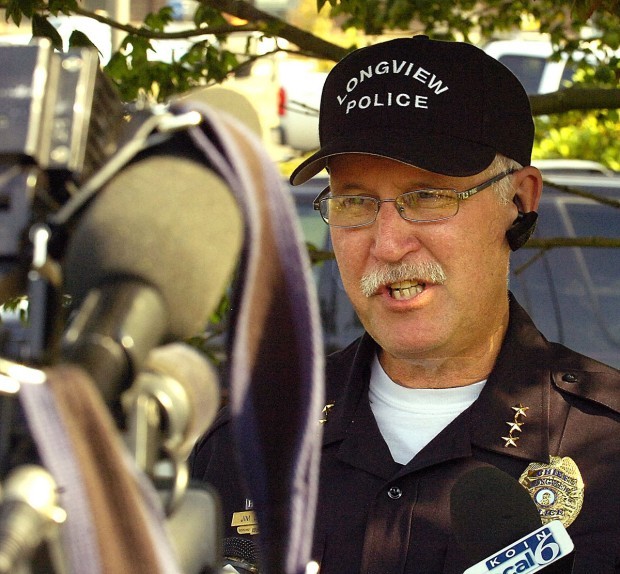
Longview Police Chief

LONGVIEW (Sept. 8th) —Violence erupted today in a major labor dispute that has simmered for months at the Port of Longview, leading to work shutdowns at ports up and down the Washington coast. Why are members of the International Longshore and Warehouse Union (ILWU) — and their supporters in Washington and Oregon — so upset about a grain terminal that employs just 50 workers?

Here’s why.

EGT Development is a joint venture of Japan-based Itochu Corp, South Korea’s STX Pan Ocean and St. Louis-based Bunge North America. Like so many corporations that promise good jobs to get what they want, EGT got a special state tax exemption and a sweetheart lease deal from the Port of Longview to build a $200 million grain terminal there. The government even seized adjacent land for the project. But as soon as the deal’s ink was dry and the ceremonial first shovel of dirt was overturned two years ago, EGT began running the project on the cheap.

Despite high unemployment in Cowlitz County and the availability of hundreds of skilled union building trades workers, EGT imported the vast majority of its construction crews from low-wage communities out-of-state and did not pay area standard wages, leading to howls from the local labor community.

EGT Terminal

After the terminal was built, EGT decided to ignore the Port of Longview’s contract with ILWU Local 21 to hire union labor on its leased site. Instead, the multinational conglomerate hired non-union workers — claiming it would save the company $1 million a year (a figure the company later admitted had been plucked from the sky) — and EGT sued the Port, arguing it was not bound by the contract with the ILWU.

For months, ILWU picketed EGT and attempted to pressure the company to negotiate with the union. Those protests gradually grew in size as EGT refused to meet with the union, culminating in a major rally on June 3, when more than 1,000 ILWU supporters from Washington to California rallied outside EGT’s headquarters in downtown Portland. The protest was loud, but nonviolent.

The dispute escalated at a July 11 protest outside the EGT terminal in Longview, when members tore down a chain-link gate and stormed the EGT grain terminal. About 100 union dock workers, including union leaders, were cited and arrested.

“We are going to fight for our jobs in our jurisdiction. We have worked this dock for 70 years, and to have a big, rich corporation come in and say, ‘We don’t want you,’ is a problem,” ILWU 21 President Dan Coffman told the (Longview) Daily News. “We’re all together. We’re all going to jail as a union.”

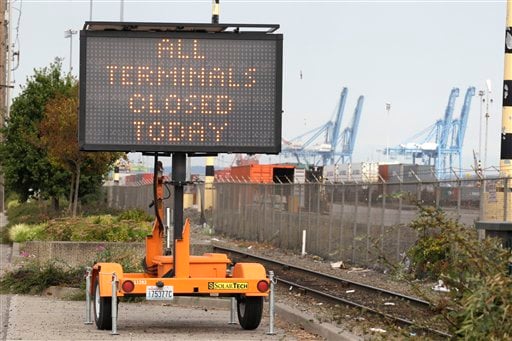
Terminal Dispute

On July 14, hundreds of union dock workers crowded onto railroad tracks to block a train from delivering grain to the EGT terminal. The Daily News reported that the 107-car train was rerouted to Vancouver following the standoff, which prompted Burlington Northern Santa Fe to indefinitely suspend train traffic to the grain terminal for safety reasons.

Trains Rerouted for Safety

“By far this is the most intense labor event that I can remember,” Cowlitz County Sheriff Mark Nelson told the Daily News. But he said he understands what the union is trying to accomplish even though he didn’t agree with its tactics. “Bless their hearts. These are our neighbors, too. These are our folks. This is our community.”

Strike Spreads to Tacoma & Seattle

EGT was feeling the heat, and community support for the local ILWU workers was growing as more people learned the facts of the dispute.

Then the company made a surprise announcement that it would hire a unionized subcontractor to run the terminal. EGT signed an agreement with Federal Way-based General Construction Co., a subsidiary of Kiewit, to operate the terminal with union members from the Portland-based International Union of Operating Engineers Local 701.

Face Off

The Washington State Labor Council condemned EGT’s attempt to pit union members against each other.

ILWU Workers Block Grain Train

“EGT, a Japanese multinational corporation that has received tax breaks from our state to build this grain elevator, has thumbed its nose at the members of ILWU Local 21  and is trying to pit workers against workers, local unions against local unions. This is unacceptable,” said WSLC President Jeff Johnson (pictured at left at a July 24 rally). “The work at the Port of Longview is longshore work and we need to come together as community and labor and say ‘no’ to EGT — ‘you will not disrespect labor in Longview or anywhere else in our state’.”

Tensions Escalate

There have been numerous incidents provoked by EGT’s union-vs.-union arrangement. Most recently, a contractor drove right through the ILWU picket line on Aug. 29 and struck two ILWU members who, fortunately, were not seriously injured. Although the contractor was not cited or arrested for the vehicular assault, an angry ILWU picketer was arrested for allegedly damaging the next vehicle that attempted to cross the picket line, a charge based on video surveillance provided by an EGT security guard.

The next day, the National Labor Relations Board announced it was seeking a court order to end “aggressive picketing” at the EGT facility and allow Burlington Northern Santa Fe trains to deliver grain to the facility. Such an order was issued last week, according to Rich Ahearn, director of the NLRB’s Seattle office.

Which brings us to yesterday, Sept. 7.

Port Protest

Some 400 ILWU members stood on the railroad tracks to block a train from delivering grain to the terminal for about four hours, but the train passed through after protesters were confronted by 50 police officers in riot gear.  ILWU President Robert McEllrath, who attended the protest, was detained by police, escalating tensions between protesters and officers. In the confrontation that ensued, police beat protesters away with clubs and pepper spray.

ILWU International President Robert McEllrath

ILWU President Robert McEllrath is detained by police Sept. 7. 

Ultimately, McEllrath returned to urge members to end the standoff.

ILWU vs. EGT

“You can get maced and tear-gassed and clubbed (today)” or wait for longshore support from all over the West Coast when the next train tries to enter the EGT terminal, McEllrath reportedly told protesters after he met with police. “If we leave here, it doesn’t mean that we gave up and quit. It means we’re coming back.”

Tensions Build

All but 16 of the protesters returned to the union hall; the 16 who refused were arrested for trespassing.

2 Protestors Break Through Police Lines

Early this morning, hundreds of ILWU members and their supporters reportedly stormed the EGT terminal at the Port of Longview, broke down the gates, overpowered security guards, damaged railroad cars, and dumped grain, according to Longview Police Chief Jim Duscha. Initial reports indicated no one was hurt and nobody has been arrested. After a few hours, the protesters returned to their union hall.

Uneasy Standoff

So that’s where we stand, as of this writing.

Courage

To sum up: a taxpayer-subsidized international conglomerate, which is operating on public property, is suing the public so it can avoid paying the area’s standard wages and undercut its competitors that do. Then, it exacerbated tensions with the local labor community by importing union workers from another jurisdiction to cross the picket lines.

Police Grab Longshoreman

That’s why ILWU members are angry, and that’s why this is about more than just 50 jobs in Longview.

Peace Train?

Posted in Uncategorized | 1 Comment

The World Dick Taylor wants the Pork to Bring You

Candidate for Pork Commissioner, Dick Taylor, besides being well past retirement age (75), clueless about Pork business, asleep in public meetings such as the KMAS sponsored candidates forum held at the Public Works facility, admits to having been an ardent supporter of the Adage promoted biomassacre proposal Jay Hupp and Tom Wallitner (2 current Pork Commissioners) also sought to foist (this environmental disaster in the making) onto an outraged community. The Pork’s Johns Prairie acreage has been responsible for aquifer contamination while Simpson flushed Dioxin contaminated ash from its hog fuel boiler down the sewer into our sewage treatment plant (STP) and Oakland Bay/Shelton Harbor where it remains as one of the most concentrated toxic waste sediments in the Puget Sound.

Naturally all this is fine with Shelton’s current City administration, including Dawn Pannel, currently running for Mayor after her 10 years of failed policies as City Commissioner. The City and its air are visibly filthy, yet its council can’t seem to get enough of just that, even welcoming yet another filth spewing incinerator permit application for another hog fuel boiler to be built by Simpson downtown near the existing belching monstrosities.

Currently, the City has another plan to bring pollution right to your doorstep: It wants you to pipe sewage treatment water to your hose bibs, lawn, and garden. They don’t want you to actually drink it (just yet), but say it would help save the CLEAN water for more important priorities–maybe they’re contemplating rinsing off the human dung from sidewalks and downtown alleyways? Is this a great town, or what?…where to pick up a postcard so your folks can take it all in.

For a peek at the world these players and their supporters want to bring you, the following video clip is at your disposal:

Posted in Uncategorized | Leave a comment

USPS Financial Crisis Looms

The US Postal Service employs more people than any other branch associated with government service in America, even the military! Due to a long history of managerial ineptitude, it’s in trouble and proposes cutting 225,000 jobs, breaching its labor contracts, eliminating career employee status,  abandoning its pension & retiree health plan obligations, plus attenuating collective bargaining rights as the nation struggles to avoid a double recession.

(Excerpt from Sept/Oct, 2011, APWU magazine):

With the Postal Service in danger of financial collapse — and an important deadline approaching — our pay, our benefits, and even our jobs are in jeopardy!

For months, speculation has been widespread that the USPS will be forced to close its doors in 2012. Earlier this year, the USPS announced that it expects to default on a $5.5 billion payment due on Sept. 30 to pre-fund the healthcare benefits of future retirees. Next year, the Postal Service may not have enough cash on hand to make payroll.

The huge pre-funding fee is for a 75-year liability, which the Postal Service is required to pay over a 10-year period. No other government agency or private company is required to make such a payment, but a provision of the 2006 Postal Accountability and Enhancement Act demands it of the USPS.

Anticipating the Demise of USPS

As the Sept. 30 due date draws near, with the USPS approaching its debt ceiling, we can expect a wave of negative news reports — as well as comments from politicians and other interested parties — about the demise of the Postal Service and what we, as a nation, should do about it.

Unfortunately, many of the stories and statements will be filled with incorrect assumptions and blatant inaccuracies. This is precisely what happened over the summer, when management announced it was suspending payments to FERS, the Federal Employees Retirement System, to conserve cash.

The next day, on June 23, Rep. Darell Issa (R-CA) and Rep. Dennis Ross (R-FL) introduced H.R. 2309, the Post- al “Reform” Act of 2011, which would be devastating for the USPS and for postal employees.

Rep. Issa said the bill is designed to avoid a “taxpayer bailout,” and many news outlets reported the “bailout” explanation without question.

But in fact, the federal government is holding billions of dollars of USPS overpayments to its pension accounts, and doesn’t need a bailout. The USPS has a surplus of $6.9 billion in its FERS account, and, according to two independent actuarial studies, has overpaid the CSRS account by $50 billion to $75 billion.

H.R. 2309 would do nothing about the pension overpayments or the pre- funding mandate – the cause of the crisis. Instead, it would punish workers and curtail service to citizens and businesses across the country.

The bill would establish a “solvency authority” with the power to unilaterally renegotiate our contract — to cut wages, abolish benefits, and end our protection against layoffs!

H.R. 2309 also would create a board that would order $1 billion worth of post office closures in the first year and $1 billion worth of facility closures in the second year. If it is enacted, thousands of offices throughout the country would be closed. (Click here for more information.)

Not a Single Cent

Regrettably, many citizens mistakenly believe the Postal Service is funded by the federal government. Of course, that’s not the case: The USPS is supported by the sale of stamps and postage — not taxpayers.

Many politicians also fail to grasp this important fact — or they choose to ignore it. They portray the USPS as a burden on the American people and characterize any effort to correct the unfair pre-funding mandate or the pension overpayments as a “bailout.”

To help dispel the “bailout-burden” myth, the APWU launched a nationwide television ad campaign on July 11, with spots airing on CNN, MSNBC, and FOX News. The union’s 30-second ad has a very direct message: It describes the enormity of the job postal workers perform, and ends with a simple question and response: Ever wonder what this costs you, as a taxpayer? Not a single cent.

Our message must have been effective, because the day it began airing Rep. Issa called the ad “misleading,” and asked the union to cancel it. We rejected his request, writing, “The Postal Service is not subsidized by taxpayers. We will continue to publicize this important truth.” As we go to press, we are planning the next phase of our media campaign.

APWU Fights Back

The ads are just a small part of our campaign to address the crisis. At the national level, the Legislative and Political Department advocates tirelessly for our position on Capitol Hill; the APWU testifies before House and Senate committees; works behind-the-scenes to advance the APWU’s goals; works constantly to make sure our members are informed about these crucial issues, and coordinates the union’s effort in the field. Organizers are calling every APWU local in the country, encouraging them to contact their congressmen, and we are tracking who has been contacted, where they stand, and who needs to be targeted for greater effort.

But our members — that’s you — are the real key to our success. It is urgent that you contact your congressional representatives to let them know that we adamantly oppose H.R. 2309 and that we support H.R. 1351, which would allow the USPS to use the billions of dollars in pension overpayments to meet its financial obligations, including the pre-funding mandate.(See below.)

We have asked locals to organize visits to members of Congress to discuss our concerns. If you don’t hear from your local officers, ask them why. Let them know you want to get involved.

A Simple Solution — Blocked?H.R. 1351, a bill introduced by Rep. Stephen Lynch (D-MA) and co-sponsored by more than 180 House members, would solve the USPS financial crisis without cutting pay and benefits, eliminating collective bargaining rights, or slashing service: It would allow the USPS to use the billions of dollars in pension overpayments to meet its financial obligations, including the pre-funding mandate.But the word on Capitol Hill is that Rep. Darrell Issa, the chairman of the House Oversight and Government Reform Committee, won’t allow Rep. Lynch’s bill to come up for a vote! We must demand that Rep. Issa stop blocking H.R. 1351.

Fix USPS Finances, Save Postal Services

At a pair of congressional hearings in May and June, APWU president

Cliff testifies in favor of preserving USPS and collective bargaining rights

Cliff Guffey told lawmakers they must act soon to address the cause of the Postal Service’s financial crisis — not slash customer service by dismantling the retail and mail processing network.

At a hearing of the House Subcommittee on Federal Workforce, U.S. Postal Service and Labor Policy, Guffey took issue with the title of the hearing GOP lawmakers had given it: “Postal Infrastructure: How Much Can We Afford?”

“The ‘we’ in this question is postal customers, not taxpayers,” Guffey said, refuting the myth that taxpayers fund the nation’s mail service, and that the USPS may need a “bailout.”

The union president pointed out that the nation’s mail service receives no taxpayer support – only payments for services rendered to the government — as Congress ordered when it established the USPS as an independent agency in 1970. Rather than gutting the retail and mail processing network our economy depends on, he said, the Postal Service “must expand its services to fill needs emerging because of digital communications.”

Instead of closing post offices, Guffey urged lawmakers to support legislation that would permit the USPS to partner with other government agencies to more efficiently deliver government services and provide economic justification to maintain a postal presence in rural and economically disadvantaged communities.

“The Post Office provides a unique public service that is still a necessity for many people,” he pointed out. “It is a focal point of many small communities; it is ‘where the flag flies;’ it is where the government provides support for the community.

“We strongly urge postal policy makers, both inside the Postal Service and elsewhere in government, to think creatively about how the Postal Service should be adapting its retail services to meet society’s current needs,” he said. “It would be tragic to dismantle the postal retail infrastructure and lose an opportunity to maintain it and improve the delivery of government services.”

The APWU recognizes the need for change in response to reduced mail volume and changes in the mail mix, Guffey said, and he pointed out that the new Collective Bargaining Agreement provides the USPS increased workforce flexibility, and includes innovative provisions that will permit management to provide retail services at lower costs.

However, the union has actively resisted the consolidation of many operations, the union president said. “In many cases, we have found that cost savings have been over-estimated and that actual cost savings cannot justify the adverse service impacts of the changes.”

It is also difficult to accurately gauge the needs of the mail processing network because mail volume is constantly in flux, Guffey said. Despite the USPS overall reduction of work hours, overtime has increased — which shows that the Postal Service needs its current employees.

Questionable Savings

Subcommittee Chairman Dennis Ross (R-FL) also invited testimony from

Rep. Dennis Ross (R-FL)

several witnesses to press the case that the USPS network should be cut. Philip Herr, director of Infrastructure Issues for the Government Accountability Office (GAO), called on Congress to “make it easier and faster to close post offices.”

When asked by Rep. Stephen Lynch (D-MA) how many USPS facilities he thinks the USPS “really needs,” Herr said he “wouldn’t venture a guess.”

Ross also called on panelist Mike Winn, president of Greylock Associates, a

Rep. Steve Lynch (D-MA)

firm that provides “consulting support to mail service providers and organizations that utilize the USPS,” and Joe Hete, President and CEO of Air Transport Services Group, a “leading provider of air cargo transportation.”

Hete’s invitation to testify at the hearing left many postal observers scratching their heads, as he has no postal experience. Nonetheless, he regaled the panel with a story about how his company gained profitability by reducing its workforce.

Hete claimed postal employees get paid too much compared to workers in the private sector, blaming employees’ salaries and benefits for the USPS’ “inability to meet its payroll in 2012.” He also suggested that the USPS restructure its union contracts, and called for elimination of the no-layoff clause.

Eight days after the hearing, Ross joined Rep. Darrell Issa (R-CA) in introducing postal “reform” legislation, H.R. 2309, which the APWU has condemned as a “reckless assault on postal workers and the Postal Service.”

NOT a ‘Bailout’

At a May 17 Senate hearing on the USPS financial crisis, Guffey stressed that the Postal Service doesn’t need a bailout.

“The Postal Service is very capable of dealing with the challenges it is facing

Rep. Darrell Issa (R-CA)

because of declining mail volumes and a shift to electronic transmissions,” the union president told the Subcommittee on Federal Financial Management, Government Information, Federal Services, and International Security.

“What it cannot sustain is the burden of the unique and unreasonable requirement that it pre-fund its retiree health benefits over a 10-year period,” he said, pointing out that no other government agency or private company bears this burden. He also noted that USPS pension accounts are overfunded by billions of dollars.

Guffey praised provisions of Sen. Carper’s “POST Act” (S. 1010) that would

Sen. Tom Carper (D-DE)

permit the USPS to use overpayments to its pension accounts to meet the pre-funding obligations, noting they would “give the Postal Service more than $5 billion in breathing room each year.”

But he also criticized several negative aspects of the bill. The proposed legislation would give the Postal Service authority to close post offices solely for financial reasons, and would require arbitrators to consider the financial health of the USPS when contract negotiations end in arbitration, he pointed out.

“Cutting service is not the answer to USPS financial difficulties,” Guffey said.

Click here for text of APWU’s testimony at these and other congressional hearings.


Urge Your Congressman to Support H.R.1351

APWU President Cliff Guffey is asking all union members to contact their legislators and urge them to oppose a bill introduced by Rep. Darrell Issa (R-CA) and Rep. Dennis Ross (R-FL). The bill, H.R. 2309, is a reckless assault on postal employees and postal services, he said.

“Instead of slashing pay and benefits and closing facilities and post offices, Congress must address the underlying cause of the USPS financial crisis,” Guffey added.

Congress should allow the Postal Service to apply the billions of dollars in overpayments to its pension funds toward its financial obligations, including the obligation to pre-fund the health benefits of future retirees,” Guffey said. H.R. 1351, introduced by Rep. Stephen Lynch (D-MA) would do just that.

“I ask all APWU members to contact their legislators and urge them to support H.R. 1351,” the union president said.

H.R. 1351, would correct the inequities in the Postal Service’s pension accounts, and would allow the USPS to use its overpayments toward its requirement to pre-fund future retiree health benefits – without slashing service.

“This important legislation will ensure a viable USPS in the future and protect jobs and service for the American people,” Guffey said.

[more about fixing USPS finances]


Preserve your local post office & collective bargaining rights/jobs

 

Posted in Uncategorized | Leave a comment

2011 world tango championships, medellin


A piece of Argentine history: We are looking for a historic arena in Argentina’s capital, Buenos Aires. It is a few blocks from the famous Plaza de Mayo, near the banks of Rio de la Plata.

The arena dates back to 1932 when it began as an open air stadium for boxing matches and also served as a venue for carnivals and concerts. It was there in 1944 that Juan Peron met Evita, an actress at the time. He was on the fast track to become the president of Argentina.

The place where they met holds a special place in the nation’s heart and still hosts boxing matches, concerts and tango. In fact, it held the finals of the World Tango Championships this week.

The answer is Luna Park Stadium.

Earlier this week dancers from around the world flocked to Buenos Aires to compete in the World Tango Championships.

Declared by UNESCO as part of the world’s “Intangible Cultural Heritage of Humanity,” Tango seems to be catching on across the globe.

More than 400,000 people participated in this year’s festival and international dancers shocked the public, beating the Argentinians at their own game.

For the first time in history, the top five ranking couples in Salon Tango were foreigners: This year’s champions were from Colombia with runners up from Venezuela, Italy, Japan and the Unites States.

By Melaina Spitzer

Earlier this week dancers from around the world flocked to Buenos Aires, Argentina, to compete in the World Tango Championships. Declared by UNESCO as part of the world’s “Intangible Cultural Heritage of Humanity,” tango seems to be catching on across the globe.

At this year’s championships, international dancers shocked the audience in Buenos Aires with an impressive accomplishment. For the first time in history, the top five ranking couples in the “salon tango” category were foreign.

That includes an American pair of dancers: Brian Nguyen and Yuliana Basmajyan, from San Francisco. They never thought they could make it to the World Tango Championships. In fact, they never even planned on becoming tango dancers.

Brian said he started out doing breakdance and salsa. “I ran into tango by accident,” he recalled, “and from then on, I converted… because it really was the dance for me.”

Basmajyan told a similar story. And it wasn’t easy for either of them, because of their family backgrounds.

“I’m originally Armenian,” said Basmajyan. “I came over to the States at the end of 1998. And I’m coming from a very traditional family and culture. So this is against what our culture would normally do.”

Basmajyan said her family wasn’t happy when she decided to become a tango dancer. “I’ve gone through a lot of struggles, [but] now they feel more comfortable about the idea that I’m pursuing tango and hopefully it will get better with time. This is my passion and I want to follow my heart,” she said.

Nguyen can relate. His parents came to the US from Vietnam after the Vietnam War. And he said being Vietnamese-American comes with certain expectations.

“I’m expected to be an engineer or a doctor. But I didn’t decide to be any of those,” Basmajyan said. “So of course my parents were mad at me for a really long time.”

Brian said his family is coming around now, encouraging him. But he can still feel their disappointment.

“My parents are always thinking, man, he should have been a doctor,” But, oh well. I push on because it’s my passion. “

And in Buenos Aires, Nguyen and Basmajyan’s passion was put to the test.

At the salon tango finals, the dancers were rushed to the stage to begin the competition. Salon tango is traditionally danced at milongas, or social tango gatherings. And unlike the highly choreographed “stage tango,” this competition was all about improvisation.

Ten couples took to the stage at once, gracefully circulating counter-clockwise before a panel of judges. Basmajyan stood out in her bright red velvet dress. And Brian’s slicked back hair was reminiscent of tango’s golden age, in the 1940’s.

After four rounds of competition, the scores were announced. A Japanese pair came in fifth. The Italians were fourth. And Basmajyan and Nguyen placed third.

Taking the equivalent of the bronze medal in salon tango was a big deal for the American pair, especially because they were only a hundredth of a point away from a three-way tie for the top spot.

The Colombian and Venezuelan pairs went on to compete in a dance-off for first place. And it was the Colombians who emerged as world champions.

Backstage after the competition, Nguyen said the win changes everything. “Now it feels really good!” he exclaimed. “I think everybody can relate to this. I mean, you go through life looking for a way to prove to yourself that you’re worth something. And I found that in tango.”

As to what they’ll do next, Basmajyan said it’s time to get down to work. “Get ready for next year, to compete again and dance more and travel more,” she said.

But first, Nguyen wanted to celebrate by pouring some wine into their third place cup.

Intricate Speedy Footwork

Posted in Uncategorized | Leave a comment

Is David Bricklin, esq. representing Peter Goldmark pro bono?

In an article by Jordan Schrader published 9-2-11 in The Olympian regarding Washington State’s Attorney General (Rob McKenna) and that office’s mandatory obligation to represent State agencies, it came to light David Bricklin, esq. may have been involuntarily representing, pro bono, Peter Goldmark (State Lands Commissioner) in a dispute involving the condemnation of State land for a power line by Okanogan’s PUD#1 in the Methow Valley.

David Bricklin was the attorney representing Concerned Citizens of Mason County (CCMC) in its lawsuit naming the Port of Shelton and Adage as defendants. Duff Badgley, an environmental activist residing in Seattle with close ties to Mr. Bricklin, described David’s legal strategy as ‘holistic’ given Peter Goldmark and Mike Dorcy (Mason County Prosecutor) sided with an analysis of the Adage dispute favoring local area residents. As it turns out, Mr. Bricklin was personally acquainted with both of these elected officials. Whether that relationship was useful in presenting Mr. Bricklin’s legal arguments favoring the citizens of Mason County to the men is simultaneously speculative and amusing. What’s known is Adage announced it withdrawal within days of their published official opinion–leaving the Port of Shelton to settle the CCMC lawsuit on its own in the bargain!

The following excerpt is taken from Mr. Schrader’s article:

CLIENT VS. LAWYER

The court said it had never before been confronted with an attorney general’s refusal to defend a state official. [Peter Goldmark, State Lands Commissioner]

Clients don’t usually disagree when his office tells them they can’t win and ought to throw in the towel, McKenna said: “I can’t think of a single instance where this has happened.”

But that’s what happened when Goldmark sought to appeal a ruling against the state that allowed the Public Utility District No. 1 of Okanogan County to condemn State land to build a power line.

McKenna said the effects of Goldmark’s victory are limited because it hinges in part on laws unique to the lands commissioner’s power – although the ruling also cites broader state laws. Those laws say the attorney general “shall” represent all state officials in court, but McKenna argued that shouldn’t mean he has to pursue cases to every avenue of appeal.

“We were surprised at the beginning that the attorney general abandoned his client, given the clarity of those statutes,” said Goldmark’s attorney in the Supreme Court case, David Bricklin.

Goldmark, in announcing his decision to appeal to the Supreme Court last year, said he had “retained the pro bono legal services of attorney David Bricklin, at no cost to the State or trusts.” But Goldmark’s spokesman, Bryan Flint, said Thursday that could change.

“(Bricklin) took on the case knowing there’s a possibility he may not get paid, and we are yet to determine if, when and how he will get compensated,” Flint said.

Bricklin said Thursday he never intended to work for free. “I’ve been sending them bills and haven’t been getting paid,” he said.

Now McKenna’s office plans to appoint a lawyer from outside the agency to represent Goldmark, a move likely aimed at making sure the lawyer isn’t influenced by the AG’s conclusions about the case.

Justices Debra Stephens and Richard Sanders dissented from the ruling favoring Goldmark, saying the opinion clashes with the one they issued in the health care case.

Jordan Schrader: 360-786-1826 jordan.schrader@thenews tribune.com blog.thenewstribune.com/politics

The article, in its entirety, can be seen at the following link:

Court splits rulings on McKenna’s power

Posted in Uncategorized | Leave a comment

Pediatrician Worried About Biomass Impact on Health

Below are excerpts from a letter written by Norma Kreilein, MD, Fellow of the American Academy of Pediatrics, in Jasper, Indiana in response to “Toxic Power: How Power Plants Contaminate Our Air and States,” a recent report by Physicians for Social Responsibility and NRDC.

I am writing as a concerned pediatrician in Southern Indiana. We live in the heart of the power plant belt of the Midwest. For many years I have suspected that our local pollution is greatly responsible for our high rate of inflammatory processes, malignancies, and increasing rates of autism.

For the past several months I have been trying to fight the addition of a biomass plant to our city. The city has long been an industrial base with many wood factories, so there has apparently been a high VOC [volatile organic compounds] load.

Strong opposition was voiced from the time it was publicly mentioned, but the city has pushed the plant through anyway. Much manipulation of emission data has occurred (averaging emissions out over the whole county to make them appear insignificant) but, ironically, one of the more interesting arguments is that the plant, though polluting and within 1/2 mile of a residential neighborhood, should nonetheless be built because the plant will decrease our dependence on coal fired plants.

Biomass combustion is being sold to communities around the country by high pressure, ambiguous, unscrupulous carpetbaggers who promise “jobs” and “green energy” but are vacuuming precious federal funds to produce expensive energy that will never solve our dependence on foreign oil nor make our air any cleaner.

The ultimate problem is that the same monitors and regulators that fail to close down coal plants will do no better with biomass. We will just spend more and think we feel better about it. 

Posted in Uncategorized | Leave a comment

Groups Appeal Port Angeles Biomass Power Air Permit

from The Biomass Monitor by Managing Editors: Rachel Smolker & Meg Sheehan; Editor & Journalist: Josh Schlossberg

July 21, 2011  No Biomass Burn and six other environmental groups are appealing the air permit decision by the Olympic Region Clean Air Agency (ORCAA), charging that the agency colluded with Nippon Paper to grossly understate toxic pollution from a 20-megawatt biomass power proposal under construction in Port Angeles, Washington.

Carcinogenic formaldehyde from Nippon’s project would be emitted at rates nearly ninety times greater than ORCAA’s permit shows, according to analysis conducted by a nationally renowned air quality engineer hired by the appellants.

Benzene, also a carcinogen, would be emitted at levels six times greater than reported levels, while VOC’s (volatile organic compounds) would be emitted in “substantially higher amounts” than the permit shows, according to Duff Badgley.

If allowed to stand, the lower pollution estimates would let Nippon avoid more rigorous government regulations and more expensive and effective pollution controls.


Posted in Uncategorized | Leave a comment