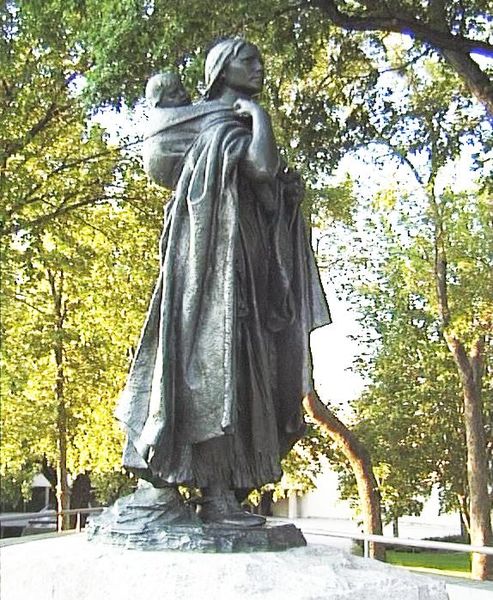
Southern Man’s Xenophobia

What if native Americans had asked for ‘proof’ when Pilgrims landed in New England? What if Mexico had barred US Citizens from settling in California before Fremont’s arrival?  What if Sacagawea’s people had turned their backs on Lewis & Clark? What if……? And are we all now at risk of arrest unless we have our PAPERS?  It’s something for those who still celebrate Columbus Day to consider.

Sacagawea: intrepid guide, diplomat, western star

Article by Jay Reeves, Associated Press, Sunday, October 9, 2011

Terrified by Alabama’s strict new immigration crackdown, parents living in the state illegally say they are doing something that was unthinkable just days ago – asking friends, relatives, co-workers and acquaintances to take their children if they’re arrested or deported.

Many illegal immigrants signed documents in the past week allowing others to care for their children if needed, assistance groups say, and a couple living illegally in nearby Shelby County extracted a promise from the man’s boss to send their three young children – all U.S. citizens – to Mexico should they be jailed under the law.

A key sponsor of the measure, Republican state Sen. Scott Beason, said such concerns weren’t raised when legislators were considering the bill, and he wonders if the stories now are designed to “pull on heart strings” and build sympathy for illegal immigrants.

But for Maria Patino – who prays every time she leaves home – even a chance encounter with police could end with her two elementary-age children being left alone or taken to foster care if she and her husband are sent back to Mexico. Both are in the country illegally and have no friends or relatives close enough to take in the kids.

“Every time I leave I don’t know if I will come back,” Patino, 27, said through tears. “I can’t stop working. My daughters need shoes and other things.”

Social worker Jazmin Rivera helps dozens of Spanish-speaking immigrants fill out paperwork weekly, and many are now seeking legal documents called powers of attorney so friends and others could care for their children.

“People are scared, and they want to be sure their kids are safe if something happens to them,” said Rivera, a case manager at the Hispanic Interest Coalition of Alabama.

Alabama’s law, regarded by many as the toughest in the United States, was passed by the Republican-controlled Legislature this year and signed by Gov. Robert Bentley. A federal judge blocked some parts of it but allowed key pieces to stand. On Friday, the U.S. Justice Department and civil rights groups asked a federal appeals court to block the law, saying it could lead to discrimination against even legal residents.

Under the law, police making traffic stops can question anyone suspected of being in the country illegally and jail them without bond if they lack proof of citizenship.

Immigrant parents say they have little choice other than to seek out people to care for their children because they fear the youngsters – many of whom are U.S. citizens – will be left home alone or sent to foster care if they are suddenly detained.

Posted in Uncategorized | Leave a comment

Jay’s Farm-stand Produce Nixed by Shelton Officials

2011 Mason County Candidates’ filing and contact info.

Many crocodile tears have been shed by the City of Shelton officials protesting their defeat at the hands of the Pork District regarding unsuccessful attempts by the City to rezone 160 acres immediately south of the Shelton airport. But after touting the rout as blocking development and jobs, Shelton officials have prohibited Jay’s Farm-stand Produce from sheltering its fruits and vegetables under a tent/fabric in order that it might be protected from the elements and spoilage.

There is to be a hearing on the matter this coming Monday @ 2:00pm at Shelton City Hall. Candidate for Mayor, Gary Cronce, when contacted promised to be in attendance to speak out against a city building department which bullies and intimidates local businesses into oblivion. The local real estate association whose invitation to back room vetting candidate Jack Miles recently rejected has come out in favor of these kind of nonsensical restrictions despite promoting themselves as a jobs oriented organization.

Jays Farmstand, Shelton, WA

Just what business Dawn Pannell and the rest imagine will move to a city with the kind of industrial blight, air pollution, dioxin contaminated bays, harbor & estuaries, broken filthy streets & alleys, abandoned dilapidated buildings, or visual eyesore in the midst of its harbor is anyone’s guess. But after 10 years of her continued ineffectiveness at leadership or instilling civic pride, it’s time for a change–a change residents sorely need. And for those who quail at the notion of voting for ‘Mussolini’ for Mayor, at least the Italian dictator made the trains run on time…which is more than City Commissioner Dawn Pannell can claim.  A cursory look at downtown will easily confirm the obvious filth and disrepair blanketing Shelton.

Posted in Uncategorized | Leave a comment

Looking For America

On this eve of Columbus Day, it’s a fair question to ask what his ‘discovery’ has wrought as well as why Native Americans aren’t celebrating.

By Conrad Black, National Post · Oct. 8, 2011:

The case of Amanda Knox presents us with not only an interesting human drama, but also raises questions of comparative international criminal law. Italy is not generally regarded as, and does not hold itself out as, any great paragon of jurisprudence. It has few famous jurists and no particular following among legal academics or jurisconsults. Yet its judiciary’s laudable willingness to revisit Ms. Knox’s case with fresh eyes suggests that other nations might examine Italy’s methods.

Ms. Knox, at the time of her arrest in 2007, was a 20-year-old American woman living in the Italian city of Perugia as a university exchange student. She was convicted of murdering her British female roommate in a drug-and sex-fuelled incident, along with two codefendants, including her Italian thenboyfriend. She also was accused of criminal slander, for accusing a local tavern operator of the crime.

At her first trial, neither she nor the jury was provided an interpreter. As a result, the jurors regarded her imperfectly communicated testimony as somewhat sketchy. As for the incriminating evidence, it consisted of what was successfully argued on appeal to be a grossly insufficient amount of DNA material. Her family, from Seattle, engaged forensic and technical evidence experts, hired additional counsel, mobilized a prodigious public-relations campaign and launched an appeal. In the United States, the appeals courts renounce any fact-finding or evidence-sifting function by hiding behind the Bill of Rights’ guaranties of trial by an impartial jury. The same isn’t true of Italy.

In practice, in the United States, over 90% of criminal cases are determined in favour of the government without trial, because the prosecutors press-gang witnesses by threatening them with prosecution themselves, granting immunities for prosecution for perjury and frog-marching them into court in great numbers. The jurors are deemed to have judged the facts correctly and the higher courts intervene only to ensure due process (which, in general, they define as the issuance of a guilty verdict). The principals in the case are not heard on appeal, only their lawyers are. And, of course, the impartiality of an American jury and the promptness of their justice are romantic heirlooms from the era of the authors of the Federalist Papers. (Canada’s system is vulnerable to some of these same criticisms, but generally speaking the odds are not stacked quite so high against defendants.)

After four years in an Italian prison, Amanda Knox had developed her Italian to high proficiency and gave a very moving statement in court. She had been pilloried as a treacherous murderer at the time of her trial, but re-emerged as a plucky young person condemned on very thin evidence. Her public relations team, paid for by a second mortgage on the family home and the assistance of friends and neighbours in Seattle, mobilized a U.S. senator from Washington, Maria Cantwell, and played very effectively on the generosity of spirit of most Italians, especially toward a damsel in distress. The opposition faction, anti-American law-and-order knuckle-draggers, were gradually outgunned, and Ms. Knox’s brilliant and affecting address to the court of appeal (something that would have been impossible in an American or Canadian appellate court, where, as noted above, only lawyers plead the case) turned the balance decisively.

It is hard to judge, in this as in so many cases, the extent to which the court was moved by the balance of evidence, carefully reviewed, and by the public relations tide; as courts are, in the words of my distinguished National Post colleague (and friend) George Jonas, “the zeitgeist in robes.”

In the manner of all prosecutors, when the fairness of the original verdict was questioned, the Italian prosecutors responded like wounded animals, screamed with rage at Ms. Knox’s ingratitude for receiving a mere 26-year sentence, and announced that they were now seeking life imprisonment. Extensive evidence was submitted on the inadequacy of the DNA support for a guilty verdict, to a mixed jury of two judges and four lay people. (American and Canadian appeal courts, by contrast, feature a panel of, usually, three judges only.)

Deliberations were not excessively prolonged, and Ms. Knox appeared to be at the outer limits of her composure when the court returned to render judgment. Her conviction for slander was upheld, although she cogently alleged that she had been bullied by prosecutors into making the slanderous allegation. But the penalty for that crime already had been served, and the far more important conviction for murder was overturned. She was released, and departed almost at once for the United States.

Ms. Knox’s conduct has been a model of protesting her innocence, behaving ingenuously and attracting the support of the good-natured and fair-minded; she is an attractive and well-spoken young woman. Italian justice has shown itself compassionate, efficient, and not above admitting error and putting things to rights. These are not the best known and most frequently encountered traits of Canadian criminal justice, much less the grim conveyer-belt to severe imprisonment or the execution chamber that usually constitutes criminal justice in the United States.

If this whole drama had unfolded in the United States, in fact, Ms. Knox likely would still be in prison: It is scandalous and notorious how reluctant American prosecutors are to yield even to overwhelming evidence of innocence from DNA, and it seems indisputable that many innocent people have been executed in the United States, even in recent decades.

Just three weeks ago, three long-convicted men accused of murder and imprisoned in Arkansas, including one who had spent 17 years on death row, were cleared on DNA evidence, beyond any question. But to regain their liberty, they had to plead guilty to a lesser offence, for which their imprisonment had already atoned, and in their allocutions to court, by prior agreement, stated that their guilty pleas were completely false and that they were in fact, as innocent as jay birds, but were going through with this lugubrious farce as a condition of release and to allay official fears of civil suits.

I believe readers are adequately familiar with my travails in the coils of the U.S. justice system, and I will avoid my customary screed on the subject. Yet the Knox case brings up many of the same issues. It obliges even Canadians, who are generally justified to regard their justice system as light years more just and condign than the American legal circus, to ask if they do not have something to learn from Italy in this matter: An appeal was achieved without difficulty, and in the teeth of prosecutorial pawing of the ground and hyperbole, the key facts were reviewed and reassessed by a mixed jury and not just a group of the trial judge’s chums from the courthouse lunchroom, and justice delayed, but unstoppable, was done.

Such a thing would be almost impossible in the United States, where the dignity of the state and invincibility of the prosecutors require that nostalgic notions of due process (such as those supposedly entrenched in the Bill of Rights, without which the Constitution of the United States would not have been ratified and promulgated) be tossed aside like dead mice. Canadians should look at both systems, Italy’s and America’s, and ask which one they would rather emulate.

cbletters@gmail.com

Posted in Uncategorized | Leave a comment

ACLU Takes On Rob McKenna

By Linda Thomas of KIRO FM, Mar 28, 2011

One of the most divisive pieces of legislation introduced in Olympia is a bill that would give police more tools to fight gangs, or restrict the rights of citizens, depending on your view.

Attorney General Rob McKenna is behind the anti-gang bill. The premise for the bill is that some law enforcement officers say a few Washington cities are under siege by gangs and they need new tools to fight gang violence. The ACLU says, not so fast. This legislation could be used to restrict the rights of innocent people.

The different view points have led to a battle between the ACLU and AG over claims related to this bill. First the Attorney General’s office did their own fact check of the ACLU’s interpretation of the proposed legislation – Fact-checking the anti-gang bill.

“Gang violence is a scourge in our communities, but the AG’s bill would not help reduce it,” the ACLU’s Doug Honig writes. “The 51-page measure is a compendium of tactics that evidence shows have failed to stem the tide of gang involvement or violent crime.”

Here is the ACLU’s fact-checking of the fact checker:

ATTORNEY GENERAL CLAIM

The bill focuses squarely on members of criminal street gangs. The bill’s civil protection orders, which provide a zone of safety in neighborhoods hardest-hit by criminal street-gang activity, are only allowed to be used on those found by “clear and convincing evidence” by a court to be active members of a criminal street-gang involved in a pattern of criminal activities.

FACT

All that needs to be proven for an injunction to issue is that a gang exists, is active in the area, and that the subject is a “member or associate” of that criminal street gang. See House Bill 1126, supra note i. In fact, no requirement is included in the bill that the subject have committed any crime at all. And as was evident from the testimony presented in the House hearing House Hearing on Bill 1126. Similar gang injunctions in California have indeed resulted in the profiling of innocent community members not affiliated with gangs.

ATTORNEY GENERAL CLAIM

Contrary to the ACLU claim that these kinds of laws “make the problem worse,” in Los Angeles County, crime levels dropped by up to 10 percent in neighborhoods benefitting from a similar law. A survey of San Bernardino, Calif., residents showed “positive evidence of short-term effects, including less gang presence, fewer reports of gang intimidation, and less fear of confrontation with gang members.” And in San Antonio, Texas, gang members subjected to the law “were charged with almost 50 percent fewer crimes in the 20 months after the injunction issued.” In other words, the law provided an incentive for gang members to cease some of their criminal activities.

FACT

The weight of the evidence suggests that gang injunctions are ineffective at best, and at worst, actively harmful. The very experts whose study the AG’s office cites in their press release state that stories of reductions in crime through use of injunctions “are often compelling, but are never buttressed with supporting evidence that meets minimal scientific standards of evaluation.” Maxson C, Hennigan K, & Sloane D. 2003. “For the Sake of the Neighborhood?: Civil Gang Injunctions as a Gang Intervention Tool in Southern California”, in S Decker (ed.), Policing Gangs and Youth Violence, Belmont, CA: Wadsworth. They also find “little support for a positive effect” when they examine crime patterns before and after the injunction, and find that “negative effects were observed in the secondary, less disordered injunction area.” Maxson C, Hennigan K, Sloane D, & Kolnick K. 2005. Can Civil Gang Injunctions Change Communities? A Community Assessment of the Impact of Civil Gang Injunctions. Report submitted to the National Institute of Justice, US Department of Justice. Another recent study warns that “even if interpreted as constitutional, gang injunctions have been proven ineffective in preventing and deterring gang members from engaging in violent gang activity.” Myers T. 2008-2009. “The Unconstitutionality, Ineffectiveness, and Alternatives of Gang Injunctions.” Michigan Journal of Race and Law, vol. 14, at 285. Even worse, an ACLU-funded study in the San Fernando Valley found a disturbing increase in violent crime due to an injunction. American Civil Liberties Union (ACLU) of Southern California. 1997. False Premises, False Promises: The Blythe Street Gang Injunction and Its Aftermath. Los Angeles: ACLU Foundation of Southern California. Our conversations with community members from California found that faced with an injunction, gang members simply pick up and move to new territory, resulting in the spread, rather than the curtailment, of gang blight.

ATTORNEY GENERAL CLAIM

The bill allows civil protection orders modeled after domestic violence protection orders and anti-harassment orders. The standard for showing the court that a person is a criminal street gang member is high. Law enforcement must provide a written document to the court, made under oath, that a person is an active member of a criminal street gang and intentionally promotes, furthers, or assists in criminal acts by that gang, and that the subject of a protection order has shown a pattern of criminal street gang activity. That pattern includes dealing drugs, breaking firearms laws, or going to a school and harassing or intimidating kids into joining a gang. Simply being friends with gang members is not enough — a judge must be convinced that a person is an active participant in criminal gang activity. And unless a prosecutor petitions the court, the protection order automatically expires after a year.

FACT

Again, a fundamental flaw in the legislation is that nowhere does it require that an individual have actually committed a crime in order to be subjected to an injunction. If the AG’s office is truly interested in pursuing hardcore gang-bangers, the bill should require proof that the respondent actually committed a “criminal street gang-related offense”—a term for which a statutory definition exists. RCW 9.94A.030 The bill relies on a tangle of loose definitions and confusing terms. The very definition of a “criminal street gang” is circular—it is defined, in part, as having “members or associates individually or collectively engage in or have engaged in a pattern of criminal street gang activity.” The latter term is not defined at all. Nor is there a definition for “intentional promotion” as used in the bill—there is no elaboration of what kinds of activities short of crimes might constitute the “clear and convincing evidence” needed. In fact, the bill expressly states that the court may consider “all relevant evidence.” So how youth dress and who they hang out with can in fact be used to prove that they are a “member or associate of a gang.” Since each of the activities the AG’s office cites as a basis for a gang injunction is already a crime in itself, why would the police not arrest and charge individuals for those crimes, rather than waste time and precious public safety resources on an injunction?

ATTORNEY GENERAL CLAIM

As the ACLU knows, appointment of counsel at a protection order hearing is not constitutionally required because the protection order hearing is a civil hearing. This is how anti-domestic violence and anti-harassment protection orders work. This protection order statute is identical to all other protection order statutes in Washington in that none of them require court-appointed counsel at the protection order hearing.

FACT

Whether or not it is constitutionally required, the ACLU has always supported the statutory right to appointment of counsel in cases where the government is seeking to deprive an individual of a significant civil liberty. And the state of Washington has a long, proud history of statutorily requiring the appointment of counsel even when that right is not constitutionally required if the individual faces the loss of liberty.

If the AG’s office were serious about protecting the civil liberties of the people who will be subject to these injunctions, their bill would include the provision of appointed counsel to individuals in their injunction hearings. Having counsel is especially important in this situation because the youth facing these injunctions are likely to be low-income and unable to afford an attorney. Without counsel, youth subject to an injunction are unlikely to be able to effectively challenge it even if they are not gang members. Jones, “Family Ties,” at 41. The proof required to obtain an injunction falls far short of the “beyond a reasonable doubt” standard required to convict someone of a crime. And the bill’s notification requirements are also fatally flawed—simply publishing a notice that a prosecutor is seeking an injunction against an individual is allowed under the bill, leading to the disturbing possibility that an individual may become subject to an injunction without ever knowing the proceeding is taking place. Though proponents assert the measure will only bar criminal or harmful activity by youth, in fact, the bill empowers judges to grant “all relief necessary and proper,” and also to bar youth from visiting designated locations, wearing particular clothes, or “directly or indirectly” contacting certain individuals. This means that the young person could face criminal charges for doing things that the rest of us can legally do—in other words, simply for living his life. Even the exceptions written into the bill for family members or legitimate purposes are problematic—how would an officer know that an individual is in the injunction zone to visit family members?

ATTORNEY GENERAL CLAIM

If the ACLU does not oppose domestic violence protection orders, in which an individual under serious threat of injury petitions the court for protection, it is inconsistent for the organization to oppose protection orders against known criminal street gang members, who intimidate and harm entire neighborhoods.

FACT

Gang injunctions and domestic violence protection orders are completely different animals and trying to compare the two is illogical. A domestic violence protection order is an order obtained by an individual against another individual based on proof that the respondent poses an imminent threat of harm to the petitioner. These orders are based on specific incidents that have reasonably led the petitioner to fear for his or her safety. By contrast, gang injunctions are court orders obtained by the government against an individual falling into a vaguely defined group, and who may not pose an imminent threat of harm to anyone. The government is not required to prove that the alleged gang member has or is threatening to cause any specific harm to any specific people. This is much broader dragnet that demands greater protections, including the right to counsel in order to prove that an individual should not be subject to an injunction.

ATTORNEY GENERAL CLAIM

Attorney General McKenna has long promoted intervention and prevention programs to help young people stay out of or abandon gangs. Through Consumer Protection settlements, AG McKenna has directed more than $600,000 to sponsor conferences featuring drug, alcohol and violence prevention programs for youth. This year, the AG’s anti-gang bill originally called for $10 million in gang prevention and intervention programs – the same amount called for by the Legislative Gang Workgroup in 2008. As in 2008, due to budget concerns, it was removed at the request of legislators, and replaced with language calling for the state to approach the federal government for funds. It’s unclear whether or not the ACLU of Washington State has ever raised funds for anti-gang intervention or prevention programs. Last year, the ACLU also declined the Attorney General’s Office’s offer to participate in the crafting of the anti-gang bill.

FACT

The ACLU of Washington participated in the 2008 Legislative Gang Workgroup and advocated strongly for prevention and intervention funds rather than failed suppression tactics. We agree entirely with the AG that suppression tactics without prevention and intervention programs are doomed to failure. But the version of the bill introduced into the legislature at the AG’s request fails to include any funding at all for prevention and intervention. The ACLU of Washington in fact met with the AG’s office immediately after becoming aware of their gang bill, and well before the legislative session. We clearly expressed our concerns about this legislation then. It is unfortunate both that we were not invited into the process earlier, and that none of our suggestions were incorporated into the actual bill.

ATTORNEY GENERAL CLAIM

Lawmakers are being blanketed with computer-generated e-mails that spread inaccuracies and misleading accusations about the Attorney General’s anti-gang bill, HB 1126.

FACT

Those “computer-generated emails” came from real people—concerned community members, some of whom testified at this week’s hearing on the AG’s bill, a clear majority of them in opposition. And if further proof is needed that communities are concerned about the bill’s consequences, the following respected community-based organizations all opposed the bill as of January 21, 2011:

American Civil Liberties Union of Washington; Asian Pacific Islander Coalition of King County; Asian Pacific Islander Coalition of Pierce County; A. Philip Randolph Institute; Asian Counseling & Referral Service; Asia Pacific Cultural Center; Building the Bridges Center for Justice; Central Washington Progress; Children’s Alliance; Community to Community; Council on American-Islamic Relations – Washington Chapter; El Centro de la Raza; El Comite Pro-Amnestia y Justicia Social; Latino Civic Alliance; Lutheran Public Policy Office of Washington; Merci Foundation; Minority Executive Directors Coalition; Mothers for Police Accountability; NAACP of Seattle/King County; Northwest Immigrant Rights Project; Northwest Leadership Foundation; OneAmerica; Powerful Voices; Tierra Nueva; SafeFutures Youth Center; Social Work Immigration Alliance; Southwest Youth and Family Services; Washington Association of Criminal Defense Attorneys; Washington Christian Leaders Coalition; Washington Defender Association.

For Comments on this article, see: Civil Liberties entangled in gang dragnet

Posted in Uncategorized | Leave a comment

Clam Pirate Selected as County Commissioner

.
.

Steve Bloomfield's self congratulatory smirk

County Commissioner’s Linda Ring Erickson and Tim Sheldon selected a man accused (or his company, Olympia-based Seattle Shellfish) of having illegally harvested shellfish from State lands:

Clam Pirate story reported on Shelton Blog

…”Mr. Bloomfield seems to think he has more rights than the average person. His e-mail screen name, CLAMPIRATE, actually fits quite well! Being from a family with their own road may make him think he is entitled to do all kinds of things…including stealing shellfish off of state DNR lands. However, he is not in the Port of Shelton and thus has no vote.

Next time someone should simply ask if he lives in the port district or if he is just there to cause trouble.

It seems that last year, it was found that he and his company, Seattle Shellfish, were found by Washington State DNR to be growing and harvesting shellfish on State owned public property. Mr. Bloomfield and Seattle Shellfish were fined $75,000 for breaking the law. So the public might want to keep this in mind when they hear him making all kinds of ridiculous statements about OUR port and OUR elected officials.

He has no right to interfere in OUR port, he has no honor, and he is nothing more than a CLAM PIRATE.”…

DNR Report of Clam Pirating, fines

…In the $417,000 settlement announced on June 23 by Commissioner of Public Lands Peter Goldmark: 

  • Shelton-based Taylor Shellfish Farms agreed to pay $225,000 for encroachment on 3.1 acres of tidelands along North Bay near Allyn.
  • Olympia-based Seattle Shellfish company agreed to pay $75,000 for encroachment at Arcadia Point on Case Inlet and Arcadia Point. [Steve Bloomfield’s company]
  • Seafood of Shelton agreed to pay $117,000 for trespassing at Arcadia Point. …

Mason County’s fate has a long history of being passed down to the hands of successive robber barons and corrupt politicians.  If Mr. Bloomfield (or his company) can’t be trusted not to steal from the State, should he be trusted not to steal from the County?  But given the long history of the County’s public funds funneled without meaningful oversight or competitive bidding to private companies like the EDC, perhaps the question is rhetorical??

Clam Pirates

Posted in Uncategorized | Leave a comment

9-27-11 ORCAA Shelton Civic Cntr. Hearing

9-27-11 ORCAA Shelton Civic Cntr. Hearing

9-27-11 ORCAA Shelton Civic Cntr. Hearing 1/3

ORCAA (Olympic Region Clean Air Agency) conducts hearing on 9-27-11 @ 5:00pm in Shelton’s Civic Center regarding Simpson’s (Green Diamond) application to renew its biomass hog fuel boiler and incinerator for another 5 years. The Shelton harbor (downtown) operation has been out of compliance with WA. Dept. of Ecology requirements for the last two extensions of 5 years/ea. it has received. Now it is on the verge of receiving yet a 3rd while continuing to be out of compliance. Testimony from local residents objecting to such a renewal/extension are shown in this series of video clips recording that hearing, Tuesday evening.

9-27-11 ORCAA Shelton Civic Cntr. Hearing 2/3

9-27-11 ORCAA Shelton Civic Cntr. Hearing 3/3

Posted in Uncategorized | Leave a comment

State Medicaid Won’t Pay for Emergency Room Visits

MEDICAID: After 3 trips to ERs in a year, some 700 conditions now won’t be covered by JORDAN SCHRADER; Staff writer | • Published September 26, 2011, Daily Olympian

More at: State limiting ER visits

State government is about to start refusing to pay for repeat visitors to emergency rooms whose conditions don’t truly rise to the level of emergencies.

The trouble is all in how you define an emergency.

Starting Saturday, Medicaid won’t pay for more than three ER visits in a year for a patient’s nonemergency conditions as defined by the state.

A list of more than 700 diagnoses put into that category has drawn fire from hospitals and doctors’ groups over inclusions whose symptoms seem awfully similar to emergencies:

 • Shortness of breath and some types of asthma attacks.

 • Kidney stones.

 • Hypoglycemic coma.

 • Nonspecific chest pain or abdominal pain.

 • Nonspecific congestive heart failure.

If a condition is left unspecified, that means it turned out to not be connected to a more dangerous ailment such as a heart attack or stroke. But doctors say that result can’t be known until patients are treated.

“Do (patients) know the difference necessarily between heartburn, heart attack, a blood clot in my lungs and a sore rib?” asked Dr. Stephen Anderson, president of the American College of Emergency Physicians’ state chapter. “These people shouldn’t be sitting at home trying to self-diagnose.

“My worry is, the message we’re going to be sending is the wrong message, which is, you should not be coming to the emergency department; you should be staying away,” said the Auburn Regional Medical Center doctor.

The state Health Care Authority sent letters to patients on Medicaid, the federal-state health insurance for the poor, warning them the government wouldn’t pay for their nonemergency treatment after three visits.

The agency is trying to save an estimated $72 million in federal and state Medicaid spending, as directed by state lawmakers who tried this spring to crack down on emergency room misuse.

Some conditions on the nonemergency list, such as sunburns and blisters, are not controversial. But others are clear emergencies, says Anderson’s group and other doctors and hospital groups putting pressure on the state to change course.

The emergency doctors’ group says refusing to pay for those conditions opens the state to a costly lawsuit.

FREQUENT USE

Many patients who are poor make the emergency room their first stop.

More than 46,000 times in fiscal year 2010, Washington ERs treated the conditions listed as nonemergencies for Medicaid patients who already had come in for three, four or even more similar visits that year, state officials say. One person visited 125 times.

That kind of repeated use is far from the norm – just 3 percent of Medicaid ER patients seek emergency care more than three times for those conditions – but when it happens, taxpayers or hospitals foot the bill.

“What we’re talking about here is people that go to the emergency room 10, 20, 30 times,” said Dr. Jeff Thompson, the state Medicaid program’s chief medical officer. “I do not have to do an (electrocardiogram) every time … because I know that this is a subjective, ill-defined chest pain.”

He said some 17,000 kinds of true emergencies will continue to be covered, and even for those conditions deemed nonemergencies, there are exceptions made for all kinds of circumstances. Abnormal vital signs or serious risk factors for poor health will be tickets to paid care, as will arriving in an ambulance or with a referral from a primary care doctor.

Thompson said his agency has removed some conditions from the list, but said critical questions about why each diagnosis is on the list miss the larger point.

“I don’t have time to engage people in silly arguments like that,” he said. “What I need is serious people to sit down at the table and work with us, because quite frankly it’s out of control.”

Thompson says Washington can’t afford to pay for emergency rooms to treat chronic conditions and hand out pain medication, a common remedy for frequent users of emergency rooms.

The government is essentially shifting the cost of providing care to frequent users of emergency rooms to hospitals. That will drive up the cost of care, said Cassie Sauer of the Washington State Hospital Association.

Budget writers in the Legislature declared hospitals could simply pass on the costs by billing the patients for their nonemergency visits – but Sauer said state laws on charity care for the poor prevent them from doing that.

Laws also require them to evaluate all patients who come in, and hospitals said they won’t be turning anyone away without treatment.

“We of course are going to see these patients. There’s no question about that,” said Dr. Tony Haftel, associate chief medical officer for Franciscan Health System.

OTHERS TO FOLLOW?

Some doctors worry that insurance companies will follow the state’s lead.

Washington and other states require insurers to pay for what a reasonable layman would think is an emergency, said Dr. Nathaniel Schlicher, associate medical director for the emergency department at St. Joseph Medical Center in Tacoma. He said the state is violating that standard and may give private insurers cover to refuse care – for any number of emergency room visits.

“This is potentially catastrophic nationally,” Schlicher said.

Thompson said it’s up to private insurers whether to mirror the state, but Medicaid is different in that the state can’t charge patients a deductible or copay. Because patients don’t pay a share of treatment, there’s no financial incentive for them to avoid using the ER.

Posted in Uncategorized | Leave a comment

Fullerton: Another day–Another homeless beating, death

The City of Shelton, WA administration would welcome these officers as additions to the local police force. Shelton & Mason County have a long tradition of cosseting/encouraging abusive/violent law enforcement personnel.

Charges filed against Fulleton police officers by CHARLOTTE KNIGHT, AND SEAN VIELE
Published: September 22, 2011

Acting Chief of Fullerton Police, Kevin Hamilton

Shelton Police brutality, mayhem

Posted in Uncategorized | Leave a comment

Special Interests seek private meeting w/Jack Miles

Yours Truly sought public comment from the ‘Quality of Life Committee‘ chair, Rob Drexler after learning of that group’s invitation to Commissioner Jack Miles to meet privately with their ‘interview team’ in Shelton’s Peninsula CU facility on 9-29-11 @ 9:30am to discuss/answer questions pertaining to ‘our issues‘ and  “…promote the election of those individuals who know and understand…”

Rob's 'Quality of Life' committee

However first, perhaps a little more about the irony of just what this group represents (given their pseudonym) and who is behind it is in order. The Mason County Association of Realtors website (in part) describes it as follows:

“In addition to helping write and implement policy, or prevent negative policy from becoming law, the QOL committee is very active in both state and local elections. By interviewing candidates the QOL committee decides which candidates to endorse and support through the election process. We only support candidates that agree to sign the Quality of Life Pledge, and by doing so, we ensure that our candidates work to support policies and laws that help maintain a quality of life in Mason County!”

“Chaired by Rob Drexler and co-chaired by Herb Baze, the Quality of Life Committee meets the first Wednesday of every month at 8:45 am at Roosters in Shelton. Feel free to stop in and attend a meeting. If you have an issue you’d like the committee to address, just contact Rob (rob@ydthomes.com, 360:620.2466) or Herb (herbbaze@aol.com, 360:701.4703).”

And just WHO is Rob Drexler, you may ask? More details later, but his website (http://activerain.com/rdrex) promotes him as follows:

Name  Rob Drexler
Company  John L. Scott – Belfair (Co-Owner) 
E-mail  Contact Rob Drexler (John L. Scott – Belfair)
Website  http://www.ydthomes.com
Office Phone  (360) 275-1600 x 214
Cell Phone  (360) 620-2466
Alt. Phone  (888) 275-7511
Fax  (360) 275-1605

 A little about Rob

Rob Drexler

“Rob Drexler is a retired U.S. Navy Master Chief Petty Officer. This, coupled with a background in contracting helps form a strong work ethic and knowledge of all aspects of the housing industry. Currently serving as Past-President on the Mason County Board of REALTORS and serves on the Washington Realtor’s Legislative Steering Committee.  Additionally Rob is Vice-Chair of the North Mason Chamber of Commerce and is the Secretary-Treasurer for the Economic Development Council, [a Mason County based private corporation]. Rob is extremely active in the real estate industry as well as our community. His most important asset is that he is one of three that make up ‘Your Dream Team‘, which affords buyers and sellers the best possible service.”

I.E. The ‘Quality of Life Committee‘ is the tactical special hierarchal interests team for the Mason County Realtors Association responsible for muscling/inducing politicians to provide their members with enhanced access  and special consideration. And they don’t hide their light under a  bushel either!

Ironically, these fat cats have their best chance at advancing their cause in Jack Miles despite their natural antipathy toward him and recent ardent support of the now defunct Adage biomassacre project or the EDC unchecked graft/favoritism machine where public funds are provided without competitive bidding to this private corporation, then circulated among Mason County’s oligarchs and elected officials inside our local cabal.

Bruce and Betty opine, “‘Your Dream Team‘ is exceptionally good at what they do and obviously love doing it”

The ‘Dream Team’ is too dense/joined at the hip in this cluster of political opportunists and robber barons to recognize the biggest impediment to their agenda is not those outside their tent, but within. e.g. Pork Commissioners Jay Hupp and Tom Wallitner along with Pork Executive Director John Dobson who have consistently litigated against the City of Shelton’s attempt to rezone the Shelton Hills 160 acres parcel south of Shelton’s Airport so as to allow for its well designed development and residential construction. The Pork septuagenarians are also among Dick Taylor’s biggest campaign donors. Dick has promised he will have an easy time getting along with these elderly officials while they obstruct the City of Shelton’s best efforts to bring development to our area. Meanwhile, Dick Taylor’s wife, Marlene Taylor, after vehemently denying a rumor Dick Taylor might seek appointment to fill the recent Jerry Lingle’s County Commissioner seat, neglected to mention she coveted it for herself. The scent of money, the mother’s milk of politics, hangs heavily in the air.

Rob’s selection ‘committee’ sent a letter to Commissioner Miles seeking his approval to meet with them behind closed doors. Jack (to his credit) delicately demurred by replying he preferred to seek the endorsement of his constituents to that of special interest groups and powerful oligarchies/corporations. He confidently assured Mr. Drexel his record spoke for itself when it came to protecting the quality of life this community and its residents have come to love. But Jack did have a little vetting of his own to pursue.

Commissioner Miles asked two salient questions of Mr. Drexel and his committee:

1)   Did you or the Mason County Association of Realtors support the ADAGE project?

2)  Did your organization support “Citizens for a Prosperous Mason County”?

Jack has yet to receive a response from Mr. Drexel, et al, to either question.

To some, the answers might be considered so obvious as to make the questions rhetorical. Nevertheless, this reporter hastened to make the very same inquiries of Rob Drexel himself, informing the Realtor his comment(s) would be provided to the community at large.

Mr. Drexel began by arguing his group was on record as supporting the ‘process’ when it came to the Adage controversy, not to say the project itself, with respect to question #1. But wouldn’t a committee that bills itself as about the quality of life want to inquire into and take a public position on this very issue surrounding one of the most toxic pollution proposals to face local residents within living memory?…or is it simply all about the $!

Mr. Drexler was blunt about denying any access to the proposed committee powwow, including the public, reporters, and photojournalists. Apparently, the sunshine would have been too intense for the delicate skins of these denizens of intrigue/graft/corruption/cronyism & special interests. Mr. Drexler is, after all, a corporate officer of the EDC: a private company forming one of the pillars of Mason County’s own Devil’s Triangle of greed and influence through the unmitigated expenditure of public funds with virtually no oversight nor competitive bidding for their professional ‘services‘.

Rob went on to refuse to answer the 2nd question with some considerable hostility including disparaging remarks about local community blogs attempting to keep residents informed regarding such local events and public policy issues. He volunteered he would consider answering such question(s) from Jack himself in a face to face encounter, though some would consider any such revelations moot or at best self serving given the recent history of Mr. Drexler and the committee when Quality of Life issues threatening the community were actually imminent. Where was Mr. Drexler and his band of knights errant when the Adage dragon was at hand before the city gates? MIA?

Jack Miles remains the most promising candidate for Port Commissioner most committed (as evidenced by his track record) without apology to defending this community’s Quality of Life, its families, their health, their children, and their environment. However, Jack is but one man and cannot continue to do so without our support as well as your urging your neighbors, friends, and family to do likewise.

Posted in Uncategorized | 1 Comment

9-4-11 Sugar Mountain w/Lilly

Oh, to live on Sugar Mountain
With the barkers and the colored balloons,
You can’t be twenty on Sugar Mountain
Though you’re thinking that
you’re leaving there too soon,
You’re leaving there too soon.

And the music...it was Grand!


It’s so noisy at the fair
But all your friends are there
And the candy floss you had
And your mother and your dad.

Lilly Gets All Choked Up

Oh, to live on Sugar Mountain
With the barkers and the colored balloons,
You can’t be twenty on Sugar Mountain
Though you’re thinking that
you’re leaving there too soon,
You’re leaving there too soon.

Gobsmacked

There’s a girl just down the aisle,
Oh, to turn and see her smile.
You can hear the words she wrote
As you read the hidden note.

Ashokan Farewell

Oh, to live on Sugar Mountain
With the barkers and the colored balloons,
You can’t be twenty on Sugar Mountain
Though you’re thinking that
you’re leaving there too soon,
You’re leaving there too soon.

Young & Free

Now you’re underneath the stairs
And you’re givin’ back some glares
To the people who you met
And it’s your first cigarette.

Lady In Red

Oh, to live on Sugar Mountain
With the barkers and the colored balloons,
You can’t be twenty on Sugar Mountain
Though you’re thinking that
you’re leaving there too soon,
You’re leaving there too soon.

Out On The Town

Now you say you’re leavin’ home
‘Cause you want to be alone.
Ain’t it funny how you feel
When you’re findin’ out it’s real?

Remember Me?

Oh, to live on Sugar Mountain
With the barkers and the colored balloons,
You can’t be twenty on Sugar Mountain
Though you’re thinking that
you’re leaving there too soon,
You’re leaving there too soon.

Just In Time

Oh, to live on Sugar Mountain
with the barkers and the colored balloons,
You can’t be twenty on Sugar Mountain
Though you’re thinking that
you’re leaving there too soon,
You’re leaving there too soon.

Antticipation

Posted in Uncategorized | Leave a comment