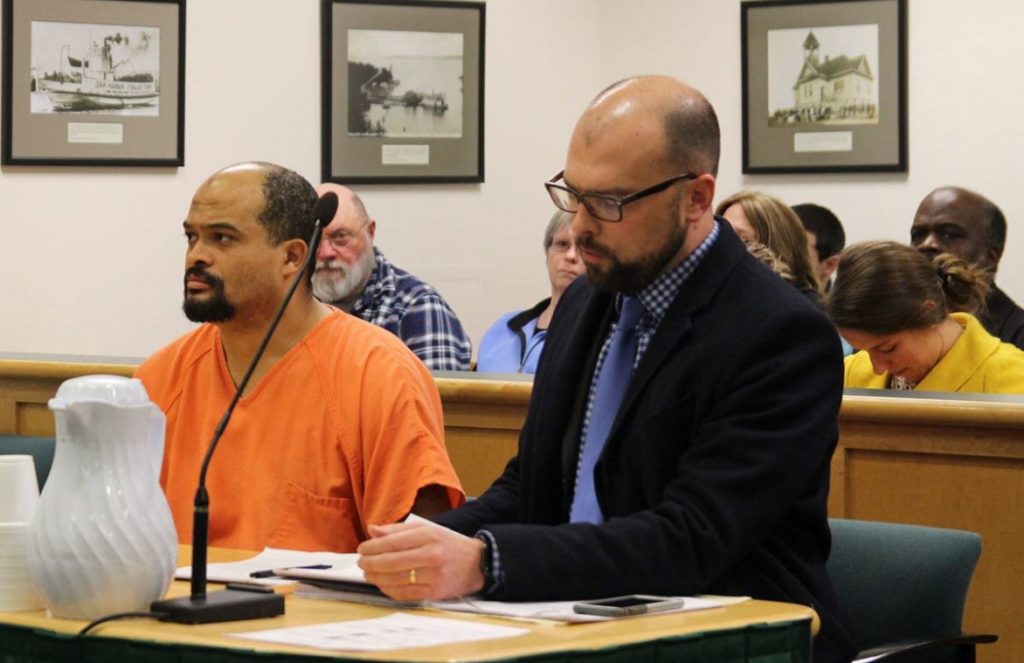
Jeremy Dawley’s conviction under a law that bars intimidation of a public servant was reversed by the Washington Court of Appeals in a ruling on Dec. 30, 2019. The court said the law was overly broad in violation of the First Amendment. (In this 2017 photo, Dawley appears in Island County Superior Court with his attorney during a hearing about revoking his bail. Photo by Jesse Stensland
Washington’s law prohibiting the intimidation of a public servant violates the First Amendment, a state appeals court has ruled. The appeals court reasoned that the law prohibits more than true threats and sweeps up a substantial amount of protected speech.
Jeremy Dawley, a former member of the United States Navy discharged with a traumatic brain injury, often calls up the nonemergency line in Island County and complains about issues he sees, such as illegally parked cars, traffic issues, and other problems.
Problems arose when Dawley had an unpleasant interaction with a police officer. Dawley had called the non-emergency line over two illegally parked cars. When the officer arrived, he asked if Dawley might carry a notebook, note all the violations, and then call to report all of them at one time.
Man’s several comments and phone call result in criminal charges of intimidation, harassment
Dawley didn’t like that comment and told the officer not to get out of his patrol car or his dog would attack him. The officer then responded that if Dawley’s dog attacked him, he would shoot the dog. Dawley then said he knew the laws of self-defense and that if the officer shot his dog, he would stab him. Another officer then responded: “If you stab my partner, I’m going to have to shoot you.”
Dawley then called the Oak Harbor Chief of Police, Kevin Dresker, and left him a voice mail complaining about his treatment by the police officers.
He stated in part: “This is Jeremy Dawley again. I’m not getting a phone call back from you. So do I need to look up your address and literally show up at your house cause I’m that not afraid of you, and I’m that pissed off at your police officer.”
Dawley also called Nikki Esparza, the Oak Harbor City attorney, making several comments. Here are some:
I really think something needs to be done about this. … So, I mean, it’s completely up to you. But if you guys aren’t willing to draw the line, like I’m gonna protect myself. I’m not saying I’m gonna come after you guys cause that’s – I’m not a murderer, I’m a law-abiding citizen.
And what you did to me as a city is to make me feel completely unsafe, not once but twice now. Your officers have put me into killing range with a firearm. A firearm, ma’am! What happens if I come to your house and I put you into killing range with a firearm, right? You’d be upset.
Dawley then filed a public records request at the Oak Harbor Police Department, asking for records on “violent offenses that resulted in physical harm and offenders to include sexual assaults.” Chief Dresker arrested Dawley after Dawley filed the public record request.
Jury finds man guilty of intimidating public service and telephone harassment
The state charged Dawley with three counts of intimidating a public servant and one count of telephone harassment. A jury found Dawley guilty of two counts of intimidating a public servant and the telephone harassment count. The jury was instructed about the intimidating a public servant law but was not instructed that the law applied only to true threats, which involve a serious expression of an intent to harm a person.
On appeal, Dawley challenged the convictions for intimidating a public servant. The Washington Court of Appeals reversed his convictions in its December 30, 2019, decision in State v. Dawley.
The intimidating a public servant law provides: “A person is guilty of intimidating a public servant if, by the use of a threat, he or she attempts to influence a public servant’s vote, opinion, decision, or other official action as a public servant.”
Dawley asserted that the law violated the First Amendment because it was overbroad and prohibited a lot more than just true threats. The state appeals court agreed.
Appeals court said intimidation law sweeps up ‘substantial amount of protected speech’
The court noted that the law did prohibit true threats but that it also “implicates protected speech because it includes threats to a person’s business, financial condition, or personal relationships.” The appeals court recognized that the law furthered the government’s compelling interests to protect public servants from threats and ensuring a fair and independent decision-making process.
However, the appeals court ruled that the law was not narrowly drawn and “sweeps up a substantial amount of protected speech.”
The appeals court concluded that “the only constitutionally permissible limiting construction to save the intimidating a public servant statute when the jury is instructed on the definition of threat … is to limit the statute to true threats alone.”
Because the jury was not instructed that the intimidating a public servant law was limited to only true threats, the appeals court reversed his convictions.
These two attorneys won ALL their traffic infraction cases heard in Thurston County’s District Court. If you were cited with a traffic infraction you need to beat, hire THESE guys…slicker than snot on a doorknob!
Jeremy Lee Quinn is an independent investigative photo journalist; he discusses with Bret the various threads involved in left wing extremism today, and their origins decades ago.
You have my sincere sympathy. I’ve experienced how colleges (e.g. TESC) give short shrift to due process and fairness. They’re almost a sacred cow in that courts are loathe to get involved in the school’s perfidy. So sue in federal court where you’re more likely to get a competent and impartial judge.
If I can be of assistance, call on me.
You’re poised, articulate, present well, and amazingly calm given the stress and outrageous abuse you’ve been subjected to. Not that it will help you feel any better, but know the attack on your fundamental rights and 1st Amendment prerogatives are part of a groundswell of cancel culture, de-platforming, and wholesale censorship by powerful social media corporations, colleges, universities, and ANTIFA.
Please, for all our sakes, don’t internalize this abuse or hide your light under a bushel. It’s apparent you’re a beautiful person who just may be a petunia in an onion patch. Elton John expressed these sentiments beautifully in Starry Starry Night. You’re doing the work of the angels.
Former Donald Trump lawyer Michael Cohen on Sunday expressed his belief that the ex-president had issued pardons for himself, his children and Rudy Giuliani before leaving office.
In the early hours of Wednesday morning, Trump granted pardons to 73 individuals and commuted the sentences of an additional 70, including Steve Bannon and rapper Kodak Black. But his list did not include preemptive pardons for himself, his family or Giuliani.
Cohen told MSNBC host Alex Witt that he started to ponder why the former president didn’t issue pardons for himself, his children or Giuliani after “knowing Donald Trump for well over a decade.”
“I started thinking to myself it doesn’t really make sense because it’s not like Donald Trump, so what am I missing?” he said.
Cohen concluded that Trump could have already pardoned himself, his children and Giuliani in secret, in what he referred to as “pocket pardons.”
Cohen rats out Trump
“I kind of think I figured it out,” he said. “I think Donald Trump actually has given himself the pardon. I think he also has pocket pardons for his children and for Rudy and it’s already stashed somewhere that, if and when they do get indicted and that there’s a criminal conviction, federal criminal conviction brought against him, that he already has the pardons in hand.”
Cohen explained that he did some research over the weekend into “whether or not the Constitution requires that pardons be disclosed to the American people and to the press.”
“I couldn’t find anything that said that it does, and that to me is more in line with what George Conway is trying to say about how Donald Trump doesn’t care about the law, how he will skirt the law, how he will do anything to benefit himself, and that includes even, you know, doing something like this with a pocket pardon,” he added.
Newsweek reached out to Trump representatives for comment.
In 2018, Trump claimed that he had the “absolute right” to issue a self-pardon.
On January 7, Reuters and TheNew York Times reported that Trump suggested to aides and advisers that he wanted to preemptively pardon himself to protect from future legal action. The reports cited anonymous sources who were unauthorized to speak on record about the matter.
CNN later suggested that Trump had been talked out of issuing pardons for himself and his children.
If he had pardoned himself, Trump would have been the first president in U.S. history to issue a self-pardon, and the move would have once again placed him in unfamiliar legal territory.
The U.S. Constitution sets out that the president may grant pardons for offenses “except in cases of impeachment.”
“Such a self-pardon will have limited utility given the sorts of legal challenges that Trump may be forced to confront,” David Gray Adler, a U.S. constitutional law scholar, wrote in a CNN article.
“A presidential pardon does not extend to state offences, which means he could still face charges arising from state and city investigations currently being conducted in New York.”
Details presently unknown but appears to be a LEO panicked after being surrounded by a mob in his car and assaulted. Note: A mob is a deadly weapon and unpredictable.
Mason County District Court George SteeleMason County District Court George Steele
Shelton, WA (1-20-21) — George Steele has been an attorney much of his life and, while no scholar, is familiar with the law–at least criminal law. But a judge’s judicial temperament is as important as his grasp of the law. Steele’s is brittle, harsh, and presumptuous.
Steele spent some years in Thurston County as a district court deputy prosecutor. He wasn’t especially good at it. He then spent a few years as a mediocre private practice attorney while sharing office space with Bob Brungardt, esq. and Bruce Finlay, esq. in Shelton. The office layout remains fresh because this reporter had to march into it to openly demand payment from George for process services George had requested. Despite the years, such arrogance affects Steele’s courtroom demeanor to this day. He remains an insensitive ham fisted martinet and an approximation of the federal judge (Julius Hoffman) who presided over the Chicago 7 trial.
There were some civil cases and a couple of criminal ones where I was either the opposing party or assisting them. George wasn’t hard to beat and lost all of those cases. Just because you graduate from law school and passed the State bar doesn’t make you a lawyer. Steele is proof of that.
Still, incompetence is as pernicious as corruption in the public sector or on the bench. In addition, exemplary judicial temperament is the sine qua non of a good judge. Steele has none. He’s brittle, almost intoxicated with the power attached to the king’s court, and, most importantly, barely masks a thinly veiled presumption of guilt and hostility toward pro se litigants. Conversely, he is more respectful of card carrying attorneys who are careful (e.g. Bob Brungardt, esq.) to suck up to George like any adroit sycophant would. Videos of the loud smacking noises and evidence of the baggage judge Steele and local attorneys bring to these hearings are being processed/edited. They will appear below, sometimes annotated, when completed.
One recent example consisted of a ZOOM session of assorted defendants being arraigned and many of their attorneys appearing via ZOOM. It became apparent that neither yours truly nor Steele nor the courtroom staff were sufficiently familiar with the software to accommodate a defense attorney’s request when she asked to speak with her client in a ‘breakout box’. After some apologies and fumbling around by the courtroom staff, the attorney and her client who made the request disappeared from the ZOOM screen…then a prompt appeared on mine inviting me to JOIN–which I did. The attorney immediately appeared/sounded uncomfortable with my avatar’s appearance in the breakout box and I ‘left’ it within seconds after recognizing she had sought a feature permitting her to conduct privileged communication with her client. She alerted Steele who immediately assumed the worst when he asked me to unmute. Rather than ask for an explanation/clarification despite his own confusion relating to the feature, he lead with threats to exclude an observer (myself) from present and future ZOOM court hearings–a direct violation of the 6 Amendment wherein the Constitution guarantees the right to transparency in ALL such proceedings not only to the public, but the litigants! Steele then launched into an insulting lecture about the privileged nature of attorney-client communications, prompting this reporter to opine “for the record, you learn something new [what ZOOM breakout boxes are] every day.” This recorded comment was made after proffering the fact of the prompt directing my avatar to join.
This is only scratching the surface of Steele’s inappropriate courtroom demeanor and deeply ingrained bias against defendants and scrutiny. He is incapable of restraining what goes against his punitive nature. In fact, when it became apparent he had won the race for the judicial position in an election against Eric Valley, esq., Mason County’s office for the public defender immediately announced it would invoke a blanket affidavit of prejudice against Steele (effectively removing him from presiding over any of those cases) which add up to over 80-90% of all the criminal cases heard by the Mason County District Court. This created a crisis of confidence among Mason County’s commissioners because the bill for a judge pro tem to replace Steele for the cases at issue would have been substantial.
Judge Steele Terrorizes Driving While Suspended Defendant
(A Court Order does not require a litigant’s signature to be effective nor does Washington law require a litigant to sign an order PROVIDED the court has in persona and subject matter jurisdiction. Here, Steele admitted he had no probable cause, thus no jurisdiction And while a judge is generally immune to lawsuits while acting in his official capacity, a judge loses immunity status from lawsuits stemming from the actions of a judge WITHOUT jurisdiction, such as here.)
Behold a monarchist tyrant eager to apply the law ON/AT the community rather than WITH the community:
The young Black defendant WAS out of his depth and smitten with misapprehensions over the meaning of corpus delicti: The facts and circumstances constituting a breach of a law–concrete evidence of a crime, such as a corpse. Of course, not all crimes involve a corpse or the person of a ‘victim’, especially status offenses as in the instant case. But our courts have ruled the state or its agency may, under appropriate circumstances, in law be considered a ‘victim’, e.g. welfare fraud. Our young Black patriot should (as should we all) have done his homework and filed an affidavit of prejudice against Steele before Steele had any opportunity to enter a discretionary order. I would think the one Steele admitted he coerced the young Black litigant into signing was void ab initio for want of jurisdiction which Steele effectively admitted by conceding he had no probable cause. The case SHOULD have been dismissed without prejudice under the circumstances.
Similarly, Steele makes it a point (as does the deputy prosecutor) to warn potential jurors against jury nullification (sitting in judgment of an unfair criminal statute or its application) and to consider only the facts presented for/against an accused malefactor. In fact, jury nullification is a fundamental right retained by the people–a long history of precedent supports that right. But it’s best not to twist the lion’s tail by voicing an opinion on the matter to the court or other jurors. Save that exercise for your most intimate and trusted confidantes. Understand, your fellow jurors will behave as a room of snitches. Nothing you say is private, no matter how superficially innocuous. Be confident, but keep your mouth shut and your own counsel.
If you’re a defendant, file an affidavit of prejudice (a procedural right you have if exercised BEFORE Steele renders any discretionary rulings) ASAP with the court clerk. This will remove Steele from your case…unless you prefer a judge who set bail at $1,000,000 for a defendant who was cited for driving on a suspended license.
Disqualifying one judge from a case in Washington is a fundamental right. No reasoning is needed. However, a judge may only be disqualified before the judge has made a discretionary ruling or order in the case. The RCW provided (now expanded) slim examples of actions by a judge which are not discretionary ruling or order. In Godfrey v. Ste. Michelle Wine Estates Ltd., 453 P.3d 992 (2019), the Washington Supreme Court analyzes the few examples and adds another for clarification.
Godfrey was a bartender who handled wine bottles. On this occasion, the wine bottle he was handling shattered in his hand. He filed suit for against the winery, Ste. Michelle Wine Estates Ltd. and the bottle manufacturer, Saint-Gobain Containers Inc.
The case was assigned to Judge Johnson, who set the initial case schedule and discovery cutoff deadlines. The case was later assigned to Judge Stolz. Judge Stolz was presented a stipulated and jointly proposed order extending the parties’ deadlines to disclose witnesses. Judge Stola ruled on and entered the order. Two months later, prior to any other rulings, Godfrey filed an affidavit of prejudice and a motion for Judge Stolz’s recusal. Judge Stolz denied the motion. Judge Stolz subsequently presided over the bench trial.
Godfrey appealed the ruling at trial, arguing the trial court erred in rejecting his affidavit of prejudice and motion for recusal. The Court of Appeals agreed with Godfrey and held the trial court erred in rejecting the affidavit of prejudice.
The defendants petitioned for review. The petition was stayed pending a decision on point with the subject matter, which ultimately had this case remanded back to the Court of Appeals. The Court of Appels reached the same conclusion as it did previously.
The Washington Supreme Court then granted review on whether an affidavit of prejudice was timely under then Washington law when it was submitted after entry of a stipulated order extending discovery deadlines.
Judicial acts which had been carved out as acceptable prior to an affidavit of prejudice include: arranging the calendar, setting a date for a hearing or trial, issuing an arrest warrant, presiding over criminal preliminary proceedings under CrR 3.2.1, arraigning the accused, fixing bail, and presiding over juvenile detention and release hearings under JuCR 7.3 and 7.4.
The Washington Supreme Court previously held an order granting a joint trial continuance motion was discretionary because the decision to grant or deny such a request required the judge to ‘”consider various factors, such as diligence, materiality, due process, a need for orderly procedure, and the possible impact of the result on trial.” Defendants urged the Court to follow this reasoning.
However, the Court held rulings on pretrial stipulated orders relating to scheduling and deadlines fall within the exception for “the arrangement of the calendar,” making the above analysis moot. Therefore, the entry of the stipulated order did not render Godfrey’s affidavit of prejudice untimely.
The Court’s holding compelled a change in the wording of RCW 4.12.050 to include “ruling on an agreed continuance” as permissible prior to the filing of an affidavit of prejudice. Thus, parties now have greater latitude and, potentially, time in making a proper decision of whether or not to disqualify a judge from the proceedings. Whether this is favorable or not will depend on the subjective desires of each respective party. Proper case analysis and strategy are imperative to keeping the law on your side.
George Steele Threatens the Press
[Look here for future videos of George in all his judicial splendor, marking how obsequious certain local attorneys appearing in his court behave. It’s embarrassing.]