




Pages
-
Recent Posts
- Moore’s Law as rebuttal to ANTIFA & An@rchists
- Anthropic AI Code, Expression: 1st Amendment Ghosts
- Why God must be killed: The Divine right of kings/judges
- Honduras-Gate Tapes Reveal Emolients in Pay to Play
- Shawna Hawk & Oly Media Island fraud investigation
- 24-2-00425-23 Karin Vartia et al v Susan L Mathers Noyes
- Politics of Mainstream Psychology v Liberation Theology
- WAR 1-3-26 via Venezuela
- Washington Open Government Guide
- Crowdsourced reports+volunteer review=info w/o the noise
- The Mahatma’s 7 Social Sins
- The Elixir of Life (Podcast & Transcript 6-6-25)
- 24-3-02379-7 Urajhia Leyaona Bailey v Michael Javon Agosto
- 25-2-00358-23 Star Lake Community Club v Cesar Varela
- Multi-Million E$tate Hans Carl Stoker trust irregularities
Recent Comments
- Home Calc on How they ‘plug’ prisoner’s bottoms before execution
- James gouldie on Mason Co. District Ct. Judge George Steele’s Temperament:
- James gouldie on Mason Co. District Ct. Judge George Steele’s Temperament:
- feettocm-net on How they ‘plug’ prisoner’s bottoms before execution
- inchtocm-net on How they ‘plug’ prisoner’s bottoms before execution
- admin on KAOS Meltdown Exposes TESC Censorship
- admin on KAOS Meltdown Exposes TESC Censorship
- Rebecca on KAOS Meltdown Exposes TESC Censorship
- Elisa on Rebekah Zinn & Washington’s DV Judicial Cesspool
- admin on Union Gospel Mission Nixes Homeless, Abets Olympia
Archives
- June 2026
- May 2026
- April 2026
- January 2026
- December 2025
- October 2025
- July 2025
- May 2025
- March 2025
- February 2025
- January 2025
- July 2024
- April 2024
- March 2024
- January 2024
- December 2023
- November 2023
- October 2023
- September 2023
- August 2023
- July 2023
- June 2023
- May 2023
- April 2023
- March 2023
- February 2023
- January 2023
- December 2022
- November 2022
- October 2022
- August 2022
- July 2022
- June 2022
- May 2022
- April 2022
- March 2022
- February 2022
- January 2022
- December 2021
- November 2021
- October 2021
- September 2021
- August 2021
- July 2021
- June 2021
- May 2021
- April 2021
- March 2021
- February 2021
- January 2021
- December 2020
- November 2020
- October 2020
- September 2020
- August 2020
- July 2020
- June 2020
- May 2020
- April 2020
- March 2020
- February 2020
- January 2020
- December 2019
- November 2019
- October 2019
- August 2019
- April 2019
- March 2019
- February 2019
- December 2018
- November 2018
- October 2018
- September 2018
- August 2018
- July 2018
- June 2018
- September 2016
- June 2016
- May 2016
- April 2016
- March 2016
- January 2016
- December 2015
- November 2015
- September 2015
- July 2015
- June 2015
- May 2015
- April 2015
- March 2015
- February 2015
- January 2015
- December 2014
- November 2014
- October 2014
- September 2014
- August 2014
- July 2014
- June 2014
- May 2014
- April 2014
- March 2014
- February 2014
- January 2014
- December 2013
- November 2013
- October 2013
- September 2013
- August 2013
- July 2013
- June 2013
- May 2013
- April 2013
- March 2013
- February 2013
- January 2013
- December 2012
- November 2012
- October 2012
- September 2012
- August 2012
- July 2012
- June 2012
- May 2012
- April 2012
- March 2012
- February 2012
- January 2012
- December 2011
- November 2011
- October 2011
- September 2011
- August 2011
- July 2011
- June 2011
- May 2011
- April 2011
- March 2011
- February 2011
- January 2011
- December 2010
- November 2010
- October 2010
- September 2010
Categories
Artist/Musicians/Dancers/etc
- (A) Welt Geist
- 1 call away
- 2012 Music In The Park
- 25 Best Opening Lines
- Allen Toussaint
- Anna's Bay Chorale
- Anybody's Game
- Apocalyptica
- Ash Soular
- Buskers Advocates
- Chris Abani
- Desiree Bassett
- Easy Free Sheet
- Geoffrey Castle
- George Winston
- Greta Matassa
- Harstine Is. Theater Club
- Harvest Moon
- John Goldsby – sax
- Juliette Valduriez
- Kursa-2013
- Mark W. Iier
- Mr. Wiggles
- NW Folklife 2009-2011 artists
- Oly Jazz Central
- Oly/Shelton Jams
- Quichua Mashis
- Railyard
- Recipes for Disaster
- Serial Killers
- Shawnie's Flickr
- Slovoj Žižek
- Stairway to Heaven
- Sung Bong Choi
- Ted Rall 'toons
- The Diggers Commune
- The Warm Hardies
- TRL Free Music
- Web Sax Blues
- Yasi Hofer
- Yawa Skits
- Yoga Undressed
Blogroll
- (A) Black Spring Press
- (A) Crimethinc
- (A) Earth Liberation Front
- (A) Free Radio Oly
- (A) Green Anarchy
- (A) Grey Coast
- (A) Lunaria Press
- (A) M11 – Tacoma
- (A) Puget Sound Anarchists
- (A) Puget Sound Anarchists
- (A) The Wildcat
- (A) Tides of Flame
- (A) Utopia or Bust
- (A) War on Society
- (A) Wild Harbor
- (A)LF Libr@ry
- (A)miable Outlaws
- (A)narchist Library
- (A)narchist News Org
- (A)narchy 101 Q & A
- (A)narchy TV
- (A)NTIFA Terrorist Manuals
- (A)UTONOMY//253
- (O)ccupy Portl(a)nd
- 200 DB Calculator
- Absolute Impugnity
- ADA & 1983 vs. WA
- ADA home page
- ADA Resources
- Adage Mason Co. Permit Status
- AJS pro se forum
- Athenaeum Library of Philosophy
- Atomic Court Watchers
- Bec(a)use We Must
- bidder 70
- Biker Forum
- Billy Frank
- Biomass Busters
- Biomass Monitor
- BioMassacre Apologists
- Bite B(A)ck
- Boing Boing
- Busker "Magic Mike"
- C(A)PR
- CBC Radio 3
- Censored News
- Chris Hedges Truthdig columns
- CLDC
- Climate Voices
- Common Dreams
- Cons Call Home svc
- Cop Shop Talk
- Copblock – know your rights
- CounterPunch
- Dana's Thunderbolt
- David Sohappy
- Dispatches from Underclass
- Documentation
- E@rth 1st Newswire
- ELF Direct (A)ction M@nual
- Emerican Johnson ANTIFA fan
- Energy Justice Network
- Eric McD(a)vid
- Eric Schechter ess(a)ys
- Expunge Records
- FB Seattle Homeless
- Flirting w/(A)narchism
- Fprison
- Game Camlog
- Gen. Vlasov
- Goldbar Reporter
- Government SLAPPs
- Grand Jury FAQs
- Homeless Elders NPR
- Homeless N.J. Camp
- Homeless Stories
- https://www.fosshub.com/Audacity.html
- I Love Oly
- IHWPOP
- Incinerator Free Mason County
- Independent Media Cntr
- Investigative Reporting Ctr
- IWW
- Jack Miles Campaign
- Jeff Vail esq
- Josie the Outlaw
- Just Cause Law ctr
- Justice Denied
- Kingcast photolaw
- Kirby Hopper
- lawyers.com forums
- Legal Beagle
- Legal Malpractice esq.
- Little Hollywood
- Mary Hath – Peace Prophet
- Mason County Budget Watch
- Mason EDC
- Mason Web TV
- May 1st/People Link
- Montesano Today
- Morning Star
- Morty the Dog
- New Car damage
- Newsroom Law Blog
- No Adage Group
- No Biomass Burn
- No Biomass burning
- No Compromise
- Nolo Press
- NPR Podcasts
- NSA Black Paper
- Occupy Oly
- Oly CopWatch
- Oly Free Skool schedule
- Oly Media Island
- Oly Satanists
- OlyBlog
- Olympia FOR
- Olympia Power & Light
- Olympia Rising Tide
- ORCAA Air Quality Reports
- ORCAA Online Complaint Form
- People For Puget Sound
- Peter Bohmer
- Photo Junkie
- pixiq
- Plugins
- Police4aqi
- Press Access
- Press Access
- Press Access
- Press Access
- Press Access
- Press Access
- Prison Legal News
- Pro Se Net
- R(a)ging Pelican
- R@dical Criminology Journ@l
- Residents Against Wood Smoke Emission Particulates
- RISEUP.NET
- Rising Tide of America
- SCMA
- scribd shared reading
- Security Culture F(A)Qs
- Self Help Network
- Sherry Colb, esq.
- Snitch Slide Show
- Snitch W@tch
- Snitchwire
- Spacing – Urban Landscape
- SPS Green Party
- SSDI Trek
- Stretch Photography
- Suggest Ideas
- Support Forum
- Target of Opportunity
- targetofopportunity.com
- TC Family Court Reporter
- TESC Activity Calendar
- TESC Facebook Events
- TESC Writing Center
- The Constitutionalist
- The Olimpian
- The Plan
- the Shac 7
- The Stand
- The Story of Bottled Water
- The Story of Cap & Trade
- The Story of Cosmetics
- The Story of Electronics
- The Story Of Stuff
- Themes
- Thunderbolt Newsletter
- Thurston Co News
- Ugly Judge
- US ch7 CIR lien
- WA 'true threat' Jacko
- WA Air Quality Index
- WA Air Quality Map
- WA Child Support Essay
- WA DV Press
- WA Eq Estoppel
- WA Evidence
- WA Evidence
- WA Supreme Court
- WA True Threat Williams
- Walidah Imarisha
- Westlake Park Urchins
- What is The Plan?
- Who's a Rat
- Why Capitalism $ux
- Wood Smoke Nuisance
- WordPress Blog
- WordPress Planet
- Works In Progress
- Your Daily Hour w/Me
- Zahid Chaudhry
Business Resources
- 10 errors editors hate
- 10 Free VPN svcs
- 11 EFF Friendly Web Hosts
- 2009 TESC Employees
- 2015 best clouds
- 9840CDW Scan jinx
- 9840CDW Scan linx
- Add NPAPI
- Add NPAPI
- AHAH Form Loop
- Anonymizer
- APWU Postal Union
- Babelfish translator
- Ban-the-Box NYC
- Canva AI Transcryption
- Canva AI Transcryption
- Carrier Gets Paid
- Cloud Drives
- Depositfiles
- DOT Broker's Bond
- ECP quotes
- Esnips File Stores
- Fidelity Secure Mail
- Fidelity TaxLoss Harvesting
- File Store Sites
- Free Ch7 Bankruptcy tool
- Google Drive
- Google Earth Map
- Google Translate
- Haven House OKBR Abuse
- HCC.NET Features Codes
- I-Bond Tutorial
- Intuit pay button
- Is WA Law Firm Collection Agency?
- KEH Used Lenses
- Lacey Employee salaries
- Lulu self-publish
- Maritime Map Traffic
- Mediafire file stores
- Olympian Portal
- Paypal button
- PC Microcenter sales
- Phones Track
- PI Labyrinth
- Postalease – Lightblue USPS
- Proxy List
- Riverside AI Transcription
- Riverside AI Transcription
- Search 4 Document
- SPJ – Soc. Prof. Journalists
- SPSCCC Employees
- Stock News
- T Boone Pickens Oil
- Talkshoe VOIP
- Taps & Bits Chart
- Thurston Employee salaries
- Transfer Big Files
- TurboScribe AI Transcripts
- UK Free Hosting
- UPS Acct Login
- US Personnel Mgmt
- WA Delta Dental Plans
- WA online Licensing
- WA Voter Database
- Whois
- Whois by IP
- WiFi Tomography
- WordPress developer
- Zazzle's Buttons
Festivals/Faires/Events
Forms
- Anonymity Online TOR
- BK pre-filing cert ndx
- CA How 2 Subpoena CV
- CA Subpoena CV form
- CA Will
- Copblock Complaint form
- Fed. Civil Cover sheet
- Fidelity Secure Mail
- HTTPS Everywhere
- Interactive Lawhelp
- IRS 200 DB Calculator
- IRS form 4506 Xscripts
- King Co. MAR
- King Sup Ct forms
- Kitsap Court
- Kitsap SC ZOOM application
- Kitsap ZOOM Request
- Mason Auditor PDR form
- Mason Civil Srvc Application
- Mason Co Xscrptnst Form
- Motion to Revise
- Oly Claim Form
- Oly omc9.40.080 trespass
- Oly Risk Proc
- OR Tort Claims pkt 180 days
- Pierce fees
- Pierce pro se LINX
- Pierce Sup Ct forms
- Power of Atty
- Send Fax Online
- Tails privacy
- Thurs JI's LCrR 6.15
- Thurston Accommodation Request
- Thurston Arbitration forms
- Thurston Arbitration Set Note
- Thurston Available Forms
- Thurston Co. Forms
- Thurston Criminal Notice
- Thurston FJC Rules & Forms
- Thurston Superior Notices
- US Bankruptcy forms
- US Dist Minn Ct
- US Treasury forms
- US WAWD 1983 Complaint
- US WAWD Civil Cover Sheet
- US WAWD Complaint
- US WAWD In Forma Pauperis
- USC18, 1922(c)(1) Aff guns
- WA ACLU help form
- WA Court Forms
- WA CRLJ 45 Subpoena
- WA DCS Modification
- WA Name Change
- WA Praecipe Subpoena
- WA RTS
- WA Rule 7 Notice
- WA Rule 7 Notice pdf
- WA squatter removal w/o court
- WA Tort Claim form
- WA Tort Claims pkt
Law Resources
- 10 Commandments of Cross
- 18 USC 2511(2)(c)&(d)
- 1983 Prisoner Packet
- 2006 IFC
- 2009 IBC
- 2009 IFC
- 2012 IBC
- 42 US code405(c)(2)(C)(i)
- 5 U.S.C. § 552a DOJ SS # privacy
- 9th Circ. photo/record app.
- Absolute Impugnity
- ACLU Photo Rights
- ADA Enforcement
- ADA Rights Laws
- Affirmative Defenses cklist
- Amicus Curia
- Avoid post Ch7 Liens
- Bloggers' Rights
- Buskers' Rights
- CA Anti-Harassment case
- CA Anti-Slapp Project
- CA City & County codes
- CA Court Photo response
- CA Courthouse Photography
- CA How 2 Subpoena CV
- CA law steps
- CA Rental-Cop Arrest Manual
- CA Subpoena CV form
- CA Sup Ct: Flanagan v. Flanagan
- CA Trespass defenses
- Canva AI Transcryption
- Canva AI Transcryption
- Carol Rose on Civil Rights
- Ch 7 Means limit$
- Ch7 WA exemptions
- Ch7 WA exemptions
- Civil case outline
- Clark Fees
- CO. Atty Schwaner
- Colt v. Freedom Communications
- Court Watchdog
- Crime Reports map
- Criminal Motion Practice
- Det. Roland Weiss doc
- Dismiss Petition
- Electronic Frontier Foundation
- ERISA handbook
- Facts Copyright
- Fed ADA CRS report
- Fed ADA index
- Fed Autostay Violations
- Fed Criminal Jurisdiction
- Fed Dockets & Filings
- Fed Franks Hearing
- Fed JAG SCRA
- fed Pacer downloads
- Fed Removal & Remand
- Fed Removal – criminal
- Fed Removal – criminal remand
- Fed Removal – jurisdictional
- Fed Removal – OH remand
- Fed Removal – racial
- Fed Removal essay
- Fed SCRA
- Fed. Areas Jurisdiction
- Fed. DOL Protection Act
- Fed. Exclusive Jurisdiction
- Fed. Lic. Protection history
- Fed: To Remove or Not
- Federal Removal strategy
- Federal Removal tutorial
- Foreign (C) Analysis
- Foreign (C) Remedies
- Free Ch7 Bankruptcy tool
- FTR Upload & Play
- Galella v. Onassis
- Genesis Law MTSC
- Gerry Spence essays
- Google Scholar
- Google Scholar search
- Grand Jury Strategies
- Grays Harbor DV/AH Chart
- Grays Harbor file purchase
- Groklaw
- Hunting & Posting on Private Land
- Is WA Law Firm Collection Agency?
- Judicial Estoppel
- KC XP Mot HRG Manual
- KCDC Services
- Khan Edu Bill Rites
- King Co crt files
- King Co. Court Forms
- King Co. ProSe Handbk
- King Dist Ct claim
- King Dist Ct records
- Kitsap Court
- Kitsap DC Case srch
- Kitsap Records
- Kitsap Records Request
- Lawless America
- LCR 7 (Motions Practice)
- Leagle law
- legal abuse articles
- Legal Dictionary
- Losing Briefs
- Mason Clerkepass
- Mason Co Jail
- Mason Ct. Sched
- Mason Jail roster
- Mason LCR 7 – Motions
- Mason S Ct. fees
- Mason Sex Offenders
- Massachusetts ACLU
- Mens Rea Wikipedia
- Mosquito sonic device
- MS Ch7 Lien Avoidance
- Municipal Codes map
- Municipal Codes map
- Municode Map
- Newsroom Law Blog
- NLG Rights & Hotline
- Notice of Motion form
- NV Liens Exec
- NW Justice Project
- OH in Limine testimony
- OH Lawful Trespass
- OH Motion In Limine
- OH Venue Motion
- OR Tort Claims pkt 180 days
- Oress Access
- Parental Alienation Illness
- Photographers' Rights
- Pierce Case Index
- Pierce LINX login
- Pierce SupCt E-Mails
- Pierce SupCt Judges
- Power of Atty
- Probono Net
- Public Performance MPAA
- Qui Tam (Whistle Blower)
- RCW 10.14 Hearsay
- RCW 10.14 Megrey
- RCW 10.14 Sweeney
- RCW 9.73.030
- Reporters Committee
- Reporters Committee Freedom
- Restatement Index
- Reuters – Practical Law
- Right to Privacy
- Riverside AI Transcription
- Riverside AI Transcription
- Selfhelp Org
- Seminal 1st Amendment cases
- Sex Offender Essay
- Shelton Municipal Code
- SLAPP Responses
- Snohomish Co. Court Forms
- Snohomish SCLCR
- SS OIG Field Offices
- SSA Child Survivor Benefits
- SSA Representative Payee docs
- SSA/OIG/OI Disability Fraud form
- Stop (Terry) & Identify Statutes
- Supremacy Doctrine
- This Matter
- Thurs LSPR rules
- Thurston Clerk Libertynet
- Thurston Co. Clerk's Site
- Thurston Co. Forms
- Thurston County Clerk
- Thurston Court Accommodation
- Thurston Court Directory
- Thurston District Court
- Thurston District Ct
- Thurston E-Filing
- Thurston E-Filing Test
- Thurston Fam Court e-mail index
- Thurston Fam Court website
- Thurston FJC Rules & Forms
- Thurston Jail Roster
- Thurston Juvenile Ct index
- Thurston LCR 5 – Service & Filings
- Thurston LCR 7 – Motions
- Thurston LCR's & Forms
- Thurston LCRLJ 26 Admissability
- Thurston LCRLJ 7 Pro Se
- Thurston LGR 33 Accommodation
- Thurston Protection Orders
- Thurston Public Records
- Thurston Records index
- Thurston Sheriff fees
- Thurston Superior Ct. E-Filing
- Thurston Superior Dockets
- Thurston Superior Judges
- Thurston Volunteer Legal Help
- Tips for Cyber-Journalists
- Traffic Stops not Private
- Tresspass Bans
- trial basics
- Tribal Business Structures
- TurboScribe AI Transcripts
- Ultra Vires Law
- US & WA laws/cases/rules
- US 9th Circuit audio
- US ADA
- US ADA Title II & III Revised
- US Bk Means Test
- US Ch.7 Trustee Hdbk
- US Constitution – Annotated
- US Copyright case law
- US Copyright Preemption
- US Court of Federal Claims
- US Forma Pauperis
- US Gen Trial Rules
- US Judge Jones rules
- US Marshalls Directory
- US Prior Bad Acts
- US Privacy Law
- US Pro Se Guide
- US Rules & Forms
- US SC Prosecutor Liability
- US SC Standby Counsel
- US WA Bk Court
- US WAWD ECF pro se registration
- US WAWD pro se
- USC18, 1922(c)(1) Aff guns
- UT 1983 Format & How2
- Voire Dire tips
- WA 9.96 RCW restor rts
- WA ACLU
- WA ACLU
- WA Admin for the Courts
- WA Affidavit of Prejudice
- WA AG Complaints
- WA AG Opinions
- WA AG Opinions
- WA Agency Debt Collection
- WA Anti-SlAPP
- WA Anti-SLAPP Essay
- WA App & Trial Cts.
- WA App Briefa
- WA App Ct Opinions
- WA App Div II Site
- WA Archives search
- WA Audio/Video archives
- WA Bar News
- WA Big Game Regs
- WA case index
- WA case law
- WA Case Law
- WA Ch7 exemption chart
- WA Ch7 exemptions
- WA child admin ndex
- WA Child Support Calculator
- WA CHINS How2 File
- WA City & Co. Codes
- WA Civil Case Schedule
- WA CJC
- WA CJC Commission
- WA Concurrent Jurisdiction
- WA Court Dir
- WA Court Forms
- WA Court Forms
- WA Court Rules
- WA Courts
- WA Courts Directory
- WA Courts Directory by City
- WA CR synopsis
- WA CR34 Produce Docs
- WA Criminal PRA
- WA CRLJ 26 Discovery
- WA CRLJ 45 subpoena
- WA CRLJ 7 Motion
- WA CrR 2.1 Indictment & Info
- WA CrR 5.2 Change Venue
- WA CrR8.1->CR6 Time
- WA CrR8.2->CR7(b) Motions
- WA CrR8.3 Knapstad
- WA CrRLJ 2.4 Citation & Notice
- WA Ct Resources Index
- WA DCS Modification
- WA Depose Cops
- WA Discovery faqs
- WA Div II Briefs
- WA DOL Lookup
- WA DSHS Contracts
- WA DSHS E-Mail ndex
- WA DSHS forms
- WA DTA/CPA 2014
- WA DV Evidence
- WA Eq Estoppel
- WA ER(904)
- WA Exculpatory Duty
- WA Expunge
- WA Expunge Record
- WA eXtreme Gun Risk RCW 7.94.
- WA Facebook Firings
- WA Fam Law Continuance
- WA GR 33 – Accommodation
- WA Guardian's Handbook
- WA Gun Restoration
- WA How2 File CHINS
- WA Human Rights
- WA Human Rights
- WA Intimidation rejected
- WA Intimidation v. Nunn
- WA IVIPS
- WA Knapstad Motion
- WA Law Library
- WA Laws & Codes
- WA Malicious Prosecution
- WA Marriage Treatise
- WA Motion Revise steps
- WA pauper brief
- WA Press Access
- WA Prisoner PDA requests
- WA Privacy Act Review
- WA privacy invasion
- WA Pro Bono list
- WA Pro Se Colloquy
- WA Process Svc Rules
- WA Property Tax Exmpt
- WA Public Affairs TV
- WA RAP Flow Chart
- WA RCW 36.18.016 fees
- WA RCW 9A.04.100 doubt
- WA RCW 9A.04.110 Definitions
- WA RCW's
- WA RCW's Leg
- WA Rights Restoration
- WA Rule GR 16
- WA SC Montano
- WA Sex Offenders
- WA Sex Reg Removal
- WA Spokane Court Viewer
- WA Spokane Court Viewer
- WA squatter removal w/o court
- WA State vs Cord
- WA support quik calculator
- WA Supreme Court
- WA Taping Cops
- WA Tort Claims pkt
- WA Tort Law profile
- WA Tort Prac
- WA Trespass v Green
- WA UCC
- WA Vacate guide
- WA Victim rights
- WA vs. Keffeler
- WA Waterfowl Game Regs
- WA Witness Rights
- WA Witness Rites2
- WA: Can we tape?
- WAC's w/seach
- WI anti-1st Amendment dissent
- WI UI Preparations
- Witness intervu tactics
- Witnesses
- WSP Trespass Ban
- WSP WATCH
- Yjitdton Records req
- Zoom Thurs Co Court
- Zuanich Law Firearms
Local Business
Medical Resources
Music Resources
- 2 Steps from Hell
- 2 Steps from Hell Invincible
- 2 Towers 2nd
- 2nd Ending
- All Rings Symphony
- All That Jazz
- ASCAP Copyright
- Audacity download site
- Blues & Standards
- Bookzz
- Carless Whisper sax
- Chord Sounder
- Church Audio supplies
- Curing Bamboo
- Ear Training
- Epic Music Mix
- Everyone Piano
- Everyone Piano
- Fakebook library
- Fellowship Ring 18th
- Flamenco Janus Foundation
- Flutomat calculator
- Free Scores
- Freedom Fighters
- Hans Zimmer Best
- Hans Zimmer Epic
- Harlem Nocturne Along
- Haynes Sax tips/reviews
- Heritage Music Review
- https://archive.org/
- Intn'l Music library
- Jimmy Yancey tutor
- JNguyen Music
- JNguyen Sax Sheets
- Lilypond Scoring prgrm
- Luv 4 U sax & piano
- Making a Flute
- MP3 Chief
- Music Copyright Essay
- Mutopia free music
- Pandora
- Pandora Antacid
- Professor Piano
- Quicktime Player Audio
- Radio Shack lapel mic
- Realbook audio
- RealBook Chord Charts
- Riff Station
- Rings – The Shire
- Romantic Sax – Kaori
- RØDE Mike Stores
- Sax – Change My Love
- Sax Breathless
- Sax Going Home
- Sax Hub tutorial
- Sax Lucas Mota
- Sax Sentimental
- Sheet Finder
- Sheet Music download
- Soft Jazz Sax
- stuffsax refacing
- Take No Glory
- Tango sax
- Theta Music Trainer
- Timberland Freegal
- Timberland Fregal
- Timberland Fregal
- Titanic Theme Hindi
- Titanic Theme piano
- Trellis Audio Chord Charts
- UK Sax Tech Reviews
- Unchained Melody sax
- Universal Sax Method
- Vanilla Book Chords
- Whistle Calc
- Xbox Free Streaming
- YouTube Converter
- YouTube Converter
- Zune Registry
PC 1st Aid
Points & Authorities
- 1st Amendment cases
- 1st Amendment Handbook
- 2nd Circ: Audio Rec OK
- 6th Amend acawiki
- ACLU v. Alvarez
- ACLU v. Alvarez (7th)
- ADA Abrogate 11th Amendment
- Admin Appeal
- anti-SLAPP Upheld Div II
- ANTIFA Library
- Antipeonage Act
- Avoid post Ch7 Liens
- Berne Convention
- Black Fax Indictment
- Brooding Declaratory Relief
- CA CIR privilege
- CA Sup Ct: Flanagan v. Flanagan
- Can I Record
- Ch7 title 18 sec 152-157 crimes
- Copyright pub performance
- CR 12 Cornell
- CR 12 Defenses
- CR59 New Trial/Reconsider
- Crawford v WA
- DC Collateral Estoppel
- DHS Photo Stipulation
- DMLP
- DOJ Photo Rights
- Elements of Intrusion
- Eyewitness mis-identification
- Fair Use trumps DMCA
- fed Glik v. Cunniffe
- Fed Grand Jury faqs
- Fed Removal Howto
- Fed Trial Problems Manual
- FL Audio Recording guide
- FL Terry Stop
- Fordyce v. Seattle
- Gathering Private Info
- Genesis Law MTSC
- GJ Resistance Briefs
- Grand Jury essay 1984
- Hiibel v 6th Dist Ct NV
- Implied Consent to Record
- Informant Case Law
- Insufficient Service
- Iqbal FR 12(b)(6) CR56
- Is WA Law Firm Collection Agency?
- Jodicial Immunity
- Johnson v. Sequim
- Judge Voorhees Essay
- Judment Collection
- Khan Edu Bill Rites
- King 5th Amend taking
- Know Your Rights
- Logical Fallacies
- Marital Bizniz Assets
- Marriage alternatives
- Marvin cohab doctrine
- Maxwell v. Roe snitch
- Meretricious Inchoate
- MS Ch7 Lien Avoidance
- NM marriage Rivera
- NY ch7 procecedures involving family law.
- NY CIR precedent
- NY CU v. Marriage
- OR CIR P&A
- OR Right to Impeach
- Oregon v. Knobel
- Oress Access
- Orig Service by Mail
- Parmley (Iqbal) WA 12(b)(6)
- Photo Privacy Issues
- Police Perjury Estimate
- Press Access
- PruneYard related WA ruling
- Qualified Immunity kaput!
- RCFP Legal Guide
- RCW 4.16.170 Tolling
- RCW 9.41.270 (batons)
- Recording Conversations
- Recording Conversations
- Reuters – Practical Law
- Sec. 1983
- Seminal 1st Amendment cases
- State v Clark recording
- State v Green (trespass)
- Thurs LSPR rules
- TIps: Gathering Private Info
- Tribal Business Structures
- Ultra Vires Law
- US 9th stay = void
- US Bounty Hunting
- US ch7 CIR relief
- US ch7 Heilman dischrg
- US Ch7 Redemption
- US ch7 Stay procs
- US Ch7 v. State courts
- US Const case law
- US Const no abrogate
- US Const no crime
- US Const no penalty
- US Const not defeated
- US Const proverbs
- US Const proverbs
- US Constitution – Annotated
- US Copyright gov
- US discovery Grace
- US Glick v. Cunniffe
- US Kalina v Fletcher
- US kalina v. fletcher
- US pconduct McGhee essay
- US Pro Se Rulings
- US Turner v Rogers
- US UPL
- USC 1983 Elements
- USC 1983 Title 43
- VT Hearsay essay
- WA 'threat' Danforth
- WA 'true threat' essay
- WA 6th Darden
- WA Adult Abuse Manual
- WA AGO RCW 9.73
- WA anti-SLAPP faqs
- WA Barratry – McCool
- WA Bone Club Analysis
- WA BOP Lockrem
- WA case law
- WA ch7 Gitts homestead
- WA ch7 jlien Burns
- WA contempt Bynum
- WA CR19 Join Party
- WA Crawford 6th Amend
- WA criminal chklst
- WA CrR4.7h Bange
- WA CrR8.3b Ewing
- WA CrR8.3b Morley
- WA CrR8.3b Wilson
- WA de facto parentage
- WA DSHS Contracts
- WA DTA/CPA 2014
- WA DV Evidence
- WA Eq Estoppel
- WA ER(904)
- WA ER404b Stultz brf
- WA eXtreme Gun Risk RCW 7.94.
- WA gun rites Rivard
- WA gunparks Chan
- WA hybrid Clark brf
- WA inconsistent Frost
- WA Intrusion Law
- WA intvu Knuth brf
- WA Jail Phone Calls
- WA Name Change
- WA pconduct Escude
- WA pconduct Kalina
- WA pconduct Langenour
- WA Practice index
- WA Print Child Names
- WA pro se Barker
- WA pro se Bowman brf
- WA pro se Brown
- WA pro se Clark brf
- WA pro se data
- WA pro se Grover
- WA pro se Madsen
- WA pro se Quezada brf
- WA pro se Silva
- WA pro se Steve Law
- WA pro se White
- WA RCW 10.52.100 kid ID
- WA Severance Hammerr
- WA Severance Sutherby
- WA SOL & DTA
- WA squatter Sain
- WA Sufficiency
- WA trespass Green brf
- WA True Threat Jako
- WA true threat Johnston
- WA True Threat Wells
- WA v Clark 129 Wn.2d 211
- WA Vacating Conviction
- WA Vagueness opinion
- WA web privacy ruling
Private Sector
Public Sector
- 2004 Medicaid Payback Index
- 2007 Thurston Drones
- 2009 WA Drones
- Anon Proxies
- Area Codes & Prefix
- Area Codes & Prefix Data
- Bus Recordings Manual
- Civil Rights docs
- Couch Surfing
- CSRS/FERS Handbook
- Donahoe v. Barclift & Lord
- DSHS contact info
- duckduckgo
- Family Tree Search
- High School Yearbooks
- History of Tyrannicide
- Jury Nullification
- King Co Metro
- Kitsap Records
- Kitsap Records Request
- KP PSHB Plans
- LYNDA.com
- Mason Co Jail
- Mason Co. Resources
- Mason Parcel Search
- Mason Records
- Mason Sheriff News
- Mason Transit
- NW Indian Fisheries
- Oakridge, OR staff
- Oly City Video-Minutes
- Oly Police Incidents
- OPM Forms
- OPM Ombudsman
- Pierce parcel search
- Pierce Recorder data
- Pirate Bay
- Police Auction
- Police the Police
- Radaris Landlines
- Scanner Frequencies
- Search People Free
- Seattle PD
- Shelton Staff
- Shelton Timberland Library
- SHTF Plan
- Skokomish PD
- Snitch List (FB)
- SPD Suspects Wanted
- SSA Q&A's
- TESC bias
- Thurston Parcel Search
- Thurston Phone #'s
- Thurston Prosecutor
- Thurston Public Records
- Thurston Sheriff
- Thurston Transit
- Thurston's Most Wanted
- Timberland Meeting Rm
- TRL.org Ebooks
- Tulane U scandal
- TVW
- US Marshalls Directory
- US Treasury Direct
- USDA SNAP screening
- Virustotal
- WA Admin Ct case rpts
- WA Admin Ct felony rpts
- WA Agency Debt Collection
- WA Archives search
- WA Assoc Co pols
- WA Bench Bar Press
- WA Bench Bar Press Comm
- WA Bremerton Ferry
- WA Child Support Calculator
- WA City crimedex
- WA Co's Drone List
- WA Crime Data
- WA DOL Crypt
- WA DOL Lookup
- WA DOR site
- WA DOT Map
- WA DSHS Eligibility
- WA Gay Marriage Q&A
- WA Health Calculator
- WA Judicial Conduct
- WA Leg E-mail list
- WA Lic Status
- WA Property Tax Exmpt
- WA SNAP Eligibility
- WA Voter register
- WIAA Gymnastics
- WSP Vin # Inspection
- Yjitdton Records req
- Your Voting District info
Video Resources
- 10 Rules: Recording Cops
- 1st Amendment Center
- 2012 Mac Pro 12-core
- 55 Free Sound Sites
- Am. Family Stories
- Archives
- AT&T Locker Service
- Audio Network
- Banned Comercials
- Bitchute.com
- Blip TV
- Candid Sexy Pranks
- Canva AI Transcryption
- Canva AI Transcryption
- CatchVideo
- City of Shelton
- Clip Converter
- Daily Motion
- Danger UXB
- DPreview Test Shots
- DSLR cam/lens sprdsht
- EVGA SR-2 momboard
- FPS-ACLU Photo Settlement
- FREE AI Art Generator
- free SFX sounds
- Free Soundbible
- getpopcorntime
- GoAnimate
- grsite sounds
- Hackintosh Youtube
- Handbrake Converter
- HP Z1 All-in-1
- HP Z1 B5Q12UA
- HP Z1 site
- Instantwatch Netflix index
- IR Filters
- Joe McHugh info
- KEH Used Lenses
- Latvian TV
- Linux Video editor
- LiveStream
- Look @ Movies
- Mac Pro 12-core 3.06 96GB DDR3
- Mac Specs
- Mac Transcription Tutorial
- Microscope Adapters
- mixbit
- MS Skydrive storage
- Night Action Sports Cam
- NPPA
- Oly TCTV Facebook
- One True Media
- Online AVI Converter
- Online Clip Converter
- Online EXIF Viewer
- Online Keep Video
- PC Video Build tips
- Pentax K1ii Tutorial
- Pentax K30 Review
- Photome Exif
- Photos not a Crime
- photoshop.com
- Quebec Photorights
- Quicktime Player Audio
- Riverside AI Transcription
- Riverside AI Transcription
- Sensor Comparisons
- Shone Carrie Dann
- Shoshone Dann Sisters
- Shoshone Dann Sisters video
- Sound Dogs
- South Park
- Stimulator
- Stupeflix
- TCTV crew calls
- Text 2 Movie
- The Raineer
- Tontine
- Toshiba custom laptop
- Tube Offline
- Tubechop
- TurboScribe AI Transcripts
- Ustream TV
- Vicman's Photo Album
- Vid to Mp3
- Video Edit Tools
- Videoguys
- Videomaker PC essay
- W. Shoshone Defense
- Xeon E5-2600 CPU
- Xtranormal
- YouTube Converter
- YouTube Converter
- Youtube GIF's
- Youtube online convert
- Youtube Opt-in HTML5
- Youtube-mp3.org
- Zahid Chaudhry photos
- ZOOM test
Meta
Nurse Exposes Extreme Malpractice in NYC Hospitals
A Nevada nurse blows the whistle on New York hospitals she has been working at amid the coronavirus pandemic. Nicole Sirotek posted a video claiming that minority patients are being “murdered” due to gross negligence and mismanagement while being treated for the coronavirus in New York-area hospitals. Sirotek explained that she has witnessed everything from an anesthesiologist improperly intubating a patient, a resident using a defibrillator on a patient with a heart rate, and another patient being given the wrong insulin. All three patients in these cases ended up dying from staff negligence. Sirotek says she’s tried reaching out to advocacy groups for minorities, but she was either put on hold or hung up on. She also stated that she tried speaking with hospital management to no avail, adding, “They don’t care what is happening to these people. … It’s like going into the f**king Twilight Zone.” According to the New York Post, Sirotek was working at Elmhurst Hospital in Queens before being transferred to another facility once the above video surfaced.
Posted in Uncategorized
Leave a comment
NZ Apocolyptic Orotundity

by Mark O’Connell (2-15-18)
If you’re interested in the end of the world, you’re interested in New Zealand. If you’re interested in how our current cultural anxieties – climate catastrophe, decline of transatlantic political orders, resurgent nuclear terror – manifest themselves in apocalyptic visions, you’re interested in the place occupied by this distant archipelago of apparent peace and stability against the roiling unease of the day.
If you’re interested in the end of the world, you would have been interested, soon after Donald Trump’s election as US president, to read a New York Times headline stating that Peter Thiel, the billionaire venture capitalist who co-founded PayPal and was an early investor in Facebook, considered New Zealand to be “the Future”. Because if you are in any serious way concerned about the future, you’re also concerned about Thiel, a canary in capitalism’s coal mine who also happens to have profited lavishly from his stake in the mining concern itself.
Thiel is in one sense a caricature of outsized villainy: he was the only major Silicon Valley figure to put his weight behind the Trump presidential campaign; he vengefully bankrupted a website because he didn’t like how they wrote about him; he is known for his public musings about the incompatibility of freedom and democracy, and for expressing interest – as though enthusiastically pursuing the clunkiest possible metaphor for capitalism at its most vampiric – in a therapy involving transfusions of blood from young people as a potential means of reversing the ageing process. But in another, deeper sense, he is pure symbol: less a person than a shell company for a diversified portfolio of anxieties about the future, a human emblem of the moral vortex at the centre of the market.
It was in 2011 that Thiel declared he’d found “no other country that aligns more with my view of the future than New Zealand”. The claim was made as part of an application for citizenship; the application was swiftly granted, though it remained a secret for a further six years. In 2016, Sam Altman, one of Silicon Valley’s most influential entrepreneurs, revealed to the New Yorker that he had an arrangement with Thiel whereby in the eventuality of some kind of systemic collapse scenario – synthetic virus breakout, rampaging AI, resource war between nuclear-armed states, so forth – they both get on a private jet and fly to a property Thiel owns in New Zealand. (The plan from this point, you’d have to assume, was to sit out the collapse of civilisation before re-emerging to provide seed-funding for, say, the insect-based protein sludge market.)
In the immediate wake of that Altman revelation, Matt Nippert, a reporter for the New Zealand Herald, began looking into the question of how exactly Thiel had come into possession of this apocalypse retreat, a 477-acre former sheep station in the South Island – the larger, more sparsely populated of the country’s two major landmasses. Foreigners looking to purchase significant amounts of New Zealand land typically have to pass through a stringent government vetting process. In Thiel’s case, Nippert learned, no such process had been necessary, because he was already a citizen of New Zealand, despite having spent no more than 12 days in the country up to that point, and having not been seen in the place since. He didn’t even need to travel to New Zealand to have his citizenship conferred, it turned out: the deal was sealed in a private ceremony at a consulate handily located in Santa Monica.

When Nippert broke the story, there was a major public scandal over the question of whether a foreign billionaire should be able to effectively purchase citizenship. As part of his application, Thiel had agreed to invest in New Zealand tech startups, and had implied that he would use his new status as a naturalised Kiwi to promote the country’s business interests abroad. But the focus internationally was on why Thiel might have wanted to own a chunk of New Zealand roughly the size of lower Manhattan in the first place. And the overwhelming suspicion was that he was looking for a rampart to which he could retreat in the event of outright civilisational collapse.
Because this is the role that New Zealand now plays in our unfurling cultural fever dream: an island haven amid a rising tide of apocalyptic unease. According to the country’s Department of Internal Affairs, in the two days following the 2016 election the number of Americans who visited its website to enquire about the process of gaining New Zealand citizenship increased by a factor of 14 compared to the same days in the previous month. In particular, New Zealand has come to be seen as a bolthole of choice for Silicon Valley’s tech elite.
In the immediate aftermath of Trump’s election, the theme of American plutocrats preparing for the apocalypse was impossible to avoid. The week after the inauguration, the New Yorker ran another piece about the super-rich who were making preparations for a grand civilisational crackup; speaking of New Zealand as a “favored refuge in the event of a cataclysm”, billionaire LinkedIn founder Reid Hoffman, a former colleague of Thiel’s at PayPal, claimed that “saying you’re ‘buying a house in New Zealand’ is kind of a wink, wink, say no more”.
Everyone is always saying these days that it’s easier to imagine the end of the world than the end of capitalism. Everyone is always saying it, in my view, because it’s obviously true. The perception, paranoid or otherwise, that billionaires are preparing for a coming civilisational collapse seems a literal manifestation of this axiom. Those who are saved, in the end, will be those who can afford the premium of salvation. And New Zealand, the furthest place from anywhere, is in this narrative a kind of new Ararat: a place of shelter from the coming flood.
Early last summer, just as my interests in the topics of civilisational collapse and Peter Thiel were beginning to converge into a single obsession, I received out of the blue an email from a New Zealand art critic named Anthony Byrt. If I wanted to understand the extreme ideology that underpinned Thiel’s attraction to New Zealand, he insisted, I needed to understand an obscure libertarian manifesto called The Sovereign Individual: How to Survive and Thrive During the Collapse of the Welfare State. It was published in 1997, and in recent years something of a minor cult has grown up around it in the tech world, largely as a result of Thiel’s citing it as the book he is most influenced by. (Other prominent boosters include Netscape founder and venture capitalist Marc Andreessen, and Balaji Srinivasan, the entrepreneur best known for advocating Silicon Valley’s complete secession from the US to form its own corporate city-state.)
The Sovereign Individual’s co-authors are James Dale Davidson, a private investor who specialises in advising the rich on how to profit from economic catastrophe, and the late William Rees-Mogg, long-serving editor of the Times. (One other notable aspect of Lord Rees-Mogg’s varied legacy is his own son, the Conservative MP Jacob Rees-Mogg – a hastily sketched caricature of an Old Etonian, who is as beloved of Britain’s ultra-reactionary pro-Brexit right as he is loathed by the left.)
I was intrigued by Byrt’s description of the book as a kind of master key to the relationship between New Zealand and the techno-libertarians of Silicon Valley. Reluctant to enrich Davidson or the Rees-Mogg estate any further, I bought a used edition online, the musty pages of which were here and there smeared with the desiccated snot of whatever nose-picking libertarian preceded me.
It presents a bleak vista of a post-democratic future. Amid a thicket of analogies to the medieval collapse of feudal power structures, the book also managed, a decade before the invention of bitcoin, to make some impressively accurate predictions about the advent of online economies and cryptocurrencies.
The book’s 400-odd pages of near-hysterical orotundity can roughly be broken down into the following sequence of propositions:
1) The democratic nation-state basically operates like a criminal cartel, forcing honest citizens to surrender large portions of their wealth to pay for stuff like roads and hospitals and schools.
2) The rise of the internet, and the advent of cryptocurrencies, will make it impossible for governments to intervene in private transactions and to tax incomes, thereby liberating individuals from the political protection racket of democracy.
3) The state will consequently become obsolete as a political entity.
4) Out of this wreckage will emerge a new global dispensation, in which a “cognitive elite” will rise to power and influence, as a class of sovereign individuals “commanding vastly greater resources” who will no longer be subject to the power of nation-states and will redesign governments to suit their ends.
The Sovereign Individual is, in the most literal of senses, an apocalyptic text. Davidson and Rees-Mogg present an explicitly millenarian vision of the near future: the collapse of old orders, the rising of a new world. Liberal democracies will die out, and be replaced by loose confederations of corporate city-states. Western civilisation in its current form, they insist, will end with the millennium. “The new Sovereign Individual,” they write, “will operate like the gods of myth in the same physical environment as the ordinary, subject citizen, but in a separate realm politically.” It’s impossible to overstate the darkness and extremity of the book’s predictions of capitalism’s future; to read it is to be continually reminded that the dystopia of your darkest insomniac imaginings is almost always someone else’s dream of a new utopian dawn.
Davidson and Rees-Mogg identified New Zealand as an ideal location for this new class of sovereign individuals, as a “domicile of choice for wealth creation in the Information Age”. Byrt, who drew my attention to these passages, had even turned up evidence of a property deal in the mid-1990s in which a giant sheep station at the southern tip of the North Island was purchased by a conglomerate whose major shareholders included Davidson and Rees-Mogg. Also in on the deal was one Roger Douglas, the former Labour finance minister who had presided over a radical restructuring of New Zealand economy along neoliberal lines in the 1980s. (This period of so-called “Rogernomics”, Byrt told me – the selling off of state assets, slashing of welfare, deregulation of financial markets – created the political conditions that had made the country such an attractive prospect for wealthy Americans.)
Thiel’s interest in New Zealand was certainly fuelled by his JRR Tolkien obsession: this was a man who had named at least five of his companies in reference to The Lord of the Rings, and fantasised as a teenager about playing chess against a robot that could discuss the books. It was a matter, too, of the country’s abundance of clean water and the convenience of overnight flights from California. But it was also inseparable from a particular strand of apocalyptic techno-capitalism. To read The Sovereign Individual was to see this ideology laid bare: these people, the self-appointed “cognitive elite”, were content to see the unravelling of the world as long as they could carry on creating wealth in the end times.

I was struck by how strange and disquieting it must have been for a New Zealander to see their own country refracted through this strange apocalyptic lens. There was certainly an ambient awareness that the tech world elite had developed an odd interest in the country as an ideal end-times bolthole; it would have been difficult, at any rate, to ignore the recent cascade of articles about Thiel acquiring citizenship, and the apocalyptic implications of same. But there seemed to have been basically zero discussion of the frankly alarming ideological dimension of it all.
It was just this ideological dimension, as it happened, that was the focus of a project Byrt himself had recently got involved in, a new exhibition by the artist Simon Denny. Denny, a significant figure in the international art scene, was originally from Auckland, but has lived for some years in Berlin. Byrt described him as both “kind of a genius” and “the poster-boy for post-internet art, whatever that is”; he characterised his own role in the project with Denny as an amalgamation of researcher, journalist and “investigative philosopher, following the trail of ideas and ideologies”.
The exhibition was called The Founder’s Paradox, a name that came from the title of one of the chapters in Thiel’s 2014 book, Zero to One: Notes on Startups, or How to Build the Future. Together with the long and intricately detailed catalogue essay Byrt was writing to accompany it, the show was a reckoning with the future that Silicon Valley techno-libertarians like Thiel wanted to build, and with New Zealand’s place in that future.
These were questions I too was eager to reckon with. Which is to say that I myself was interested – helplessly, morbidly – in the end of the world, and that I was therefore interested in New Zealand. And so I decided to go there, to see for myself the land that Thiel had apparently set aside for the collapse of civilization: a place that would become for me a kind of labyrinth, and whose owner I was already beginning to mythologize as the monster at its centre.
Within about an hour of arriving in Auckland, I was as close to catatonic from fatigue as made no difference, and staring into the maw of a volcano. I was standing next to Byrt, who’d picked me up from the airport and, in a gesture I would come to understand as quintessentially Kiwi, dragged me directly up the side of a volcano. This particular volcano, Mount Eden, was a fairly domesticated specimen, around which was spread one of the more affluent suburbs of Auckland – the only city in the world, I learned, built on a technically still-active volcanic field.
I was a little out of breath from the climb and, having just emerged in the southern hemisphere from a Dublin November, sweating liberally in the relative heat of the early summer morning. I was also experiencing near-psychotropic levels of jetlag. I must have looked a bit off, because Byrt – a bearded, hoodied and baseball-capped man in his late 30s – offered a cheerful apology for playing the volcano card so early in the proceedings.
“I probably should have eased you into it, mate” he chuckled. “But I thought it’d be good to get a view of the city before breakfast.”
The view of Auckland and its surrounding islands was indeed ravishing – though in retrospect, it was no more ravishing than any of the countless other views I would wind up getting ravished by over the next 10 days. That, famously, is the whole point of New Zealand: if you don’t like getting ravished by views, you have no business in the place; to travel there is to give implicit consent to being hustled left, right and centre into states of aesthetic rapture.

“Plus I’ve been in the country mere minutes,” I said, “and I’ve already got a perfect visual metaphor for the fragility of civilisation in the bag.”
I was referring here to the pleasingly surreal spectacle of a volcanic crater overlaid with a surface of neatly manicured grass. (I jotted this observation down in my notebook, feeling as I did so a smug infusion of virtue about getting some literary non-fiction squared away before even dropping my bags off at the hotel. “Volcano with lawn over it,” I scrawled. “Visual manifestation of thematic motif: Civ as thin membrane stretched over chaos.”)
I remarked on the strangeness of all these Silicon Valley geniuses supposedly apocalypse-proofing themselves by buying up land down here right on the Pacific Ring of Fire, the horseshoe curve of geological fault lines that stretches upward from the western flank of the Americas, back down along the eastern coasts of Russia and Japan and on into the South Pacific.
“Yeah,” said Byrt, “but some of them are buying farms and sheep stations pretty far inland. Tsunamis aren’t going to be a big issue there. And what they’re after is space, and clean water. Two things we’ve got a lot of down here.”
The following day, I went to the gallery in downtown Auckland to take a look at The Founder’s Paradox. Denny, a neat and droll man in his mid-30s, talked me through the conceptual framework. It was structured around games – in theory playable, but in practice encountered as sculptures – representing two different kinds of political vision for New Zealand’s future. The bright and airy ground floor space was filled with tactile, bodily game-sculptures, riffs on Jenga and Operation and Twister. These works, incorporating collaborative and spontaneous ideas of play, were informed by a recent book called The New Zealand Project by a young leftwing thinker named Max Harris, which explored a humane, collectivist politics influenced by Māori beliefs about society.
Down in the low-ceilinged, dungeon-like basement was a set of sculptures based around an entirely different understanding of play, more rule-bound and cerebral. These were based on the kind of strategy-based role-playing games particularly beloved of Silicon Valley tech types, and representing a Thielian vision of the country’s future. The psychological effect of this spatial dimension of the show was immediate: upstairs, you could breathe, you could see things clearly, whereas to walk downstairs was to feel oppressed by low ceilings, by an absence of natural light, by the darkness of the geek-apocalypticism captured in Denny’s elaborate sculptures.
This was a world Denny himself knew intimately. And what was strangest and most unnerving about his art was the sense that he was allowing us to see this world not from the outside in, but from the inside out. Over beers in Byrt’s kitchen the previous night, Denny had told me about a dinner party he had been to in San Francisco earlier that year, at the home of a techie acquaintance, where he had been seated next to Curtis Yarvin, founder of the Thiel-funded computing platform Urbit. As anyone who takes an unhealthy interest in the weirder recesses of the online far-right is aware, Yarvin is more widely known as the blogger Mencius Moldbug, the intellectual progenitor of Neoreaction, an antidemocratic movement that advocates for a kind of white-nationalist oligarchic neofeudalism – rule by and for a self-proclaimed cognitive elite – and which has found a small but influential constituency in Silicon Valley. It was clear that Denny was deeply unsettled by Yarvin’s brand of nerd autocracy, but equally clear that breaking bread with him was in itself no great discomfort.

Beneath all the intricacy and detail of its world-building, The Founder’s Paradox was clearly animated by an uneasy fascination with the utopian future imagined by the techno-libertarians of Silicon Valley, and with New Zealand’s role in that future. The exhibition’s centrepiece was a tabletop strategy game called Founders, which drew heavily on the aesthetic – as well as the explicitly colonialist language and objectives – of Settlers of Catan, a cult multiplayer strategy board game. The aim of Founders, clarified by the accompanying text and by the piece’s lurid illustrations, was not simply to evade the apocalypse, but to prosper from it. First you acquired land in New Zealand, with its rich resources and clean air, away from the chaos and ecological devastation gripping the rest of the world. Next you moved on to seasteading, the libertarian ideal of constructing manmade islands in international waters; on these floating utopian micro-states, wealthy tech innovators would be free to go about their business without interference from democratic governments. (Thiel was an early investor in, and advocate of, the seasteading movement, though his interest has waned in recent years.) Then you mined the moon for its ore and other resources, before moving on to colonise Mars. This last level of the game reflected the current preferred futurist fantasy, most famously advanced by Thiel’s former PayPal colleague Elon Musk, with his dream of fleeing a dying planet Earth for privately owned colonies on Mars.
The influence of the Sovereign Individual, and of Byrt’s obsession with it, was all over the show. It was a detailed mapping of a possible future, in all its highly sophisticated barbarism. It was a utopian dream that appeared, in all its garish detail and specificity, as the nightmare vision of a world to come.
Thiel himself had spoken publicly of New Zealand as a “utopia”, during the period in 2011 when he was manoeuvring for citizenship, investing in various local startups under a venture capital fund called Valar Ventures. (I hardly need to tell you that Valar is another Tolkien reference.) This was a man with a particular understanding of what a utopia might look like, who did not believe, after all, in the compatibility of freedom and democracy. In a Vanity Fair article about his role as adviser to Trump’s campaign, a friend was quoted as saying that “Thiel has said to me directly and repeatedly that he wanted to have his own country”, adding that he had even gone so far as to price up the prospect at somewhere around $100bn.
The Kiwis I spoke with were uncomfortably aware of what Thiel’s interest in their country represented, of how it seemed to figure more generally in the frontier fantasies of American libertarians. Max Harris – the author of The New Zealand Project, the book that informed the game-sculptures on the upper level of The Founder’s Paradox – pointed out that, for much of its history, the country tended to be viewed as a kind of political Petri dish (it was, for instance, the first nation to recognise women’s right to vote), and that this “perhaps makes Silicon Valley types think it’s a kind of blank canvas to splash ideas on”.

When we met in her office at the Auckland University of Technology, the legal scholar Khylee Quince insisted that any invocation of New Zealand as a utopia was a “giant red flag”, particularly to Māori like herself. “That is the language of emptiness and isolation that was always used about New Zealand during colonial times,” she said. And it was always, she stressed, a narrative that erased the presence of those who were already here: her own Māori ancestors. The first major colonial encounter for Māori in the 19th century was not with representatives of the British crown, she pointed out, but with private enterprise. The New Zealand Company was a private firm founded by a convicted English child kidnapper named Edward Gibbon Wakefield, with the aim of attracting wealthy investors with an abundant supply of inexpensive labour – migrant workers who could not themselves afford to buy land in the new colony, but who would travel there in the hope of eventually saving enough wages to buy in. The company embarked on a series of expeditions in the 1820s and 30s; it was only when the firm started drawing up plans to formally colonise New Zealand, and to set up a government of its own devising, that the British colonial office advised the crown to take steps to establish a formal colony. In the utopian fantasies of techno-libertarians like Thiel, Quince saw an echo of that period of her country’s history. “Business,” she said, “got here first.”
Given her Māori heritage, Quince was particularly attuned to the colonial resonances of the more recent language around New Zealand as both an apocalyptic retreat and a utopian space for American wealth and ingenuity.
“I find it incredibly offensive,” she said. “Thiel got citizenship after spending 12 days in this country, and I don’t know if he’s even aware that Māori exist. We as indigenous people have a very strong sense of intergenerational identity and collectivity. Whereas these people, who are sort of the contemporary iteration of the coloniser, are coming from an ideology of rampant individualism, rampant capitalism.”
Quince’s view was by no means the norm. New Zealanders tend to be more flattered than troubled by the interest of Silicon Valley tech gurus in their country. It’s received by and large as a signal that the tyranny of distance – the extreme antipodean remoteness that has shaped the country’s sense of itself since colonial times – has finally been toppled by the liberating forces of technology and economic globalisation.
“It’s very appealing,” the political scientist Peter Skilling told me, “these entrepreneurs saying nice things about us. We’re like a cat having its tummy rubbed. If Silicon Valley types are welcomed here, it’s not because we’re particularly susceptible to libertarian ideas; it’s because we are complacent and naive.”
Among the leftwing Kiwis I spoke with, there had been a kindling of cautious optimism, sparked by the recent surprise election of a new Labour-led coalition government, under the leadership of the 37-year-old Jacinda Ardern, whose youth and apparent idealism suggested a move away from neoliberal orthodoxy. During the election, foreign ownership of land had been a major talking point, though it focused less on the wealthy apocalypse-preppers of Silicon Valley than the perception that overseas property speculators were driving up the cost of houses in Auckland. The incoming government had committed to tightening regulations around land purchases by foreign investors. This was largely the doing of Winston Peters, a nationalist of Māori descent whose New Zealand First party held the balance of power, and was strongly in favour of tightening regulations of foreign ownership. When I read that Ardern had named Peters as her deputy prime minister, I was surprised to recognise the name – from, of all places, The Sovereign Individual, where Davidson and Rees-Mogg had singled him out for weirdly personal abuse as an arch-enemy of the rising cognitive elite, referring to him as a “reactionary loser” and “demagogue” who would “gladly thwart the prospects for long-term prosperity just to prevent individuals from declaring their independence of politics”.

During my time in New Zealand, Ardern was everywhere: in the papers, on television, in every other conversation. On our way to Queenstown in the South Island, to see for ourselves the site of Thiel’s apocalyptic bolthole, Byrt and I were in the security line at Auckland airport when a woman of about our age, smartly dressed and accompanied by a cluster of serious-looking men, glanced in our direction as she was conveyed quickly along the express lane. She was talking on her phone, but looked towards us and waved at Byrt, smiling broadly in happy recognition.
“Who was that?” I asked.
“Jacinda,” he said.
“You know her?”
“We know quite a lot of the same people. We met for a drink a couple of times back when she was Labour’s arts spokesperson.”
“Really?”
“Well yeah,” he laughed, “there’s only so many of us.”
“The endgame for Thiel is essentially The Sovereign Individual,” said Byrt. He was driving the rental car, allowing me to fully devote my resources to the ongoing cultivation of aesthetic rapture (mountains, lakes, so forth). “And the bottom line for me,” he said, “is that I don’t want my son to grow up in that future.”
We were on our way to see for ourselves the part of New Zealand, on the shore of Lake Wanaka in the South Island, that Thiel had bought for purposes of post-collapse survival. We talked about the trip as though it were a gesture of protest, but it felt like a kind of perverse pilgrimage. The term “psychogeography” was cautiously invoked, and with only the lightest of ironic inflections.
“The thing about Thiel is he’s the monster at the heart of the labyrinth,” said Byrt.
“He’s the white whale,” I suggested, getting into the literary spirit of the enterprise.
Byrt’s obsession with Thiel occupied a kind of Melvillean register, yearned toward a mythic scale. It coloured his perception of reality. He admitted, for instance, to a strange aesthetic pathology whereby he encountered, in the alpine grandeur of the South Island, not the sublime beauty of his own home country, but rather what he imagined Thiel seeing in the place: Middle-earth. Thiel’s Tolkien fixation was itself a fixation for Byrt: together with the extreme libertarianism of The Sovereign Individual, he was convinced that it lay beneath Thiel’s continued interest in New Zealand.
Matt Nippert, the New Zealand Herald journalist who had broken the citizenship story earlier that year, told me he was certain that Thiel had bought the property for apocalypse-contingency purposes. In his citizenship application, he had pledged his commitment to devote “a significant amount of time and resources to the people and businesses of New Zealand”. But none of this had amounted to much, Nippert said, and he was convinced it had only ever been a feint to get him in the door as a citizen.
In a cafe in Queenstown, about an hour’s drive from Thiel’s estate, Byrt and I met a man to whom a wealthy acquaintance of Byrt’s had introduced us. A well known and well connected professional in Queenstown, he agreed to speak anonymously for fear of making himself unpopular among local business leaders and friends in the tourism trade. He had been concerned for a while now about the effects on the area of wealthy foreigners buying up huge tracts of land. (“Once you start pissing in the hand basin, where are you gonna wash your face?” as he put to me, in what I assumed was a purely rhetorical formulation.) He told us of one wealthy American of his acquaintance, “pretty left-of-centre”, who had bought land down here to allay his apocalyptic fears in the immediate aftermath of Trump’s election. Another couple he knew of, a pair of bitcoin billionaires, had bought a large lakeside estate on which they were constructing a gigantic bunker.
This was the first I’d heard since coming here of an actual bunker being built. From the point of view of the modern apocalypticist, the whole appeal of the country – its remoteness and stability, its abundant clean water, its vast and lovely reaches of unpeopled land – was that it was itself a kind of reinforced geopolitical shelter, way down there at the bottom of the world.
The people I spoke to in the property business were keen to portray New Zealand as a kind of utopian sanctuary, but to give as little oxygen as possible to the related narrative around the country as an apocalyptic bolthole for the international elite. Over coffee at his golf club near Queenstown, Terry Spice, a London-born luxury property specialist who had recently sold a large estate abutting the Thiel property on Lake Wanaka, said he felt Thiel had highlighted internationally that the country was “a safe haven, and a legacy asset”. He himself had sold land to one very wealthy American client who had called him on the night of the presidential election. “This guy couldn’t believe what was happening. He wanted to secure something right away.” But on the whole, he insisted, this kind of apocalyptically motivated buyer represented a vanishingly small proportion of the market.
Showing me around the high-end beachfront properties he represented about an hour or so north of Auckland, another luxury property specialist named Jim Rohrstaff – a Californian transplant who specialised in selling to the international market – likewise told me that although quite a few of his major clients were Silicon Valley types, the end of the world tended not to be a particular factor in their purchasing decisions.
“Look,” he said, “it might be one strand in terms of what’s motivating them to buy here. But in my experience it’s never been the overriding reason. It’s much more of a positive thing. What they see when they come here is utopia.”
In one sense, I knew what he meant by this. He meant excellent wine. He meant world-class golf. He meant agreeable climate, endless white sand beaches that scarcely aroused the suspicion of the existence of other human beings. But having lately spoken to Khylee Quince about the historical resonances of the concept of utopia, I wondered what else he might mean, and whether he intended to mean it or not.
In Queenstown, before we set out to find the former sheep station Thiel had bought, we went to look for the house he owned in the town itself. This place, we speculated, must have been purchased as a kind of apocalyptic pied-a-terre: somewhere he could base himself, maybe, while whatever construction he had planned for the sheep station was underway. Nippert had given us the address; we found it easily enough, not far from the centre of town, and recognized it right away from one of the paintings in The Founder’s Paradox. It was the sort of house a Bond villain might build if for some reason he’d been forced to move to the suburbs. It looked modestly ostentatious, if such a thing was possible; the front of the building was one giant window, gazing out blankly over the town and the lake below. There was some construction going on in the place. I wandered up the drive and asked the builders if they knew who their client was. “No idea, mate,” they said. They were just doing some renovation on contract. There’d been a fire in the place a while back, apparently. Nothing sinister, just wiring.

The next day, we made our way to Lake Wanaka, where the larger rural property was located. We rented bikes in the town, and followed the trail around the southern shore of the lake. It got rockier and more mountainous the further we pursued it, and by the time we knew for certain we were on Thiel’s property, I was so hot and exhausted that all I could think to do was plunge into the lake to cool off. I asked Anthony whether he thought the water was safe to drink, and he said he was sure of it, given that its purity and its plenty was a major reason a billionaire hedging against the collapse of civilisation would want to buy land there in the first place. I swam out further into what I had come to think of as Thiel’s apocalypse lake and, submerging my face, I drank so deeply that Anthony joked he could see the water level plunging downward by degrees. In truth, I drank well beyond the point of quenching any literal thirst; in a way that felt absurd and juvenile, and also weirdly and sincerely satisfying, I was drinking apocalypse water, symbolically reclaiming it for the 99%. If in that moment I could have drained Lake Wanaka just to fuck up Thiel’s end-of-the-world contingency plan, I might well have done so.
I suggested I might take a rock, a piece of the place to bring home and keep on my desk, but Byrt warned me that to do so would be a transgression of the Māori understanding of the land’s communal sacredness. We scrabbled up the stony flank of a hill and sat for a while looking out over the calm surface of the lake to the distant snowy peaks, and over the green and undulating fields unfurling into the western distance, all of it the legal possession of a man who had designs on owning a country, who believed that freedom was incompatible with democracy.
Later, we made our way to the far side of the property, bordering the road, where we saw the only actual structure on the entire property: a hay barn. It is the opinion of this reporter that Thiel himself had no hand in its construction.
“There you have it,” said Byrt. “Eyeball evidence that Thiel is stockpiling hay for the collapse of civilisation.” I wish to state categorically that we did not steal so much as a single straw from that barn.
We had made it to the centre of the labyrinth, but it was elsewhere in the end that the monster materialised. In early December, a couple of weeks after I’d left the country, Max Harris, the young Kiwi author whose book Denny and Byrt had used as a counterpoint to Thiel’s ideas, was home for Christmas, and went along to the gallery to see the exhibition.
Down in the basement, in the central chamber – with its low ceilings, its iron vault door, its Führerbunkerishly oppressive vibe – Harris encountered, staring intently downward into the glass case containing the Founders game, a man in shorts and a blue polo shirt, surrounded by a group of younger men, likewise polo-shirted. The older man was doughier and less healthy-looking than he appeared in photographs, Harris told me, but he had little doubt as to his identity.
Harris, who was aware that Peter Thiel had not been seen in New Zealand since 2011, asked the man whether he was who he thought he was; the man smirked and, without raising his eyes from the board game toward Harris, replied that a lot of people had been asking him just that question. Harris asked the man what he thought of the exhibition, and the man paused a long time before saying that it was “actually a work of phenomenal detail”. He asked Harris if he knew the artist, and Harris said that he did, that he himself was in a fact a writer whose work had formed part of the conceptual framework for the show. Of the sheer improbability of these two men– one for whom New Zealand was a means of shoring up his wealth and power in a coming civilisational collapse, one for whom it was home, a source of hope for a more equal and democratic society – just happening to cross paths at an art exhibition loosely structured around the binary opposition of their political views no mention was made, and they went their separate ways.
Thiel left his contact details with the gallery, suggesting that Denny get in touch. He did, and Thiel responded quickly; he’d been intrigued by what he had seen, but claimed to be a little disturbed by how dark his cyber-libertarianism appeared when refracted through the lens of The Founder’s Paradox. In any case, the conversation continued, and they made arrangements to meet on Denny’s next trip to the US.
Denny was eager to keep talking, if only because he was determined to reach a deeper understanding of Thiel’s vision of the future. Byrt, the more straightforwardly political in his antagonism toward Thiel and what he represented, was bewildered by this unexpected turn of events, though strangely thrilled by it, too. For my part, this came as a disorienting rug-pull ending – partly because the monster had materialised, and he was therefore no longer merely a human emblem of the moral vortex at the centre of capitalism, but also an actual human, goofily got up in polo shirt and shorts, sweating in the heat, traipsing along to an art gallery to indulge his human curiosity about what the art world thought of his notoriously weird and extreme politics. A sovereign individual in the same physical environment as us ordinary subject citizens. But it also deepened the mystery of what Thiel had planned for New Zealand, for the future.
There was one mystery that did get solved, though not by me: the admittedly frivolous enigma of what sort of renovations those builders were working on at the apocalyptic pied-a-terre in Queenstown. Nippert, in a recent New Zealand Herald article, had published the architect’s plans for the place. Thiel was making some alterations to the master bedroom. He was putting in a panic room.
Support for this article was provided by a grant from the Pulitzer Center on Crisis Reporting
Posted in Uncategorized
Leave a comment
Galley Slaves Oar-dered Back to Work

by Susan Rosenthal (5-4-20). http://susanrosenthal.com
Under pressure from employers and right-wing organizations, governments are forcing people back to work, despite no evidence that this is safe.
According to the World Health Organization a pandemic ends when disease transmission is reduced to the level of occasional new cases and small clusters of new cases. This is achieved through testing, contact tracing, and isolation of the infected. As I explained in an earlier post, this is not possible in a penny-pinching capitalist framework.
We still have no reliable test for the virus, so we cannot know how many people are infected, how many are dying from COVID-19 (and not from other causes) and how quickly the disease is spreading.
This pandemic could have been prevented or contained. Failure to do so has allowed COVID-19 to become embedded in the human population, with devastating effects for the most vulnerable. It could take years to develop a safe vaccine. And vaccines are effective only when they are freely available to everyone. This is unlikely, given the billions of dollars being invested.
Half a dozen pandemics have emerged over the past few decades, and more are expected. Over a million unidentified viruses could make the leap from wild animals to human beings, as COVID-19 did. As long as the capitalist class remain in power, these new diseases will also escape containment to ravage humanity.
Roller-coaster
We are riding a pandemic roller-coaster. Lifting social restrictions will lead to a spike in infections, provoking new restrictions. When restrictions are loosened, another spike may develop, and so on.
Capitalists are desperate to resume production, regardless of the risk. They put out contradictory or falsely reassuring information. They cry crocodile tears about how workers must return to their jobs so they can pay their bills and how poor children need school meals. They could afford to provide these things, yet they refuse to do so. Capitalists profit from workers’ labor; there is no profit in paying them to stay home.
Workers rightly distrust that they would be safe on the job or that employers care that they are safe. They have three good reasons:
‘Essential’ workers are not being protected, so why would it be different for other workers? Instead of redesigning work for maximum safety, businesses are demanding legal protection from pandemic-related lawsuits if they reopen and workers die. And instead of defending workers’ right to be safe, governments threaten them with loss of unemployment benefits if they refuse to return to their jobs.
Workers are in an impossible position: return to work under conditions that could kill them, or avoid work and starve. This dilemma is as old as capitalism itself.
Class war
Workplace safety lies at the heart of the class war between capitalists and workers. Capitalists risk workers’ lives to extract maximum profit, and workers demand the right to preserve life, limb, and sanity.
At any particular time, the balance of power between the two classes determines the level of workplace safety. As bosses gain power, they sacrifice safety in order to raise productivity. As workers gain power, they force improvements in safety.
Decades of capitalist assault have made work more dangerous and life more precarious.
Prior to COVID-19, American workers were suffering an epidemic of deaths of despair. ‘Normal’ had become intolerable. The risk of contracting COVID-19 on the job is a final straw that is breaking the willingness of workers to accept the unacceptable.
Fight back
The global economy serves as a transmission belt for disease. Currently, half the world’s workers face the immediate risk of losing their livelihood, if not their lives, to this pandemic. At the same time, international production and supply chains connect workers in all nations, making it possible to coordinate international struggles.
Before COVID-19, mass political protests had reached an historic high. Social restrictions interrupted this surge, but only temporarily. This pandemic has given the world’s workers a common cause – survival.
Across the globe, people are refusing to work without personal protective equipment (PPE), hazard pay, paid sick leave, and cleaning supplies on the job. The US has seen more than 150 pandemic-related wildcat strikes, some spanning multiple cities. And this is just the beginning.
Lifting pandemic-related restrictions will release a tsunami of pent-up demand that could challenge capitalist control.
Bosses retaliate
Who will pay for trillion-dollar government bailouts and lost corporate profits? If capitalists have their way, it will be the working class, just as they forced workers to take the fall for the 2008 recession. The current crisis is much deeper, pushing the stakes much higher.
To protect their profits, bosses counter workers’ demands with force.
They use the force of starvation – work under our rules or starve. They use the force of unemployment to drive down wages. They use the force of the media to blame people for getting sick. They use the force of racism to divide workers. And they use the force of the State to target troublemakers, attack protestors, break strikes, and bust unions.
Solutions?
Some call for shutting down the economy for as long as it takes to end the pandemic. This is not doable under capitalism because workers need a wage to survive, and the system refuses to support them to stay home.
Some argue that the working class can “use the power of the government” to make needed change. This crisis has starkly revealed that government serves as the glove for the capitalist fist.
Some call for mass strikes. This is premature. Capitalists treat mass strikes as a declaration of war, which they are, and workers have not yet built the political clarity and organizational base necessary to win such a war. The capitalists have littered history with the murdered corpses of failed worker uprisings. If we aim to win, we must lay the groundwork.
Unions
One anti-union consultant warned that “current employee insecurities” are increasing workplace disruptions and raising interest in joining unions. He reassuringly concluded that most unions are not equipped to take advantage of this opportunity. He has a point.
While organized workers have power to force improvements in job safety, union bureaucrats often sacrifice worker safety in contract bargaining.
Union executives manage the labor force for capitalism, and they cannot see beyond the existing system of worker exploitation. In a recent public statement, four top union executives wrote,
We look forward to sitting down with the nation’s business leaders, as well as the leaders of governments, universities, hospitals and school systems, to hammer out agreements that will restore profits and economic growth as we emerge from this crisis, and protect as many jobs as possible as we battle it.
Labor activists rightly condemn this as class collaboration. As they put it, “The only way to protect the lives and livelihoods of working people is through class struggle, not class snuggle.”
To escape the suffocating weight of union bureaucracy, workers need to build democratic, member-controlled unions that will not compromise their rights. [If only this was so easy. –former founding member & delegate for local 360, residential carpenters union, Olympia–]
If we must work, WE must set the terms
Capitalists need workers to produce profits, so they deprive them of any way to survive other than to work for a wage. At the same time, the economic role of workers gives them power to negotiate the conditions under which they will work.
The National Union of Healthcare Workers (NUHW) has drawn up a workers’ Bill of Rights that includes: personal protective equipment, testing for COVID-19, safe staffing, proper training, input into decisions that impact their work, and protection for whistleblowers. Such declarations can be used to build workplace and community campaigns.
Workers can do more than set the terms of exploitation; they can redirect production and society.
An injury to one is an injury to all
Social crises demand social solutions, and workers are stepping up to the plate with demands that reach beyond the walls of their workplace.
After General Electric announced mass layoffs, workers in Massachusetts demanded that the company’s jet engine factories be reopened or converted to produce badly needed ventilators. Within a week, their protest spread to factories in New York, Texas, and Virginia.
Chicago teachers’ strikes not only demanded more pay and smaller classes, but also more school nurses and librarians, anti-racist hiring, and improved learning and living conditions, including access to affordable housing. These class demands won broad community support.
The concerns of healthcare workers also align with those of the people they serve. A coalition of health and social service workers’ unions launched a petition calling on the governor of California to secure their safety at work and also suspend rent payments, ban evictions, guarantee paid leave during the crisis, and establish universal access to free medical care.
All over the world, legions of ordinary people are producing, at their own expense and for no compensation, thousands of masks and gowns that the ruling class failed to provide.
Knitting ourselves together
Forcing workers to return to unsafe jobs will release an explosion of class rage. The challenge is how to connect rising struggles without reproducing the top-down elitism of the managerial class.
A successful workers’ revolt cannot be ‘managed from above.’ Workers must liberate themselves. Anything else would simply trade one master for another.
Workers cannot rely on bosses, bureaucrats, or experts to fight for them; they must fight for themselves and each other. And they are perfectly capable of doing this.
While capitalists accumulate capital, workers accumulate something far more valuable: skills, experience, problem-solving abilities, common interest, and the ability to cooperate. This is the workers’ wealth and, unlike money or capital, it grows the more it is shared.
Power for the working class means more than having a seat at the capitalist table. It means owning the table. It means workers deciding together what needs to be done and who will do it. No one is more qualified to make such decisions than those who actually do the work. As one Chicago teacher put it,
The strike has changed the conversation about education in Chicago. It made clear that we are the experts on education, not these consulting firms, not these millionaire dilettantes. They have a lot of money to throw around, but they’re not educators.
A central database
Workers are an international class, yet they are divided by workplace, industry, nation, and a host of other divisions based on skin color, gender, religion, status, etc. These divisions enable capitalists to defeat workers by pitting them against each other.
We can build working-class power by knitting struggles together, stitch by stitch, to build inter-union and inter-national networks of activists.
No worker should have to reinvent the wheel of effective struggle.
We need to construct an international database that gathers information about workers’ struggles from all over the world, a database that enables any worker to submit information and encourages all workers to discover who is fighting where, what was achieved, what worked and what didn’t, and what was learned.
Armed with such information, workers can build on each other’s successes, learn from each other’s setbacks, and forge international solidarity over common class concerns.
Many organizations, such as PayDay Report and Labour Start, collect strike information. Others draw lessons from major strikes. These are some of the building blocks on which a more extensive and international database could be constructed.
Conclusion
The capitalist class and their State cannot end this pandemic; they can only manage the damage, just as they ‘manage’ all the maladies that plague humanity because there is no profit in ending them.
The political downturn of the past 50 years is over. A new era of class struggle has begun.
The only way out of this deadly crisis is through revolutionary social transformation – from capitalist rule to workers’ rule. This path runs directly through the workplaces of the world.
Posted in Uncategorized
1 Comment
AOC Calls for Workers to Boycott Jobs
by Andrew Mark Miller | April 25, 2020 05:39 PM
Conservative political commentator Candace Owens got involved in a Twitter argument between former White House press secretary Sarah Sanders and Rep. Alexandria Ocasio-Cortez, accusing the New York congresswoman of hypocrisy in her response to the coronavirus.
“Trump has NO PLAN to get people safely back to work,” Ocasio-Cortez said in response to a Sanders tweet criticizing her comments calling for American workers to boycott their jobs. “GOP Govs like Kemp are sending vulnerable workers to die w/ false claims of safety. Trump also pushed an unproven, dangerous treatment as a ‘cure’ & firing experts who want to vet claims. Last thing you care about is safety.”
“You routinely complain that poverty is the reason that more minorities will die from Covid-19,” Owens responded. “But you advocate for a BOYCOTT of employment, thereby impoverishing millions MORE minorities. You’re an intellectual coward that only responds to white people that criticize you.”
“You’re a racist, radical communist that wants to expand government control and dependency— and you are using the plight of minorities to fulfill your sick and twisted goals,” she added.
Ocasio-Cortez said earlier this week that low-income workers should boycott their jobs to protest economic insecurity when national stay-at-home orders are lifted.
Only in America does “liberation” mean going back to work.@AOC sits down with @anandwrites to talk about why a return to normalcy isn’t enough in a post-coronavirus world. SEAT AT THE TABLE premieres tonight at 10p. #seatatthetable

https://twitter.com/i/status/1252982096743759874
“When we talk about this idea of reopening society, you know, only in America does the president — when the president tweets about liberation — does he mean go back to work. When we have this discussion about going back or reopening, I think a lot of people should just say ‘no’ — we’re not going back to that,” she said.
“We’re not going back to working 70-hour weeks just so that we could put food on the table and not even feel any sort of semblance of security in our lives.”
Posted in Uncategorized
Leave a comment
Social Activists Call for Nationwide Rent Strike
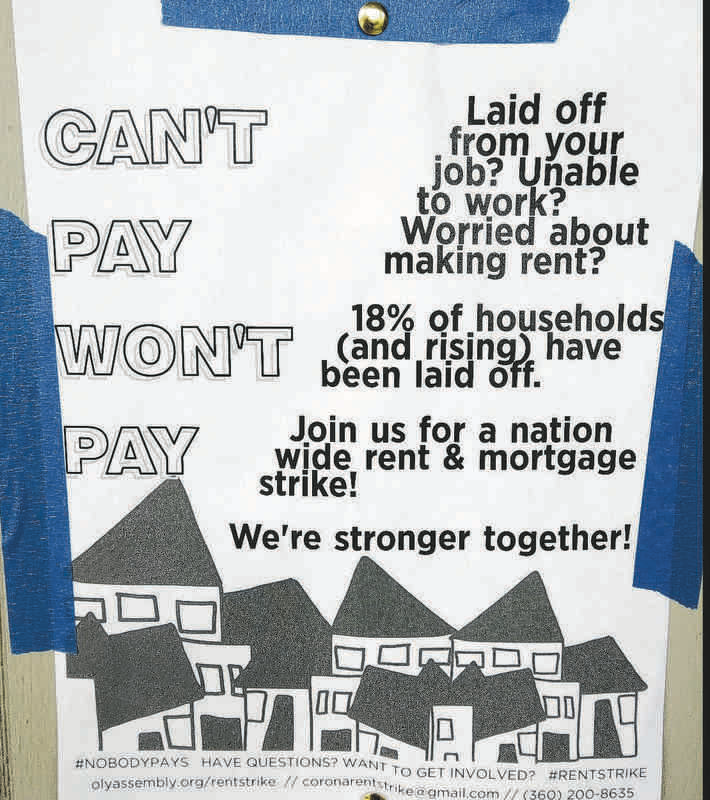
An example of rent strike posters that have popped up around the Olympia area
BY ROLF BOONE (4-26-20) 360-754-5403, @ROLF_BOONE
RBOONE@THEOLYMPIAN.COM
Olympia, WA — Thurston County property managers say most tenants paid their rent on April 1, the date falling only a couple of weeks after the governor ordered schools and businesses to close to combat the novel coronavirus.
But May 1 is likely to look a lot different, they say.
The economy has been further slowed by the virus, jobless claims have soared, and although jobless benefits have been enhanced and stimulus checks are arriving, average rents in the county still hover around $1,200 — the amount of the largest stimulus checks.
Some local tenants are calling for a rent strike, wanting to call attention to the economic burden placed on renters during the pandemic.
“It’s looking a lot worse,” said Andrew Barkis, a Republican state Representative and the longtime owner of Olympia-based Hometown Property Management, a business that manages 1,100 single-family residences in the county for an array of owners and their renters.
About 90 percent of tenants paid their rent on April 1, but come May 1, Barkis expects that to fall to 60 percent to 70 percent.
“People are going to have a tougher time,” he said, adding that he hopes tenants are receiving jobless benefits and a stimulus check. “There’s a lot of uncertainty.”
HOMES FIRST
That uncertainty extends to the nonprofit sector as well, such as Lacey-based Homes First, a provider and property manager of affordable housing in the area. It works with 277 tenants spread among 46 properties.
Chief Executive Trudy Soucoup said all but two tenants paid their rent on April 1, but come May 1, she expects rental income to drop as much as
20 percent.
She said those who can’t pay rent will not face any consequences, but she does expect tenants to eventually pay, or to seek assistance to pay rent.
“We will continue to do the things we do,” she said, which includes helping tenants with food and child care, “but tenants need to do the things they need to do.”
Rental income helps the nonprofit carry on with its mission, she said. Faced with a drop in income, the nonprofit lined up for a federal loan through the Small Business Administration called the “paycheck protection program.”
Homes First secured a $95,100 loan through the program, which converts to a grant if 75 percent of the money is used for payroll over the next eight weeks. That’s the plan to retain eight staff members, she said.
That money will help the nonprofit through the end of October. However, they also need to continue to raise funds through donations, and that has become more challenging, she said.
‘THERE HAS TO BE A BALANCE’
A small business like Hometown Property Management could seek a loan as well, but Barkis is not aware of a program to specifically help landlords themselves. He also was disappointed in Gov. Jay Inslee’s recent extension of an eviction moratorium through June 4.
“People have lost their livelihoods through no fault of their own and we must continue to take steps to ensure they don’t also lose the roofs over their heads,” Inslee said in a written statement at the time.
Under the latest moratorium, landlords are not able to raise rents or charge late fees, Barkis said.
Barkis isn’t seeking to add to the hardships of tenants, he said. He has worked with them on payment plans, breaking up rent payments and extending time frames, but, he asks, what about help for landlords? Many of them have to pay mortgages on their rental properties.
“There has to be a balance,” he said.
Some of the home owners that Hometown Property Management works with are investors, some are home owners who held onto their first home to rent, and some are members of the military who have been transferred out of the area but who want to return at a later date. In the meantime, they are working with Hometown to rent their property, he said.
There is a state landlord mitigation program, in which landlords can tap funds for certain rental situations, but in its current configuration he doesn’t think it could be used during the crisis.
Or could it? “There is a program and a framework for the crisis,” he said.
TENANTS STRIKE BACK
Meanwhile, Brian Wolcott, a student at The Evergreen State College is on strike — rent strike, that is.
He rents a house with three other roommates for about $1,500 a month. Rent wasn’t paid in April, and likely won’t be paid in May, but he said they are in contact with the property owner about their decision.
For Wolcott, it’s both political and practical: he wants to stand in solidarity with those who can’t pay rent, but work — such as the farm work, yard work and other odd jobs that he used to do — also has dried up.
Wolcott also acknowledged that he could probably find work, but then he wonders if he has his priorities straight, especially if he’s out interacting with people, possibly exposing others to the virus or being exposed himself. Rather than being guided by economic decisions, he’d rather follow the guidelines of health care professionals and scientists.
The economic burden placed on renters needs to be pushed up the ladder, he said.
“Financial institutions have the ability to weather this stuff, but it’s a real push for everyday people,” Wolcott said.
Posted in Uncategorized
Leave a comment
CA. Judge: Background Checks for Ammo? Illegal!

by Dennis Romero (4-23-20)
SAN DIEGO – A federal judge Thursday blocked background checks for ammunition buyers in California, calling the state’s law on the matter “onerous and convoluted.”
San Diego-based U.S. District Judge Roger Benitez granted a preliminary injunction against the rule after plaintiffs, including the California Rifle and Pistol Association and six-time Olympic medalist skeet shooter Kim Rhode, sued the state.
In 2016, Golden State voters approved Proposition 63, which included the background checks as well as a ban on high-capacity magazines for firearms. The same judge halted sales of the magazines as the state appeals another court challenge.
But in this case, Benitez was unequivocal.
“California’s new ammunition background check law misfires, and the Second Amendment rights of California citizens have been gravely injured,” he wrote. “In this action, Plaintiffs seek a preliminary injunction enjoining California’s onerous and convoluted new laws requiring ammunition purchase background checks and implementing ammunition anti-importation laws.”
The judge argued that the checks hurt legal ammo buyers while doing little to prevent criminals from obtaining firepower. “Criminals, tyrants and terrorists don’t do background checks,” Benitez wrote.
It wasn’t immediately clear if the state will appeal. The California Attorney General’s office but did not receive an immediate response Thursday evening.
The background checks went into effect in July, making California the first state to implement such a process. New York enacted ammunition screening in 2013 but it never went into effect. Four states — Connecticut, Illinois, Massachusetts and New Jersey — vet ammo sales through licensing.
“This is a devastating blow to the anti-gun-owner advocates who falsely pushed Prop 63 in the name of safety,” California Rifle and Pistol Association president Chuck Michel said in a statement. “In truth, red tape and the state’s disastrous database errors made it impossible for hundreds of thousands of law-abiding Californians to purchase ammunition for sport or self-defense.”
The nonprofit Brady: United Against Gun Violence said it would support an appeal and called the decision “unprecedented.”
“This decision is patently wrong, and we expect that it will be reversed on appeal,” Brady president Kris Brown said in a statement. “The Second Amendment does not provide felons or domestic abusers with the right to buy ammunition or firearms, and it does not prevent states like California from requiring background checks.”
Posted in Uncategorized
Leave a comment
Using pulse oximeter for early detection of COVID-19

by Richard Levitan (4-20-20) Dr. Levitan is an emergency doctor.
I have been practicing emergency medicine for 30 years. In 1994 I invented an imaging system for teaching intubation, the procedure of inserting breathing tubes. This led me to perform research into this procedure, and subsequently teach airway procedure courses to physicians worldwide for the last two decades.
So at the end of March, as a crush of Covid-19 patients began overwhelming hospitals in New York City, I volunteered to spend 10 days at Bellevue, helping at the hospital where I trained. Over those days, I realized that we are not detecting the deadly pneumonia the virus causes early enough and that we could be doing more to keep patients off ventilators — and alive.
On the long drive to New York from my home in New Hampshire, I called my friend Nick Caputo, an emergency physician in the Bronx, who was already in the thick of it. I wanted to know what I was facing, how to stay safe and about his insights into airway management with this disease. “Rich,” he said, “it’s like nothing I’ve ever seen before.”
He was right. Pneumonia caused by the coronavirus has had a stunning impact on the city’s hospital system. Normally an E.R. has a mix of patients with conditions ranging from the serious, such as heart attacks, strokes and traumatic injuries, to the nonlife-threatening, such as minor lacerations, intoxication, orthopedic injuries and migraine headaches.
During my recent time at Bellevue, though, almost all the E.R. patients had Covid pneumonia. Within the first hour of my first shift I inserted breathing tubes into two patients.
Even patients without respiratory complaints had Covid pneumonia. The patient stabbed in the shoulder, whom we X-rayed because we worried he had a collapsed lung, actually had Covid pneumonia. In patients on whom we did CT scans because they were injured in falls, we coincidentally found Covid pneumonia. Elderly patients who had passed out for unknown reasons and a number of diabetic patients were found to have it.
And here is what really surprised us: These patients did not report any sensation of breathing problems, even though their chest X-rays showed diffuse pneumonia and their oxygen was below normal. How could this be?
We are just beginning to recognize that Covid pneumonia initially causes a form of oxygen deprivation we call “silent hypoxia” — “silent” because of its insidious, hard-to-detect nature.
Pneumonia is an infection of the lungs in which the air sacs fill with fluid or pus. Normally, patients develop chest discomfort, pain with breathing and other breathing problems. But when Covid pneumonia first strikes, patients don’t feel short of breath, even as their oxygen levels fall. And by the time they do, they have alarmingly low oxygen levels and moderate-to-severe pneumonia (as seen on chest X-rays). Normal oxygen saturation for most persons at sea level is 94 percent to 100 percent; Covid pneumonia patients I saw had oxygen saturations as low as 50 percent.
To my amazement, most patients I saw said they had been sick for a week or so with fever, cough, upset stomach and fatigue, but they only became short of breath the day they came to the hospital. Their pneumonia had clearly been going on for days, but by the time they felt they had to go to the hospital, they were often already in critical condition.
In emergency departments we insert breathing tubes in critically ill patients for a variety of reasons. In my 30 years of practice, however, most patients requiring emergency intubation are in shock, have altered mental status or are grunting to breathe. Patients requiring intubation because of acute hypoxia are often unconscious or using every muscle they can to take a breath. They are in extreme duress. Covid pneumonia cases are very different.
A vast majority of Covid pneumonia patients I met had remarkably low oxygen saturations at triage — seemingly incompatible with life — but they were using their cellphones as we put them on monitors. Although breathing fast, they had relatively minimal apparent distress, despite dangerously low oxygen levels and terrible pneumonia on chest X-rays.
We are only just beginning to understand why this is so. The coronavirus attacks lung cells that make surfactant. This substance helps the air sacs in the lungs stay open between breaths and is critical to normal lung function. As the inflammation from Covid pneumonia starts, it causes the air sacs to collapse, and oxygen levels fall. Yet the lungs initially remain “compliant,” not yet stiff or heavy with fluid. This means patients can still expel carbon dioxide — and without a buildup of carbon dioxide, patients do not feel short of breath.
Patients compensate for the low oxygen in their blood by breathing faster and deeper — and this happens without their realizing it. This silent hypoxia, and the patient’s physiological response to it, causes even more inflammation and more air sacs to collapse, and the pneumonia worsens until oxygen levels plummet. In effect, patients are injuring their own lungs by breathing harder and harder. Twenty percent of Covid pneumonia patients then go on to a second and deadlier phase of lung injury. Fluid builds up and the lungs become stiff, carbon dioxide rises, and patients develop acute respiratory failure.
By the time patients have noticeable trouble breathing and present to the hospital with dangerously low oxygen levels, many will ultimately require a ventilator.
Silent hypoxia progressing rapidly to respiratory failure explains cases of Covid-19 patients dying suddenly after not feeling short of breath. (It appears that most Covid-19 patients experience relatively mild symptoms and get over the illness in a week or two without treatment.)
A major reason this pandemic is straining our health system is the alarming severity of lung injury patients have when they arrive in emergency rooms. Covid-19 overwhelmingly kills through the lungs. And because so many patients are not going to the hospital until their pneumonia is already well advanced, many wind up on ventilators, causing shortages of the machines. And once on ventilators, many die.
Avoiding the use of a ventilator is a huge win for both patient and the health care system. The resources needed for patients on ventilators are staggering. Vented patients require multiple sedatives so that they don’t buck the vent or accidentally remove their breathing tubes; they need intravenous and arterial lines, IV medicines and IV pumps. In addition to a tube in the trachea, they have tubes in their stomach and bladder. Teams of people are required to move each patient, turning them on their stomach and then their back, twice a day to improve lung function.
There is a way we could identify more patients who have Covid pneumonia sooner and treat them more effectively — and it would not require waiting for a coronavirus test at a hospital or doctor’s office. It requires detecting silent hypoxia early through a common medical device that can be purchased without a prescription at most pharmacies: a pulse oximeter.
Pulse oximetry is no more complicated than using a thermometer. These small devices turn on with one button and are placed on a fingertip. In a few seconds, two numbers are displayed: oxygen saturation and pulse rate. Pulse oximeters are extremely reliable in detecting oxygenation problems and elevated heart rates.
Pulse oximeters helped save the lives of two emergency physicians I know, alerting them early on to the need for treatment. When they noticed their oxygen levels declining, both went to the hospital and recovered (though one waited longer and required more treatment). Detection of hypoxia, early treatment and close monitoring apparently also worked for Boris Johnson, the British prime minister.
Widespread pulse oximetry screening for Covid pneumonia — whether people check themselves on home devices or go to clinics or doctors’ offices — could provide an early warning system for the kinds of breathing problems associated with Covid pneumonia.
People using the devices at home would want to consult with their doctors to reduce the number of people who come to the E.R. unnecessarily because they misinterpret their device. There also may be some patients who have unrecognized chronic lung problems and have borderline or slightly low oxygen saturations unrelated to Covid-19.
All patients who have tested positive for the coronavirus should have pulse oximetry monitoring for two weeks, the period during which Covid pneumonia typically develops. All persons with cough, fatigue and fevers should also have pulse oximeter monitoring even if they have not had virus testing, or even if their swab test was negative, because those tests are only about 70 percent accurate. A vast majority of Americans who have been exposed to the virus don’t know it.
There are other things we can do as well to avoid immediately resorting to intubation and a ventilator. Patient positioning maneuvers (having patients lie on their stomach and sides) open up the lower and posterior lungs most affected in Covid pneumonia. Oxygenation and positioning helped patients breathe easier and seemed to prevent progression of the disease in many cases. In a preliminary study by Dr. Caputo, this strategy helped keep three out of four patients with advanced Covid pneumonia from needing a ventilator in the first 24 hours.
To date, Covid-19 has killed more than 40,600 people nationwide — more than 10,000 in New York State alone. Oximeters are not 100 percent accurate, and they are not a panacea. There will be deaths and bad outcomes that are not preventable. We don’t fully understand why certain patients get so sick, or why some go on to develop multi-organ failure. Many elderly people, already weak with chronic illness, and those with underlying lung disease do very poorly with Covid pneumonia, despite aggressive treatment.
But we can do better. Right now, many emergency rooms are either being crushed by this one disease or waiting for it to hit. We must direct resources to identifying and treating the initial phase of Covid pneumonia earlier by screening for silent hypoxia.
It’s time to get ahead of this virus instead of chasing it.
Richard Levitan, an emergency physician in Littleton, N.H., is president of Airway Cam Technologies, a company that teaches courses in intubation and airway management.
Posted in Uncategorized
Leave a comment
Dems Propose $2K/mo. per American

by Bob Fredericks (April 15, 2020) New York Post
A pair of House Democrats have introduced legislation that would pay millions of Americans $2,000 a month during the ongoing coronavirus pandemic.
The bill — the Emergency Money for the People Act — was proposed by Reps. Tim Ryan of Ohio and Ro Khanna of California.
“The economic impact of this virus is unprecedented for our country. As millions of Americans file for unemployment week over week, we have to work quickly to patch the dam — and that means putting cash in the hands of hard-working families,” Ryan said in a statement.
The act would provide significant relief to struggling Americans and includes a $2,000 monthly payment to every qualifying American over the age of 16 until US employment returns to pre-pandemic levels, which could take months or even years.
“A one-time, twelve hundred dollar check isn’t going to cut it,” Khanna said about the Trump administration’s current payouts, which were arriving for many starting this week.
“Americans need sustained cash infusions for the duration of this crisis in order to come out on the other side alive, healthy, and ready to get back to work. Members on both sides of the aisle are finally coming together around the idea of sending money out to people. Rep. Ryan and I are urging leadership to include this bill in the fourth COVID relief package to truly support the American working class.”
Every American adult age 16 and older making less than $130,000 annually would receive at least $2,000 per month, the statement said.
Married couples earning less than $260,000 would receive at least $4,000 per month.
Qualifying families with children will receive an additional $500 per child, and families can get payments for up to three children.
A married couple making under $260,000 with 3 kids would receive $5,500 per month, for example.
Those who had no earnings, were unemployed, or are currently unemployed would also be eligible.
Posted in Uncategorized
Leave a comment