Malum Prohibitum Amerikan Style

Malum prohibitum (plural mala prohibita, literal translation: “wrong [as or because] prohibited”) is a Latin phrase used in law to refer to conduct that constitutes an unlawful act only by virtue of statute, as opposed to conduct evil in and of itself, or malum in se.

Conduct that is so clearly violative of society’s standards for allowable conduct that it is illegal under English common law is usually regarded as malum in se. An offense that is malum prohibitum may not appear on the face to directly violate moral standards. The distinction between these two cases is discussed in State of Washington v. Thaddius X. Anderson:

Criminal offenses can be broken down into two general categories malum in se and malum prohibitum. The distinction between malum in se and malum prohibitum offenses is best characterized as follows: a malum in se offense is “naturally evil as adjudged by the sense of a civilized community,” whereas a malum prohibitum offense is wrong only because a statute makes it so. State v. Horton, 139 N.C. 588, 51 S.E. 945, 946 (1905).
“Public welfare offenses” are a subset of malum prohibitum offenses as they are typically regulatory in nature and often “‘result in no direct or immediate injury to person or property but merely create the danger or probability of it which the law seeks to minimize.'” Bash, 130 Wn.2d at 607 (quoting Morissette v. United States, 342 U.S. 246, 255-56, 72 S. Ct. 240, 96 L. Ed. 288 (1952)); see also State v. Carty, 27 Wn. App. 715, 717, 620 P.2d 137 (1980).

Crimes and torts that might be considered as malum prohibitum—but not malum in se—include:

  • building or modifying a house without a license
  • copyright infringement
  • illegal drug use
  • illegal hunting
  • operating a business without a license
  • prohibition of alcohol
  • surrogacy for profit
  • weapon possession
  • illegal immigration
  • harboring a bad attitude toward American foreign policy?
  • traveling abroad to destinations disfavored by the U.S. government?
  • donating $ without the U.S. administration’s blessings?
  • buying air fare without the U.S. government’s approval?
  • having foreign bank accounts without informing Uncle Sam?
  • failing to apply for a social security number for yourself or your children?
  • purchasing a weapon to defend yourself if you’ve ever run afoul of malum prohibitum?
  • possessing a bullet proof vest in Oregon by a convicted felon? (increasingly inclusive)
  • driving while black?
  • insufficient submissiveness to authority or the police?
  • homelessness? poverty in all but name only?
  • ridiculing the emperor’s new clothes?
  • feeding the hungry without the City’s ‘permit’/permission?

The thought police are actively ferreting out those with ‘ungoodthinkful’ sentiments, or (even worse) donating their own money for the ‘wrong’ reasons. Never mind that money is fungible or that we condemn individual acts we condone collectively. In fact, it is historically rare for the U.S. to be at peace. The vast majority of the time since its inception, we’ve been at war with someone or engaged in genocidal confrontations.

What you do on the internet, social media, or even what books you buy, read, or check out at the library are of keen interest to the federal thought police. Nor is it enough that they have your social security/driver’s license number, vehicle registration, credit reports (which they check routinely) as well as all your banking records and earnings/income data. The sad truth is a government supposedly of the people, by the people, and FOR the people knows much more about you than your own mother/father/spouse/children. Virtually all States now want your DNA too for even the most petty of not just offenses/infractions, but ALLEGATIONS!

Allegations, nothing more, are also now sufficient to be banned from public housing or assistance under contemporary U.S. regulations. Refusing to register for the draft will earn you persona non-grata status for any student loans or education assistance. It has become increasingly perilous not only to disobey Big Brother, but to fail to demonstrate sufficient ‘love’ for him as well.

St. Louis, MO — The Christian Science Monitor recently reported 6 Bosnian immigrants have been arrested after being accused of helping ISIS and Al Qaeda by sending $ and/or ‘military equipment’ to ‘terrorist fighters’ (non-state sponsored ones or at least ones unapproved by U.S. authorities) overseas, including the Islamic State group and Al Qaeda in Iraq.

An indictment was unsealed Friday in the St Louis U.S. District Court which said the defendants gave money themselves and sometimes collected funds from others to send the donations overseas. It charges two of the defendants used some of that money to purchase U.S. military uniforms, firearms ‘accessories’, tactical gear et al, which was sent to folks in Turkey and Saudi Arabia who forwarded the supplies to terrorists. [FedEX? One must wonder why a ‘terrorist’ would want to be caught wearing a U.S. military uniform?]

The feds claim the supplies and money [contraban?] eventually made its way to fighters in Syria, Iraq and ‘elsewhere’, according to the indictment’s allegations. Money also was sent to support family members of terrorist fighters, the indictment says. [This is a ‘crime’?!] The defendants all knew where the money and supplies were going, the indictment claims. [This beats the track record of most phone solicitation charities!]

The indictment claims the ‘conspiracy’ began no later than May 2013, the defendants used email, phones and social media websites including Facebook to communicate using coded words, such as “brothers,” ”lions” and “Bosnian brothers.” [These were lifted from the same dictionary Reagan used when citing ‘Cadillac welfare queens’ and ‘peacekeeper’ missals…or his attorney general (Edwin Meese) pronouncing ketchup as a ‘vegetable’?]

All six charged are natives of Bosnia legally living in the U.S. Three are naturalized citizens; the others had either refugee or legal resident status, according to the U.S. attorney’s office.

Those indicted were Ramiz Zijad Hodzic, 40, his wife, Sedina Unkic Hodzic, 35, and Armin Harcevic, 37, all from St. Louis County; Nihad Rosic, 26 of Utica, New York; Mediha Medy Salkicevic, 34, of Schiller Park, Illinois, and Jasminka Ramic, 42, of Rockford, Illinois.

They face charges of conspiring to provide material support and resources to ‘terrorists’ and with providing material support to ‘terrorists’. Rosic and Ramiz Hodzic are also charged with conspiring to kill and maim people in a foreign country. [That last sounds like the government intensely dislikes competition in this category. The rest is obnoxiously vague/ambiguous as it does not cite the ‘terrorist(s)’ by name. One is forced to assume they’re delineated by ‘category’, though just who can properly and legally be construed to be in such an index remains unclear.]

The indictment says that last July, Rosic tried to board a flight from New York to Syria. [Hang him!]

The U.S. attorney’s office said five of the defendants have been arrested; the sixth is overseas, but the Justice Department declined to say exactly where. [Delivering parcels and good will? The U.S. could stand some fence mending.]

Online court records do not list defense attorneys for any of the defendants. [No doubt the esquires fear being charged with providing aid, comfort, and material resources to the ‘enemy’?] According to court records, the Hodzics had a first appearance before a U.S. magistrate judge in St. Louis on Friday and the court said it would appoint attorneys for them. [This will, no doubt, insure the defendants get a ‘fair’ trial after being charged with providing aid and comfort to terrorists–a bit like Benedict Arnold being nominated for President?]

The landlord at the complex where the Hodzics live told the St. Louis Post-Dispatch the couple and their 3 children had been living there for 1 ½ years. Larry Sorth, and his wife, Joyce, stated they were surprised by the arrests and that the couple was friendly.

“She was very sweet, to tell you the truth,” Joyce Sorth said of Sedina Hodzic.

In a news release announcing the charges, the U.S. attorney’s office said the crimes of conspiring to provide material support and providing material support carry penalties ranging up to 15 years in prison. Conspiring to kill and maim people in a foreign country carries a penalty of up to life in prison.

Posted in Uncategorized | Leave a comment

Why Are So Many Americans in Prison?–District Attorneys

Mule Creek State Prison

by Leon Neyfakh (a SLATE staff writer)

Criminal justice reform is a contentious political issue, but there’s one point on which pretty much everyone agrees: America’s prison population is way too high. It’s possible that a decline has already begun, with the number of state and federal inmates dropping for three years straight starting in 2010, from an all-time high of 1.62 million in 2009 to about 1.57 million in 2012. But change has been slow: Even if the downward trend continues, which is far from guaranteed, it could take almost 90 years for the country’s prison population to get down to where it was in 1980 unless the rate of decline speeds up significantly.

What can be done to make the population drop faster? Many reformers, operating under the assumption that mass incarceration is first and foremost the result of the war on drugs, have focused on making drug laws less punitive and getting rid of draconian sentencing laws that require judges to impose impossibly harsh punishments on people who have committed relatively minor crimes. But according to John Pfaff, an associate professor at Fordham Law School, neither of those efforts will make a significant dent in the problem, because they are based on a false understanding of why the prison boom happened in the first place. Having analyzed statistics on who goes to prison, why, and for how long, Pfaff has emerged with a new and provocative account of how the problem of mass incarceration came to be. If he’s right, the implications for the prison reform movement are huge and suggest the work needed to achieve real progress will be much harder than most people realize.

Pfaff explains his theory:

The U.S. prison population increased fivefold between 1980 and 2009—from approximately 320,000 inmates to 1.62 million. When you look at the work of scholars and the policymakers who are influenced by them, what do you see as the dominant explanations for why this happened?

One is that we’re sending people to prison for more and more and more time. The other is the war on drugs—that we’ve made this concerted effort to target people for drug dealing and drug possession, and we’re filling up our prisons with all of these drug-related offenses. The dominant view is that those two changes have transformed the size of the prison population in the United States.

What do you think of those two explanations?

I understand where they come from. It’s true that legislators have passed a lot of new, tougher sentencing laws over the past 30 or 40 years. And it’s true that we have increased the attention paid to drugs. But in the end, there are other things that play a much, much bigger role in explaining prison growth. The fact of the matter is in today’s state prisons, which hold about 90 percent of all of our prisoners, only 17 percent of the inmates are there primarily for drug charges. And about two-thirds are there for either property or violent crimes.

Has the percentage of drug offenders among the prison population been higher in the past?

It peaked in 1990 at 22 percent and then steadily declined. So even when the percentage of drug offenders among the state prison population was at its peak, about four out of every five people were there for a nondrug offense.

Why are you skeptical of the idea that longer sentences have been a significant driver of the prison boom?

Because while it’s true that legislators have passed a lot of longer sentences, if you actually look at time served by inmates in prison, it doesn’t appear to have changed that much. We have good data going back approximately 20 years or so, and at least in northern and northwestern states where we have better data, about half of all prisoners who get admitted in a given year only spend about two or three years in prison. And only about 10 percent serve more than about seven or eight years in prison. These laws look incredibly punitive—25 years for a class B felony—but you just don’t see people serving that amount of time.

OK. So if it’s not the drug war, and it’s not harsh sentencing laws, what is it? What do you think caused the prison boom?

You need to break the question into two periods. Because there’s a time between 1975 and 1991 when you see this dramatic rise in crime, and the prison population went up as well. And then there’s a more interesting period, between 1991 and 2010, when crime steadily declined, yet prison populations kept going up. So, between ’75 and ’91, it’s almost certain that the increase in crime had to play at least some significant role in increasing the prison population. The scale of the crime boom that took place was dramatic: From 1960 to 1991, violent crime rose by 400 percent, and property crime rose by 200 percent. Figuring out how much of prison growth can be attributed to the crime boom is actually statistically quite difficult, but the best estimate that’s out there—which is not a perfect estimate, but it’s the best we have—suggests that about half of prison growth during that period was due to rising crime. Clearly other stuff mattered, but rising crime played a very big role during the first phase.

So why did the prison population keep on rising after 1991, when the crime wave ended? It seems like if your theory is right, that the increase in violent crime and property crime caused the prison boom, the end of the crime wave should have been accompanied by decreasing incarceration rates. 

Three things could have happened. One, police just got much more efficient—they’re just arresting more and more people, with new policing technologies, new policing approaches—maybe they’re just arresting a bigger share of offenders. But we don’t actually see that. Arrests tend to drop with the crime rate. So the total number of people being arrested has fallen. The other thing it could be is we’re just locking people up for longer—but like I said, it’s not that. So clearly what’s happening is we’re just admitting more people to prison. Though we have a smaller pool of people being arrested, we’re sending a larger and larger number of them to prison.

Why would that be?

What appears to happen during this time—the years I look at are 1994 to 2008, just based on the data that’s available—is that the probability that a district attorneys file a felony charge against an arrestee goes from about 1 in 3, to 2 in 3. So over the course of the ’90s and 2000s, district attorneys just got much more aggressive in how they filed charges. Defendants who they would not have filed felony charges against before, they now are charging with felonies. I can’t tell you why they’re doing that. No one’s really got an answer to that yet. But it does seem that the number of felony cases filed shoots up very strongly, even as the number of arrests goes down.

Isn’t the traditional explanation for why prosecutors tend to be overzealous is that their political careers depend on it?

The political question is interesting because generally the district attorney election is not very difficult to win. DAs tend to win elections pretty regularly. So, when Joe Hynes was defeated in the Democratic primary in Brooklyn, New York, in 2012, he was the first sitting Brooklyn DA to run for re-election and lose in more than a century. But that’s not to say that politics don’t matter: Maybe it’s that next election they’re looking at, that they remain tough on crime because they want to become attorney general or governor. There’s no clear data on this. We’re only just starting to look at this question. But that strikes me as a possible story. What might have happened is the crime boom made being a prosecutor more of a launch-pad position—it elevated the status of prosecutors, and perhaps elevated their political ambitions, and they remained tough on crime even as crime started going down.

OK. So why does any of this matter? Why is it important for reformers to have the right theory for why mass incarceration happened?

The reason it’s important to get it right is that if we’re trying to reduce the prison population, we want to make sure we do it correctly—and if you focus on the wrong thing, you won’t solve the problem. So if you think it’s the war on drugs, you might think, ‘OK, if we just decriminalize drugs, that will solve the problem.’ And, you know, it’s true that if we shift away from punishment to treatment that could be a huge improvement. But just letting people out of prison—decarcerating drug offenders—will not reduce the prison population by as much as people think. If you released every person in prison on a drug charge today, our state prison population would drop from about 1.5 million to 1.2 million. So we’d still be the world’s largest incarcerating country; we’d still have an enormous prison population.

And if we focused on cutting back sentence lengths, maybe that would weaken DAs’ bargaining power at plea bargaining, but since people aren’t serving the massively long sentences anyway, it probably won’t have that big an effect on prison population either.

What would?

Well, the real growth in the prison population comes from county-level district attorneys sending violent people to prison. And there’s a lot to be said for nonprison approaches to a lot of people who are in prison for violent crimes. But that’s a political issue that we haven’t even begun to address, in part because it’s politically scary.

Where does that leave reformers who want to see the prison population drop significantly?

What makes it very hard is that the person we really need to target now—whose behavior we need to regulate—is the district attorney, and the district attorney is a very politically independent figure. He’s directly elected, and he’s directly elected at the county level. So there’s no big centralized fix. You can’t necessarily go to Washington and say, ‘Here’s the law that’s going to control what the DAs do,’ because they don’t have to listen to the federal government at all. So you have to figure out how to go county by county and either elect DAs who have less punitive attitudes, or you can try to sort of change the incentives DAs face at the state level. But it’s very tricky.

Posted in Uncategorized | Leave a comment

Eric M. Collier of Shelton/Oly Charged w/23 Felonies/Robbery

EricMCollier1

Eric M. Collier, 35 (DOB: 6-17-79) w/fiance’ Trisha Davis (circa 9-19-14) 5549 Boston Harbor Rd, Oly, WA

Shelton, WA (1-29-15) — Natalie Johnson reported Eric M. Collier of Shelton was arrested and charged in Thurston County (1-23-15) w/23 felony counts alleging/relating to armed robberies including banks and restaurants, perhaps most notably the Pizza Time in Thurston.  He was arrested Tuesday, Jan. 20, 2014 after a massive investigation by numerous cooperating local and federal law enforcement agencies (Olympia PD, Pierce County Sheriff, Puyallup PD, Thurston County Sheriff, Kent PD, & the FBI) into the crimes alleged. They (courtesy of the Olympia PD) include the following:

Robberies Collier is accused in:
Sept. 20: Olympia Taco Bell is robbed. $15 and one cell phone reported stolen.
Sept. 20: Olympia Bank of America is robbed. $13,000 reported stolen.
Oct. 14: Olympia Pizza Time is robbed. $35 reported stolen.
Oct. 20: Olympia Pizza Time is robbed. Between $700 and $800 reported stolen.
Oct. 22: Spanaway Pizza Time is robbed. Between $500 and $1,000 reported stolen.
Oct. 27: Puyallup Pizza Time is robbed. Between $800 and $1,000 reported stolen.
Oct. 29: Kent Domino’s Pizza is robbed. $400 reported stolen.
Nov. 1: Thurston County Pizza Time is robbed, and suspect fires his gun.
Nov. 1: Spanaway Pizza Time is robbed. $500 reported stolen.
Nov. 26: Olympia Umpqua Bank is robbed. $10,000 reported stolen.
Dec. 3: Spanaway Umpqua Bank is robbed. $5,500 reported stolen.
Dec. 9: Spanaway Heritage Bank is robbed. $17,566 reported stolen.
Dec. 26: Olympia Federal Savings Bank is robbed. $9,935 reported stolen.
Jan. 6: Tacoma Umpqua Bank is robbed. $5,600 reported stolen.
Jan. 10: Lacey Columbia Bank is robbed. $6,654 reported stolen.
Jan. 20: Attempted robbery at Olympia Federal Savings Bank. Collier is arrested

The Olympian reported, according to court documents, Collier, a 35-year-old Shelton man (previously resided on Boston Harbor Rd. near Olympia) was accused of stealing about $60,000 in a string of Puget Sound bank and pizza restaurant robberies was arrested Tuesday night after a months-long investigation.

EricMCollier8

Eric M. Collier(?), 35 (DOB: 6-17-79) 5549 Boston Harbor Rd NE, Oly, WA 98506; (360)943-1249(?)

Eric M. Collier was caught by the Olympia Police Department as he was allegedly attempting to rob yet another bank while armed. The 35-year-old Shelton man was booked into the Thurston County Jail on seven counts of first degree robbery while armed with a deadly weapon and two counts of first-degree attempted robbery.

EricMCollier3

Eric Michael Collier tattoos sister-in-law, Buff,  circa May, 2011

Thurston County Deputy Prosecutor Mark Thompson said the nine counts of robbery and attempted robbery cover crimes committed in Thurston County. Other charges may be filed in other counties.

EricMCollier4

Buff’s tatoo — in remembrance of Collier’s mother

The crime spree began Sept. 20 when Collier is suspected of robbing a west Olympia Taco Bell and a Bank of America, according to the Olympia Police Department. Since then, 14 similar robberies were reported at places throughout Thurston and Pierce counties, including Olympia, Lacey, Puyallup, Tacoma, Spanawayand Kent.

EricMCollier5

Not the face of poverty.

Thompson said that in all his years as a deputy prosecutor, he’s never seen a defendant face so many robbery charges. At a Thurston County Superior Court hearing Wednesday, he asked Judge Anne Hirsch to set bail at $2 million.

“Just the sheer number, I’ve never seen a defendant come into the court with this many robberies,” Thompson said.

Hirsch agreed that Collier posed a significant threat to the safety of the community and set bail at $1 million. If Collier posts bail, he’ll need to appear in court to establish other conditions of release.

EricMCollier6Zoe

Zoe, man’s best & most loyal friend (circa Oct, 2010)

Olympia officers found two guns when they arrested Collier: One was loaded and on his person, and the other was found in his car, Thompson said. The gun found in the car was reported stolen in the 1980’s.

“That suggests that he has access to firearms that are not legally tracked,” Thompson said.

The Olympia Police Department gave the following account of the events leading to Collier’s arrest:

During all but one of the robberies, the suspect displayed a handgun, wore a mask and had a hooded sweatshirt pulled over his head. In a November robbery, the suspect fired his gun during a struggle with a Pizza Time employee. No one was injured.

Detectives and analysts from multiple agencies — Olympia Police Department, Pierce County Sheriff’s Department, Puyallup Police Department, Thurston County Sheriff’s Office, Kent Police Department and the FBI — began investigating the robberies together in October, piecing together information from the various robberies.

An Olympia officer noticed a suspicious dark sedan driving slowly through a west Olympia bank parking lot. The officer lost sight of the vehicle in heavy traffic. About 30 minutes later, Columbia Bank in Lacey was robbed at gunpoint.

EricMCollier10

Eric & Trisha during happier times (circa mid-2014)

Officers learned that the license plate of the suspicious vehicle didn’t match the car. The sedan was seen again at local banks.

On 1-10-15, detectives identified a gray sedan believed to belong to the robbery suspect.

Officers soon learned the sedan’s license plates weren’t registered to any vehicles, but were traded in and resold at the Olympia Auto Mall. Later that month (1-20-15), detectives spotted what they believed to be the same grey sedan and followed it to a house in Shelton. When the driver pulled out of his garage a short time later, detectives noticed the car had switched license plates.

After detectives followed the vehicle to a residence in Shelton, then to a bank in West Olympia, Collier was arrested while walking from the car to the bank. Police claim he was wearing similar clothing to that worn at the previous robberies and he was armed. Eric Collier was booked into Thurston County Jail on suspicion of 8 counts of 1st degree robbery, but it appears many more counts may be lodged against the defendant after further investigation is completed as he is suspected of robberies in Pierce and King counties.

EricMCollier9

Eric & Trisha, circa mid-2014

Thurston County Jail data:

Eric Michael Collier

COURT:   SUPERIOR COURT
CAUSE NUMBER:   151001021
CHARGE:   THEFT 3RD DEGREE
BAIL:   $170000, BONDABLE
ARREST DATE:   1/20/2015
COURT:   SUPERIOR COURT
CAUSE NUMBER:   151001021
CHARGE:   THEFT 1ST DEGREE
BAIL:   $170000, BONDABLE
ARREST DATE:   1/20/2015
COURT:   SUPERIOR COURT
CAUSE NUMBER:   151001021
CHARGE:   ROBBERY 1ST DEGREE WHILE ARMED WITH A DEADLY WEAPON
BAIL:   $170000, BONDABLE
ARREST DATE:   1/20/2015
COURT:   SUPERIOR COURT
CAUSE NUMBER:   151001021
CHARGE:   KIDNAPPING 1ST DEGREE WHILE ARMED
BAIL:   $160000, BONDABLE
ARREST DATE:   1/20/2015
COURT:   SUPERIOR COURT
CAUSE NUMBER:   151001021
CHARGE:   ATTEMPTED ROBBERY 1ST DEGREE
BAIL:   $170000, BONDABLE
ARREST DATE:   1/20/2015
COURT:   SUPERIOR COURT
CAUSE NUMBER:   151001021
CHARGE:   ASSAULT 2ND DEGREE WHILE ARMED
BAIL:   $160000, BONDABLE
ARREST DATE:   1/20/2015
EricMCollier7

Eric Michael Collier, 35, in Thurston Co. Jail custody

Posted in Uncategorized | Leave a comment

Charlize Theron & Christina Ricci in Girl Meets Girl Scene

Charlize Theron & Christina Ricci star in one of the best directed/acted Girl Meets Girl scenes ever.

Posted in Uncategorized | Leave a comment

1% Holds Half the World’s Wealth/Resources

Waste pickers look for recyclable items at a landfill on the outskirts of New Delhi, India. A report by Oxfam says  not enough is being done by world leaders to tackle inequality. Photo / AP

Waste pickers look for recyclable items at a landfill on the outskirts of New Delhi, India. A report by Oxfam says not enough is being done by world leaders to tackle inequality.

by Kunal Dutta

The combined wealth of the world’s richest 1% will overtake that of the remaining 99% by 2016 unless action is taken to curb “shocking extremes” of inequality, a new report warns.

The richest 1% currently own 48% of all global wealth, Oxfam says. Next year that figure is forecast to exceed 50% for the first time.

Using data from Credit Suisse’s latest global wealth report, the charity warns that rising inequality is holding back the fight against global poverty at a time when more than a billion people still live on less than US$1.25 a day.

The report warns that global wealth “is becoming increasing concentrated among a small, wealthy elite”.

The richest 1 per cent include US investor Warren Buffett, former New York mayor Michael Bloomberg and Indian businessman Dilip Shanghvi. Those in the “1 per cent” command an average wealth of US$2.7 million per adult.

The report is released today ahead of the World Economic Forum in Davos.

Oxfam will use the summit in Switzerland to call for new measures to tackle global inequality, including a clampdown on tax evasion and a living wage for all workers.

Winnie Byanyima, executive director of Oxfam International, said: “The scale of global inequality is quite simply staggering, and despite the issues shooting up the global agenda, the gap between the richest and the rest is widening fast. Failure to tackle inequality will set the fight against poverty back decades.

“The poor are hurt twice by rising inequality – they get a smaller share of the economic pie and because extreme inequality hurts growth, there is less pie to be shared around.”

Lynn Forester de Rothschild, chief executive of E L Rothschild, said: “Extreme inequality undermines economic growth and it threatens the private sector’s bottom line.

“All those gathering at Davos who want a stable and prosperous world should make tackling inequality a top priority.”

Oxfam research shows that 20% of billionaires have interests in the financial and insurance sectors, a group which saw their cash wealth increase by 11% in the 12 months to March 2014.

The charity made headlines at Davos last year with the revelation that the world’s 85 richest people were as wealthy as the poorest 50%. This year, it claims that number has shrunk to 80 as the world becomes more unequal.

Posted in Uncategorized | Leave a comment

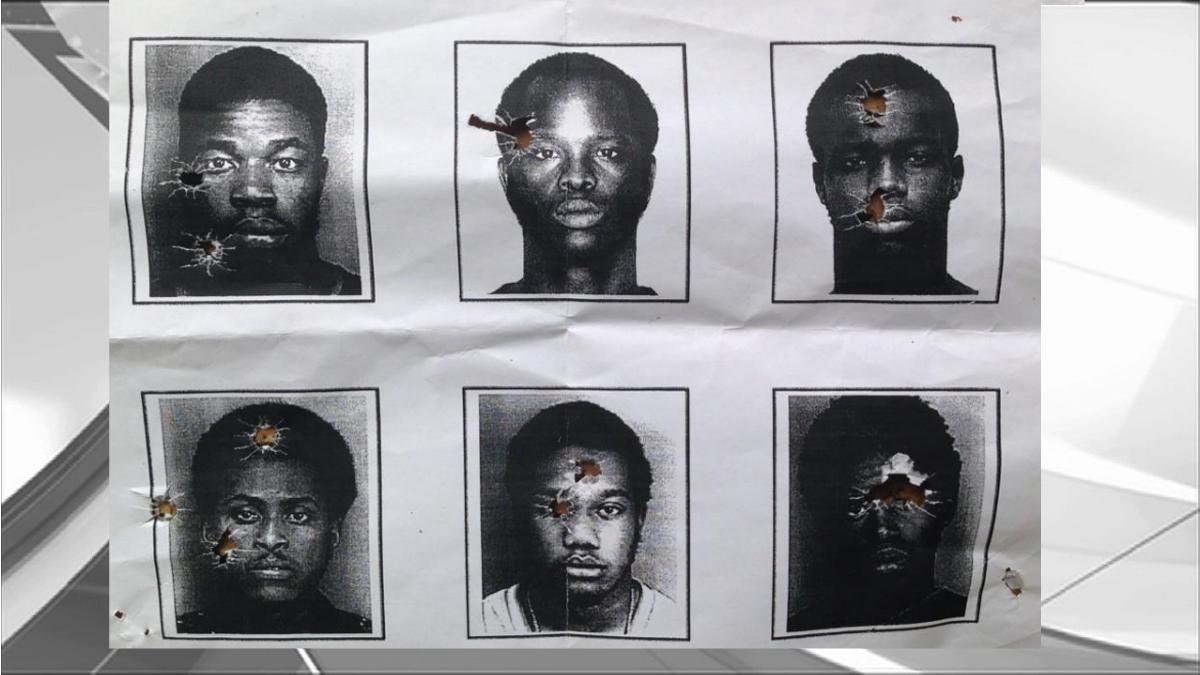
Miami sniper training using target practice mugshots halted

Police in North Miami have suspended a sniper training program after it was revealed that trainees used old mugshots of black suspects during target practice.

The pictures, which featured inmates who had been arrested more than a decade ago, were discovered by a member of the National Guard who saw a bullet-riddled photo of her brother at the gun range used by police in early December.

Army Sgt. Valerie Deant told reporters she broke down in tears when she saw her brother Woody Deant, who was arrested 15 years ago, pictured in a lineup of other suspects with bullet holes through his forehead and eyes.

View image on Twitter

Family outraged after North Miami Beach Police use criminal photos as #HumanTargets. VIDEO: http://on.nbc6.com/0mqG5F1

by Andrew Mach 1-17-15

While North Miami Beach Police Chief J. Scott Dennis launched an internal investigation into the program in late December, it wasn’t until Friday after swelling public outcry that he formally halted the program.

“I immediately suspended the sniper training program as we conduct a thorough review of our training process and materials, ordered commercially produced training images, and opened an investigation into the matter,” Dennis said in a statement.

But Dennis said that none of the department’s policies were violated and that no disciplinary action will be taken.

He also said the grid of 22 target photos also included images of whites, Hispanics and even Osama bin Laden.

“We’ll have six pictures of people who will look very similar,” Dennis told NBC Miami. “We have an array for black males, we have an array of white and Hispanic males. And the purpose for this is to be able that they can have the sniper identify a particular individual that they’re given a small picture of and looking down range at this array of six to be able to pick the proper target out based on what was presented to them in intelligence.”

Amid a climate of strained relationships between police and minority communities across the country, Dennis released on Friday a 22-point memo with facts about the sniper program, in which he insisted the training was not racially motivated.

“This was not a race issue,” the memo said. “There was no mal-intent or prejudice involved. The same target inventory has been used for more than a decade.”

Posted in Uncategorized | Leave a comment

Poker

1candle

He’d adroitly played the hands dealt him in life, sometimes off the bottom of the deck, given they rarely held more than a pair–bluffing his way to respectable if not impressive pots. He might have done better but for those wild cards in his life…the women. Yeah, he knew the poker game was crooked–but, it was the only game in town. He doubled down. Maybe he’d draw a wild card this round. He glanced at the handful of chips left…thought of pushing away from the table while he still had gas money to get home, but abandoned the idea.

2ndgentree1

It was the heart of Saturday night in a remote wooded backwater peppered with glacier encrusted mountains and impenetrable bogs. The valleys were too narrow for the sunlight–what there was of it in a perpetually overcast Pacific NorthWest–to ever quite defrost the soil. On occasion, that happened, and the mushrooms loved it. The thick moss would beckon the tired trekker with promises of sweet blissful sleep before the rain quickened in this storied rain forest. City folks had their streets replete with sidewalks, parks, bars, and cultural event centers, their schools and modern hospitals, shopping malls, churches, super grocery stores, fruit stands, and greener salads. They had more than their fair share of the homeless, car prowls, burglaries, and drug addiction now so intense heroin was cheaper than weed for a little as $10/day to stay high. The public parks were beautiful, yes, but parents feared letting their young children play in them because of the needles littered within the grass. All in all, being in the middle of nowhere turned out to be centrally located with the kinds of amenities his urban cousins dreamed of.

10fthuck2

“Hit me,” he instructed the dealer. What was he hoping for?–another wild card? The Queen of Diamonds invariably left him penniless and the Queen of Hearts left him an emotional wreck–but only after an overdose of melodrama piled on self aggrandizement. These masters of the double reverse left him emotionally bankrupt as well as broke–a form of double jeopardy he could ill afford. The only straight and true one for over 30 years had none of the guile and was entirely available. Like so many men, it seemed as though he was only besotted by the ones he could not get. It often proved to be his undoing. To be sure, he had high standards, and a live one only appeared every decade or so, but the resulting chaos was just as epic.

80daykids

“Fifty dollars,” called the man on the right hoping to see what he was holding. “I’ll fold,” he replied, knowing he wasn’t going to parlay a bluff into a winning hand and wondering how he was going to get home. Then it struck him–he WAS home. This had always been his home. In his heart, he’d never left. Wasn’t that a kind of fidelity? Fortune, at least the glittery kind, had never smiled on him. Dialing For Dollars was still trying to reach him. But, the Queen of Hearts had–for that night true love was the winning hand and held all the aces. Wishing his feet had better sight, he teetered off in the dark toward a warm bed, a banked fire, good company, a prepared meal he knew lay waiting in the refrigerator for the microwave and his return. He knew the puppies would be waiting too, faithful and without reproach. Despite all his failures in the basics of the art of love, it was his bumbling feckless naivete that had always preserved the balance. Sometimes, God protects even fools.

1890shoeshineboy

Painter, lobster pirate, professional birthday clown, general contractor, journeyman carpenter, plumber, writer, paralegal, collection agency, building inspector, aspiring musician, independent investigative photojournalist, skip tracer, process server, guerrilla farmer, lab tech, California woolly white fruit-fly larva inspector, door-to-door bible salesman, producer, publisher, poet, dispossessed, sat upon, spat upon, ratted on, and a host of avocations or misfortunes too disreputable/pedestrian to mention presented evidence of a life, if not to its fullest, thoroughly lived. Yet, here he was, still breathing and feeling every new day was a good one, the race not yet run. Yes, sometimes God protects even fools and gives suckers an even break.

airhead

Posted in Uncategorized | Leave a comment

Are We Safer w/Guns in the Face of Police Oppression or Not?

This publication stands 4-square for the U.S. and Washington State Constitution–ALL of it! That includes, of course, the 2nd Amendment. Many Washington residents, only recently, have shown a lack of appreciation for this fundamental right when they last sent in their ballots. We have an inalienable right to defend against ALL enemies of a free people, BOTH foreign AND domestic!

Ben Franklin was credited with saying, “When the people are afraid of the government, that’s tyranny. When the government is afraid of the people–that’s liberty!”

Today, after the Ferguson crisis, it’s clear the American people have had enough of poorly trained/corrupt police/government officials…and grand juries that refuse to hold them accountable. Yet these same local police officers are fathers, mothers, our cousins/neighbors and our countrymen. Despite evidence of our worst fears, we need them, both to keep the peace and to demonstrate there is an incentive to remain peaceful.

So how do guns play into the mix of armed police officers on patrol in our neighborhoods. It’s a volatile question in the wake of the unprovoked cold blooded murder/assassination of two officers in New York City by a man unduly influenced by the spate of hate rhetoric directed at ordinary police officers.

A historical perspective gives some hints: The Civil Rights Movement was a watershed era in American politics with many landmark legal precedents established by those advancing the cause of equal rights and social justice. Still, it wasn’t a cakewalk…or a rose garden. Not only did a lot of Freedom Riders die for the cause, but huge numbers of blacks were beaten, tortured, murdered, not only in the South, but in the North. Dr. Martin Luther Kings, Jr. was reviled by white racist churches (e.g. Mormons) after receiving the Nobel Peace Prize, as nothing but a ‘common criminal’ (alluding to his stint in the Burmingham Jail for protesting Jim Crow laws).  No, it was a rough VIOLENT fractious time and even King recognized the obvious moral imperative for survival including by means of self defense. Thus was born the notorious Black Panther Party which advocated openly carrying fire arms as a means of protecting the black community from premeditated murder at the hands of local authorities and police officials (e.g. The Algiers Motel massacre in Detroit, the MOVE Commune in Philadephia, etc.). Even so, there’s clearly a trade-off between increasing police paranoia of ambush or violent confrontations (often justified) and submitting to a police state.

Young people today may not be aware of the lackadaisical attitude many privileged whites had towards demands for Civil Rights by the black community back in the day. “Yes, the Negroes should have equal rights…eventually. But, they should be patient and not create street confrontations or social unrest by pursuing it too vigorously or immediately.” Yeah, that’s right–hurry up and wait some MORE!  In fact, Congress was rather slow to implement some Civil Rights reforms until places like Watts, Detroit, and Newark began to burn. The National Guard was called out. The media was told looters would be shot on sight. But Congress and local State houses acted!–fast.

With armed bands of Black Panthers patrolling black neighborhoods, the police were no longer as cavalier or violent with residents. They no longer stopped black citizens lightly, and were circumspect when they did.

Another obvious example of this principle came years later during the 80’s with the popular COPS TV series. If there was to be a search/arrest warrant served on a residence, the ones where no armed confrontation was anticipated were assailed by a battering ram to the front door literally only a second or 2 at the most after police announced their presence and that of the warrant. Where the resident was known to be armed (no matter how elderly), a line of police cars would assemble at the curbside, a bull horn would be produced, Mr. Jones would be informed he was surrounded and ordered to come out with his hands up, unlike the resident of the demolished front door example filmed with a police boot on his neck being ordered to “spit it out!” Clearly, having a weapon with which to defend a citizen’s home has the intended effect the founding fathers intended. Perhaps guns make the community a more polite arena. They appear to give LEO’s pause. That’s as it should be. They even gave Congress pause along with local legislatures. The old sop, “power comes from the barrel of a gun” seems to yet hold true. It’s the principle we use in our international gunboat diplomacy, and it was a lynch pin in the Civil Rights Movement.

Police Stopped Brutalizing Protesters When Armed Citizens Showed Up to Support a John Crawford Rally

armedfolks

by Moreh B.D.K. w/additional reporting by E.J. Newsman (dateline: 12-27-14)

After two weeks of the Beavercreek Police brutalizing peaceful protesters for John Crawford, today’s #OpJohnCrawford protest did not see one officer so much as slow down, stop or get out of their cruisers to harass protesters.

On Christmas Eve, our reporters, reporters with Alternative Media Syndicate, as well as those with the Greene County Herald and local NBC 2 News were all threatened by police for simply recording them illegally assaulting citizens, including Elementary School age children, mothers with strollers attempting to go shopping, and a retired University of Dayton Law Professor.

armedfolks2

Some are suggesting that the reason why police have felt they could brutalize protesters at the last two rallies before this was because there were very few visible guns in sight.

Recently, NPR ran an illuminating piece called “‘Guns Kept People Alive’ During The Civil Rights Movement” which argued not only that the roll of armed civil rights leaders has been downplayed in popular conceptions of the 50s, 60s and 70s activism, but also that Martin Luther King Jr’s own attitude and history with firearms for personal defense was not as black and white as it is often imagined. The piece argued that “passive resistance did not necessarily mean an unwillingness to use force to protect themselves from violence in other circumstances.”

armedfolks3

In an interview with the author of This Nonviolent Stuff’ll Get You Killed: How Guns Made the Civil Rights Movement Possible, the author Charles E. Cobb Jr. explains the following:

“I’m very much concerned with how the history of the southern freedom movement or civil rights movement is portrayed. And, I’m very conscious of the gaps in the history, and one important gap in the history, in the portrayal of the movement, is the role of guns in the movement. I worked in the South, I lived with families in the South. There was never a family I stayed with that didn’t have a gun. I know from personal experience and the experiences of others, that guns kept people alive, kept communities safe and all you have to do to understand this is simply think of black people as human beings and they’re gonna respond to terrorism the way anybody else would. …The southern freedom movement has become so defined, the narrative of the movement has become so defined by non-violence that anything presented outside that narrative framework really isn’t paid that much attention to. I like the quip that Julian Bond made…that really the way the public understands the civil rights movement can be boiled down to one sentence: Rosa sat down, Martin stood up, then the white folks saw the light and saved the day.”

armedfolks4

Today’s protest at the Beavercreek Walmart was by all definitions peaceful, and without incident. But why weren’t all of the smirking, high-fiving, bullying cops out to antagonize protesters today?

armedfolks5

Clearly all of the protesters today were not armed. In fact, only about half were. But that appeared to be enough to keep the police from trying the antics of the past two protests, including running into a woman at the same Walmart, in a pedestrian crosswalk, with police SUV cruiser #149 and then driving away without stopping.

Police Chief Evers has thus far refused to charge that officer – or even cite him – for the hit-and-run that was caught on video from multiple citizens.

armedfolks6

At the last protest, officers even physically assaulted and threatened a protester in a wheelchair, nearly tipping her out of her chair. Today she said she felt much safer.

Several of the protesters we talked to said that they do not personally like guns whatsoever. But they, like all of the protesters there, had come out to support John Crawford, not to declare their support for all of each others personal politics.

There were notably less protesters today than at the Christmas Eve rally. Today saw a few dozen protesters of all backgrounds and from all ends of the political spectrum.

armedfolks8

Representatives from Yellow Springs Cop Block said, “considering there were a handful of folks who we were told had been going around discouraging people from attending because there would be more than just one mindset of people in attendance, the turn out isn’t half bad. This was real progress towards people looking past personal differences and keeping the focus on John and the details of his murder.

As for the next rally, “We will keep trying to get people of all perspectives and groups to come out together for John, like what happened today. We don’t all have to agree on yes guns or no guns or Democrat, Republican, Libertarian, Anarchist or Marxist, but this isn’t about that: it’s about justice for John Crawford.

armedfolks9

Do you think that the presence of armed protested helped keep the police in check? Certainly there was no civil disobedience going on at this rally, unlike the die-ins, but the vast majority of those arrested at the previous protests were not in fact violating any laws, or participating in acts of civil disobedience. Some were, as noted, journalists, while others were simply talking on their way out to their vehicles.

While guns don’t seem to be the only thing that distinguished today’s protest from the two just before it, it definitely does seem to be one factor.

Posted in Uncategorized | Leave a comment

The Paradox of American Racism & Bigotry

Who was the most racist modern president? Here are 5 surprising candidates

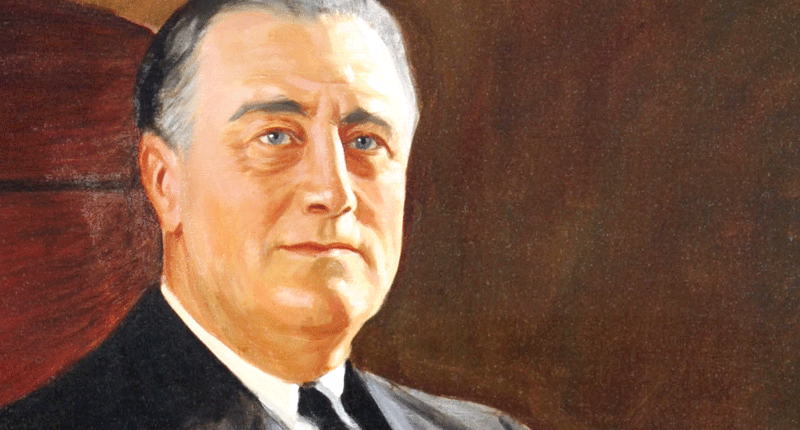
FDR

Franklin Delano Roosevelt

by Larry Schwartz

What these presidents said in private and what they did in public were often sharply at odds.

Given America’s history of slavery, the stain that won’t go away, the argument could reasonably be made that all of our lily-white presidents, Obama excepted for obvious reasons, were racists. Out of our first 12 presidents, up to Zachary Taylor, all but John Adams and his son John Quincy Adams actually owned black human beings. Andrew Jackson, our seventh president and gracer of the $20 bill, may have been the most racist president of all. Despite significant opposition from Congress, Jackson forged the infamous Trail of Tears, forcibly relocating tens of thousands of Cherokee people to territories west of the Mississippi River. He sincerely believed that the removal would allow the Native Americans, “to cast off their savage habits and become an interesting, civilized, and Christian community.”

Slavery-era presidents are the obvious candidates for the “racist” label. More surprising are these five 20th-century presidents who can compete for the title of most racist modern president.

1. Woodrow Wilson

Let’s start with a progressive Democrat, so our conservative critics don’t accuse us of right-wing bashing. Wilson is not on this list as a token, though. He earned the right to be called a racist. As president of Princeton University, he said, “The whole temper and tradition of the place [Princeton] are such that no Negro has ever applied for admission, and it seems unlikely that the question will ever assume practical form.”

As our 28th U.S. president, Wilson signed legislation making interracial marriage illegal in Washington DC, in order to, as he said, “reduce the social friction building up in American society.” The army under Wilson was segregated and most black people were not allowed to fight in World War I. When a delegation to the White House protested, Wilson retorted that, “segregation is not a humiliation but a benefit, and ought to be so regarded by you gentlemen.”

An apologist for Southern racism, President Wilson believed that the South was forced to enact racist Jim Crow laws as a consequence of harsh carpetbagger laws that were imposed during Reconstruction after the Civil War. The Ku Klux Klan, “began to attempt by intimidation what they were not allowed to attempt by the ballot or by any ordered course of public action.” Some historians have even accused Wilson of idealizing slavery, viewing slaves as “indolent” and masters as patient in dealing with them. Indeed, critics argue that Wilson held the opinion that slavery was wrong on economic, not moral, grounds.

2. Theodore Roosevelt

Next up, a progressive Republican. Teddy Roosevelt makes a surprise appearance on our racist list. Despite representing everything progressive Democrats see missing in today’s Republican Party, Teddy failed the test of tolerance. He was a devout follower of eugenics, the belief that there are superior and inferior strains of humankind, and that it is best to filter out the inferior brand in order to foster the development of mankind. “Society has no business to permit degenerates to reproduce their kind…. Some day, we will realize that the prime duty, the inescapable duty, of the good citizen of the right type, is to leave his or her blood behind him in the world; and that we have no business to permit the perpetuation of citizens of the wrong type,” he said.

In 1914 Teddy Roosevelt said that, “criminals should be sterilized and feeble-minded persons forbidden to leave offspring behind them.” It was, of course, no mystery as to who the “citizens of the wrong type” were. Roosevelt once referred to Africans as, “ape-like naked savages, who…prey on creatures not much wilder or lower than themselves.” In a 1905 statement he asserted that Caucasians were “the forward race” destined to raise “the backward race[s]” through “industrial efficiency, political capacity and domestic morality.” Whites, he felt, needed to reproduce in abundance or else risk “race suicide.” Black people were not the only targets of his racism. He had this to say about American Indians: “I don’t go so far as to think that the only good Indians are dead Indians, but I believe nine out of 10 are, and I shouldn’t like to inquire too closely into the case of the 10th.”

3. Franklin Roosevelt

Not to be outdone by his wife’s famous Uncle Teddy, Franklin Delano Roosevelt, considered by many to be one of our greatest presidents, was a racist in his own spectacular way. Under his orders, more than 100,000 Japanese Americans were relocated and imprisoned during World War II for the crime of having Asian heritage.

Anyone who doubts this was racism need only compare this to way many hundreds of thousands of German Americans were treated during the war. In 1936, after the Berlin Olympics, FDR invited the athletes who competed for the U.S. to the White House. But Jesse Owens, who had won four gold medals, humiliating Adolph Hitler in the process, did not receive the invitation from the president. No surprise then, that Owens stumped for Roosevelt’s Republican rival, Alf Landon, in the 1936 presidential election. “Hitler didn’t snub me—it was our president who snubbed me,” Owens said during the campaign.

Because he needed the political support of southern Democrats, FDR did not support anti-lynching laws. Roosevelt placed Jimmy Byrnes, a South Carolina overt racist in the Supreme Court, and almost named him vice-president instead of Truman in 1944, which would have made Byrnes president following FDR’s death. Apologists will argue, with some merit, that FDR’s New Deal programs should speak for him, and in truth, African Americans were widely supportive of him. Still, there is little doubt that FDR failed to transcend his time, and his views on race were not enlightened.

4. Richard Nixon

Nixon burnished his racist credentials in the 1968 campaign for the presidency by adopting the “Southern Strategy,” which entailed appealing to the racist nature prevalent at that time among white Southerners, insinuating that the Democrats sold out their interests to the African-American community via Lyndon Johnson’s Great Society programs. In adopting this strategy, Nixon turned a formerly Democratic South into the Republican stronghold that exists to this day, and secured the ultimate prize for himself, the presidency.

Once in the oval office, Nixon, as we know, expanded what had been a more limited secret tape-recording system. Not only did this prove his undoing once Watergate reared its head, it also exposed Nixon’s private, vicious nature. He was recorded expressing opinions about all sorts of groups: Jews were communists out to legalize marijuana; the ancient Greeks and Romans were a bunch of “fags”; and African Americans were “Negro bastards” who preferred to live on welfare like “a bunch of dogs.”

Nixon, however, did see a future for the black community—though he belived it would take 500 years to accomplish: “They are coming along, and that after all they are going to strengthen our country in the end because they are strong physically and some of them are smart.” In another rant, he asserted that blacks couldn’t run Jamaica or any other country. “Blacks can’t run it. Nowhere, and they won’t be able to for a hundred years, and maybe not for a thousand … Do you know maybe one black country that’s well run?”

5. Lyndon Johnson

Anyone who has read anything about the life of Lyndon Baines Johnson knows what a complicated and contradictory man he was. On the one hand, modern black America can look at LBJ as a partner in the long and ongoing struggle for civil rights in the United States. It was LBJ who pushed through the civil rights bills in 1957, 1964 and 1965 that finally gave African Americans the same rights (at least on paper) as white America. On the other hand, there can be no question that Johnson was a racist who looked down on people of color as inferior. In the 1940s, he referred to Asians as “hordes of barbaric yellow dwarves.”

During his congressional career, he was mostly a reliable part of the Southern bloc of politicians who thwarted civil rights bills at every turn. As president, when he appointed Thurgood Marshall to the Supreme Court over a lesser-known black judge, LBJ explained in private, “When I appoint a nigger to the bench, I want everybody to know he’s a nigger.” He even referred to his own Civil Rights bill as the “nigger bill.” Still, Johnson had enough self-awareness to say, about the struggle for civil rights, “It is not just Negroes but all of us, who must overcome the crippling legacy of bigotry.” There is little doubt he included (or should have) himself in that statement.

Posted in Uncategorized | Leave a comment

The Legend of Deirdre & Bane of Patriarchy

DeirdreLegend
adapted from the original Gaelic by John Stuart Dick

I
A long time ago in Ireland, King Connacher of Ulster stood on a raised podium in the Great Hall of his palace on the eve of Samhain. The day was over and it was now twilight, the beginning of Samhain. More than a thousand people gathered in the King’s Hall and the uproar was joyous as the King’s servants prepared for the first night of the feast. Poets sang, women danced, and the King’s knights, the Knights of the Red Branch, laid down their arm to join in the merriment, and told stories of noble adventures. Despite the merriment, Cathbad the druid stood alone in the stone-archway window staring into the otherworld. Perhaps only Malcolm, the King’s harper, was at peace, for his wife, Elva, was with child. They sat together on a pile of woven blankets in a darkened corner of the Great Hall talking in gentle whispers.

King Connacher raised his wine horn in a grand gesture. He was about to speak when a cry arose that pierced the air. Fear spread through the people and silence dropped across the room. A few knights drew their weapons and prepared to defend the King.

“Do not stir,” commanded the King. “Take not one step until the cause of that noise be known.” Cathbad stepped forward into the Great Hall and raised his staff. He removed the hood from his cloak and his silver hair reflected the candlelight. His face wrinkled as a winter apple, looked up slowly and he said to the King, “I have been observing the clouds, the age of the moon, and the posture of the stars this week.” He walked to where Elva lay, for it had been discovered that it was the child of her womb that had cried out. He placed his hand over Elva’s stomach and spoke of the child’s fortune.  “This is no common child, but one of great beauty, and her name shall be Deirdre. From her beauty will arise a sharp sword to split the tree of Ulster. Kings will seek to marry her and this will lead to disaster. The Red Branch will divide itself and there will be strife and warfare because of her.” Having spoken, he retired again to his contemplation of the skies.

“Kill the child,” cried the knights. “Is the life of one child worth the destruction of many? What say you, King Connacher?” The King knew the druid’s prophecies to be accurate, but his curiosity about such beauty overcame him. He spoke calmly to the people. “It is not good that Elva should see her child die before it is born. And I must not bring pain to the hearts of my guests.”

Many people stirred and murmured to one another, not persuaded. Connacher raised his left hand for silence.

  “This child will be born,” he continued. “I will have her raised in a secluded place and I will marry her myself when she is grown. As my charge and then as my wife she will be unable to cause harm. In this way I will defeat the prophecy.”

II
In two weeks time, the child Deirdre was born. Before she was a year old, the King built a thatched house of stone upon the knoll on a distant hill. A fine orchard was planted around the cottage and enclosed by a circular wall of fieldstones. Deirdre was to live there as the sole charge of Levercham, the King’s Storyteller who, now a young woman, had been raised in King Connacher’s household. The King trusted her beyond any other. “Guard my treasure,” he told Levercham, “and you will see your reward.”

Deirdre was raised among the great hunting lands. Levercham taught Deirdre all she knew about herbs, flowers, trees, and skies, and how to play the harp and sing. Daily, she grew more patient and kind, honest and fair–and loved her. Her hair was crimson and her body was honey-colored like a golden orchid. Only her cheeks and lips and fingertips were coloured by faint carmine. To gaze upon her was to find one’s gaze slipping, grasping for a hold on some part of her that was not in balance with the remainder. She fired the imagination with a look or a gesture, and which gave meanings to common things.  Let her kneel and stroke the head of a fine hunting dog and you felt there was goodness in all animals. Her heart grew strong and revealed in its quality in her body—a vision without horizons where life itself could be endlessly explored.

One day in the autumn of her fifteenth year, Levercham told Deirdre that she was to marry the King the following year. It saddened her and she became despondent. When Levercham saw her distress, she said, “But you shall marry the King!–a great honour. This is to be the honour of your life.” Deirdre merely sighed and refused to eat.

III
One morning, Deirdre sat by the window looking out at an early snowfall. A congress of ravens suddenly descended upon the orchard and one landed on the snow to peck at a beautiful apple that had recently fallen. “Why, that bird,” said Deirdre, “is like the man I saw in my dream last night. His hair was dark like the raven’s, his skin fair as the snow, and his cheeks red as that apple. He is the man I shall marry.”  But Levercham called her away from the window.

The winter months that followed were grey and tremulous. Lowered skies released mists of snow upon the hut. Finally, spring came and one day Deirdre was out collecting wood for the stove when she heard a light singing voice. Three hunters were upon a path along the northern most edge of the Royal forest. Deirdre found their song enchanting, but the hunters took no notice of her. As they passed, her attention fell to the tallest hunter. He entered the forest as the other two traveled on. “He is the man of my vision,” she said incredulously. Deirdre could not contain herself, she hurriedly gathered her skirts to follow after him.

IV
Deirdre found the hunter in a wide clearing in the forest. He was a young knight of the Red Branch with grey certain eyes. The canopy of tall oaks spread overhead, the branches reaching together but not quite touching. Deirdre was compelled by a force she had never known before. She went near to him. From  the corner of her eye, she saw the sunbeams of light streaming downward, though they seemed to her to shoot from the earth towards the sky. Her heart throbbed in her chest as she drew her face to his own. She waited a moment, then she kissed him. Stepping away, Deirdre quietly spoke this speech. “I saw you in a vision. I will run away with you and love you  forever. My kiss is against the King’s rule and I have come away with my mistress without permission. At the new moon, they will take me to his palace to be his wife. You must take me away from here, as in days of old, when Dectera loved the green harper, and ran away with him forever.”

The hunter looked at her and he spoke. “I am Naois, the eldest of the sons of Uisnach.” He had never seen such beauty. As he spoke he trembled, for he realized who he now held in his arms. “Do you not remember the Druid’s prophecy? There is still time for you to return.”

“I value this one moment more than ten lifetimes with Connacher.” Deirdre looked into Naois’ eyes and he there decided. He gave her his love.

They ran together to find Naois” brothers, Allen and Arden, who welcomed Deirdre, but feared for their brother’s safety. They together decided to leave that night so they gathered provisions and left in a hurry going into exile by sea to Alba,  that is Scotland.

V
Naois, Deirdre, Allen and Arden settled at the head of Loch Etive. They built a home of red clay at the top of a waterfall, and called the home, “Granian Deirdre,” which means Deirdre’s Sunny Home. The mountain people of Argyll welcomed the great warriors. Naois caught the river’s salmon and the deer of the glen, and Deirdre thought that none could be so content as they. For many moons they lived happily. The months became years and time moved slowly and beautifully—slower than a candle burns, slower, indeed, that a memory fades.

VI
Back in Ireland, King Connacher had, through force of arms, destroyed or made peace with his enemies and established his right to rule. His land was prosperous, but he had become restless. He went to see Cathbad the Druid on an evening two years after the exile of Naois. Cathbad listened in silence, for he knew what weighed upon the King.

King Connacher spoke of it this way. “Our greatest people, the three torches of the Gael, Naois, Allen and Arden, are not amongst us. It is unfit that they be in exile on account of a woman only. I am going to send Fergus mac Roigh to Alba to announce the King’s pardon, and invite them here to Emhain Macha, for a great feast.”

”So shall it be,” said Cathbad. And it was done.

Fergus arrived three days later with the King’s message, and there Naois welcomed him. Fergus spoke of news from Ulster and nostalgia grew in Naois. He desired to go home more than anything and he went to Deirdre in a green field high above the glen to tell her the good news.

She listened to Naois and was frightened.  They talked until a pale wash of light remained in the western sky, though Deirdre knew his resolve and that nothing could change it.

In the morning they walked along the high cliffs over the reef and the hissing waters of the ocean. She tried to persuade Naois from departing.

“I had a vision last night. Three ravens came to us from Emhain Macha with three drops of honey in their beaks, and took away with them three drops of blood.”

“What means this dream?”

“It means Fergus comes to us with offers of peace as sweet as honey, but the three drops of blood are Allen, Arden, and you, my soul. Connacher is a flatterer and the honey is a trap for death.”

Despite the vision, Naois decided to return without Deirdre’s consent. “We will lay aside our grievance,” Naois told Deirdre. “We sail tomorrow morning.” Deirdre shed tears through the night and hardly slept.

VII
In the morning they gathered at the shore where Fergus waited with the sailing ship. The air smelled of tar and sunburned barnacles. They set off early, the mist intermingled with the sky and the the coast of Alba became blue, then pale blue as it gradually faded from sight altogether.

By midnight the full moon glowed upon their sails and the wind tugged hard at the ropes. Deirdre brought forth her harp and sang a gentle song. The brothers were stilled by its sadness. They each looked upwards while she sang and their hearts were halved more swiftly than the sword divides an apple.

At last, they could see the sunrise upon the north hills of Ireland. Onshore, Fergus traveled ahead by horse and gave his word to the King. “The Sons of Uisnach have come. Let your kindness be shown,” he said

“But I am not ready to receive them,” said Connacher. “Send them to the Inn of the Red Branch. My house will be ready tomorrow.”

VIII
Late that night, King Connacher sent for a warrior, Gelban Grednach, to the Inn where Naois and Deirdre stayed.  “Go to the Inn, where Deirdre stays and tell me whether she has kept her great beauty. This I must know quickly.”

Gelban hurried to the Inn. Out of breath, he looked in through a slat in the window. So great was Deirdre’s beauty that he gasped and gave himself away. Naois looked up at Grednach, angrily seized some dice from a table, and hurled them at the window. One struck Grednach in the eye and blinded him. Grednach howled as he ran back to the King who was pacing in his chamber.

When Grednach entered, blood streamed from his face.

“You have seen her?” asked the King.

“I have, and while I was looking Naois took my eye out.” He cringed at the pain.

“How does she appear?” demanded the King.

“I say the truth. Although my eye has been blinded, were it not for your urgent request, it was my one desire to remain there and gaze upon her for all my days.”

Connacher flew into a rage and immediately gathered one hundred brave men in his great hall.

“Go down to the Inn at once. Kill the strangers, and bring Deirdre back to me alive or you shall all die.”

The warriors prepared for battle.

Unknown to the King, Levercham had been hidden in the crowd and ran ahead to warn Naois.

” I will put an end to this,” said Naois when he heard the news. “My brothers and I will stop the pursuit.” The brothers prepared for battle in haste. Fully armed, they went forth upon the great plain towards a distant copse and hid themselves in the shadowy tanglewood.
During the millennia that men have lived in the world with other men, they have battled one another, but on this night there were none so disadvantaged as the Sons of Uisnach. But it is also true  that there were none with such noble hearts. Indeed, by measurement of spirit, each brother was the equivalent of twenty warriors.

In a rush, the King’s warriors appeared at the edge of the plain and the young heroes went straight into the fray. The brothers swords shone in the gloom with a gleam of chill flame, so deadly were the hearts of those who had been betrayed. It was impossible to tell among the clashing swords who challenged whom and blood soaked the grass until it was a slippery pool. When the fighting had ended, the brothers had laid down the entire hundred.

IX
Connacher came to the edge of the plain and cried out with wrath, but the Sons of Uisnach and Deirdre were traveling across the great plain in the darkness towards the shore, towards Alba, towards home.

The King ordered Cathbad the Druid to his side and spoke in forced calmness. “Stop them or I shall see to it that you shall be banished forever.”

Silently, Cathbad went to work. He raised a forest on the plain, with dense undergrowth, but the brothers went through it as easily as though it were air.

Then the druid turned the plain into a freezing sea. The brothers stripped their shirts from their backs. Deirdre climbed upon Naois’ shoulders and they swam against the howling current. Their speed did not slow and the brothers traveled as swiftly as if they had fled on foot.

Seeing this the King frowned and the druid feared for his life. He raised his arms and the sea turned to stone, rocks as sharp as swords seared upwards, and ground together with a great noise, chewing like the monstrous teeth of some enormous granite creature.

The brothers ran upon the stones but slipped and fell many times. Finally, Allen, the youngest, cried out in pain and Naois took him upon his right shoulder, but he soon died. Naois did not let him go, but continued to carry him. He looked around for Arden but saw, to his misery, that he had also died, and the will to live was torn from him. Wounded and heartbroken, not even the love of Deirdre could sustain Naois, and he slipped between two stones. Lying within the gnashing rocks, he was overcome, and died without a word. At this instant the plain returned to grass.

“They are gone,” said Cathbad. “The Sons of Uisnach are dead. They shall trouble you no more.” He slipped back into the night.

DeirdreLegend2
X
The King went forth to behold Deirdre for himself. She knelt over Naois and his brothers in tears. While still deep in her sorrow the King ordered her taken away and locked in his palace. He demanded the brothers be buried in a grave where they lay. The people did so and marked the place with a standing stone, with the name Uisnach.

The prophecy of Deirdre had come to pass and she stayed in the household of Connacher. She could not eat nor sleep nor cry. After thirty days, a soft blanket of snow fell upon the world outside her window. She sent a foot-warrior for her harp. Alone alone in her locked room she sang quietly to Naois. She knew she was dying as surely as though it had been ordered by Connacher. She looked upon the vast empty plain where the battle had been held as she sang:

DeirdreLegend3

In skies of frozen snow
Where winds of sadness roam
Red sun’s burning low
You were my home
Where I would go

In green fields
Now unknown
Your name upon
The standing stone
Love invites
One last call
When death from life
Begins to fall

The streams no longer go
To tides of distant seas
No love can grow old
Without memories
Your arms my home
Where I would sleep

Tears
Now unfold
How can I now
Alone grow old
Dusty Stars
Shed their lights
When death from life
Slips silently to the night

XII
In the morning, when the King called for her, Deirdre was dead. The King ordered her buried in the hills where she had been raised. In the night, however, a small band of people in Ulster stole into the night and removed her to a grave on the Great Plain, beside the grave of Naois. The people drove a stake of Yew wood to mark each grave.

Two years later, beside the standing stone, grew two beautiful Yew trees. Though the trunks emerged from the ground six feet apart, the trees had grown together and had twisted around one another. The branches were intertwined, so that the two trees were one. All this happened a long time ago in Ireland, and though the stone has crumbled to dust, the trees still grow there today.

Posted in Uncategorized | Leave a comment