
The arrest of three alleged eco-terrorists on January 13 was thanks to the work of a mysterious FBI informant who went by the name of Anna.
ILLUSTRATION BY GIA-BAO TRAN
|
|
|
On the morning of January 13, the FBI was keeping a close eye on a cabin in Dutch Flat, about a half-hour north of Auburn. The government had the cabin and its four occupants—two men and two women—under 24-hour surveillance for nearly a week because the group was suspected of plotting acts of domestic terrorism in the name of the Earth Liberation Front.
The four left the cabin at around 10 a.m. in a 1997 maroon Chevy Lumina and traveled about 30 miles to a Kmart in Auburn. There were agents inside the store, watching them shop.
Agents outside watched the parking lot, too, as one of the men, 28-year-old Eric McDavid—tall and athletic, who wore his red hair short under a baseball cap—returned to the car with his companion, Anna, a pretty, dark-haired woman in her mid-20s. Inside, 20-year-old Lauren Weiner and 20-year-old Zachary Jenson continued to shop, stopping a clerk to inquire about Pyrex cookware. All the while, agents watched and waited.
Once all four reassembled in the parking lot, carrying bags full of household cleaning supplies and a Pyrex bowl—bomb-making materials, according to the government—members of the FBI, the SWAT team and the Joint Terrorism Task Force moved in.
It wasn’t a violent takedown.
Three from the group were quietly handcuffed and loaded into patrol cars. Their shopping bags were inspected, quickly inventoried and loaded into the trunk of another. All but Anna were taken to the Sacramento County Jail and then charged with conspiracy to commit arson. The government alleged that the conspiracy was part of a planned terrorist bombing campaign targeting power stations in San Francisco, a forest-genetics research lab in Placerville and even the Nimbus Dam.
The three never saw Anna again. She had befriended them, brought them together, paid the rent on the Dutch Flat cabin and encouraged them every step of the way. She had been an FBI informant all along.
According to a report from FBI agents, Jenson muttered, “Friday the 13th, what a day,” from the back of the squad car as they drove away to jail.
The green scare
The arrest of the three would-be eco-terrorists was part of a larger crackdown on what the government considers one of the most fearsome domestic terrorist organizations in the United States: the Earth Liberation Front.
That same month, with great fanfare, the FBI and the U.S. Department of Justice announced the arrests of 17 alleged members of ELF, charged with 65 counts of arson and conspiracy. That investigation was called Operation Backfire.
But critics, like the National Lawyers Guild, call Operation Backfire and other investigations and arrests of eco-radicals the “green scare” and a misuse of resources to fight terrorism.
“The indictment tells a story of four-and-a-half years of arson, vandalism, violence and destruction claimed to have been executed on behalf of the Animal Liberation Front and the Earth Liberation Front—extremist movements known to support acts of domestic terrorism,” said Attorney General Alberto Gonzales at the press conference announcing the results of Operation Backfire, on January 20, just a week after the arrests of Weiner, McDavid and Jenson.
“Investigating and preventing animal-rights and environmental extremism is one of the FBI’s highest domestic-terrorism priorities,” said FBI Director Robert Mueller at the same press conference.
That quote was widely reprinted in newspapers all over the country. Here’s another, which didn’t make it into most media accounts: “The FBI becomes involved, as it did in this case, only when volatile talk crosses the line into violence and criminal activity,” Mueller also said.
Keep that in mind as you read further. The government says that its confidential source, Anna, foiled the plot cooked up by McDavid, Jenson and Weiner. But court documents suggest that it took a lot of care and feeding, encouragement and money from the FBI informant, Anna, to get this particular conspiracy to hatch.
In May, Weiner agreed to plead guilty. She faces a maximum of five years in prison and is free on bail, living with her family in New York.
Last week, after more than six months in the Sacramento County Jail, Jenson also agreed to a plea bargain, and to testify against McDavid. He’s been released on bail and is scheduled to be sentenced in early October.
That leaves McDavid left to stand trial. He’s the oldest, and the one prosecutors say was the real leader behind the plot. He was also the one who was closest to Anna, the FBI informant who stuck with McDavid for a year-and-a-half, asking him questions, making suggestions and acting as if she were his lieutenant while reporting on his every move to the FBI. According to testimony from Sacramento-based FBI Special Agent Nasson Walker, she got paid at least $75,000 for her work.
The defendants’ lawyers say that there could have been no conspiracy at all without Anna. Documents from the investigation reviewed by SN&R suggest that Anna provided much of the financial support, the encouragement and the know-how needed to turn their talk into action. They also show that whenever the group started to lose focus, or to have second thoughts, Anna badgered them about being all talk and not sticking to an action plan.
“She was the glue,” said defense attorney Mark Reichel, who represents McDavid. “Take away Anna, and they would have scattered in the wind like so many tumbleweeds.”
Anna the anarchist
ELF, and its sister group, ALF, the Animal Liberation Front, has been a tough organization for the FBI to crack—mostly because, as U.S. Attorney Steven Lapham notes, “it’s not an organization.”
It’s not an organization in the sense that a criminal gang, or the Mafia, or a group like Al Qaeda is an organization. Federal law enforcement works against these groups in large part by arresting the foot soldiers and prying information out of them about the higher-ups. With perseverance, and enough underlings flipping on their bosses, you’ve got a shot at decapitating the organization.
Not so with ELF. These folks are, after all, anarchists who believe in an anti-authoritarian way of organizing society. Nobody pays membership dues; there are no bosses or foot soldiers. They carry out their actions, from simple tagging and vandalism to firebombings causing millions of dollars’ worth of damage, under the banner of ELF. They have been credited with $110 million in property damage to date, from car dealerships to ski resorts since 1997. Though the government considers ELF one of the most important domestic terror groups in the nation, if not the most important, so far, nobody has died as a result of an ELF action.
Lapham prosecuted the ELF firebombing of a UC Davis veterinary clinic in 1987. He also prosecuted the Unabomber, Ted Kaczynski, in 1998 and members of the San Joaquin County Militia for conspiring to blow up two large propane tanks in Elk Grove—in order to start the second American Revolution—in 2002. And he’s the lead prosecutor against McDavid, Weiner and Jenson.

Anna pushed the others constantly to stick to the plan. She told them she liked the idea of taking out the Nimbus Dam.
ILLUSTRATION BY GIA-BAO TRAN
|
|
He claims ELF is a serious threat. “These people are committed to a cause, a cause that has as its tenets property destruction and violence.”
Cracking ELF requires a special approach. And that’s where someone like Anna comes in.
In an affidavit filed in the case, FBI Special Agent Walker said that the “confidential source” (the government never refers to Anna by name; it’s always the “source”) had been used in at least 12 prior investigations of anarchists and anarchist groups. “Her information has proved accurate and reliable,” Walker said, and she was “granted authority to participate in Tier 1 Otherwise Illegal Activity” as part of the investigation. Tier 1 means investigations of the most dangerous criminals: terrorists. OIA means just that. Anna was allowed to break the law in order to get her collar.
McDavid first encountered Anna in Iowa in 2004, at an anarchist convention called CrimethInc. He was already friends with Jenson, who also went to Iowa that time.
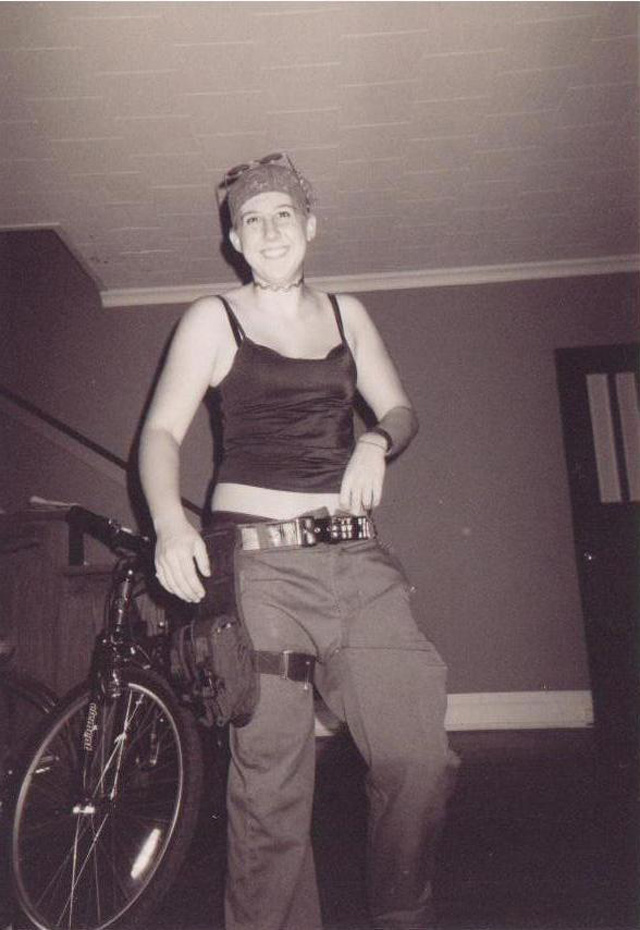
“She showed up with this pink hair and camo miniskirt. I guess she was pretty cute,” said Reichel.
According to Reichel, Anna and McDavid never slept together, but there was romantic tension between the two over the next year-and-a-half. “They argued like a couple. Everyone around them assumed they were sleeping together. She definitely had my boy after her.”
The two would see each other again about a year after the Iowa convention. In the meantime, it seems, Anna had work to do in southern Florida.
According to accounts of organizers of a protest against the Organization of American States in June 2005, Anna showed up in the Miami area, posing as an activist and volunteer medic.
Miami organizer Ray Del Papa said he believes the FBI was monitoring organizers of the demonstrations, even though they were legal, permitted and not intended to include any civil disobedience or “direct action.”
“I was on the phone one day, complaining to someone that we only had one volunteer medic,” Del Papa explained.
“I think the phones were tapped, because the next day, this woman Anna shows up, with short blond hair, in these leather pants, with a medic bag.”
But Del Papa said Anna didn’t seem very interested in offering medical care and comfort to protesters. She was more curious about the protest organizers.
“She started asking all of these really specific questions about who was coming and how many people were coming. She got really aggressive about wanting detailed information about our plans.”
During the march, Del Papa said, Anna started recruiting high-school students to stage a sit-in to block traffic, right in front of a large group of Broward County sheriff’s officers in riot gear. Del Papa was sure the provocation would lead to arrests and to the police clearing protesters from the area around the Fort Lauderdale Convention Center where the protest was being held. “It was a trap,” Del Papa told SN&R. That’s when Del Papa was sure that Anna was a government agent. Not that it’s uncommon for political demonstrations and meetings to have an undercover agent or two in their midst.
“What bothers me is that they’ve gone from being information gatherers to being provocateurs. To provoking people into these actions.”
Mark Reichel went to Miami to check it out. He brought a photo of the Miami Anna, taken by organizers there, back to his client in the Sacramento jail. It was the same Anna, McDavid told him.
Reeling them in
In late June, Anna left Miami and headed for Philadelphia and the BIO 2005 conference, where many activist groups, including some anarchists, were gathering to protest the biotech industry.
Anna’s real contact with McDavid, Weiner and Jenson started with meetings in a Philadelphia coffee shop. It was there that McDavid told Anna of his interest in “direct action.” It was there also that McDavid first mentioned the “Placerville tree factory.” He was vague on the details, but he knew that “they genetically modify trees there.” The “tree factory” turned out to be the Institute of Forest Genetics—one of the alleged targets in the conspiracy.
According to the government’s complaint, the four agreed to meet again in the fall in Northern California. After Philadelphia, McDavid went back to the Auburn area. Weiner stayed in Philadelphia, and Jenson roamed around a bit, sleeping on couches in D.C., Oregon and San Francisco.
Getting the three anarchists together must have been something like herding cats for Anna. E-mail records and other notes from the investigation show that Anna was the one trying to keep the others on a time schedule.
Anna bought Weiner’s plane tickets to California, said Reichel. Later, in audio transcripts of a conversation between the two women, Anna asked Weiner, “You’re going to pay me back for those plane tickets, right?”
“They needed money to survive. They had no money at all. They were ‘freegans,’” said Reichel.
In November, the four met at McDavid’s parents’ house in Foresthill, where, according to the government, they discussed carrying out some sort of “direct action” in the name of ELF. They ate stir-fried shrimp and vegan pancakes. They hiked and read. They also discussed a recipe that involved crystals created by mixing and heating ammonia and bleach. Those crystals, McDavid believed, then could be mixed with “plumber’s putty” to create an explosive akin to C4. According to the FBI, McDavid acknowledged that they were involved in a criminal conspiracy.
After the fall meeting, Anna wrote numerous e-mails trying to coordinate the group’s plans.
She urged Jenson to help convince Weiner to come back to California, saying, “You should help me work on ff.” (FF stands for Firefly, a nickname of Weiner’s.) In another e-mail, she wrote, “[Weiner] wants to push off Cali till later. I told her that’s bullshit. Argh.”

The alleged conspirators never did manage to create any explosive material—despite Anna’s help.
ILLUSTRATION BY GIA-BAO TRAN
|
|
During this time, according to FBI notes included in evidence, in December, Weiner purchased a copy of the book The Poor Man’s James Bond—containing recipes and instructions for various makeshift explosives and do-it-yourself weapons—from an anarchist bookstore in Philadelphia. Reichel said that earlier, Anna had told the group that she had worked as a high-school chemistry teacher.
On December 10, 2005, Anna gave McDavid the recipe for potassium chlorate in an e-mail that she had encoded with a simple letter-shift code (A equals G, B equals H, etc). The e-mail starts, “I think this is what you meant at your house. If you want the rest, tell me …”
“It was really unsophisticated,” Reichel said. “I think she was trying to think of something that could possibly yield something and was simple enough to do in the backyard for three idiots.”
At first, McDavid didn’t get it. He thickly replied, “Did you see what you sent me? You need to lay off the caffeeen cheeka.”
Anna replied, “Why don’t you think a little broader about what I sent you?”
“Don’t take it so hard/or me so seriously cheeka,” he wrote back.
Later, Anna wrote to Jenson complaining about McDavid. “Tell the Pirate [McDavid’s nickname] I’m sorry I snapped. I worked really hard on that e-mail, it seemed like he just laughed it off.” She asked Jenson to write to McDavid and give him the key to decoding the message. “Tell him to subtract six,” she explained.
She and McDavid smoothed things over, because two days later she wrote, “I’m just glad were talking again. Talk to me more. I miss you and am counting down the days.”
Cabin fever
Before the others arrived back in Northern California, Anna had rented the cabin in Dutch Flat, which she described in one e-mail as “a place that’s totally under the table, secure, hidden, but not too hidden that we look like Ted Kazynciski [sic].”
The group would stay in the cabin for less than a week—from January 8 to January 13—unaware that there was a hidden video camera already set up beside the television and an FBI surveillance team set up outside videotaping and recording what was happening inside.
FBI agent Walker confirmed during the bail hearing of Weiner that Anna rented the cabin and may have helped buy some of the materials for making the potassium chlorate that the four agreed to test while at Dutch Flat.
Much of the surveillance of the cabin captured the mundane details of the lives of four young people on vacation. There are reports of the four traveling to a pizza restaurant, buying pizza, returning to the cabin and eating pizza. They discussed music. Weiner enjoys Jimi Hendrix and Jello Biafra. Anna likes Beyoncé and Destiny’s Child. The other three never seemed to realize that Anna was an informant, even when she used a heavy hand to guide their conversations.
“All right, what do we wanna do next? Do we want to go back to Auburn and recon banks and gas stations?” she asked at one point on the tape. “You guys change your mind a lot,” she offered later. Then, later still, “It seems like you guys don’t want to do it at all.”
On January 10, the four toured the Institute of Forest Genetics in Placerville, using fake names and posing as college students for a tour. They were under surveillance the whole time by FBI agents and agents of the U.S. Forest Service.
The government says in its complaint that McDavid said that he felt human casualties would be acceptable in an action against the IFG. But McDavid denies that he ever said that. “We’ve asked them to show us where on the tapes he said that. They can’t find it because he never said that,” Reichel insisted.
On January 11, there’s a report that Anna “goes outside” to meet an agent. Not into town, not down the road—she just “goes outside.”
“I know. I know. How did they not realize?” Reichel said, laughing. “These are not the most sophisticated people. This is not the Symbionese Liberation Army.”
On January 11, Anna drove the other three in her Chevy Lumina to Wal-Mart in Natomas, where the group bought the items needed to make the explosives from Anna’s recipe.
McDavid and Weiner tried to cook bleach and other chemicals down to create crystals of potassium chlorate, in full view of the FBI surveillance team outside. But the glass container they were using became too hot and broke, spilling its contents on the ground. The two would-be guerrillas had nothing to show for their troubles but rattled nerves and a puddle of warm bleach.
On January 12, cabin fever set in. The audio transcripts contain a long and convoluted discussion that evening involving all four members of the group. The transcripts reveal a lot of disagreement and doubt.
At this point, the IFG facility was out, at least for the time being, partly because, even after its tour, the group still wasn’t quite sure what the scientists there did. McDavid suggested the IFG could be a fallback plan.
The Nimbus Dam was out; Weiner didn’t like the idea of creating another New Orleans. “Why would we want to create that?” she asked.
“It’ll kill people and take out people’s homes,” Jenson agreed.
The four moved on to a discussion of blowing up buildings, banks and ATMs. Jenson liked the idea of targeting power stations to cause power outages. Anna asked him, “So you’ll study power grids?”
McDavid threw in, “I think smaller stuff, right now.” Jenson added, “It doesn’t need to be done, like, now, right?”

Eric McDavid’s attorney, Mark Reichel, says the government is “manufacturing crime.”
ILLUSTRATION BY GIA-BAO TRAN
|
|
Anna pressed them. “I thought we were going to do the tree factory because it was easy,” she complained. Weiner replied, “But it’s not,” and the two guys agreed. McDavid apologized for his waffling. “I don’t want to hurt anybody’s feelings,” he said.
During the conversation, McDavid asked Anna what was wrong. “Big shuffle a little too big for you?” Anna replied, “I’m just sad we lost the Forest Service one.” It’s not lost, Weiner answered. “It’s not going anywhere,” McDavid added.
But Anna was getting frustrated. “I guess I’m just different than you guys. I don’t like amorphous crap. … I wish one day we could keep the damned plan. I wish one day you guys could stick to a list. Why can’t one of you guys say, ‘Hey, this is what we want’?”
Here, Reichel said, Anna sensed that the conspiracy was falling apart, and she began trying hard to get them to make statements about specific targets. “Yeah, I would like a damned goal,” she pleaded with the others.
The four agreed that they needed to purchase more supplies to keep experimenting with the explosive. “But at that point, it’s over,” said Reichel. “The whole thing had peaked,” and the conspirators were going to break up and leave Dutch Flat. But then Friday the 13th happened.
Terrorists or knuckleheads?
U.S. Attorney Lapham refused to answer specific questions about the evidence against the three would-be ELF members. He wouldn’t comment on things Anna did or didn’t do, or respond to questions about the transcripts from FBI surveillance of the cabin or the e-mail correspondence between the group members. “I just can’t be perceived as trying my case in the press,” Lapham explained. He did speak generally about what is in the government’s complaint against the three and about conspiracy and entrapment generally.
For example, he disagreed that debate about possible targets, such as the conversation on January 12, indicated a lack of agreement about carrying out a criminal act.
“Let’s say Al Qaeda has a meeting, and one guy wants to target the World Trade Center, and another guy wants to target Congress, and another wants to target the White House,” Lapham explained. “Just because there’s a debate, does that mean there’s no conspiracy to target buildings in the United States?”
“Bullshit,” responded Reichel. “If you had to choose, with limited resources, which of these places to protect from these people, you’d say, ‘None of them.’”
Like his rival, Reichel has some history with cases against anarchists.
He’s defended anarchists before, like Wobbly organizer Harjit Gill, who was convicted of lying to a grand jury about a McDonald’s that was torched in Chico in 2003 in the name of ALF. (Gill was never accused of being involved in the fire.)
Reichel describes himself as a mainstream Democrat. “I eat at McDonald’s. I live in a tract home. I drive an Excursion.” He likes his client, but he has a habit of calling McDavid a knucklehead and an idiot.
And he’s getting ready to file a motion to dismiss the case because of “outrageous government misconduct.”
His client engaged in stupid, evil talk, said Reichel. But that was all. There could have been no conspiracy, he insisted, without Anna, the FBI agent who seemed to have all the answers.
“She provides the money. She provides the car. She rents the cabin. Oh, and by the way, ‘I used to be a high-school chemistry teacher, so this is second nature to me.’” All that adds up to entrapment and worse, he said. “This is a case where the government is manufacturing crime,” Reichel added.
Professor George Harris, who teaches at McGeorge School of Law, isn’t so sure. He explained that federal law gives law enforcement and prosecutors a lot of latitude.
“Just because the FBI provides an opportunity to commit the crime doesn’t make it entrapment,” Harris said. He added, “Federal conspiracy law has developed in a way that is quite broad. It’s generally fairly easy to prove. That’s why prosecutors like it a lot.”
Consider the recent arrest for conspiracy of a group of Haitians in Miami, who had no expertise, no bomb-making materials and only an inkling of what they wanted to target. The government declared another victory against domestic terrorism in that case, but it raised questions of “pre-emptive” arrests in the national media.
Closer to home, the trial of father and son Umer and Hamid Hayat revealed that an FBI informant encouraged Hamid to attend terrorist training camps in Pakistan, exactly what Hayat was tried for.
The jury will have to decide whether those activities constituted entrapment or good clean anti-terrorist work. “If the defense of entrapment is raised, the government does have the burden of proving that the defendant wasn’t induced into the crime. We think we can do that,” Lapham said.
“You don’t have to wait until the match is lit to take action,” he added. McDavid is facing somewhere between 17 and 20 years in federal prison for the conspiracy. He’s eligible for the maximum penalty because it was considered a terrorist conspiracy.
Reichel said that, unlike Weiner and Jenson, McDavid wants to go to trial—though life in custody is taking its toll. “He lives a life of total hell. He spends 24 hours a day in his tiny cell.” McDavid is in what jailers call “T-sep,” or total separation. It’s supposed to be for McDavid’s own protection. Having been labeled a terrorist, he’s more likely to be attacked by other inmates, Reichel explained.
But McDavid is no terrorist, Reichel said. He’s just a big talker who got manipulated by an informant eager to produce a real live terrorist for her bosses.
“There’s a certain angst that comes with being a certain age. You say things you probably wouldn’t act on.”
“But when you have someone poking you and prodding, egging you on, that’s different,” Reichel added.
As for Anna, nobody but her FBI handlers knows where she is today. There are rumors that she’s back in Iowa, though she could be anywhere that young anarchists and radical environmentalists are congregated. In fact, the next time you attend a large demonstration, against the World Trade Organization or maybe the Democratic National Convention, you might meet her.

Anna: FBI Informant




























COMMENTS SO FAR ↓
The “Major’s” photo looks familiar for all of the years since a dramatically different experience at John Brown’s Military Academy on Cherry Ave. in the 50’s. There’s no photo of his wife, Marie, but she likely was involved in the administration of that bastion of child abuse as well.
Imprisoned there through 3rd and 4th elementary school years full-time as a boarded child, I came to fear and hate the place for good reason. Many other children (some had disciplinary problems in public schools) were deposited there by frustrated families either inconvenienced by their charge or out of ideas on how to raise them.
The inferior caliber of education experienced there set me back at least the two years of forced endurance–sexual molestation by older children, rank egregious physical child abuse and witnessing sexual fondling by adult staff (Mrs. French, a ‘housemother’), serious injuries from unsupervised older children and staff alike (Mrs. French and ‘Captain’ Armstrong), as well as the perverse encouragement of the school’s children, themselves, to engage in brutal acts of physical abuse.
When some of this was brought to Marie’s (possibly the young woman superintendent remembered) attention and the physical scars/wounds from Mrs. French’s assault w/a cast iron towel rack on the back of a 4th grade boy were exposed to her eyes, she did NOTHING. Years later, after he graduated from a Riverside public high school, Mrs. French still worked there!
Having a father incarcerated in New York for robbery didn’t help. Aunt Jackie (his half-sister) and uncle Jack took charge as my alcoholic paternal grandmother (Eunice) began to fail. Aunt Jackie was a brilliant woman (graduated Magna Cum Laud from Long Beach State, then went on to receive a master’s degree in political science) but she was emotionally fragile. She never had any children of her own. She attempted a career in public teaching. It proved too stressful for her. She often endured bouts of migraine headaches and stomach upset, disabling her for days.
After being deposited at John Brown’s, my father, a decorated Marine from WWII, was expected to help defray the cost from his veteran’s disability payments for wounds he suffered in the Pacific despite his incarceration. No respite from a mother intervened, for he’d absconded w/her infant and successfully hidden the child until adulthood when she was eventually located, years later, working at Hannah’s Oregon nickel smelting plant, jack hammering slag from the furnace walls. For years she’d been a San Diego Transit driver, only a stone’s throw away–a WWII Rosey the Riveter, bus driver, blast furnace attendant, cow-girl; she’d been more than he bargained for and more than he could chew. He’d met his match.
Earliest recollections of John Brown’s were as a toddler, still in kindergarten, living w/my grandmother (almost burning the house down while playing with matches in the side yard) in a residence near the railroad tracks and a tiny little grocery store owned by the family which occasionally provided me an ice cream treat for delivering a thermos of hot coffee the 1-block distance between the home and store. It was also quite close to the pedestrian underpass (if it still exists) beneath W. Pacific Coast Hwy…in the vicinity of Dawson Ave. and railroad tracks at that time.
Grandmother, because of her health and lack of a car, had difficulty supervising a rambunctious toddler doing things like climbing onto the roof and jumping off. Playing hooky from kindergarten while wandering around exploring the city, on one such occasion the vast lawn w/large wheeled cannons at John Brown’s, a for profit depository for kids established by a 2-year Navy veteran enamored by the idea of military pomp & circumstance, was discovered. It was a great business model for the time, given the nation’s gratitude and approval of its servicemen. These were times when any sailor in uniform could hitchhike without spending much time waiting for a ride. All those faux uniforms and military titles were just the ticket to prod families to open their wallets before leaving a child they weren’t eager to parent themselves.
Abandonment was only the first injury. Children were regularly subjected to the rigors of parade ground drills, uniforms, dormitory bunks (more on THAT below!) and highly orchestrated routines, but with little expertise by staff in child psychology, education, or even the love/compassion a child needs to remain healthy. Subjecting the tykes to military discipline was imagined good for them–a paradigm later portrayed in scenes from The Sound Of Music. ‘Major’ Hurte’s fundamentalist Christianity proved to be the perfect matrix for a ’spare the rod, spoil the child’ regimen. This underlying ill-conceived maxim was not only counter-productive, but became a cloak for criminal child abuse that remains shocking after all these years.
Mrs. French was a dour ‘housemother’ at the academy. Children were required to address all adults as ’sir’ or ‘mam’ and the supervising adult males by their faux military titles. From time to time, Mrs. French would lapse into paranoid histrionics, ranting about how we just called her ma’m out of duty and not because we ‘loved’ her.
We had a group shower enclosure in our ‘barracks’/dormitory and a group urinal (as was common on military bases) for the children’s use. It goes without saying this was an all boys school. 3rd graders gave Mrs. French the pretext to demonstrate how we were to clean ourselves by rubbing one boy’s penis with soap in the shower while we watched. Mrs. French seemed entirely too fond of this particular lesson, all too often.
Bunks consisted of a wooden cubbyhole stacked end to end w/a thin mattress and 2 drawers for our clothing beneath. The day came when the handyman/custodian installed a new chrome plated wrought iron towel rack at the foot end of our bunks. The bunks were fairly short, even for a child. Sleep inadvertently placed my feet on the newly installed hexagonal iron towel rack, causing it to break away from the wooden partition on which it had been installed with screws too short.
Mrs. French discovered this calamity during her morning inspection. Enraged, she seized the thin towel rack, chased me into the boys lavatory, and cornered me by the urinal where she proceeded to beat me, as I cowered, with the cast iron towel rack, leaving numerous open wounds and scars on my back.
Even as a child, escape from that Hellhole became an imperative. Despite age, the way to my aunt & uncle’s home, 6-miles distant, was known as near Milikan High School. The escape plan was poorly executed. Waiting, naturally, until dark, but without the presence of mind to wear dark non-reflective clothing in an imagined walk to freedom, the city’s streets had been learned by wandering alone on them instead of attending kindergarten.
As it so happened, that very night was the occasion for some kind of meeting in which all the ’school’ staff attended. Getting no farther than an empty overgrown field across the street when cars started to exit the facility, I crouched low to the ground to avoid their headlights but was spotted by one. After complaining about the injuries from Mrs. French, a young woman superintendent (probably Marie) had me lift my shirt and examined the wounds and scabs. She said nothing–no words of sympathy or concern. Given Mrs. French’s long career there, she also did nothing about it. Possibly she decided to keep it quiet for liability reasons even in those days of treating children like brats.
So yeah, Mrs. French was a pervert and violent child abuser. But we have our share of mentally ill in a country this size–unfortunately, some have charge over our children. A couple of years later, a violent assault at the hands of a Mr. Danny, the 6th grade teacher at Emerson Elementary School in Long Beach, was endured. Mr. Danny was most careful to make certain no one was looking when he grabbed the 12 year old student by the throat and slammed him against the outside wall of the bungalow classroom. The schools had trouble providing enough classroom space for these early baby boomers. Dr. Spock books hadn’t become popular as yet, and parentis in locus was never questioned.
Lack of supervision, and even malicious supervision was another insidious evil promoted by John Brown’s. One older kid came to school with a handgun. Whether it was loaded remains unknown. But, he terrorized me and others with it. This juvenile delinquent was never disciplined for it. Boys will be boys?
Children, like the rest of us, have conflicts and confrontations. One of these resulted in the top of my head slammed full force into a masonry wall. Years later, X-rays would reveal a cervical anomaly that could have been the result. Dyslexia was another. It’s difficult to diagnose proximate cause decades later.
One memory of the ‘care’ provided by John Brown’s to its charges stands out. There was a nearby park we’d be taken to for outings. There were perhaps 8-10 boys in our group shepherded by ‘Captain’ Armstrong. We were all under 10 years old, ranging from 8-9. Two of the boys got into a fight and the loser lay on the park’s grass crying. This must have embarrassed ‘Captain’ Armstrong, who proceeded to berate the sobbing boy. As the lad lay on the ground, Armstrong encouraged each of us to give him a kick in turn, presumably to teach him to be more manly. Each of the boys followed Armstrong’s instructions, as did I, for fear the others would turn on a new victim!
The scholastic quality at John Brown’s was abysmal. It took years to recover from the endemic poor reading levels and lack of quality instructors.
Eventually, my aunt & uncle removed me from the school after I summoned the courage to detail my grievances–courage that was a long time coming. A note of explanation is in order when it comes to why a child is reluctant to blow the whistle on such blatant abuse.
First, a child tends to internalize the abuse and believe it’s because of failure/short comings on the child’s part–something the child is reluctant to admit: i.e. failure.
Next, the child may believe (as did I) nobody will care or he/she won’t be believed. There was ample evidence of that at John Brown’s. It takes some courage and maturity for a child to stand up to abusive adults or even articulate the abuse because children don’t understand they have certain inalienable rights. Adults typically are curiously silent about explaining those rights to children.
Over the ensuing years, after being liberated from this canker sore on Signal Hill, the flames of hatred and resentment remained though dying down to a hot ember. After graduating from high school, I supposed I was ready to return to John Brown’s and confront one of its tormentors, Mrs. French.
Upon arrival, indeed, she was still working there these years later as a ‘housemother’–a perversion of the term in her case. After identifying myself, she exploded into a cacophony of euphoria: “Oh! It’s one of my boys come back to see me. How wonderful!”
The inability to tell her what an evil perverted witch she was, but couldn’t bring myself to say, remains a mystery. Finding my voice came later in life. The threads of such early extreme abuse I (and many others) experienced at John Brown’s run deep. They can never be removed from the warp & weave of the personalities coalesced during those tender years.
Google’s map of John Brown’s indicates it may have been purchased by someone who changed its name. The only good thing that can be said of John Brown’s would also apply to Auschwitz. It’s an example of what can happen when we allow others who do not love them to supervise our children.