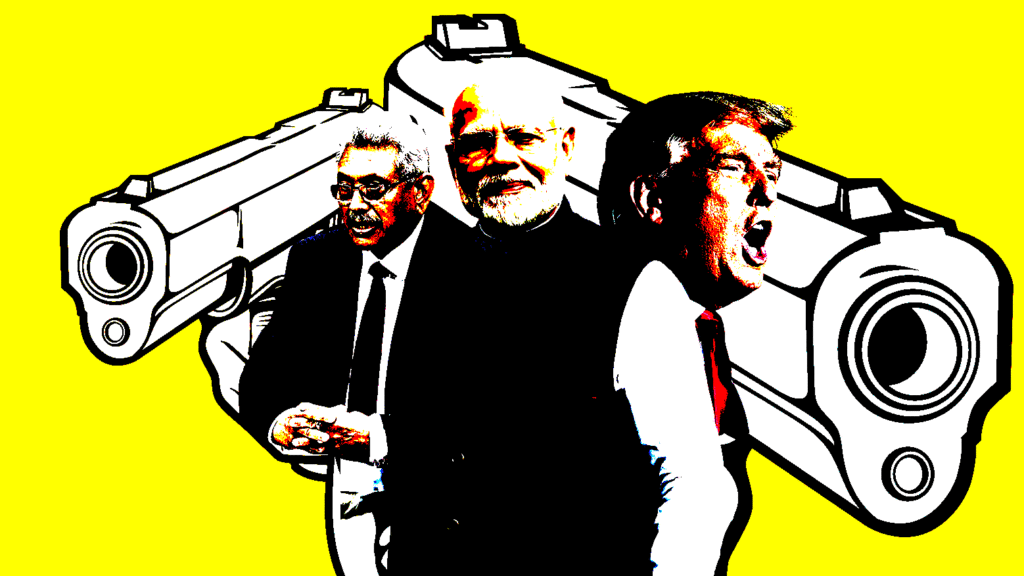
Why Donald Trump will/should win the 2020 Election


The Conservative Trans Woman Who Went Undercover With ANTIFA in Portland

Confessions of a black bloc mole

by NANCY ROMMELMANN 


Erin Smith was at a GOP election watch party at Twitter headquarters in San Francisco on November 8, 2016. For the one-time deputy vice chair of communications for the city Republication Party, it should have been a time of jubilation.


“As soon as they announced Trump the presumptive winner, we’re told, ‘Hey, there’s a mob of protestors out front,'” says Smith, who stepped outside to find the San Francisco cops being pushed back by a crowd, some in head-to-toe black: clothes, helmets, face masks. 


A trans woman, conservative, and former tugboat captain who says she’s “a weird activist/analyst-type person right now,” Smith soon became galvanized to find out more about a group that dressed as revolutionaries and took their fight to the streets. What was animating them? Trump animus? The romance of revolution? The boredom and frustration of COVID sequestration? An unfocused desire to fuck shit up?


It takes a special moral blindness to see setting fires, breaking windows, and threatening journalists as the road to justice. I’ve seen this moral blindness rise along with the violence in Portland. Young activists have told me frankly that they don’t give a shit if someone working in the basement of the police station burns to death because, hey, she chose to work there. I’ve seen activists cheer the murder of a member of the conservative group Patriot Prayer. You cannot employ the violence of your perceived enemies and expect your revolution to end in peace.


What Smith has experienced has not been peaceful. She’s had friends beaten up by ANTIFA. She’s been threatened herself. It made her curious. This summer, she decided to find out more by going undercover with the black bloc anarchists in Portland.


I went out with Smith several nights, and while I could not follow her directly—black bloc avoids having those outside its ranks interview or photograph them—I was able to watch her, wearing all black and carrying a shield bearing an anarchist “A,” slip into the group. I saw that she was present at the same locations where black bloc attacked buildings and set fires.


After one such night, Smith and I sat over a couple of hard seltzers and discussed why she decided to infiltrate the black bloc and what she found.


What did you know about ANTIFA when you first encountered them in San Francisco?


I had a vague idea of what ANTIFA was, but it wasn’t nearly as big a deal as it is now, outside of maybe Berkeley or Seattle. I’d had friends that got attacked at the Trump rally they tried to hold in San Jose [in April 2016]. I’d had a year of watching that happen, and basically, I don’t like bullies, so I started showing up at these things, at rallies and protests and places where my friends were getting beaten up. It felt like in 2016, everything really changed in the Bay Area. It stopped being so carefree, in a sense Everything started kind of feeling like it was for keeps.


April 27, 2017, was the first rally I went to, in Berkeley. This was a Trump MAGA rally. I started livestreaming in June and I got to be pretty good at talking to people from the other side. The first time I ever actually dressed in black and put on a mask on and tried to slip into the bloc was last weekend. It is a little scary, because I’ve faced them down so much. I’m like, “I’m going to dress in black and slip in?”


I’ve studied them for a bit, watching videos and stuff. I wrote a piece on ANTIFA tactics for a monograph that’s coming out next month, for the Center for Security Policy. And I have an advantage, having gone to the rallies. But they know who I am. When ANTIFA hates you and know who you are, the best way to hide is right in the middle of their black bloc. That’s the last place they think to look. It’s one of the advantages of dressing in black and wearing your mask. 


You had a shield tonight. Did you make it?


Actually, I acquired it at the riot. Someone set it down, and I’m like, “That’s cool. It’s communism, no property. This is mine.”


How organized are things on the inside?


There are different types of bloc organization styles. The building block of ANTIFA is what’s called an affinity group, people you live and work with and trust and know in real life. All the planning is done within that closed bloc, and they don’t let everyone know [what they’re going to do]. I didn’t know that they were going to burn the Portland Police Association when I joined. What they did was put a call out that said, “Anyone show up in black that night at this place, and you can join the action.”


That’s called a semi-open bloc. The planning is done within the closed group, but anyone who’s dressed in black can come join the action. If you know what you’re looking for, you can spot affinity groups that are working together. One thing they’ll do sometimes is have written agreements with other protest organizations that aren’t in black bloc. I know of one from Berkeley that illustrates this: “We agree that to not take pictures of anyone in ANTIFA.” It will say that literally in writing, so everyone’s working together. It’s like a combined arms type thing, almost like the military. They work together and are mutually reinforcing.


So your first night with them, you burned the Portland Police Association…


We get to the Portland Police Association and immediately, they blockade both ends of the street. They built the shield wall and they’re hammering the door open. I went over and I’m standing in the bloc as they’re breaking the door down. It took them a little while longer than what I thought. They could have found better ways to breach the building, but they had hammers and pry bars and they pry it open and pry the plywood back and they pour fuel and light it on fire and start burning stuff.


Strategically what they’re doing is, they’re forcing a dilemma action. A dilemma action is when you put your opponent in a no-win situation. Your enemy has to react. If they don’t react, they look weak; if they do react, they have to react in a certain way where it looks like it’s an overreaction.


When the feds were in Portland, they were presented as overreacting, a presentation helped by innumerable people with PRESS written across their clothing flooding the internet with images that presented protesters wholly as victims of an authoritarian regime.


That’s their [ANTIFA’s] objective. It’s not a tactical thing. That’s why all the “press” is there, the sympathetic press. They’re trying to create propaganda. They know how the police are going to react, so they carefully calibrate what they do to try to provoke the police into reacting and then filming it. They want to try to push public opinion in favor of removing the police. The police aren’t perfect, but what a police force is, it’s putting force under an objective third party, under government control. ANTIFA wants to separate the police from the populace.


This is basically guerilla warfare. They’re trying to undermine legitimacy of the state. The police right now, I think some of them are catching up. There’s a playbook for how police respond to riots and they’re not actually doing it; it’s not an actual riot. I mean, it is a riot, but at the same time, it’s a specific type of riot that’s trying to make the police respond in a certain way.


Meaning, they’re able to provoke the police into taking the bait.


Yeah. Basically they’re baiting the police into overreacting.


So how did you feel when the police station was on fire?


It was pretty wild, actually. Right when the fire was lit, the police announced, “This is a riot” and they [the black bloc] started marching. For me it was really kind of amazing, because they were incredibly proficient. This was 600, 700 people. They moved a group of people through the city in close order, quickly and efficiently, and attacked a target and caught it on fire and then escaped from the police.


I describe it as an open-source networked insurgency. They were incredibly efficient. They hit a target and vanished into the city and got away. Basically, they’re like skirmishers: They come in, they attack the cops, they get out.


ANTIFA goes for a certain type of violence, a mid-level violence. Most people aren’t practiced in violence, and what they’ll do is, they’ll either back down or they’ll overreact. ANTIFA basically as a group does the equivalent of just pushing someone on the shoulder, and again, and again.


They keep it at a simmer.


Yes. It’s very tricky to react to because people get angry. If you just go in public and pick someone and start pushing them, if you keep pushing them, they’re going to slug you; it’s just how it’s going to work, at the individual level but also at the group level too. I’m also speaking metaphorically, in a sense. Of course if you hit them, they’re going to fall down and go, “Oh, God, you’re violent. You’re a Nazi!”


What they’re intending to do is use that level of violence that will scare people enough to back down. [The radical left] learned in the ’70s that killing people is bad PR. A body count is horrible.


So we’re not going to see another Weather Underground?


Not at this point. They’ve learned and adapted. What they want to do is make it difficult for people [they don’t like] to organize.


So that’s really the two responses. Most people don’t know how to handle that mid-level force. So they either back down or they slug people; either way is a win.


When you don’t know what you’re looking at, you see a lot of random, rage-filled kids. You sometimes wonder: Do they even know how to formulate a plan? But you go out with them a few nights and understand, people are actually working together.


It’s really interesting. I did a breakdown of the Grant Park video, the tech they had. And that was freaking incredibly sophisticated. This is Grant Park in Chicago, when they attacked the statue and put like 49 police officers in the hospital. [Tonight] was so much like this, in terms of operational sophistication, how coordinated everything was. 


But not centralized.


Let me explain that a little more. People keep looking for a chain of command, and you don’t necessarily need that, as long as everyone understands a basic level of instruction it works.


What are the basics?


Basically, don’t talk about it. Don’t photograph people’s faces. “What did you see?” “I didn’t see shit!” is a chant you’ll hear. You can go to websites like CrimethInc. and they’ll have a lot of breakdowns of tactics. It’s an anarchist website. It’s an open-source network insurgency, not so much a chain of command.


People think ANTIFA and they picture people in black. ANTIFA is bigger than that. Black bloc is a tactic. Dressing in black, it’s a tactic. You don’t have to dress in black to be ANTIFA. You don’t even have to hit the streets. There are people who work in tech, hackers who never hit the streets, and they’re still ANTIFA. [The media] play these little word games, “Oh, ANTIFA doesn’t exist.” Yes and no. It’s not an organization where you have to sign up for a membership. It’s one of those things where it’s just a loose-knit network of people.


Whose message can be a sweet song, not just young people looking for identity, or those for whom COVID-19 has cooped up, but anyone wanting to be part of what they see as a fighting force for justice.


People want to fight through things. I first heard of CrimethInc in 2000. I’ve got their seminal work, Days of War, Nights of Love. I’ve got it inscribed, “Love and insurrection”; it’s anarchist stuff. I’m not an anarchist or a communist or anything like that. But it is a siren song. Young people, they sense there’s something wrong, and they want to fight. That’s a human instinct. Francis Fukuyama talks about it: People want to struggle. And if everything is fine, they’ll struggle against democracy. 


I understand where some of that comes from. People want community and want to feel like they’re fighting. That’s why we love Star Wars. We love the underdog fighting. And I think young people that don’t have a network, it’s just something very intoxicating.


And totally honestly, when I was out there with black bloc [and] busted open a door to a police station, set it on fire and ran from the cops? It was fun. I know that sounds weird. I don’t support that as a policy, but when you’re there in the street, it’s fun.


Violence is fun. This is one of the things we don’t talk about as a society. It’s like, wow, this is pretty fun, especially when you feel like you have grounds for any type of legitimate complaint. It’s easy to knock on these people. And I still do. I don’t agree with what they’re doing, but I respect them. I’ve been facing these people down for four years. I take them seriously and I respect their skill at what they’re doing and their dedication.


What are the ages of the people you were hanging out with?


Anywhere from twenties to thirties.


Do you have any idea what they do for work?


In the Bay Area, we’ve had people arrested that were physicists. Look up Freddy Martinez. He was arrested for punching some guy in Berkeley. And Freddy Martinez is the director of Lucy Parsons Labs. I know there’s another guy who was a Johns Hopkins grad. You can dismiss them as a bunch of losers, but I’ve seen some incredibly smart people.


I’ve told some demonstrators mouthing off to me to read Utopia or Auschwitz, about the 1968 generation in Germany who were livid with their Nazi-collaborating parents and were going to build a better society. The movement became progressively less peaceful and eventually took to bombing and murdering people. ANTIFA right now is able to keep things at a simmer and provoke others into behaving badly, but history tells us things usually don’t stay at a simmer. Do we get to skip the part where people are building bombs in basements in Portland?


Well, they are making those primitive small IEDs made out of commercial grade fireworks. They’re roughly about the power of police flash-bangs. I’ve had them go off right next to me and you feel it; you feel the heat wave hit you. But a big thing for them [ANTIFA] is they have convinced themselves that they’re doing something good. They’re very big about trying to maintain, at least in their eyes, the moral high ground. Part of that is not killing people. They want that moral high ground and they construct it. And that’s kind of what they do by using that mid-level of violence. They want you to overreact because not being extremely violent is how they convince themselves they’re better. And it’s also great propaganda. 


Do you see ANTIFA as getting more than a toehold in city government here?


Quite possibly, yes, I think by weakening the police, or defunding the police. They have the organization that if the police went away tomorrow, you would basically have an ANTIFA police force.

They wouldn’t call themselves ANTIFA, but they have the organization that, if there’s no objective third-party security force, then who’s going to stop it?


I think the worst case is if they weaken the police; they don’t go away because then the police are still there and they’ll be able to target the normal law-abiding people. It’s what we have in San Francisco. It’s anarcho-tyranny. It’s like the law really only applies to people that are trying to follow the law.


I wouldn’t say the majority of people in Portland are sympathetic to ANTIFA, but you’ve got a lot of people that either are apathetic or don’t think it matters or they’re scared. You put all of those people together, maybe you have a majority. There’s a woman running for mayor that is openly pro-ANTIFA, a woman who was photographed wearing a skirt with Chairman Mao’s face on it. It could be that Portland is the place where ANTIFA goes Main Street.


I think that in many areas they are already there. I don’t think ANTIFA will get out there and start dressing in police uniforms and be the official police. I think they’ll always stay kind of a paramilitary. But the police are weakened to the point where they can barely oppose [ANTIFA] now as it is. So the police go away, it’s operant conditioning. If every time I grabbed this [hard seltzer] I got shocked, after a while I would stop grabbing it. And that’s basically how they operate. It’s not so much a matter of ruling the whole city, it’s the sense that ANTIFA [moves] the Overton window. “If this person is advocating for something we don’t agree with, we can go punish them and we can punish their friends and family.” It’s a self-censorship. If the cops are a token force now, and they can’t stop anyone, and ANTIFA can destroy your life, then people are going to know that. 


And they’re going to shut up and just try to go about their lives.


That’s what they’re going to do.

Posted in Uncategorized | Leave a comment

Feds Bust Ryan Howe, Rochester NY ANTIFA Terrorist


Feds prosecute Ryan Howe, Rochester NY ANTIFA Terrorist
An upstate New York suspect is facing federal charges for instructing their comrades to make firebombs to harm police in one of the few known cases where federal prosecutors explicitly detail the accused’s ties to Antifa.

by Andy Ngo and Mia Cathell (10-2-20) —


An upstate New York suspect is facing federal charges for instructing their comrades to make firebombs to harm police in one of the few known cases where federal prosecutors explicitly detail the accused’s ties to Antifa.


The U.S. Attorney’s Office for the Western District of New York charged 27-year-old Ryan Howe, of Rochester, last week with using a facility of interstate and foreign commerce to incite, promote and encourage a riot. Howe—who uses the pronouns “they/them” and “she/her”—is also known as “Rylea Autumn.”


A July 2020 Twitter post by Ryan Howe

Howe was among nine arrested on Sept. 2 by Rochester Police at a violent Black Lives Matter-antifa protest at the Public Safety Building. Several dozen had gathered to protest the death of Daniel Prude, a black man who died in police custody. The criminal complaint filed by a Federal Bureau of Investigation special agent says Howe shook the metal barricade protecting the police station, and screamed to agitate the crowd to violence. Howe then allegedly wrapped themselves around a street sign to resist arrest and kicked to avoid being handcuffed.


Ryan Howe, aka “Rylea Autumn,” identifies as part of the Antifascist Action group

According to the criminal complaint, Howe made a number of extremists posts throughout September that caught the attention of law enforcement. They allegedly urged violence against the state and law enforcement using arson attacks. On Sept. 8, the Monroe County Sheriff’s Office alerted federal investigators to Howe’s Facebook, which shows they espoused extreme antifa beliefs. Howe’s Facebook profile photo depicts them dressed in black bloc, with the accompanying text, “Antifascist Action.” Antifascist Action is the original English-language antifa organization formed in the 1980s.

[Editor’s note: ANTIFA’s original roots lie in Europe as Leon Trotsky’s brainchild to destabilize foreign governments in a bid to promote worldwide Communism. Trotsky was the Soviet propaganda minister and Communist party’s leading theoretician.]


Howe’s Facebook bio line reads: “Genderqueer, Anti-Fascist, Anti-Racist, Anarcho-communist.” Additionally, their Twitter account is filled with posts identifying with antifa and expressing support for communism. Howe’s other social media posts show they are heavily involved in far-left activism and organizing in the Rochester-area. ‘They’ were previously arrested in July at another protest.


The complaint says that on Sept. 23, Howe wrote on Facebook, “Burn this sh— to the f—ng ground” in response to news that the Kentucky officer involved in Breonna Taylor’s death was charged with three counts of felony wanton endangerment, rather than murder.


A day later, Howe allegedly shared a recipe on how to make a Molotov cocktail and then instructed readers to throw it at police. They later posted on the same day: “Good morning to everyone ready to burn this whole f—ing country to the ground!” Howe’s third post was a graphic of a smiley face holding a flaming Molotov cocktail.


The affidavit says Howe admitted to making the posts when he was interviewed by an FBI agent. ‘They’ said ‘they’ obtained the Molotov cocktail recipe from an anarchist book.

Howe made an initial appearance in federal court last week and was released on pre-trial with conditions. Howe is required to undergo a mental health examination, is required to seek employment, do drug testing and adhere to a curfew. Howe’s next court date is on Nov. 17.

The FBI conducted the investigation alongside the Monroe County Sheriff’s Department and the Rochester Police Department. The case is being prosecuted by Assistant U.S. Attorney Brett A. Harvey. If convicted, Howe faces a maximum penalty of 5 years in prison and a $250,000 fine. The case is one of the few known federal prosecutions since riots began in May that allege a suspect’s explicit ties to Antifa.

Posted in Uncategorized | Leave a comment

The Nazi Shadow Behind World’s Youngest Billionaires


by David De Jong (5-8-18)


Their grandfather was said to be Nazi Germany’s richest man after building a weapons empire on the backs of slave labor.


Their father was involved in one of postwar Germany’s biggest political scandals. He almost frittered away the family fortune.


Enough remained for Viktoria-Katharina Flick and twin brother Karl-Friedrich Flick to lay claim, at 19, to being the world’s youngest billionaires. Each has $1.8 billion, according to the Bloomberg Billionaires Index.


Behind the riches, discreetly managed by their family office in Austria, lies a dark history of one of Germany’s wealthiest industrial dynasties.


The Flicks’ wealth traces its roots to Friedrich Flick, who spent three years in prison after he was convicted by the Nuremberg war crimes tribunal of using slave labor to produce armaments for the Nazis, among other crimes. He created a steel empire, which expanded by seizing companies in Nazi-occupied territories and in Germany through Aryanizations—the expropriation and forced sale of Jewish-owned businesses. As many as 40,000 laborers may have died working for Flick companies, according to a study of his Nazi-era businesses published in 2008.


Flick was released from prison in 1950, after the U.S. high commissioner for Germany granted controversial pardons to German industrialists. The U.S. and U.K. returned his money and business properties, including one Aryanized asset. He sold his coal businesses and invested the proceeds in numerous companies, including Daimler-Benz AG, eventually becoming the carmaker’s biggest shareholder.


“Leaving aside all moral standards, Friedrich Flick had the genius ability to become the richest person in Germany—twice,” said Thomas Ramge, author of “The Flicks,” a family history.


Other German business dynasties whose fortunes partly stem from the Nazi era, such as the Quandts and the Oetkers—and even some Flick family members—have made some form of restitution for using slave labor. Friedrich Flick and his youngest son, who became sole owner of the conglomerate, never did.


Friedrich Flick maintained his innocence and said that he had neither a legal nor a moral obligation to pay restitution. The son “just didn’t have the intellectual ambition to deal with the complexity of German history and how his family was involved,” Ramge said.


That son, Friedrich Karl Flick, took the reins of the family business upon his father’s death in 1972. He became sole owner of what was then Germany’s largest closely held conglomerate after buying out three family members in 1975. He also sold the remaining Aryanized asset, the Luebeck blast furnaces in northern Germany, to U.S. Steel Corp. that year.


In the 1980s, he was mired in a scandal involving illegal political donations that led to the resignations of Germany’s minister of economics and the parliamentary president. Friedrich Karl Flick denied knowledge of the payments and was not indicted. In 1987, his closest associate was fined for tax evasion and given a suspended jail sentence.


Friedrich Karl Flick sold the businesses to Deutsche Bank AG for 5.36 billion deutsche marks ($2.17 billion) in 1985, at the height of the scandal. After that, he withdrew from public life.


Almost a decade later, Flick moved to Austria, home of his third wife, Ingrid Ragger, 32 years his junior. They met while she was working as a hotel receptionist in a ski resort. He died in 2006, when Viktoria-Katharina and Karl-Friedrich, her younger brother by a minute, were 7 years old.


He “retreated to a safe mix of stocks, bonds, real estate and whatnot,” Ramge said in an interview. “Although there was still plenty to leave to the twins and his two other daughters.” When Flick died, he left behind $1 billion for each child, according to the Bloomberg Billionaires Index.


Today the twins’ fortune is overseen by the Flick Privatstiftung, a Vienna- and Velden am Woerthersee, Austria-based family office. Stefan Weiser, a board member, declined to comment on Bloomberg’s tally of the family wealth.


“As we are a single-family office we do not divulge any details to outsiders,” Weiser said in an email. The twins were not made available for interviews. Their two half-sisters, Alexandra Butz, 50, and Elisabeth von Auersperg-Breunner, 44, from Friedrich Karl Flick’s second marriage, are based in Munich and Austria. The sisters’ net worth is also $1.8 billion each. They declined to comment.


The twins’ lives have remained intensely private; no photographs of them have gone public. Karl-Friedrich won a regional junior sabre-fencing title in 2017. Little is known about his sister.


Their mother has said she tried to make their childhoods as normal as possible.


“They’ve been getting pocket money since second grade, age-appropriate, not more than their friends,’’ Ingrid Flick told Austrian newspaper Kronen Zeitung in 2009. “This is how they’ll learn how to deal with money and its significance. I want them to be no different from their friends.”


Ingrid Flick once said she withheld a credit card from her teenage daughter, telling Germany’s Bunte magazine: “The kids have to learn that they’re nothing special, but that the name Flick obliges.”


The twins attended public high school in southern Austria, yet they’ve grown up with the trappings of wealth. When they were 13, they moved into their own villa on the grounds of Ingrid Flick’s Austrian estate. The residence had a disco, a playground and a tennis court, according to the Austrian newspaper Kleine Zeitung. The court was inaugurated by Ilie Nastase, a former world No. 1-ranked player.


They leave the management of their money to three executives with decades of experience in wealth management, investment banking and legal affairs. The investment goals of the family office seem modest. Friedrich Karl Flick’s goal was a 4 percent annual return after taxes, inflation and expenses. “Sounds little, doesn’t it?” he told Austria’s Trend magazine in 1998.


Yet even in death, Friedrich Karl Flick couldn’t escape the family’s notoriety. In 2008, grave robbers removed a coffin containing his body from a mausoleum in the lakeside town of Velden. They demanded a 6 million euro ($7.5 million at the time) ransom. Three men were convicted in the case. Flick’s remains were later recovered in Hungary and reburied in Austria.


“Finally, my husband is back home,” Ingrid Flick told Bunte magazine. “The hope and fear is over. The prayers were answered.”


Posted in Uncategorized | Leave a comment

Why Kyle Rittenhouse will be exonerated:


Arrestees Charged w/rioting by Feds

Posted in Uncategorized | Leave a comment

Open Letter to Corrupt Thurston Co. Courts RE: ZOOM


Thurston Court ZOOM Instructions

TO: Thurston County Court Clerk, (360)786-5430       

2000 Lakeridge Dr SW, Bldg #2       

Olympia, WA   98502


RE:  Administrative arrogance in light of 1st & 6th Amendment guarantees

Dear Court Clerk/Administrator.


I am in possession of ZOOM instructions from your office to the public regarding witnessing courtroom proceedings, of necessity, in an era of pandemic contagion.  I have file attached a PDF copy of the same to eliminate any ambiguity and for clarification.  See below.


As a citizen and American, I am particularly offended by the chutzpah contained in the sentence instructing the public they may NOT record, capture, or ‘journal’ said proceedings via the ZOOM session in the relative comfort and privacy of their own homes, et al. This is blatantly inconsistent with 1st and 6th Amendment guarantees including (but not limited to) freedom of the press, freedom of speech, and the right to complete transparency in each and every step of a legal proceeding in a court of law. I am personally familiar with Thurston County’s pattern of violating these legal standards and fundamental liberties.


It is not by largesse or grace your office makes these sessions available to the public, but by Constitutional mandate and the obvious threat of pandemic contagion.  You may be able to arrogantly throw the weight of what remains of the King’s Court around during sessions defined by the 4 walls of the courtroom or in personam/subject matter jurisdiction, but you have NO authority to prohibit journaling a PUBLIC proceeding outside those 4 walls or as to people who are not litigants/witnesses.  Your office publicly broadcasts these sessions because it HAS to.  Moreover, you yourselves record them and make them available to any member of the public who can afford a copy.  Thus, not only does your office lack the dictatorial authority you seek, but no one in that courtroom has any expectation of privacy.


Please allow me one further, but simple clarification:  If you think you can stop/prevent me or any other citizen from capturing/recording the ZOOM sessions your office broadcasts, you can kiss my hairy ass!  I shall endeavor to enlighten the rest of the general public as to the limits of your arrogance/misapprehensions/incompetence and encourage them to follow suit in challenging it.

Posted in Uncategorized | 2 Comments

Why ANTIFA Can’t Admit Its Nazi/Fascist Roots


Paul Bloom

“A lot of people blame cruelty on dehumanization. They say that when you fail to appreciate the humanity of other people, that’s where genocide and slavery and all sorts of evils come from. I don’t think that’s entirely wrong. I think a lot of real awful things we do to other people arise from the fact that we don’t see them as people.


But the argument I make in my New York article is that it’s incomplete. A lot of the cruelty we do to one another, the real savage, rotten terrible things we do to one another, are in fact because we recognize the humanity of the other person.


We see other people as blameworthy, as morally responsible, as themselves cruel, as not giving us what we deserve, as taking more than they deserve. And so we treat them horribly precisely because we see them as moral human beings.”

Posted in Uncategorized | Leave a comment

Princeton University President Takes a Knee to BLM


9-17-20 — Princeton University takes a knee to BLM potentially costing the school tens of million$ as the feds dig into the admission of systemic discrimination/racism.


The Department of Education has informed Princeton University that it is under investigation following the school president’s declaration that racism was “embedded” in the institution.


Princeton University President takes a million$ Knee

Posted in Uncategorized | Leave a comment

1st Amendment & 5th Estate vs. DMCA Repression


Washington, 9-15-20

Dana,
Thank you for asking.  It’s a huge problem poised on the rotting foundation of 1st Amendment guarantees.  You’ve experienced and been to court over it.  So have I.  People are dying in the streets over it today.


Almost half of my articles are now dedicated to conflicts surrounding free speech/censorship and 5th estate journalism in all its many forms.  If the Civil War was fought, at least in part, over slavery, its contemporary manifestation is playing out in pitched battles between fully armed opposing camps struggling over who can exercise inalienable 1st Amendment rights, or whether the same is now a dead letter in all but name only.


Before the mid-80’s, copyright disputes were purely civil actions that could only be tried in Federal courts because of their exclusive jurisdiction over the subject matter. But everybody’s favorite boy nerd destined to become, for a time, the world’s wealthiest man, created a programming language called BASIC embedded on paper tape cassettes.  Floppy disks hadn’t been invented yet, but Bill dropped out of Harvard after 2 years to pursue his career as a software tycoon…and soon, Microsoft was born.  He never returned.


Bill’s father was a successful lawyer, his mother the director of United Way, and his grandfather the head of a national bank.  He attended the best private schools his family’s wealth could buy.  


Bill Gates’ post-Harvard path led him to develop BASIC as a programming language (essentially a series of recipes, algorithms/instructions for a machine…NOT a human!) for a PC known as  an ALTAIR 8800.  Before Gates, mathematical formulas, recipes (which is why books containing them are so relatively inexpensive), ideas, instructions, typing, or sweat of the brow couldn’t be copyrighted.


Truman Capote once panned Jack Kerouac’s book ON THE ROAD, said by its author to have been typed at one sitting, with “That’s not writing. That’s typing.” A Federal judge dismissed a copyright lawsuit brought against an alleged infringer who had distributed phone numbers from his purchase of an exhaustive set of discs purporting to have virtually every residential phone number in America when she opined/ruled copyright did not extend to sweat of the brow no matter how laborious.


In reality, Gates and Allen did not have an Altair and had not written code for it; they merely wanted to gauge MITS’s (the PC’s manufacturer) interest.  Microsoft’s Altair BASIC became popular with computer hobbyists, but Gates discovered that a pre-market copy had leaked out and was being widely copied and distributed. In February 1976, he wrote an Open Letter to Hobbyists in the MITS newsletter in which he asserted that more than 90% of the users of Microsoft Altair BASIC had not paid Microsoft for it and the Altair “hobby market” was in danger of eliminating the incentive for any professional developers to produce, distribute, and maintain high-quality software. This letter was unpopular with many computer hobbyists, but Gates persisted in his belief that software developers should be able to demand payment.


The spoiled little rich kid had plenty of powerful connections including Congressmen on Capital Hill where he has served as a page in the House of Representatives.  Almost single handedly, he succeeded in transmuting copyright law from a civil action to the gold of criminal litigation where Federal jurisdiction was no longer exclusive.  What was once a tort, but not a crime, became punishable by prison shepherded through the halls of Congress by Bill’s wealth and influence.  Holders of Microsoft stock subsequently became multimillionaires.  A 20th Century anachronism became a cudgel and the enemy of 1st Amendment principles.  Yours truly can be found in the annals of Washington case law precedent circa mid 80’s contributing to the criminalization of copyright violations.


But here’s a singularly most interesting footnote to the spoiled brat whining about what he insisted on calling copyright ‘theft’:


At 13, he (Bill) enrolled in the private Lakeside prep school.  When he was in the eighth grade, the Mothers’ Club at the school used proceeds from Lakeside School’s rummage sale to buy a Teletype Model 33 ASR terminal and a block of computer time on a General Electric (GE) computer for the students.  Gates took an interest in programming the GE system in BASIC, and he was excused from math classes to pursue his interest. He wrote his first computer program on this machine, an implementation of tic-tac-toe that allowed users to play games against the computer.


Gates was fascinated by the machine and how it would always execute software code perfectly. After the Mothers Club donation was exhausted, Gates and other students sought time on systems including DEC PDP minicomputers. One of these systems was a PDP-10 belonging to Computer Center Corporation (CCC) which banned for the summer Gates, Paul Allen, Ric Weiland, and Gates’s best friend and first business partner Kent Evans, after it caught them exploiting bugs in the operating system to obtain free computer time.


Ric Weiland & Bill Gates

Yeah, the rich kid who became the world’s wealthiest man due, at least in part, to labeling his peers as thieves started out stealing expensive computer time from his school while in league with his partners in crime.  Naturally criminal prosecution was out of the question for the scions, but a poor Black kid would have been taken to juvenile hall for shoplifting a candy bar.


Bill’s bill criminalizing copyright violations was followed by the DMCA (Digital Millennial Copyright Act) passed on 10-12-1998 at the height of the Dot Com Bubble.  This 20th century anachronism sought to protect Internet Service Providers (ISPs) and digital Hosts from copyright complaint liability if they’d take down the disputed content within 24 hours.  To be sure, the Act provided for a counter claim appeal, but virtually all U.S. Hosts and Providers went for the low hanging fruit as a cost saving measure, many not even providing any notice or explanation (SYNC) to their patrons before destroying their account and files, let alone provide an avenue for challenging false DMCA complaints. The upshot has been the streetwise have recognized what a convenient weapon false DMCA complaints are to harass a publisher for publishing what the miscreant doesn’t want the public to know. 


One would think, given the non-stop eulogizing of U.S. free speech rights and unimpeded journalism, the right to speak/write/document/publish one’s opinion would thrive in America more than any other land.  Not so!  The DMCA and mobs roaming our streets at night make it not so.  Tangentially, the police antipathy toward the press, who the cops also attack with regularity, can only be exacerbated by the news 3 dozen Chicago street gangs have joined in a threat to summarily execute any cop they see/videotape drawing their weapon on the street.


As it so happens, in contrast, many offshore nation states provide, in practice, MORE freedom to publish and expression, MORE protection of online privacy and file content.  These include, but are not limited to the likes of Mexico, Spain, the Netherlands, Iceland, and Cuba.  While said jurisdictions honor international agreements/treaties protecting intellectual property, they provide greater leeway to freedom of the press (especially the 5th estate) than does the U.S. or England.  They respect fair use principals and many won’t even acknowledge a non-commercial copyright complaint at all.  Even China has copyright laws it enforces though one can’t imagine it cooperating with the U.S. just now.  Their services are also cheaper and frequently more secure/reliable.


We all stand on the shoulders of giants who preceded us.  The 20th century anachronism of ill conceived U.S. copyright law now acts as a bulwark against progress in the age of information at light speed.  It does little to protect artists and writers, but much to enrich corporate balance sheets.
The displaced orthodoxy of soap boxes in town squares and public parks has been replaced by new 21st century commons consisting of online social media gathering spots such as FaceBook, Twitter, YouTube, Vimeo, Flickr, Tic Tock, MySpace, etc.  Indeed, while these powerful amplifiers reach hundreds of millions instantly, they’ve also become our new masters encouraging the most insidious form of all censorship: Self Censorship!


Congress has granted these titans virtual immunity from liability under the guise of common carrier status, reasoning tens of millions of daily posts can’t be monitored the way a periodical edits its articles.  Yet these behemoths not only appropriate our most personal data/interests far beyond even government’s reach, but enrich themselves in so doing while stifling every American who ventures into these modern day commons.


There is a fatuous argument that 1st Amendment guarantees only protect against government censorship, leaving employers, online/street mobs, Karens, SJW’s, and digital witch hunts to do so with abandon and impunity.  Photography, for instance, isn’t a crime, but you wouldn’t know it given how often photojournalists are openly attacked today in the streets–to the point some are now arming themselves for their own protection.  This was largely unheard of until relatively recently.  Now, a street photographer would be foolish to go alone or unarmed. 


After all, only a small fraction of our communications are directed to/from government agencies.  While no one doubts your front room, hallway, or bedroom/kitchen is your own to control, this does not (nor should it) extend to the commons whether technically ‘owned’ by a private party/company or not.  See the PRUNEYARD case which arose and was litigated in California for further analysis.


Starbuck’s may own the table and seats, but are you going to tolerate their dictating what course your conversation may take while you brunch with your familiar?  1st Amendment principles are hollow if they cannot enter these modern day commons of social discourse.  As the justices found the penumbra of the U.S. Constitution extended the right of privacy to a pregnant woman in Roe vs. Wade without explicitly saying as much, so too the penumbra of our U.S. and State Constitutions should extend our 1st Amendment natural rights into every commons where the public gathers, whether privately held or no, whether online or in the light of day.  Any other paradigm is a pretext for the thought police.  


Similarly, copyright, at least as we’ve currently constructed it in the U.S., is the antithesis and enemy of the press, particularly the 5th estate.  The Gorgons of the internet who bludgeon citizens and the press with specious DMCA claims are choking the the life out of a democracy dependent on a fully informed electorate as surely as a similarly arrogant badged monster did to George Floyd. 


It’s a bitter pill when we can more easily seek these freedoms abroad than in our own home in America.

How Social Justice Silences | Peter Boghossian

Posted in Uncategorized | Leave a comment

LA County Gangs Wear Badges


It’s said: Live by the sword die by the sword. Did Law enforcement and politicians create this environment by giving officers enormous powers without holding them accountable for police brutality? In order for civil society to work there needs to be trust between civilians and government. When that trust is broken–horrible things will happen.


by Zak Cheney-Rice


L.A. County Sheriff’s deputies in riot gear


Much of the recent debate about policing’s excesses involves a clash of two viewpoints: one claiming that there is something structurally and culturally wrong with American law enforcement that encourages immoral behavior, and another that attributes their worst conduct to “bad apples,” rogue individuals whose actions speak for them alone and do not indict their fellow officers or their profession as a whole. The Los Angeles County Sheriff’s Department provides a helpful literalization of the former point: an entire law-enforcement entity whose members regularly join criminal gangs, earn clout by harassing, assaulting, and killing county residents, and retaliate against their colleagues who dare to oppose them.

[Don’t forget the Rampart Division of the LA Sheriff scandal some years ago where an entire contingent was engaged in planting evidence, perjury, false arrests, robbing drug dealers, and murder!]


Sworn testimony made in June by a whistleblower, Deputy Art Gonzalez, details a pattern of such behavior inside the Compton sheriff’s station, which exists as part of the Southern California city’s partnership with the county sheriff to provide local law enforcement. Gonzalez claimed that Deputy Miguel Vega, who shot 18-year-old Andres Guardado during a June incident that sparked protests, was a prospective member of the Executioners, a dozen or so deputies who allegedly operate as a gang — setting illegal arrest quotas, threatening work slowdowns if they don’t get their desired shift assignments, assaulting their fellow deputies, and holding parties to celebrate when their members shoot or kill someone in the line of duty, the Los Angeles Times reports. The existence of the Executioners is “common knowledge” within the department, Gonzalez said, according to Spectrum News 1, which obtained a transcript of his testimony this week. Decades of harassment and violence at the hands of the Compton office — including one 2019 incident where the city’s mayor, Aja Brown, claims to have been ordered out of her car by more than half a dozen deputies and searched for drugs that she did not possess — have led the city to propose severing ties with the department altogether, a proposal that the Executioners revelations stand to accelerate. According to the whistleblower complaint, Deputy Vega, who shot Guardado six times in the back, was “chasing ink” — a term used to describe efforts to impress the Executioners in order to be drafted into their ranks and obtain their signature tattoo: a skeleton backed by flames, brandishing a rifle and wearing a Nazi-style helmet.


Part of what makes this dynamic notable is how ordinary it is. Though the central allegation is that the Executioners “dominate” the Compton sheriff’s office, at least nine other such gangs are known to operate across the department, and have done so for decades. “Vikings, Reapers, Regulators, Little Devils, Cowboys, 2000 Boys and 3000 Boys, Jump Out Boys, and most recently the Banditos and the Executioners,” Matthew Burson, chief of the department’s professional standard division, told KABC last month of the LASD’s gang problem. “I am absolutely sickened by the mere allegation of any deputy hiding behind their badges to hurt anyone.” Sheriff Alex Villanueva has said he intends to fire or suspend more than two dozen deputies involved in a widely covered assault on four non-gang members at an off-duty party in 2018. Villanueva was elected under immense pressure to clean up the department, whose former heads — Lee Baca and his undersheriff, Paul Tanaka — were convicted of obstructing a federal probe of abuses in the county’s jail. Tanaka was an alleged member of the Lynwood Vikings, a white supremacist sheriff’s gang. Villanueva has also said that he will implement measures to discourage deputies from joining these cliques at all, but county Inspector General Max Huntsman said last month that he’d seen no evidence of this actually happening. The fallout has been costly on several fronts. Since 2010, misconduct claims linked to these sheriff’s gangs have cost the county $21 million in settlements and associated legal costs, according to the Los Angeles Times.


It’s hard to make sense of this phenomenon without acknowledging that discrete individual malfeasance is insufficient for explaining its scope and longevity. The existence of ten or more gangs operating within the law-enforcement agency that patrols America’s most populous county, and whose members have occupied its highest ranks, indicates a level of tolerance and normalization that cannot be isolated to any one person, and a scale of public danger that cannot be calculated in mere dollar amounts or police shooting statistics. These gangs have been implicated in sustaining an environment of terror, and are regularly celebrated and rewarded for it. Their existence, and seeming intractability, are stark manifestations of the ways that American law-enforcement agencies operate as fraternities the nation over, with less regard for public partnership than for capitalizing upon their own impunity. This is perhaps most evident in the conduct of police unions. But survey any heavily patrolled community and it becomes clear that the existence of police gangs are not necessary to promote illegal arrest quotaswork slowdowns, or internal plaudits for acts of brutality — though gangs are an especially brazen way of formalizing them. This is simply the reality of policing.


It is also incompatible with the arguments made by champions of “bad apple” theory — chief among them President Trump, who this week equated killings by police to having a bad golf game. “The police are under siege,” he said during a Monday interview with Fox News’ Laura Ingraham. He continued:


They can do 10,000 great acts — which is what they do — and one bad apple. Or, you know, a choker. They choke. Shooting a guy in the back many times — I mean, couldn’t you have done something different, couldn’t you have wrestled him, you know? I mean, in the meantime, he might’ve been going for a weapon, there’s a whole big thing there. But they choke. Just like in a golf tournament, they miss a three-foot put —


“You’re not comparing it to golf,” Ingraham interrupted, denying what Trump was literally doing. “I’m saying, people choke,” he replied. “People choke.”


Framed in this way — which, despite its trivialization of homicide, is an apt distillation of what is commonly being asserted when people argue that police abuse is aberrant and discrete — the inadequacy of this explanation is made obvious. It’s also cynical. Trump has pegged much of his reelection campaign’s success to a performative support of the police, lying that his Democratic opponent, Joe Biden, wants to defund them, and characterizing calls to rein in officer misconduct as unduly prohibitive, even as he’s promoted better credentialing and data-keeping practices. Officers have reveled in these lies and rewarded him with their fealty. “New York’s finest I love,” he remarked on August 14, accepting the endorsement of the Police Benevolent Association in New Jersey. “And you’re the finest, they just don’t let you do your job. They won’t let you do your job.” Thunderous applause greeted him. In fact, the NYPD — whose members the PBA represents — have spent years subjecting Black and Latino New Yorkers to a law-enforcement regime marked by routine violence and harassment, such that the mere act of walking down the street was functionally criminalized. Few professions enjoy such broad discretion and unaccountability. Fewer still enjoy the benefit of having their deadly fecklessness waved off as a bad round of golf. The particular incentive structure that governs gangs like the Executioners may be eye-catching in its boldness. But it also typifies policing in places where they do not proliferate so literally, where the apples rot in bunches but are rarely deemed so bad they can’t be fed to the public.


THREE DOZEN CHICAGO GANGS VOW TO ‘SHOOT ON-SITE’ ANY ARMED POLICE OFFICER


BY JEREMY PORTER — 02 SEPTEMBER, 2020


Last weekend alone, over 50 people were shot in Chicago as riots and protests continued to push through the Windy City. With another two police officers being among those shot, the Chicago Police Department is on high alert as new reports indicate 36 gangs hunting for police officers with a vow to “shoot on-site!”


First obtained by WLS-TV, the report written by the Chicago FBI office states “members of these gang factions have been actively searching for, and filming, police officers in performance of their official duties.”


According to officials, the reasoning for the surveillance is to “catch on film an officer drawing his/her weapon on any subject and the subsequent ‘shoot on-site’ of said officer, in order to garner national media attention.”


Included in the report was a list of gang factions believed to be participating. The list contained Black P Stones, El Rukns, Vice Lords, and Latin Kings. The police were informed that members of the gang factions made a pact to slay any police officer whose weapon is exposed during performance of duty.


While the source of this information is unclear, the FBI released a potential activity alert in response to receiving threats to harm or kill members of local law enforcement. For Chicago Police Department Superintendent David Brown, the violence happening to his officers is more than a threat, “I think 51 officers being shot at or shot in one year, I think that quadruples any previous year in Chicago’s history. So I think it’s more than a suggestion that people are seeking to do harm to cops.”


Surpassing 500 murders, Chicago is currently on track to have its deadliest year in decades. Democrat Mayor Lori Lightfoot appeared more worried about gaining federal aid for the $1.2 billion budget hole than protecting the city or its officers.


Just a week ago, leaked reports indicated Mayor Lightfoot pledged $10 million to rebuild businesses damaged from looting, but only $232,760 has been granted to 77 Chicago business owners.


As many are seeing the incompetence of the Democrats, Chief Brown had a simple solution to controlling the riots in Chicago: “We need police officers, and as community members, we need to push back fervently against lawlessness.” As we’ve seen in several Democrat-controlled, that kind of reasoned and applicable statement often concludes the tenure of a police chief. We shall see…

Posted in Uncategorized | Leave a comment

Another Alligator by any Otter means


Lunch!

We’ve barely recovered from the snake-eats-croc photos, and now this: Photos reveal a river otter in Florida attacking a young alligator, which it then ripped into for lunch.


The photos, shot in 2011 in Florida’s Lake Woodruff National Wildlife Refuge by a visitor named Geoff Walsh, were posted this week on the refuge’s Facebook page. Our favorite reptile expert, Terry Phillip, had this initial reaction: “Man, that’s a bold and hungry otter! Very cool.”


We asked Phillip, of Reptile Gardens in South Dakota and Black Hills Pythons, to tell us more about how such a battle might go down.


A cute-faced mammal killing a powerful gator? Wildlife is full of surprises. How common might it be for a river otter to take on such an animal?


Otters are voracious predators, close to being apex [top predator] in most places where they live. So anywhere they overlap with gators this would be a pretty common occurrence. Still, this is impressive: That’s not a small alligator, probably three or four years old and five feet [1.5 meters] long. If that’s a male otter it might be 30 pounds. That’s a very bold animal!


How does the otter know to bite the gator behind the head?


It’s actually a learned behavior. That otter has probably tried attacking smaller ones and got some bites to learn from. Remember that crocs swing their heads side to side when they fight, so the otter wants to be entirely out of the reptile’s strike zone. Mounted on the gator’s back with teeth into the neck, that’s a smart strategy.


How does the otter actually kill the gator?


It doesn’t, not directly. First, that’s a pretty hard animal to bite through. The armor on the back is made to deflect bites from other alligators, so it’s very tough. Where the otter wins is in energy: The otter has sustainable energy, whereas the gator is like a grenade, with explosive energy that doesn’t last long. So the best tactic is to wear the gator out, which only takes a few minutes of thrashing and rolling around. Quite quickly it will be very tired, its muscles filled with lactic acid and no longer functioning. At that point it’s almost like it’s intoxicated, and the otter can then get it up on shore. The gator dies of lactic acid buildup, not from being eaten. It would take a long time to kill it that way.


Cling to me, swing with me, make me your own.

So the otter eats its prey alive?


Yeah, once on shore it will rip off pieces of the hide—otters have very sharp teeth—to get to the guts and meat, the good stuff, inside. A lot of parts will end up scattered around. It’s like a lion’s kill as opposed to a snake’s. If there’s a mated pair or young otters, they’ll get a piece of it, too. It’s a good education for otter pups.


What other big animals might an otter eat?


Whatever they can catch and overpower. They are smart, agile, and strong predators. They do eat a lot of amphibians and fish, but they’ll also take out sizeable beavers, raccoons, plus snapping turtles, snakes, and small gators. Of course, gators can also eat otters, so it goes both ways!


And what else might go for a gator?


When they’re hatchlings, everything eats them. Large fish, snapping turtles, bird of prey. Bobcats and panthers and black bears can certainly eat young ones. (See video: jaguar attacks caiman.) But once the gators are good-sized, the only predator that will typically beat one is another gator. And, apparently, an otter if it’s hungry enough!


Posted in Uncategorized | Leave a comment