



Pages
-
Recent Posts
- Moore’s Law as rebuttal to ANTIFA & An@rchists
- Anthropic AI Code, Expression: 1st Amendment Ghosts
- Why God must be killed: The Divine right of kings/judges
- Honduras-Gate Tapes Reveal Emolients in Pay to Play
- Shawna Hawk & Oly Media Island fraud investigation
- 24-2-00425-23 Karin Vartia et al v Susan L Mathers Noyes
- Politics of Mainstream Psychology v Liberation Theology
- WAR 1-3-26 via Venezuela
- Washington Open Government Guide
- Crowdsourced reports+volunteer review=info w/o the noise
- The Mahatma’s 7 Social Sins
- The Elixir of Life (Podcast & Transcript 6-6-25)
- 24-3-02379-7 Urajhia Leyaona Bailey v Michael Javon Agosto
- 25-2-00358-23 Star Lake Community Club v Cesar Varela
- Multi-Million E$tate Hans Carl Stoker trust irregularities
Recent Comments
- Home Calc on How they ‘plug’ prisoner’s bottoms before execution
- James gouldie on Mason Co. District Ct. Judge George Steele’s Temperament:
- James gouldie on Mason Co. District Ct. Judge George Steele’s Temperament:
- feettocm-net on How they ‘plug’ prisoner’s bottoms before execution
- inchtocm-net on How they ‘plug’ prisoner’s bottoms before execution
- admin on KAOS Meltdown Exposes TESC Censorship
- admin on KAOS Meltdown Exposes TESC Censorship
- Rebecca on KAOS Meltdown Exposes TESC Censorship
- Elisa on Rebekah Zinn & Washington’s DV Judicial Cesspool
- admin on Union Gospel Mission Nixes Homeless, Abets Olympia
Archives
- June 2026
- May 2026
- April 2026
- January 2026
- December 2025
- October 2025
- July 2025
- May 2025
- March 2025
- February 2025
- January 2025
- July 2024
- April 2024
- March 2024
- January 2024
- December 2023
- November 2023
- October 2023
- September 2023
- August 2023
- July 2023
- June 2023
- May 2023
- April 2023
- March 2023
- February 2023
- January 2023
- December 2022
- November 2022
- October 2022
- August 2022
- July 2022
- June 2022
- May 2022
- April 2022
- March 2022
- February 2022
- January 2022
- December 2021
- November 2021
- October 2021
- September 2021
- August 2021
- July 2021
- June 2021
- May 2021
- April 2021
- March 2021
- February 2021
- January 2021
- December 2020
- November 2020
- October 2020
- September 2020
- August 2020
- July 2020
- June 2020
- May 2020
- April 2020
- March 2020
- February 2020
- January 2020
- December 2019
- November 2019
- October 2019
- August 2019
- April 2019
- March 2019
- February 2019
- December 2018
- November 2018
- October 2018
- September 2018
- August 2018
- July 2018
- June 2018
- September 2016
- June 2016
- May 2016
- April 2016
- March 2016
- January 2016
- December 2015
- November 2015
- September 2015
- July 2015
- June 2015
- May 2015
- April 2015
- March 2015
- February 2015
- January 2015
- December 2014
- November 2014
- October 2014
- September 2014
- August 2014
- July 2014
- June 2014
- May 2014
- April 2014
- March 2014
- February 2014
- January 2014
- December 2013
- November 2013
- October 2013
- September 2013
- August 2013
- July 2013
- June 2013
- May 2013
- April 2013
- March 2013
- February 2013
- January 2013
- December 2012
- November 2012
- October 2012
- September 2012
- August 2012
- July 2012
- June 2012
- May 2012
- April 2012
- March 2012
- February 2012
- January 2012
- December 2011
- November 2011
- October 2011
- September 2011
- August 2011
- July 2011
- June 2011
- May 2011
- April 2011
- March 2011
- February 2011
- January 2011
- December 2010
- November 2010
- October 2010
- September 2010
Categories
Artist/Musicians/Dancers/etc
- (A) Welt Geist
- 1 call away
- 2012 Music In The Park
- 25 Best Opening Lines
- Allen Toussaint
- Anna's Bay Chorale
- Anybody's Game
- Apocalyptica
- Ash Soular
- Buskers Advocates
- Chris Abani
- Desiree Bassett
- Easy Free Sheet
- Geoffrey Castle
- George Winston
- Greta Matassa
- Harstine Is. Theater Club
- Harvest Moon
- John Goldsby – sax
- Juliette Valduriez
- Kursa-2013
- Mark W. Iier
- Mr. Wiggles
- NW Folklife 2009-2011 artists
- Oly Jazz Central
- Oly/Shelton Jams
- Quichua Mashis
- Railyard
- Recipes for Disaster
- Serial Killers
- Shawnie's Flickr
- Slovoj Žižek
- Stairway to Heaven
- Sung Bong Choi
- Ted Rall 'toons
- The Diggers Commune
- The Warm Hardies
- TRL Free Music
- Web Sax Blues
- Yasi Hofer
- Yawa Skits
- Yoga Undressed
Blogroll
- (A) Black Spring Press
- (A) Crimethinc
- (A) Earth Liberation Front
- (A) Free Radio Oly
- (A) Green Anarchy
- (A) Grey Coast
- (A) Lunaria Press
- (A) M11 – Tacoma
- (A) Puget Sound Anarchists
- (A) Puget Sound Anarchists
- (A) The Wildcat
- (A) Tides of Flame
- (A) Utopia or Bust
- (A) War on Society
- (A) Wild Harbor
- (A)LF Libr@ry
- (A)miable Outlaws
- (A)narchist Library
- (A)narchist News Org
- (A)narchy 101 Q & A
- (A)narchy TV
- (A)NTIFA Terrorist Manuals
- (A)UTONOMY//253
- (O)ccupy Portl(a)nd
- 200 DB Calculator
- Absolute Impugnity
- ADA & 1983 vs. WA
- ADA home page
- ADA Resources
- Adage Mason Co. Permit Status
- AJS pro se forum
- Athenaeum Library of Philosophy
- Atomic Court Watchers
- Bec(a)use We Must
- bidder 70
- Biker Forum
- Billy Frank
- Biomass Busters
- Biomass Monitor
- BioMassacre Apologists
- Bite B(A)ck
- Boing Boing
- Busker "Magic Mike"
- C(A)PR
- CBC Radio 3
- Censored News
- Chris Hedges Truthdig columns
- CLDC
- Climate Voices
- Common Dreams
- Cons Call Home svc
- Cop Shop Talk
- Copblock – know your rights
- CounterPunch
- Dana's Thunderbolt
- David Sohappy
- Dispatches from Underclass
- Documentation
- E@rth 1st Newswire
- ELF Direct (A)ction M@nual
- Emerican Johnson ANTIFA fan
- Energy Justice Network
- Eric McD(a)vid
- Eric Schechter ess(a)ys
- Expunge Records
- FB Seattle Homeless
- Flirting w/(A)narchism
- Fprison
- Game Camlog
- Gen. Vlasov
- Goldbar Reporter
- Government SLAPPs
- Grand Jury FAQs
- Homeless Elders NPR
- Homeless N.J. Camp
- Homeless Stories
- https://www.fosshub.com/Audacity.html
- I Love Oly
- IHWPOP
- Incinerator Free Mason County
- Independent Media Cntr
- Investigative Reporting Ctr
- IWW
- Jack Miles Campaign
- Jeff Vail esq
- Josie the Outlaw
- Just Cause Law ctr
- Justice Denied
- Kingcast photolaw
- Kirby Hopper
- lawyers.com forums
- Legal Beagle
- Legal Malpractice esq.
- Little Hollywood
- Mary Hath – Peace Prophet
- Mason County Budget Watch
- Mason EDC
- Mason Web TV
- May 1st/People Link
- Montesano Today
- Morning Star
- Morty the Dog
- New Car damage
- Newsroom Law Blog
- No Adage Group
- No Biomass Burn
- No Biomass burning
- No Compromise
- Nolo Press
- NPR Podcasts
- NSA Black Paper
- Occupy Oly
- Oly CopWatch
- Oly Free Skool schedule
- Oly Media Island
- Oly Satanists
- OlyBlog
- Olympia FOR
- Olympia Power & Light
- Olympia Rising Tide
- ORCAA Air Quality Reports
- ORCAA Online Complaint Form
- People For Puget Sound
- Peter Bohmer
- Photo Junkie
- pixiq
- Plugins
- Police4aqi
- Press Access
- Press Access
- Press Access
- Press Access
- Press Access
- Press Access
- Prison Legal News
- Pro Se Net
- R(a)ging Pelican
- R@dical Criminology Journ@l
- Residents Against Wood Smoke Emission Particulates
- RISEUP.NET
- Rising Tide of America
- SCMA
- scribd shared reading
- Security Culture F(A)Qs
- Self Help Network
- Sherry Colb, esq.
- Snitch Slide Show
- Snitch W@tch
- Snitchwire
- Spacing – Urban Landscape
- SPS Green Party
- SSDI Trek
- Stretch Photography
- Suggest Ideas
- Support Forum
- Target of Opportunity
- targetofopportunity.com
- TC Family Court Reporter
- TESC Activity Calendar
- TESC Facebook Events
- TESC Writing Center
- The Constitutionalist
- The Olimpian
- The Plan
- the Shac 7
- The Stand
- The Story of Bottled Water
- The Story of Cap & Trade
- The Story of Cosmetics
- The Story of Electronics
- The Story Of Stuff
- Themes
- Thunderbolt Newsletter
- Thurston Co News
- Ugly Judge
- US ch7 CIR lien
- WA 'true threat' Jacko
- WA Air Quality Index
- WA Air Quality Map
- WA Child Support Essay
- WA DV Press
- WA Eq Estoppel
- WA Evidence
- WA Evidence
- WA Supreme Court
- WA True Threat Williams
- Walidah Imarisha
- Westlake Park Urchins
- What is The Plan?
- Who's a Rat
- Why Capitalism $ux
- Wood Smoke Nuisance
- WordPress Blog
- WordPress Planet
- Works In Progress
- Your Daily Hour w/Me
- Zahid Chaudhry
Business Resources
- 10 errors editors hate
- 10 Free VPN svcs
- 11 EFF Friendly Web Hosts
- 2009 TESC Employees
- 2015 best clouds
- 9840CDW Scan jinx
- 9840CDW Scan linx
- Add NPAPI
- Add NPAPI
- AHAH Form Loop
- Anonymizer
- APWU Postal Union
- Babelfish translator
- Ban-the-Box NYC
- Canva AI Transcryption
- Canva AI Transcryption
- Carrier Gets Paid
- Cloud Drives
- Depositfiles
- DOT Broker's Bond
- ECP quotes
- Esnips File Stores
- Fidelity Secure Mail
- Fidelity TaxLoss Harvesting
- File Store Sites
- Free Ch7 Bankruptcy tool
- Google Drive
- Google Earth Map
- Google Translate
- Haven House OKBR Abuse
- HCC.NET Features Codes
- I-Bond Tutorial
- Intuit pay button
- Is WA Law Firm Collection Agency?
- KEH Used Lenses
- Lacey Employee salaries
- Lulu self-publish
- Maritime Map Traffic
- Mediafire file stores
- Olympian Portal
- Paypal button
- PC Microcenter sales
- Phones Track
- PI Labyrinth
- Postalease – Lightblue USPS
- Proxy List
- Riverside AI Transcription
- Riverside AI Transcription
- Search 4 Document
- SPJ – Soc. Prof. Journalists
- SPSCCC Employees
- Stock News
- T Boone Pickens Oil
- Talkshoe VOIP
- Taps & Bits Chart
- Thurston Employee salaries
- Transfer Big Files
- TurboScribe AI Transcripts
- UK Free Hosting
- UPS Acct Login
- US Personnel Mgmt
- WA Delta Dental Plans
- WA online Licensing
- WA Voter Database
- Whois
- Whois by IP
- WiFi Tomography
- WordPress developer
- Zazzle's Buttons
Festivals/Faires/Events
Forms
- Anonymity Online TOR
- BK pre-filing cert ndx
- CA How 2 Subpoena CV
- CA Subpoena CV form
- CA Will
- Copblock Complaint form
- Fed. Civil Cover sheet
- Fidelity Secure Mail
- HTTPS Everywhere
- Interactive Lawhelp
- IRS 200 DB Calculator
- IRS form 4506 Xscripts
- King Co. MAR
- King Sup Ct forms
- Kitsap Court
- Kitsap SC ZOOM application
- Kitsap ZOOM Request
- Mason Auditor PDR form
- Mason Civil Srvc Application
- Mason Co Xscrptnst Form
- Motion to Revise
- Oly Claim Form
- Oly omc9.40.080 trespass
- Oly Risk Proc
- OR Tort Claims pkt 180 days
- Pierce fees
- Pierce pro se LINX
- Pierce Sup Ct forms
- Power of Atty
- Send Fax Online
- Tails privacy
- Thurs JI's LCrR 6.15
- Thurston Accommodation Request
- Thurston Arbitration forms
- Thurston Arbitration Set Note
- Thurston Available Forms
- Thurston Co. Forms
- Thurston Criminal Notice
- Thurston FJC Rules & Forms
- Thurston Superior Notices
- US Bankruptcy forms
- US Dist Minn Ct
- US Treasury forms
- US WAWD 1983 Complaint
- US WAWD Civil Cover Sheet
- US WAWD Complaint
- US WAWD In Forma Pauperis
- USC18, 1922(c)(1) Aff guns
- WA ACLU help form
- WA Court Forms
- WA CRLJ 45 Subpoena
- WA DCS Modification
- WA Name Change
- WA Praecipe Subpoena
- WA RTS
- WA Rule 7 Notice
- WA Rule 7 Notice pdf
- WA squatter removal w/o court
- WA Tort Claim form
- WA Tort Claims pkt
Law Resources
- 10 Commandments of Cross
- 18 USC 2511(2)(c)&(d)
- 1983 Prisoner Packet
- 2006 IFC
- 2009 IBC
- 2009 IFC
- 2012 IBC
- 42 US code405(c)(2)(C)(i)
- 5 U.S.C. § 552a DOJ SS # privacy
- 9th Circ. photo/record app.
- Absolute Impugnity
- ACLU Photo Rights
- ADA Enforcement
- ADA Rights Laws
- Affirmative Defenses cklist
- Amicus Curia
- Avoid post Ch7 Liens
- Bloggers' Rights
- Buskers' Rights
- CA Anti-Harassment case
- CA Anti-Slapp Project
- CA City & County codes
- CA Court Photo response
- CA Courthouse Photography
- CA How 2 Subpoena CV
- CA law steps
- CA Rental-Cop Arrest Manual
- CA Subpoena CV form
- CA Sup Ct: Flanagan v. Flanagan
- CA Trespass defenses
- Canva AI Transcryption
- Canva AI Transcryption
- Carol Rose on Civil Rights
- Ch 7 Means limit$
- Ch7 WA exemptions
- Ch7 WA exemptions
- Civil case outline
- Clark Fees
- CO. Atty Schwaner
- Colt v. Freedom Communications
- Court Watchdog
- Crime Reports map
- Criminal Motion Practice
- Det. Roland Weiss doc
- Dismiss Petition
- Electronic Frontier Foundation
- ERISA handbook
- Facts Copyright
- Fed ADA CRS report
- Fed ADA index
- Fed Autostay Violations
- Fed Criminal Jurisdiction
- Fed Dockets & Filings
- Fed Franks Hearing
- Fed JAG SCRA
- fed Pacer downloads
- Fed Removal & Remand
- Fed Removal – criminal
- Fed Removal – criminal remand
- Fed Removal – jurisdictional
- Fed Removal – OH remand
- Fed Removal – racial
- Fed Removal essay
- Fed SCRA
- Fed. Areas Jurisdiction
- Fed. DOL Protection Act
- Fed. Exclusive Jurisdiction
- Fed. Lic. Protection history
- Fed: To Remove or Not
- Federal Removal strategy
- Federal Removal tutorial
- Foreign (C) Analysis
- Foreign (C) Remedies
- Free Ch7 Bankruptcy tool
- FTR Upload & Play
- Galella v. Onassis
- Genesis Law MTSC
- Gerry Spence essays
- Google Scholar
- Google Scholar search
- Grand Jury Strategies
- Grays Harbor DV/AH Chart
- Grays Harbor file purchase
- Groklaw
- Hunting & Posting on Private Land
- Is WA Law Firm Collection Agency?
- Judicial Estoppel
- KC XP Mot HRG Manual
- KCDC Services
- Khan Edu Bill Rites
- King Co crt files
- King Co. Court Forms
- King Co. ProSe Handbk
- King Dist Ct claim
- King Dist Ct records
- Kitsap Court
- Kitsap DC Case srch
- Kitsap Records
- Kitsap Records Request
- Lawless America
- LCR 7 (Motions Practice)
- Leagle law
- legal abuse articles
- Legal Dictionary
- Losing Briefs
- Mason Clerkepass
- Mason Co Jail
- Mason Ct. Sched
- Mason Jail roster
- Mason LCR 7 – Motions
- Mason S Ct. fees
- Mason Sex Offenders
- Massachusetts ACLU
- Mens Rea Wikipedia
- Mosquito sonic device
- MS Ch7 Lien Avoidance
- Municipal Codes map
- Municipal Codes map
- Municode Map
- Newsroom Law Blog
- NLG Rights & Hotline
- Notice of Motion form
- NV Liens Exec
- NW Justice Project
- OH in Limine testimony
- OH Lawful Trespass
- OH Motion In Limine
- OH Venue Motion
- OR Tort Claims pkt 180 days
- Oress Access
- Parental Alienation Illness
- Photographers' Rights
- Pierce Case Index
- Pierce LINX login
- Pierce SupCt E-Mails
- Pierce SupCt Judges
- Power of Atty
- Probono Net
- Public Performance MPAA
- Qui Tam (Whistle Blower)
- RCW 10.14 Hearsay
- RCW 10.14 Megrey
- RCW 10.14 Sweeney
- RCW 9.73.030
- Reporters Committee
- Reporters Committee Freedom
- Restatement Index
- Reuters – Practical Law
- Right to Privacy
- Riverside AI Transcription
- Riverside AI Transcription
- Selfhelp Org
- Seminal 1st Amendment cases
- Sex Offender Essay
- Shelton Municipal Code
- SLAPP Responses
- Snohomish Co. Court Forms
- Snohomish SCLCR
- SS OIG Field Offices
- SSA Child Survivor Benefits
- SSA Representative Payee docs
- SSA/OIG/OI Disability Fraud form
- Stop (Terry) & Identify Statutes
- Supremacy Doctrine
- This Matter
- Thurs LSPR rules
- Thurston Clerk Libertynet
- Thurston Co. Clerk's Site
- Thurston Co. Forms
- Thurston County Clerk
- Thurston Court Accommodation
- Thurston Court Directory
- Thurston District Court
- Thurston District Ct
- Thurston E-Filing
- Thurston E-Filing Test
- Thurston Fam Court e-mail index
- Thurston Fam Court website
- Thurston FJC Rules & Forms
- Thurston Jail Roster
- Thurston Juvenile Ct index
- Thurston LCR 5 – Service & Filings
- Thurston LCR 7 – Motions
- Thurston LCR's & Forms
- Thurston LCRLJ 26 Admissability
- Thurston LCRLJ 7 Pro Se
- Thurston LGR 33 Accommodation
- Thurston Protection Orders
- Thurston Public Records
- Thurston Records index
- Thurston Sheriff fees
- Thurston Superior Ct. E-Filing
- Thurston Superior Dockets
- Thurston Superior Judges
- Thurston Volunteer Legal Help
- Tips for Cyber-Journalists
- Traffic Stops not Private
- Tresspass Bans
- trial basics
- Tribal Business Structures
- TurboScribe AI Transcripts
- Ultra Vires Law
- US & WA laws/cases/rules
- US 9th Circuit audio
- US ADA
- US ADA Title II & III Revised
- US Bk Means Test
- US Ch.7 Trustee Hdbk
- US Constitution – Annotated
- US Copyright case law
- US Copyright Preemption
- US Court of Federal Claims
- US Forma Pauperis
- US Gen Trial Rules
- US Judge Jones rules
- US Marshalls Directory
- US Prior Bad Acts
- US Privacy Law
- US Pro Se Guide
- US Rules & Forms
- US SC Prosecutor Liability
- US SC Standby Counsel
- US WA Bk Court
- US WAWD ECF pro se registration
- US WAWD pro se
- USC18, 1922(c)(1) Aff guns
- UT 1983 Format & How2
- Voire Dire tips
- WA 9.96 RCW restor rts
- WA ACLU
- WA ACLU
- WA Admin for the Courts
- WA Affidavit of Prejudice
- WA AG Complaints
- WA AG Opinions
- WA AG Opinions
- WA Agency Debt Collection
- WA Anti-SlAPP
- WA Anti-SLAPP Essay
- WA App & Trial Cts.
- WA App Briefa
- WA App Ct Opinions
- WA App Div II Site
- WA Archives search
- WA Audio/Video archives
- WA Bar News
- WA Big Game Regs
- WA case index
- WA case law
- WA Case Law
- WA Ch7 exemption chart
- WA Ch7 exemptions
- WA child admin ndex
- WA Child Support Calculator
- WA CHINS How2 File
- WA City & Co. Codes
- WA Civil Case Schedule
- WA CJC
- WA CJC Commission
- WA Concurrent Jurisdiction
- WA Court Dir
- WA Court Forms
- WA Court Forms
- WA Court Rules
- WA Courts
- WA Courts Directory
- WA Courts Directory by City
- WA CR synopsis
- WA CR34 Produce Docs
- WA Criminal PRA
- WA CRLJ 26 Discovery
- WA CRLJ 45 subpoena
- WA CRLJ 7 Motion
- WA CrR 2.1 Indictment & Info
- WA CrR 5.2 Change Venue
- WA CrR8.1->CR6 Time
- WA CrR8.2->CR7(b) Motions
- WA CrR8.3 Knapstad
- WA CrRLJ 2.4 Citation & Notice
- WA Ct Resources Index
- WA DCS Modification
- WA Depose Cops
- WA Discovery faqs
- WA Div II Briefs
- WA DOL Lookup
- WA DSHS Contracts
- WA DSHS E-Mail ndex
- WA DSHS forms
- WA DTA/CPA 2014
- WA DV Evidence
- WA Eq Estoppel
- WA ER(904)
- WA Exculpatory Duty
- WA Expunge
- WA Expunge Record
- WA eXtreme Gun Risk RCW 7.94.
- WA Facebook Firings
- WA Fam Law Continuance
- WA GR 33 – Accommodation
- WA Guardian's Handbook
- WA Gun Restoration
- WA How2 File CHINS
- WA Human Rights
- WA Human Rights
- WA Intimidation rejected
- WA Intimidation v. Nunn
- WA IVIPS
- WA Knapstad Motion
- WA Law Library
- WA Laws & Codes
- WA Malicious Prosecution
- WA Marriage Treatise
- WA Motion Revise steps
- WA pauper brief
- WA Press Access
- WA Prisoner PDA requests
- WA Privacy Act Review
- WA privacy invasion
- WA Pro Bono list
- WA Pro Se Colloquy
- WA Process Svc Rules
- WA Property Tax Exmpt
- WA Public Affairs TV
- WA RAP Flow Chart
- WA RCW 36.18.016 fees
- WA RCW 9A.04.100 doubt
- WA RCW 9A.04.110 Definitions
- WA RCW's
- WA RCW's Leg
- WA Rights Restoration
- WA Rule GR 16
- WA SC Montano
- WA Sex Offenders
- WA Sex Reg Removal
- WA Spokane Court Viewer
- WA Spokane Court Viewer
- WA squatter removal w/o court
- WA State vs Cord
- WA support quik calculator
- WA Supreme Court
- WA Taping Cops
- WA Tort Claims pkt
- WA Tort Law profile
- WA Tort Prac
- WA Trespass v Green
- WA UCC
- WA Vacate guide
- WA Victim rights
- WA vs. Keffeler
- WA Waterfowl Game Regs
- WA Witness Rights
- WA Witness Rites2
- WA: Can we tape?
- WAC's w/seach
- WI anti-1st Amendment dissent
- WI UI Preparations
- Witness intervu tactics
- Witnesses
- WSP Trespass Ban
- WSP WATCH
- Yjitdton Records req
- Zoom Thurs Co Court
- Zuanich Law Firearms
Local Business
Medical Resources
Music Resources
- 2 Steps from Hell
- 2 Steps from Hell Invincible
- 2 Towers 2nd
- 2nd Ending
- All Rings Symphony
- All That Jazz
- ASCAP Copyright
- Audacity download site
- Blues & Standards
- Bookzz
- Carless Whisper sax
- Chord Sounder
- Church Audio supplies
- Curing Bamboo
- Ear Training
- Epic Music Mix
- Everyone Piano
- Everyone Piano
- Fakebook library
- Fellowship Ring 18th
- Flamenco Janus Foundation
- Flutomat calculator
- Free Scores
- Freedom Fighters
- Hans Zimmer Best
- Hans Zimmer Epic
- Harlem Nocturne Along
- Haynes Sax tips/reviews
- Heritage Music Review
- https://archive.org/
- Intn'l Music library
- Jimmy Yancey tutor
- JNguyen Music
- JNguyen Sax Sheets
- Lilypond Scoring prgrm
- Luv 4 U sax & piano
- Making a Flute
- MP3 Chief
- Music Copyright Essay
- Mutopia free music
- Pandora
- Pandora Antacid
- Professor Piano
- Quicktime Player Audio
- Radio Shack lapel mic
- Realbook audio
- RealBook Chord Charts
- Riff Station
- Rings – The Shire
- Romantic Sax – Kaori
- RØDE Mike Stores
- Sax – Change My Love
- Sax Breathless
- Sax Going Home
- Sax Hub tutorial
- Sax Lucas Mota
- Sax Sentimental
- Sheet Finder
- Sheet Music download
- Soft Jazz Sax
- stuffsax refacing
- Take No Glory
- Tango sax
- Theta Music Trainer
- Timberland Freegal
- Timberland Fregal
- Timberland Fregal
- Titanic Theme Hindi
- Titanic Theme piano
- Trellis Audio Chord Charts
- UK Sax Tech Reviews
- Unchained Melody sax
- Universal Sax Method
- Vanilla Book Chords
- Whistle Calc
- Xbox Free Streaming
- YouTube Converter
- YouTube Converter
- Zune Registry
PC 1st Aid
Points & Authorities
- 1st Amendment cases
- 1st Amendment Handbook
- 2nd Circ: Audio Rec OK
- 6th Amend acawiki
- ACLU v. Alvarez
- ACLU v. Alvarez (7th)
- ADA Abrogate 11th Amendment
- Admin Appeal
- anti-SLAPP Upheld Div II
- ANTIFA Library
- Antipeonage Act
- Avoid post Ch7 Liens
- Berne Convention
- Black Fax Indictment
- Brooding Declaratory Relief
- CA CIR privilege
- CA Sup Ct: Flanagan v. Flanagan
- Can I Record
- Ch7 title 18 sec 152-157 crimes
- Copyright pub performance
- CR 12 Cornell
- CR 12 Defenses
- CR59 New Trial/Reconsider
- Crawford v WA
- DC Collateral Estoppel
- DHS Photo Stipulation
- DMLP
- DOJ Photo Rights
- Elements of Intrusion
- Eyewitness mis-identification
- Fair Use trumps DMCA
- fed Glik v. Cunniffe
- Fed Grand Jury faqs
- Fed Removal Howto
- Fed Trial Problems Manual
- FL Audio Recording guide
- FL Terry Stop
- Fordyce v. Seattle
- Gathering Private Info
- Genesis Law MTSC
- GJ Resistance Briefs
- Grand Jury essay 1984
- Hiibel v 6th Dist Ct NV
- Implied Consent to Record
- Informant Case Law
- Insufficient Service
- Iqbal FR 12(b)(6) CR56
- Is WA Law Firm Collection Agency?
- Jodicial Immunity
- Johnson v. Sequim
- Judge Voorhees Essay
- Judment Collection
- Khan Edu Bill Rites
- King 5th Amend taking
- Know Your Rights
- Logical Fallacies
- Marital Bizniz Assets
- Marriage alternatives
- Marvin cohab doctrine
- Maxwell v. Roe snitch
- Meretricious Inchoate
- MS Ch7 Lien Avoidance
- NM marriage Rivera
- NY ch7 procecedures involving family law.
- NY CIR precedent
- NY CU v. Marriage
- OR CIR P&A
- OR Right to Impeach
- Oregon v. Knobel
- Oress Access
- Orig Service by Mail
- Parmley (Iqbal) WA 12(b)(6)
- Photo Privacy Issues
- Police Perjury Estimate
- Press Access
- PruneYard related WA ruling
- Qualified Immunity kaput!
- RCFP Legal Guide
- RCW 4.16.170 Tolling
- RCW 9.41.270 (batons)
- Recording Conversations
- Recording Conversations
- Reuters – Practical Law
- Sec. 1983
- Seminal 1st Amendment cases
- State v Clark recording
- State v Green (trespass)
- Thurs LSPR rules
- TIps: Gathering Private Info
- Tribal Business Structures
- Ultra Vires Law
- US 9th stay = void
- US Bounty Hunting
- US ch7 CIR relief
- US ch7 Heilman dischrg
- US Ch7 Redemption
- US ch7 Stay procs
- US Ch7 v. State courts
- US Const case law
- US Const no abrogate
- US Const no crime
- US Const no penalty
- US Const not defeated
- US Const proverbs
- US Const proverbs
- US Constitution – Annotated
- US Copyright gov
- US discovery Grace
- US Glick v. Cunniffe
- US Kalina v Fletcher
- US kalina v. fletcher
- US pconduct McGhee essay
- US Pro Se Rulings
- US Turner v Rogers
- US UPL
- USC 1983 Elements
- USC 1983 Title 43
- VT Hearsay essay
- WA 'threat' Danforth
- WA 'true threat' essay
- WA 6th Darden
- WA Adult Abuse Manual
- WA AGO RCW 9.73
- WA anti-SLAPP faqs
- WA Barratry – McCool
- WA Bone Club Analysis
- WA BOP Lockrem
- WA case law
- WA ch7 Gitts homestead
- WA ch7 jlien Burns
- WA contempt Bynum
- WA CR19 Join Party
- WA Crawford 6th Amend
- WA criminal chklst
- WA CrR4.7h Bange
- WA CrR8.3b Ewing
- WA CrR8.3b Morley
- WA CrR8.3b Wilson
- WA de facto parentage
- WA DSHS Contracts
- WA DTA/CPA 2014
- WA DV Evidence
- WA Eq Estoppel
- WA ER(904)
- WA ER404b Stultz brf
- WA eXtreme Gun Risk RCW 7.94.
- WA gun rites Rivard
- WA gunparks Chan
- WA hybrid Clark brf
- WA inconsistent Frost
- WA Intrusion Law
- WA intvu Knuth brf
- WA Jail Phone Calls
- WA Name Change
- WA pconduct Escude
- WA pconduct Kalina
- WA pconduct Langenour
- WA Practice index
- WA Print Child Names
- WA pro se Barker
- WA pro se Bowman brf
- WA pro se Brown
- WA pro se Clark brf
- WA pro se data
- WA pro se Grover
- WA pro se Madsen
- WA pro se Quezada brf
- WA pro se Silva
- WA pro se Steve Law
- WA pro se White
- WA RCW 10.52.100 kid ID
- WA Severance Hammerr
- WA Severance Sutherby
- WA SOL & DTA
- WA squatter Sain
- WA Sufficiency
- WA trespass Green brf
- WA True Threat Jako
- WA true threat Johnston
- WA True Threat Wells
- WA v Clark 129 Wn.2d 211
- WA Vacating Conviction
- WA Vagueness opinion
- WA web privacy ruling
Private Sector
Public Sector
- 2004 Medicaid Payback Index
- 2007 Thurston Drones
- 2009 WA Drones
- Anon Proxies
- Area Codes & Prefix
- Area Codes & Prefix Data
- Bus Recordings Manual
- Civil Rights docs
- Couch Surfing
- CSRS/FERS Handbook
- Donahoe v. Barclift & Lord
- DSHS contact info
- duckduckgo
- Family Tree Search
- High School Yearbooks
- History of Tyrannicide
- Jury Nullification
- King Co Metro
- Kitsap Records
- Kitsap Records Request
- KP PSHB Plans
- LYNDA.com
- Mason Co Jail
- Mason Co. Resources
- Mason Parcel Search
- Mason Records
- Mason Sheriff News
- Mason Transit
- NW Indian Fisheries
- Oakridge, OR staff
- Oly City Video-Minutes
- Oly Police Incidents
- OPM Forms
- OPM Ombudsman
- Pierce parcel search
- Pierce Recorder data
- Pirate Bay
- Police Auction
- Police the Police
- Radaris Landlines
- Scanner Frequencies
- Search People Free
- Seattle PD
- Shelton Staff
- Shelton Timberland Library
- SHTF Plan
- Skokomish PD
- Snitch List (FB)
- SPD Suspects Wanted
- SSA Q&A's
- TESC bias
- Thurston Parcel Search
- Thurston Phone #'s
- Thurston Prosecutor
- Thurston Public Records
- Thurston Sheriff
- Thurston Transit
- Thurston's Most Wanted
- Timberland Meeting Rm
- TRL.org Ebooks
- Tulane U scandal
- TVW
- US Marshalls Directory
- US Treasury Direct
- USDA SNAP screening
- Virustotal
- WA Admin Ct case rpts
- WA Admin Ct felony rpts
- WA Agency Debt Collection
- WA Archives search
- WA Assoc Co pols
- WA Bench Bar Press
- WA Bench Bar Press Comm
- WA Bremerton Ferry
- WA Child Support Calculator
- WA City crimedex
- WA Co's Drone List
- WA Crime Data
- WA DOL Crypt
- WA DOL Lookup
- WA DOR site
- WA DOT Map
- WA DSHS Eligibility
- WA Gay Marriage Q&A
- WA Health Calculator
- WA Judicial Conduct
- WA Leg E-mail list
- WA Lic Status
- WA Property Tax Exmpt
- WA SNAP Eligibility
- WA Voter register
- WIAA Gymnastics
- WSP Vin # Inspection
- Yjitdton Records req
- Your Voting District info
Video Resources
- 10 Rules: Recording Cops
- 1st Amendment Center
- 2012 Mac Pro 12-core
- 55 Free Sound Sites
- Am. Family Stories
- Archives
- AT&T Locker Service
- Audio Network
- Banned Comercials
- Bitchute.com
- Blip TV
- Candid Sexy Pranks
- Canva AI Transcryption
- Canva AI Transcryption
- CatchVideo
- City of Shelton
- Clip Converter
- Daily Motion
- Danger UXB
- DPreview Test Shots
- DSLR cam/lens sprdsht
- EVGA SR-2 momboard
- FPS-ACLU Photo Settlement
- FREE AI Art Generator
- free SFX sounds
- Free Soundbible
- getpopcorntime
- GoAnimate
- grsite sounds
- Hackintosh Youtube
- Handbrake Converter
- HP Z1 All-in-1
- HP Z1 B5Q12UA
- HP Z1 site
- Instantwatch Netflix index
- IR Filters
- Joe McHugh info
- KEH Used Lenses
- Latvian TV
- Linux Video editor
- LiveStream
- Look @ Movies
- Mac Pro 12-core 3.06 96GB DDR3
- Mac Specs
- Mac Transcription Tutorial
- Microscope Adapters
- mixbit
- MS Skydrive storage
- Night Action Sports Cam
- NPPA
- Oly TCTV Facebook
- One True Media
- Online AVI Converter
- Online Clip Converter
- Online EXIF Viewer
- Online Keep Video
- PC Video Build tips
- Pentax K1ii Tutorial
- Pentax K30 Review
- Photome Exif
- Photos not a Crime
- photoshop.com
- Quebec Photorights
- Quicktime Player Audio
- Riverside AI Transcription
- Riverside AI Transcription
- Sensor Comparisons
- Shone Carrie Dann
- Shoshone Dann Sisters
- Shoshone Dann Sisters video
- Sound Dogs
- South Park
- Stimulator
- Stupeflix
- TCTV crew calls
- Text 2 Movie
- The Raineer
- Tontine
- Toshiba custom laptop
- Tube Offline
- Tubechop
- TurboScribe AI Transcripts
- Ustream TV
- Vicman's Photo Album
- Vid to Mp3
- Video Edit Tools
- Videoguys
- Videomaker PC essay
- W. Shoshone Defense
- Xeon E5-2600 CPU
- Xtranormal
- YouTube Converter
- YouTube Converter
- Youtube GIF's
- Youtube online convert
- Youtube Opt-in HTML5
- Youtube-mp3.org
- Zahid Chaudhry photos
- ZOOM test
Meta
1/3rd of Americans Miss April Rent Payment
April 10, 2020
According to a new study from the National Multifamily Housing Council, it was found about a third of renters in the United States did not make their monthly payment by April 5, as a result of the COVID-19 pandemic.
While 82% of tenants paid rent in April 2019, the study found only 69% paid in April 2020.
This follows reports that nearly 10 million Americans applied for unemployment in March after the pandemic caused massive layoffs across the country.
About 35% of renters lost income in march and 45% do not have enough money saved to cover rent payments, according to a survey cited by Yahoo! Finance.
The NMHC data only includes 13.4 million of the 44 million renting households in the U.S., so the full impact of the pandemic on renters could be unknown until May, according to CNN.
“People were working in March. April rent may have come from their savings,” Enterprise Community Partners CEO Priscilla Almodovar told CNN. “The rent check is probably the first thing they pay. Now they may be unemployed, and we don’t know what resources will get to them in time for May.”
Posted in Uncategorized
Leave a comment
Who Will Care For You when We Are Dead?
by Susan Rosenthal https://susanrosenthal.com/strategies/covid-19-a-question-of-power/

Globally, many people are afraid, angry, uncertain, and without confidence in their national leadership. – The Lancet
The COVID-19 pandemic is affecting people all over the world in an immediate and deeply personal manner. Close to one-third of humanity is under some form of lock-down. Within one month of quarantine, 60 percent of American workers will be unable to pay rent or buy groceries. Society is thrown into chaos, and the established order is failing to meet people’s needs.
What needs to change? What kind of society do we want, and how can we achieve it? Before we can answer such questions, we need to clarify what went wrong and who is responsible.
What went wrong
To maximize profit, the global capitalist economy is based on just-in-time production and minimal inventory, with no built-in reserve for the unexpected. When crises occur, supply chains break down, profits plummet, people are thrown out of work, and basic essentials become difficult to obtain.
Austerity policies were imposed on the faulty premise that smaller government is better because, it was argued, the private sector can deliver services more efficiently. When challenged by this virus, stripped-down governments and business leaders floundered, while nations with robust public health programs proved better able to contain the epidemic, preserve jobs, and save lives.
Who is responsible?
The capitalist class claim the exclusive right to rule, yet they failed to prepare for COVID-19; they failed to cooperate; they mounted a disorganized response; and they refuse to accept responsibility for the disastrous outcome.
According to The Atlantic, “America’s coronavirus response failed because we didn’t understand the complexity of the problem.” The New York Times stated, “the fundamental force damaging the economy is…an out-of-control virus.”
Lack of understanding did not cause this problem; it was predicted years ago. Nor did a virus cause this crisis. Human actions determine how infections spread and how much harm they cause.
The world spends more than $1 trillion a year on war, yet the World Health Organization reports that only half the world’s countries have a national program to prevent and control infection, including clean water, sanitation, and hygiene standards in all medical facilities.
Eight countries, containing 25 percent of the world’s population, have inadequate medical systems because of punitive economic sanctions. Venezuela is one of them. When Venezuela appealed to the International Monetary Fund for an emergency loan to manage the pandemic, their request was rejected.
The capitalist class are 100 percent responsible for this global crisis and for every death they could have prevented.
Their reckless exploitation of the non-human world releases dangerous new pathogens. Their drive to accumulate capital creates mass deprivation and encourages the spread of disease. Their competition for profit prevents cooperation within and among nations. When challenged by COVID-19, their house of cards collapsed.
Hell to pay
On March 26, the Organization for Economic Co-operation and Development reported,
Millions of deaths and collapsed health care systems will decimate us financially and as a society… The impact effect of business closures could result in reductions of 15% or more in the level of output throughout the advanced economies and major emerging-market economies. In the median economy, output would decline by 25%.
If this projection is correct, then the global economy will slump more deeply and for longer than during the 1930s Great Depression.
In The Shock Doctrine (2007), Naomi Klein describes how capitalists treat crises as an opportunity to increase their wealth and power. This crisis is no exception.
Even as the pandemic rages, capitalists are pushing to restart the economy at the cost of more deaths; cut access to medical care when the opposite is needed; and fund oil extraction instead of public health.
The Environmental Protection Agency gave polluting industries a long-desired gift by suspending enforcement of environmental standards “during the coronavirus outbreak,” with no specified end date. Pennsylvania declared construction on a natural gas pipeline to be an essential service.
The US National Labor Relations Board suspended all union elections and made it more difficult for workers to organize new unions and maintain existing ones.
Washington moved to seal the border with Mexico, turning back asylum seekers and deporting ‘illegals’ to their countries of origin. The excuse of protecting Americans is bogus, because the number of confirmed cases in the US is greater than all the cases in Latin America and the Caribbean combined.
Authorities are stepping up surveillance and tracking of the population, targeting specific groups, suspending civil liberties, banning public meetings, prohibiting protest rallies, and increasing the role of the military in civil society. The New York Times warned,
leaders across the globe are invoking executive powers and seizing virtually dictatorial authority.
Restoring profitability after this pandemic will require, “a grinding and deep destruction of all that capitalism had accumulated in previous decades.” Smaller businesses and poorer nations will be driven to bankruptcy, enabling bigger corporations and wealthier nations to absorb them and grow even bigger. Inequality will skyrocket, as billions of people scramble desperately to survive. Brute force will be necessary to suppress dissent.
The working class can go along with this capitalist agenda – profits for the few and misery for the many – or they can choose a different road, one that meets their needs.
Ideas
Naomi Klein tells us that when crises occur, “the actions that are taken depend on the ideas that are lying around.”
The idea that the working class could end capitalist rule and manage society directly is not ‘lying around.’ The capitalists have shoved it deeply down the memory hole, and for good reason. Workers have the power to stop the flow of profit, democratize society, and redirect production to meet human needs.
In response to the crisis of WWI, the working class took power in Russia, inspiring a global wave of revolt. The capitalists barely defeated it with a combination of brute force and major concessions.
During the Great Depression of the 1930s, American workers mounted a serious challenge to the capitalist system. In order to save it, the Roosevelt administration was forced to concede the New Deal.
Today, the working class are larger and more powerful than ever, forming more than half of humanity and connected through global systems of production and communication.
The concept of workers revolution is far too dangerous to be left ‘lying around.’ It must be dug out from under a shitload of capitalist lies and resurrected in its original form.
‘Shoulds’
Ideas that are permitted to ‘lie around’ are ones that can be ignored or incorporated (even if temporarily) into the existing system. I call these ideas ‘shoulds,’ for example, “They should do x instead of y.”
‘Shoulds’ dominate the liberal left in the form of proposals, plans, and policies that the ruling class should adopt in response to this crisis. These include: protecting jobs and wages; protecting essential workers; expanding public health systems and social programs; a universal basic income; nationalizing industries instead of bailing them out; suspending or forgiving consumer debt, rent, and home mortgage payments; prohibiting evictions, foreclosures, and utility shut-offs; releasing imprisoned refugees and immigrants; ending mass incarceration; ending punitive economic sanctions; forgiving foreign debt; and defunding the military.
Such demands should be implemented. However, the ruling class are deaf to any idea that is not profitable or that might undermine their control. They would rather cull a generation of older, frailer people, than suffer a loss of profit. They only do the right thing under threat of mass revolt, and only until they can regain control.
Despite this reality, the intelligentsia persist in the delusion that capitalist priorities are negotiable, because they see no alternative. Positioned as society’s ‘experts,’ they perceive their role as advisors to the ruling class, not as facilitators of working-class revolution. This is revealed in their persistent use of the term ‘we,’ as in, “We are all in this together” and “We should….”
There can be no ‘we’ in a society that is divided into an exploiting class and an exploited class. We (the majority) must choose sides.
Until workers press their demands as a class, the middle class will bang their heads against the capitalist wall, seeking solutions from rulers whose overriding concern is, always has been, and always will be to amass more capital than their competitors, regardless of the cost in human suffering.
The working class
A great many people have ‘discovered’ the importance of the working class, the folks who feed us, transport us, deliver our mail, remove our trash, tend to our sick, and perform the every-day essential tasks that are normally taken for granted. No longer.
Homemade signs and giant ‘Thank you!’ notes chalked on city walls, roads, and sidewalks display a new awareness of who we actually depend on for survival. While capitalists and politicians dither over the cost of care, essential workers are putting their lives on the line to provide what people need.
Appreciating the vital role of workers is not the same as seeing them as a revolutionary class.
Most left reformers believe that workers should be free from abuse, honored for their contribution, and well compensated. However, they do not see the working class as the solution to society’s problems, but as victims in need of rescue. In reality, workers are society’s rescuers.
Workers all over the world are fighting to protect public health against the fierce resistance of employers who are pushing to cut costs and stay in business, prolonging the pandemic and raising the death rate.
Amazon profits are soaring due to the surge in online shopping. Yet the world’s biggest corporation, run by the world’s richest man, refused to implement measures to protect workers and customers. To compel Amazon’s compliance, workers at Whole Foods organized a mass ‘sick-out.’
General Electric workers facing job loss are pushing a reluctant company to convert its closed or underused factories to produce more ventilators.
Transit workers are vital to get essential workers to their jobs. Yet many cities did not provide transit workers with personal protective equipment, sanitize their vehicles, or implement physical distancing, threatening drivers and passengers alike.
Detroit bus drivers refused to work under such conditions. Within 24 hours, they won all their demands, including blocking off the first row of seats, having passengers enter and exit though the back doors, and no collection of fares. As union president Glenn Tolbert remarked, “It caught the ridership off guard, but the strike was for them.”
In every nation and at every level of society, workers are demonstrating that what benefits them promotes public health, and capitalists are proving that what benefits them endangers public health.
State control?
Profit-seeking entities cannot solve social problems or cushion society from disaster. Is the solution to nationalize the production of essential goods and the delivery of basic services? Nationalizing something, or putting it ‘under public control,’ means putting it in the hands of the State.
Essential services should be nationalized, because State-managed industries are generally more responsive to human needs than profit-driven ones. However, this benefit has proved to be temporary. Austerity policies imposed in Spain, Portugal, Canada, and the UK cut billions of dollars from national medical systems, to the point that they could neither prepare for the pandemic nor respond to it effectively.
The State is not a class-neutral body that serves the greater good. The capitalist class constructed the State as a weapon to secure their rule over society.
A State that invests billions of dollars on war and billions more on fossil fuel extraction, refuses to provide the basic necessities of life, suppresses protest by force, and incarcerates the oppressed, is a tool of the ruling class. And the master’s tools can never be used to dismantle the master’s house.
Public control requires workers control
The only one way to ensure that an industry, institution, or service will function solely in the public interest is to put it under workers control.
All over the world, medical workers have given their lives to manage a disaster created by capitalist incompetence and negligence. Had workers been in charge of the medical system, they would have prepared for this pandemic and moved quickly to contain it. They would have cooperated to provide the public with timely, accurate information and mobilized them to meet the challenge. Afterwards, they would identify any mistakes and implement corrective measures.
The capitalist class cannot tolerate such projects. Any display of workers power would spread faster than the corona virus.
The only way for workers to manage any section of society is to remove the capitalists from power and take control of society as a whole.
A question of power
Capitalists insist that social change happens slowly, if at all. Yet, seemingly overnight, social relations have changed dramatically, and in unforeseen ways. The world is being reshaped. The question is which class will shape it in their interests.
There will be no ‘return to normal.’ The capitalist system is in a downward dive. Efforts to flatten the pandemic curve will also prolong and deepen the economic recession.
The solution to this crisis is not to demand a progressive capitalism or a smaller, kinder capitalism.
The solution is not to counter international competition with national self-sufficiency, because epidemics that arise anywhere can spread everywhere.
The solution is not to tax Amazon or even to nationalize it. The solution is for Amazon workers to remove Jeff Bezos from power and design a health-promoting environment for themselves, their suppliers, and their customers.
As I explain in Rebel Minds, the working class produce all social wealth, form the majority of humanity, and include the majority of people in every oppressed group. A united working class could end capitalist rule, abolish all oppression, and construct a truly democratic, global society.
We must not allow the capitalist class to keep making decisions that threaten our survival. We must put ‘removing the capitalist class from power’ on the agenda. We cannot ‘wait until people are ready.’ We need to get ready now.
Posted in Uncategorized
Leave a comment
Feds seize WA Hospital Bound Virus test kits
BY DAVID RASBACHAPRIL 09, 2020 08:39 AM
A delivery of test kit materials that would have allowed Bellingham’s St. Joseph hospital and other PeaceHealth medical facilities in the Northwest to run COVID-19 tests quicker were seized and diverted by the federal government to the East Coast, PeaceHealth reports.
A response statement from the Federal Emergency Response Management Agency emailed to The Bellingham Herald said, “Reports of FEMA commandeering or re-routing such supplies are false.”
The Los Angeles Times first reported about the federal government quietly seizing orders for medical supplies made by hospitals in a story Tuesday, April 7. Those seizures came despite President Trump directing states and hospitals to secure what supplies they could to deal with the coronavirus pandemic.
The Times reported that PeaceHealth, which has 10 hospitals in Washington, Oregon and Alaska including St. Joseph hospital in Bellingham, was among those impacted.
““It’s incredibly frustrating,” PeaceHealth Chief Operating Officer Richard DeCarlo told the Times. “We had put wheels in motion with testing and protective equipment to allow us to secure and protect our staff and our patients.”
The materials seized from PeaceHealth include vital test kit materials that are needed to run in-house analyzer machines, PeaceHealth Manager of Public Affairs Jeremy Rush told The Bellingham Herald in an email.
Those machines were purchased specifically for COVID-19 testing in PeaceHealth hospitals, Rush reported.
“Our analyzers remain idle, while we continue to send specimens to outside laboratory testing sites, prioritizing labs based on the shortest turnaround times,” Rush wrote.
In Northwest Washington, including St. Joseph hospital, that’s Northwest Labs in Bellingham, Rush reported.
If PeaceHealth hospitals had received the test kit materials and been able to do in-house testing, Rush wrote, and then it more quickly could rule out patients that tested negative for COVID-19. That, in turn, would have allowed the hospital to conserve personal protective equipment at a greater rate.
That being said, Rush stressed that “because of our ongoing planning and preparedness efforts, we continue to be stocked with PPE to meet current demand.”
When the test kit materials were redirected, PeaceHealth simply received information from its supplier that the items were not going to be delivered and told “they had been diverted to the East Coast based on direction from the federal government,” Rush reported.
According to the Los Angeles Times story, hospital and clinic officials in seven states described similar seizures in the past week, though the Federal Emergency Management Agency has not publicly announced the seizures.
FEMA and the U.S. Customs and Border Protection are working to prevent domestic brokers, distributors and others from sending critical medical resources overseas, according to the FEMA statement.
“PPE being distributed internally within the United States is not being seized or re-routed by FEMA,” the statement read.
If a hospital suspects that has happened to an order, the FEMA statement suggested it be reported to their state’s governor. Governors who believe it has happened should report it to the FEMA Region.
“If a company decides to cancel on a state contract in favor of federal one, FEMA will work with the company and the state to resolve the matter in a way that best serves their people,” the statement read.
FEMA also suggests anyone who learns of hoarding or price gouging of PPE to report it to the National Center for Disaster Fraud by calling 866-720-5721 or emailing disaster@leo.gov.
Posted in Uncategorized
Leave a comment
Oly Transit requiring reservations due to COVID-19
BY SARA GENTZLERAPRIL 07, 2020 01:47 PM, UPDATED APRIL 07, 2020 01:47 PM
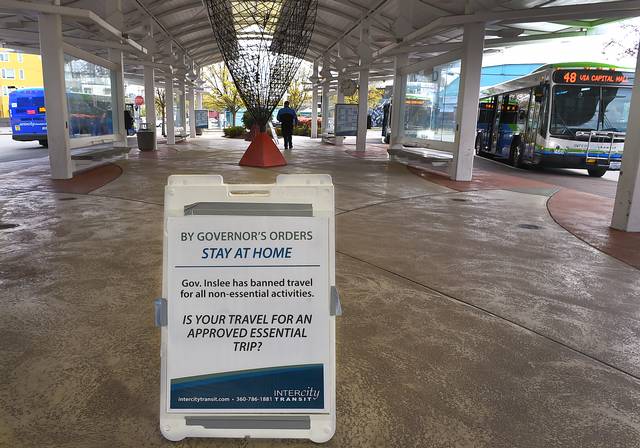
Intercity Transit will suspend its regular bus service and require advance reservations for people who need transportation for “essential trips” starting Monday, April 13, the agency announced Tuesday.
The public transportation agency, which serves Olympia, Lacey, Tumwater, and Yelm, cites Gov. Jay Inslee’s “Stay Home, Stay Healthy” emergency order in its announcement and says the move is aimed at limiting the risk of COVID-19 exposure for customers and employees.
The Olympia and Lacey transit centers will close to the public while regular bus service is paused, according to an IT press release. Dial-A-Lift, a door-to-door service for people with disabilities, will still be available for essential trips.
“We are absolutely committed to serving our customers and our community throughout this crisis,” said General Manager Ann Freeman-Manzanares in a prepared statement. “To do that in our current environment, we have to make adjustments to ensure the health and safety of our riders and our employees.”
Essential trips, according to the press release, include trips to grocery stores, pharmacies, and medical appointments, along with transportation for essential employees who work for essential businesses.
Representatives will be vetting trips to ensure they’re essential, according to IT.
When The Olympian asked via email whether trips would be considered essential for people experiencing homelessness who rely on public transit to get to the shelter where they stay or to support services, an IT spokesperson replied that the agency is coordinating with local social service providers.
“Intercity Transit is working closely with local social service providers to ensure the populations they serve — including, but not limited to, individuals with limited income, homeless populations, people with disabilities, the senior community — will be able to coordinate with us for essential trips under this new service delivery model with case-by-case flexibility,” spokesperson Nicky Upson wrote in an email.
Service providers can contact IT on a client’s behalf, Upson said.
Riders can make reservations two to five days in advance — not the day-of, according to the agency — and trips will run between 7 a.m. and 9:30 p.m.
The agency will use its many types of vehicles to complete the trips, it says, which will be detailed and disinfected each night. It plans to “re-evaluate whether fixed route service will be restored and to what level” when the end date for the governor’s order draws nearer. Last week, the governor extended his order to May 4.
HOW TO RESERVE A RIDE
Reservations can be made two to five days ahead of a trip by:
- Calling IT’s customer service line at 360-786-1881 between 8 a.m. and 5 p.m. Monday through Friday or 9 a.m. and 4 p.m. on weekends; or
- emailing DALdispatch@intercitytransit.com.
IT uses an interpreter service for customers with limited English proficiency, which allows it the ability to serve customers in over 200 languages, according to spokesperson Upson.
The agency asks people requesting rides to be ready to provide their names, phone numbers, addresses of origin and destination, and the time they would like a ride.
Riders can start making reservations Wednesday for the service, which starts Monday.
Posted in Uncategorized
Leave a comment
US Civil Rights Office Nixes Triage Death Squad Discrimination
Medical providers must not engage in “ruthless utilitarianism” in deciding who gets lifesaving treatment for the coronavirus, a federal civil rights officer warned.

“Our civil rights laws protect the equal dignity of every human life from ruthless utilitarianism,” said Roger Severino, the director of the Office for Civil Rights at the U.S. Department of Health and Human Services, in a news release on Saturday.
by Sheri Fink

Her article “The Deadly Choices at Memorial,” co-published by The New York Times Magazine and ProPublica, received a 2010 Pulitzer Prize for investigative reporting and a National Magazine Award for reporting.
Dr. Fink is the author of the New York Times best-selling book “Five Days at Memorial: Life and Death in a Storm-Ravaged Hospital” (Crown, 2013), about choices made in the aftermath of Hurricane Katrina.
A former relief worker in disaster and conflict zones, she received her M.D. and Ph.D. from Stanford University. Her first book, “War Hospital: A True Story of Surgery and Survival” (PublicAffairs), is about medical professionals under siege during the genocide in Srebrenica, Bosnia-Herzegovina. “Five Days at Memorial” was the winner of the National Book Critics Circle Award for nonfiction, the PEN/John Kenneth Galbraith Award for nonfiction and the J. Anthony Lukas Book Prize, among others.
Her website is www.sherifink.net. She loves to hear from readers and people with story ideas. Please get in touch!
March 28, 2020 — The director of the federal health department’s civil rights office said on Saturday that his office was opening a series of civil rights investigations to ensure that states did not allow medical providers to discriminate on the basis of disabilities, race, age or certain other factors when deciding who would receive lifesaving medical care during the coronavirus emergency.
The office released a new bulletin on civil rights during the coronavirus crisis, days after disability rights advocates filed complaints arguing that protocols to ration lifesaving medical care adopted by Alabama and Washington State were discriminatory.
“Our civil rights laws protect the equal dignity of every human life from ruthless utilitarianism,” Roger Severino, the office’s director, said in a news release. “Persons with disabilities, with limited English skills and older persons should not be put at the end of the line for health care during emergencies.”
Mr. Severino said in an interview that in response to multiple complaints, his office was opening the investigations to ensure that state-mandated rationing plans “are fully compliant with civil rights law.” He said his office had heard from “a broad spectrum of civil rights groups, pro-life groups, disability rights groups, from prominent members of Congress from both sides of the aisle, from ordinary people who are concerned about their civil rights in this time of crisis.”
The bulletin “represents an important first step in protecting the rights of people with disabilities in the current crisis,” said Ari Ne’eman, a visiting scholar at the Lurie Institute for Disability Policy at Brandeis University and a senior research associate at the Harvard Law School Project on Disability. He said there was an “urgent need for comprehensive guidance.”
Many states and hospitals are developing plans for how to ration care if the number of critically ill coronavirus patients exceeds capacity. Patients who develop severe respiratory distress from coronavirus infection often require support from mechanical ventilators for days to weeks; the machines are expected to be in short supply in the United States. In Italy, doctors have had to make wrenching choices about who gets them and who does not. While attempts are made to increase production of new ventilators and to expand hospital capacity, these plans lay out who will get care if those efforts are not able to meet the need.
Many of the plans would prioritize patients who were most likely to survive their immediate illness, and who also had a better chance of long-term survival when taking other factors into consideration. Some assign patients a score based on calculations of their level of illness, with decisions between patients who have the same score made by random selection.
Some plans instruct hospitals not to offer mechanical ventilators to people above a certain age or with particular health conditions.
In Alabama’s plan, people with “severe or profound mental retardation” as well as “moderate to severe dementia” should be considered “unlikely candidates for ventilator support” during a period of rationing. Washington’s guidance recommends that triage teams consider transferring hospital patients with “loss of reserves in energy, physical ability, cognition and general health” to outpatient or palliative care.
Dr. Kathy Lofy, the health officer of Washington State, said in an email, “We are very concerned that people believe our scarce resource guidance might discriminate against people with disabilities so we are in the process of setting up time to meet with disability advocacy groups to discuss their concerns.”
“The guidance in Washington around managing scarce resources during emergencies was largely designed to avoid discrimination during the allocation of scarce resource and involves a regional team to ensure resources are being allocated in a fair way,” Dr. Lofy said.
An emailed statement from the Alabama health department said that the state’s ventilator triage guidelines had been “greatly misunderstood” and were “solely intended as a tool for providers” making difficult choices. The statement said the document, which remained on its website on Saturday, was over a decade old and had since been replaced by a more comprehensive set of guidelines for health care emergencies. Those newer guidelines did not address ventilator triage, but said that the allocation of care should not be discriminatory.
Dr. Doug White, who published a proposed framework for rationing critical care in the Journal of the American Medical Association on Friday, said in a webinar that it was important to have “triage guidelines that don’t exclude groups of patients.” He said a score-based approach, endorsed by Pennsylvania, would allow as many patients to be treated as possible, so that “if suddenly 1,000 new ventilators become available, nobody’s sitting without a ventilator.”
Still, some citizen groups who have looked at draft protocols expressed fears that even using predicted survival to determine who would get access to resources — the most common strategy — might be inherently discriminatory.
In a report of a community exercise held in Seattle, some participants said they were concerned that using the likelihood of survival as a rationing criterion was problematic because some groups, such as African-Americans and immigrants, might have poorer health as a result of “institutional racism in the health care system.”
The plans typically include protocols for removing ventilators from people after a certain time period if they do not appear to be improving. In some states, including New York, people who required ventilators long-term, such as those who have certain spinal cord injuries, could be subject to having their ventilators reassigned under the protocol if they were admitted to hospitals during the crisis.
Many of the plans, even if they do not include outright age restrictions, consider stage of life as a factor in assigning ventilators or critical care beds. The civil rights office’s new statement might put that into question.
Mr. Severino said that his office was not telling states how to allocate care, but that the bulletin “puts entities on notice that they need to start considering the civil rights implications of any crisis standards of care plans they may be putting into effect if it were to come to that.”
“It has to be part of the discussion,” he continued.
If the country reached a point where health care rationing standards would be applied, Mr. Severino said, “those standards must comply with civil rights laws.”
“Ultimately the question as to resource allocation is not a scientific or medical one,” he added. “It is ultimately a moral and legal one.”
The bulletin had an important new legal provision. It said that a March 17 declaration by the Secretary of Health and Human Services that provided immunity from legal liability to those developing or using “medical countermeasures” to fight the disease might also provide some immunity from civil rights claims.
Mr. Ne’eman said that finding was “deeply concerning,” adding that “enforcement of our civil rights laws should never be called into question, even in the context of an emergency.”
Mr. Severino said he was “unaware” of any time in which the federal health authorities had placed any limitations on civil rights laws during an emergency. He referred questions about the provision to the Office of the General Counsel, which did not immediately respond to a request to comment on it.
“I want to make sure in this time of crisis, we don’t forget the foundational principles that are part of what makes America so special,” Mr. Severino said. “That we do care for everybody, that every person in America deserves equal dignity and respect.”
He added, “Our response will be a reflection of our national character.”
Posted in Uncategorized
Leave a comment
40%+ Americans<--COVID-19 & Triage Abattoir
Despite all the cheap rhetoric of protecting the most vulnerable, seniors and those with pre-existing medical conditions (who really are the MOST vulnerable) are actually being targeted for the dung heap under the euphemism of ‘triage’ by medical death squads in all but name only. As bad as all that is, it’s consistent with what has already been going on in most nursing homes for decades. Residents are visibly obsequious and fawning toward medical staff because they fully realize the difference between life & death can be as slight as how fast a nurse/CNA responds to the bedside help button. The contemporary COVID-19 triage protocols are even worse. If you’re over 65. and become infected with the virus, without an ICU slot, it’s a 95% likelihood YOU DIE! You’re deemed to be past your pull date…even if you’ve never missed a health insurance premium payment. You might as well hitch a ride on the nearest ice floe.
Imagine (not much of a stretch under current circumstances) the police or fire dept. refused to respond to your emergency because you were over 65 and they were out of water…had been low on water FOR YEARS! How would you feel if the perp who murdered your spouse was only sentenced to a few months because the victim was over 65? What if the library wouldn’t reserve books for you because your remaining years were discounted? Should seniors be permitted to vote or their ballots devalued proportionate to their actuarial life expectancy? Like infants, should seniors have fewer civil/human rights than their contemporaries? If so, where is the breakdown of their social contract’s demise codified? This all smacks of the ‘ethics’ of Nazi death camp procedures where the youngest, eldest and infirm were sent to the ovens first. Our hospitals have begun to resemble Nazi inspired abattoirs. The thought provokes dread rather than hope, their saintly nomenclatures now feel like obscenities.
In the Chinese city of Wuhan, the epicenter of the coronavirus pandemic, doctors made life-or-death decisions last month when 1,000 people needed ventilators to support their breathing, but only 600 were available.
In Iran, where numerous high-level officials have been infected, doctors sought unsuccessfully to get the international community to lift sanctions so they could purchase more of the lifesaving machines.
And in northern Italy, doctors last week took the painful step of issuing guidelines for rationing ventilators and other essential medical equipment, prioritizing the young and others with the best chance of survival.
Such tough choices couldd be ahead for the United States, a nation with limited hospital capacity and grim epidemiological projections estimating that as many as 40 per cent to 60 per cent of the country’s population of 327 million could eventually become infected.
“We are looking at a new war no one as seen before. We have never fought a virus like this with this potential consequence,” New York Gov. Andrew Cuomo said Sunday afternoon. He warned, “It is only a matter of time before ICU beds are full.”
The situation in the U.S. is more complicated than in many other nations due to this country’s diversity, deep political and economic divisions and decentralized decision-making. The Centers for Disease Control and Prevention has laid out general principles for how to allocate scarce resources in a pandemic response plan, but leaves most of the details to individual states and institutions. The result is a patchwork of approaches – with some states proposing broad ethical principles to determine need, and others assigning priority scores using detailed algorithms for patients based on their condition, preexisting health problems and age.

COVID-19 Robotic Sterilizer
In an extreme outbreak, rationing would raise tortured questions: Should someone with a terminal cancer or serious heart disease get more or less priority? Should the CEO of a hospital or a health worker be able to jump the queue? What about pregnant women? How should prisoners or undocumented immigrants be considered? All things being equal, would a lottery or coin flip be an equitable approach?
“These are really hard decisions,” said George Anesi, a critical-care specialist at the University of Pennsylvania. “In a public health emergency, you shift from a focus on individual patients to how society as a whole benefits and that’s a big change from usual care.”
For now, the number of U.S. cases is limited – 3,020 cases of confirmed coronavirus infections and 60 deaths as of Sunday – and hospitals still have capacity to handle more sick if the virus’s spread is slowed using strategies such as social distancing. But the situation is evolving quickly and experts say it’s impossible to predict how many people might become seriously ill and whether they could overwhelm the system’s capacity, as happened in parts of Italy, Iran and China.
Many of the state plans were written following the global devastation of the SARS outbreak in 2002 and Hurricane Katrina in 2005. Some are still in draft form, and none has never been activated in a real crisis. State health officials and hospital leaders say they have been urgently updating them in recent days to address the unique aspects of the pandemic.
Arthur Caplan, a bioethicist at NYU Langone Medical Center who has served on numerous national and international panels addressing resource allocation during Zika, Ebola, and avian flu outbreaks, said no single approach is more “right” than others. But he said that transparency is critical as the crisis develops.
“The public will accept triage and rationing if they understand the process,” Caplan said. “But if it’s secretive or looks like favoritism to politicians or the rich, they will not accept that – whatever the rules are.” [Oh, really? NOT here–NOT if you’re excluding me and my spouse and my neighbors and classmates–NOT by a long shot!] Seniors have no less right to life than any human!

While much about covid-19, the disease caused by the novel coronavirus, is still a mystery – its origin, how exactly it spreads – one thing doctors are sure about is how it kills. It attacks the lungs, leading to respiratory distress. And in these situations, access to oxygen therapy with a mask or nasal cannula for milder cases, or to mechanical ventilation for more severe illnesses can give a patient’s body time to fight the virus and mean the difference between life and death.
The earliest reports from China estimated that about 6% of patients needed ventilator support. But those numbers were misleading, experts says, because so many people never made it to hospitals, or were simply unable to gain access to ventilators. About 25% of those who died had been placed on ventilators.
Newer information from Italy in a March 4 email from University of Milan physicians Maurizio Cecconi, Antonio Pesenti, and Giacomo Grasselli to other critical care doctors around the world showed a much higher number – 10% – requiring mechanical ventilation.
“This happens like a bomb that explodes,” Grasselli said in an interview. “It happens all of a sudden and keeps growing and growing.”
Grasselli said that in his region there were barely enough ventilators and beds to go around but that many patients required 15 days to three weeks of ventilator support. “Clearly when resources are not enough for the number of patients, you have to prioritize patients who have the highest chance of survival,” he said.
The Italian critical-care society sanctioned the idea of placing age limits on access to intensive treatments, and said doctors should “privilege greater life expectancy.”

Angelo Pan, head of infectious disease at Italy’s Cremona hospital, said the high number of patients needing ventilators – about 25% of the 170 people with coronavirus at his hospital in early March – was straining resources.
“I don’t want to be too pessimistic,” Pan said, “but I think this is going to be a problem for all the health care systems.”
By many accounts, the United States is ill-prepared for a such a situation.
A 2005 federal government report estimated that in the event of a pandemic like the 1918 flu, the nation would need mechanical ventilators for 740,000 patients. Currently 160,000 ventilators are available for patient care, with at least an another 8,900 in the national stockpile, according to a February estimate by the Center for Health Security at Johns Hopkins.
Hospital officials and doctors interviewed in several states emphasized that rationing is a last resort and that they have begun to experiment with other ways to increase capacity.
Initially, they said, patients would likely be transferred from more crowded, urban facilities such as Johns Hopkins in Baltimore and the University of Pennsylvania Health System in Philadelphia, which routinely operate at 80% to 90% capacity, to community or rural hospitals that may have more intensive-care beds.
If the number of victims surges beyond that capacity, they say, they may try novel approaches such as having two patients on one ventilator. Tubing for ventilators, which is usually thrown out, could be sanitized and reused. Other types of hospital equipment, such as those used for sleep apnea, could be repurposed as makeshift ventilators. Only if those strategies fail and the sick continue to exceed capacity would rationing protocols be put into place. – – –
In normal times, U.S. hospitals operate mostly on a principle of first come, first served – “like getting concert tickets” as one clinician put it. In a mass casualty situation, this all goes out the door. Americans generally agree that in a crisis, the goal should be doing the greatest good. But that concept has shifted depending on the era, setting and culture. During World War II, the greatest good might have been getting soldiers back out to the front lines. When the Titanic hit an iceberg, it was all about saving the women and children, while the men were left to die on the sinking vessel. U.S. ethicists have historically talked about saving the most lives as doing the greatest good. But with greater recognition these days of factors such as quality of life and burdens on the health-care system, the discussion has shifted from maximizing lives saved to maximizing life years. Saving one child may outweigh the “good” of saving two elderly adults, according to the cold arithmetic of life expectancy. If a patient is not getting better, has little path to survival, at what point are we willing to move an intervention rather than lose two lives? Lee Daugherty Biddison, an associate professor of pulmonary and critical care at Johns Hopkins Medicine, said the idea is to give priority to those “most likely to live a long life after they got though the current epidemic”: “The thinking is, ‘Am I going to survive the flu to die of advanced cancer in three months?’ ”
Deciding between lives saved and life years is among the most tortured decisions that doctors will ever make, Anesi said. “Different value steps could push people to different decisions,” he said. Another tough call would be to take a ventilator away from one patient and move it to another, who may benefit more.
“If a patient is not getting better, has little path to survival, at what point are we willing to move an intervention rather than lose two lives?” he said.
Such questions are addressed in many state pandemic strategies, including New York state’s highly regarded 52-page planning document – which notes that the U.S. Department of Homeland Security “views pandemic influenza as both the most likely and most lethal of all threats facing the United States.”
Philip Rosoff, professor emeritus of at Duke University’s medical school and chair of its hospital ethics committee from 2005 to 2019, compared the New York strategy to a battlefield triage plan – except that in the latter there is a finite beginning and a reasonably finite end. But in the case of covid-19, he said, “no one really knows if and when this really ramps up.”
The plan’s basic outlines are simple and “fairly draconian,” Rosoff explained. “If you are in respiratory failure and there is a ventilator available and an ICU bed, and you meet certain medical criteria, you go on the ventilator. You have a certain amount of time to get better. If you don’t, we’ll take you off and give it to someone else.”
“If you take it off someone who is not doing very well,” he added, “the reality is they die.”
To avoid conflicts of interest and the emotional toll of life-or-death judgments, many state plans call for a senior, supervisory doctor or panel of doctors – similar to a “three wise men” protocol developed in Britain for this scenario – who is different from the one caring for the patient.
But state and hospital plans often vary widely in how they deal with issues such as a patient’s age.
Some states do not set specific age cutoffs for ventilators during rationing, while others explicitly exclude access for older people, with access barred to those ranging in age from 65 to 85. A Minnesota panel, for instance, recommended prioritizing children over adults, and young adults over older adults, while the New York group did not use age as a criteria alone.
Most plans include a list of serious conditions that would exclude someone from getting a ventilator if rationing were in effect, and many conditions are more common in the elderly, such as severe cardiac issues, kidney failure, and metastatic cancer.
In Maryland, avoiding discrimination is a major concern for those who drafted the guidelines, Daugherty Biddison said. She explained that disasters – epidemics, wars and attacks – tend to exacerbate society’s inequalities and in discussions about how to ration resources, there’s been tension among politicians, the public and ethicists about how to protect vulnerable groups.
A person with advanced diabetes is likely to have a shorter life span than someone with well-controlled diabetes. However that may be because the second person has greater access to medical care.
“So if you were to say, ‘Look, you are unwell because of diabetes and you’re also not going to get a ventilator,’ you are double penalizing someone who didn’t have access to care,” Daugherty Biddison said.
So while New York’s guidelines exclude people with renal failure from getting ventilator support in an emergency, Maryland’s guidelines include them in the pool of people who would be eligible.
There’s also variation in whether health-care personnel get priority. New York’s working group felt strongly that health care workers should not be prioritized because the group is so large that it would result in denying access to everyone else, including children. – – –
The most painful cases, providers acknowledge, are situations in which a patient will be taken off a ventilator or will not get one.
Rosoff from Duke believes that part of planning for a larger coronavirus outbreak in the United States should involve ensuring comfort to dying people who will go without the benefit of advanced intensive care. Such situations could be especially agonizing as family members may be absent due to the risk of contagion.
“We have very effective means of making that a comfortable, peaceful death,” he said, citing things such as supplemental oxygen, morphine, chaplains and people trained to talk to those nearing death.
Daugherty Biddison said transparency about how care may be rationed in a pandemic situation may change how doctors talk with their patients about end-of-life decisions.
“I don’t think there will be a scenario where someone will say, ‘Do you want a ventilator or should I give it to a 6-year-old?’ That’s not going to happen,” she said. “But I do think if you’re in this situation, at least people can contextualize their stress on the system and can make a decision accordingly.”
– – – The Washington Post’s Loveday Morris in Lodi, Italy, Tiffany Leung in Hong Kong and Magda Jean-Louis contributed to this report.
Posted in Uncategorized
Leave a comment
COVID-19 Death Squads Target Seniors
Washington (3-25-20) — It’s time for some uncomfortable truths and frank warnings/talk about seniors, survival, the human condition, and the God complex infecting some public officials as surely as COVID-19 itself. This panic run amok has begun to appear in bizarre pernicious public euphemisms (“triage”) reminiscent of the 3rd Reich’s ‘Final Solution’.
Make no mistake about it, they’re talking about US–at least if you’re older than 65. Lord Of The Flies has assumed the mantle of government and intends to herd seniors into the abattoir with the medical establishment’s blessing. Like geriatric layers, we’re considered past our pull dates. It’s a scene straight out of Logan’s Run coming very soon to a hospital near you. It may not be Soylent Green exactly, but the dead fail to notice such fine distinctions, Moreover, it reveals a deep crevasse and moral hazard in the national character of America which, historically, has always shown its most ugly profile in a crisis. We’re now being told there isn’t room or resources enough for American seniors. Like the Inuit of old, the seniors will have to go onto the nearest ice floe.
An NPR reporter was interviewing a professor of medicine at Johns Hopkins. The question arose of what strategy would be deployed to combat the COVID-19 pandemic given our long anticipated catastrophic failure to have sufficient ICU beds, ventilators, gloves, masks, or adequate protocols in place to meet such a national emergency. “Triage,” she opined. “Seniors over 65yo will be denied ICU bed space without which they had a 95% chance of dying at such a critical stage. Even with ICU ventilator therapy, the odds were no better than 50% survival and a residual 30% permanent reduction in lung capacity.”
“But who will inform the elderly patients of this fate?–their attending physician?” the reporter asked incredulously.
“No. That will be assigned to a special team of triage experts who will evaluate the patient’s number of life years, stages of life lived, and value regardless of the contractual obligations the medical establishment/hospital/health care provider might legally owe the patient,” she predicted.
“Will doctors/health care workers be given extra consideration as critical occupations?” the journalist asked.
“Perhaps not,” she said. “After all, their full recovery may take longer than the curve of the crisis itself–thus their utility might well be considered limited under those circumstances.”
It was a disturbing exchange to hear. But let’s get a realistic perspective on this megalomaniacal proposal and be perfectly blunt: EITHER WE ARE ALL IN THIS TOGETHER, OR WE ARE NOT!
It is one thing to propose an unavoidable lottery such as we had for the draft during Nixon’s administration. It is entirely another to deliberately choose which group/race/gender/creed will live or die like some Nazi death camp guard for new arrivals sent to the ovens. Moreover, we’re constantly instructed to be honorable–to behave in a way that protects others as much as ourselves as part of our social duty in the face of a common enemy.
Well, selective abandonment and death squads in all but name only IS A CARDINAL VIOLATION OF THAT SOCIAL CONTRACT. If seniors are not going to be provided protection from the problem, then you’ve eliminated much of the incentive for them to be part of the solution. This planned ‘final solution’ won’t do for a designer virus apparently already engineered to target the elderly or immune-compromised AND MALES (at double the rate of females) IN EVERY AGE RANGE. What a coincidence! And now our social engineering Nazi mimics want to amplify said targeting by targeting seniors in the throes of our current crisis?
Most seniors/pensioners have worked their entire lives for the guarantee of a stipend and reasonable health care in their final years. It’s called a CONTRACT–A binding contract. It’s a violation of the most fundamental rights to change the rules after the dye is cast. Seniors cannot start over. Reneging on the deal they bargained and worked for is beyond deplorable. It is unconscionable. It is theft and virtual manslaughter.
Under such dystopian totalitarianism and lethal agism, seniors just might decide to abandon their gloves and face masks in pulic–Devil take the hindmost. Those face masks tend to protect others more than the wearer in any event. Seniors can always wait until they get home to wash their hands while avoiding touching their face. In the meantime, they can slime freely on every available public surface. Public officials are already announcing their lives are worthless in this viral crisis. If that’s the case, this is truly the beginning of the end and society will suffer a self induced lobotomy in the bargain.
Choose carefully before sacrificing seniors. The blowback may involve unintended consequences of Biblical proportions beyond your imagination. Oppression (and death) breed resistance. And seniors are not alone. Many have families who love them that will pursue the executioners/death squads. i.e. Honor thy mother and thy father.
Posted in Uncategorized
Leave a comment
Spain’s Military Finds Dead Bodies & Seniors ‘Completely Abandoned’ In Care Homes

Madrid (3-24-20)–The Spanish military has found older residents of some care homes “completely abandoned” and even “dead in their beds,” Defense Minister Margarita Roblessaid in a television interview on Monday.
They were found as soldiers disinfected and provided emergency health care services this week to residential homes across the country. Robles did not give an exact figure for the number of dead bodies found by Spanish soldiers.
With more than 39,000 confirmed cases of COVID-19 and 2,800 deaths as of Tuesday, Spain is the second hardest-hit country in Europe.
On Tuesday, 514 new deaths were registered in a 24-hour period, the worst increase since the outbreak began. Retirement homes have been particularly affected.
Last week, one privately owned home in Madrid reported 20 deaths and 75 infections, claiming it didn’t have adequate material to take care of the sick residents and dead bodies.
While the usual protocol in Spanish nursing homes is to put the body of a deceased person in cold storage until a funeral service picks it up, bodies are now being left in beds until properly equipped staff can remove them.
Speaking in a television interview, Robles said staff in some centers had left the nursing homes after cases of COVID-19 were detected. Residents were abandoned to take care of themselves, even though some were sick and in serious condition.
The defense minister said the government will take action against those responsible. “We will be completely relentless and forceful with the kind of treatment elderly residents receive in these centers,” Robles said. “I know that a vast majority [of centers] are fulfilling their obligations.”
Meanwhile, Spanish prosecutors have launched an investigation into the incidents. In Spain, around 19% of the population is older than 65; the country has one of the longest life expectancies in the world.
Health Minister Salvador Illa said residential care homes are “a high priority during this time” for the Spanish government, and it will exert “maximum control” over these centers.
Prime Minister Pedro Sánchez has called for the nationalization of all privately owned nursing homes, just as he had previously called for the nationalization of private hospitals, to help ensure better access as well as adequate staff and equipment. Over the weekend, Spain’s Defense Ministry made thousands of phone calls to seniors living alone or in vulnerable situations to assess their health.
Posted in Uncategorized
Leave a comment
COVID-19 destined to be recurring fact of life?
by Tomas Pueyo (3-19-20)

2 MSc in Engineering. Stanford MBA. Ex-Consultant. Creator of viral applications with >20M users. Currently leading a billion-dollar business @ Course Hero
What the Next 18 Months Can Look Like, if Leaders Buy Us Time

This article follows Coronavirus: Why You Must Act Now, with over 40 million views and 30 translations. If you agree with this article, consider signing the corresponding White House petition. Translations available in 27 languages at the bottom. Running list of endorsements here. 5 million views so far.
Summary of the article: Strong coronavirus measures today should only last a few weeks, there shouldn’t be a big peak of infections afterwards, and it can all be done for a reasonable cost to society, saving millions of lives along the way. If we don’t take these measures, tens of millions will be infected, many will die, along with anybody else that requires intensive care, because the healthcare system will have collapsed.
Within a week, countries around the world have gone from: “This coronavirus thing is not a big deal” to declaring the state of emergency. Yet many countries are still not doing much. Why?
Every country is asking the same question: How should we respond? The answer is not obvious to them.
Some countries, like France, Spain or Philippines, have since ordered heavy lockdowns. Others, like the US, UK, or Switzerland, have dragged their feet, hesitantly venturing into social distancing measures.
Here’s what we’re going to cover today, again with lots of charts, data and models with plenty of sources:
- What’s the current situation?
- What options do we have?
- What’s the one thing that matters now: Time
- What does a good coronavirus strategy look like?
- How should we think about the economic and social impacts?
When you’re done reading the article, this is what you’ll take away:
Our healthcare system is already collapsing.
Countries have two options: either they fight it hard now, or they will suffer a massive epidemic.
If they choose the epidemic, hundreds of thousands will die. In some countries, millions.
And that might not even eliminate further waves of infections.
If we fight hard now, we will curb the deaths.
We will relieve our healthcare system.
We will prepare better.
We will learn.
The world has never learned as fast about anything, ever.
And we need it, because we know so little about this virus.
All of this will achieve something critical: Buy Us Time.
If we choose to fight hard, the fight will be sudden, then gradual.
We will be locked in for weeks, not months.
Then, we will get more and more freedoms back.
It might not be back to normal immediately.
But it will be close, and eventually back to normal.
And we can do all that while considering the rest of the economy too.
Ok, let’s do this.
1. What’s the situation?
Last week, this curve was published:

It showed coronavirus cases across the world outside of China. We could only discern Italy, Iran and South Korea. So I had to zoom in on the bottom right corner to see the emerging countries. My entire point is that they would soon be joining these 3 cases.
Let’s see what has happened since.

As predicted, the number of cases has exploded in dozens of countries. Here, I was forced to show only countries with over 1,000 cases. A few things to note:
- Spain, Germany, France and the US all have more cases than Italy when it ordered the lockdown
- An additional 16 countries have more cases today than Hubei when it went under lockdown: Japan, Malaysia, Canada, Portugal, Australia, Czechia, Brazil and Qatar have more than Hubei but below 1,000 cases. Switzerland, Sweden, Norway, Austria, Belgium, Netherlands and Denmark all have above 1,000 cases.
Do you notice something weird about this list of countries? Outside of China and Iran, which have suffered massive, undeniable outbreaks, and Brazil and Malaysia, every single country in this list is among the wealthiest in the world.
Do you think this virus targets rich countries? Or is it more likely that rich countries are better able to identify the virus?
It’s unlikely that poorer countries aren’t touched. Warm and humid weather probably helps, but doesn’t prevent an outbreak by itself — otherwise Singapore, Malaysia or Brazil wouldn’t be suffering outbreaks.
The most likely interpretations are that the coronavirus either took longer to reach these countries because they’re less connected, or it’s already there but these countries haven’t been able to invest enough on testing to know.
Either way, if this is true, it means that most countries won’t escape the coronavirus. It’s a matter of time before they see outbreaks and need to take measures.
What measures can different countries take?
2. What Are Our Options?
Since the article last week, the conversation has changed and many countries have taken measures. Here are some of the most illustrative examples:
Measures in Spain and France
In one extreme, we have Spain and France. This is the timeline of measures for Spain:On Thursday, 3/12, the President dismissed suggestions that the Spanish authorities had been underestimating the health threat.
On Friday, they declared the State of Emergency.
On Saturday, measures were taken:
- People can’t leave home except for key reasons: groceries, work, pharmacy, hospital, bank or insurance company (extreme justification)
- Specific ban on taking kids out for a walk or seeing friends or family (except to take care of people who need help, but with hygiene and physical distance measures)
- All bars and restaurants closed. Only take-home acceptable.
- All entertainment closed: sports, movies, museums, municipal celebrations…
- Weddings can’t have guests. Funerals can’t have more than a handful of people.
- Mass transit remains open
On Monday, land borders were shut.
Some people see this as a great list of measures. Others put their hands up in the air and cry of despair. This difference is what this article will try to reconcile.
France’s timeline of measures is similar, except they took more time to apply them, and they are more aggressive now. For example, rent, taxes and utilities are suspended for small businesses.
Measures in the US and UK
The US and UK, like countries such as Switzerland, have dragged their feet in implementing measures. Here’s the timeline for the US:
- Wednesday 3/11: travel ban.
- Friday: National Emergency declared. No social distancing measures
- Monday: the government urges the public to avoid restaurants or bars and attend events with more than 10 people. No social distancing measure is actually enforceable. It’s just a suggestion.
Lots of states and cities are taking the initiative and mandating much stricter measures.
The UK has seen a similar set of measures: lots of recommendations, but very few mandates.
These two groups of countries illustrate the two extreme approaches to fight the coronavirus: mitigation and suppression. Let’s understand what they mean.
Option 1: Do Nothing
Before we do that, let’s see what doing nothing would entail for a country like the US:

This fantastic epidemic calculator can help you understand what will happen under different scenarios. Below the graph, I’ve pasted the key factors that determine the behavior of the virus. Note that infected, in pink, peak in the tens of millions at a certain date. Most variables have been kept from the default. The only material changes are R from 2.2 to 2.4 (corresponds better to currently available information. See at the bottom of the epidemic calculator), fatality rate (4% due to healthcare system collapse. See details below or in the previous article), length of hospital stay (down from 20 to 10 days) and hospitalization rate (down from 20% to 14% based on severe and critical cases. Note the WHO calls out a 20% rate) based on our most recently available gathering of research. Note that these numbers don’t change results much. The only change that matters is the fatality rate.
If we do nothing: Everybody gets infected, the healthcare system gets overwhelmed, the mortality explodes, and ~10 million people die (blue bars). For the back-of-the-envelope numbers: if ~75% of Americans get infected and 4% die, that’s 10 million deaths, or around 25 times the number of US deaths in World War II.
You might wonder: “That sounds like a lot. I’ve heard much less than that!”
So what’s the catch? With all these numbers, it’s easy to get confused. But there’s only two numbers that matter: What share of people will catch the virus and fall sick, and what share of them will die. If only 25% are sick (because the others have the virus but don’t have symptoms so aren’t counted as cases), and the fatality rate is 0.6% instead of 4%, you end up with 500k deaths in the US.
If we don’t do anything, the number of deaths from the coronavirus will probably land between these two numbers. The chasm between these extremes is mostly driven by the fatality rate, so understanding it better is crucial. What really causes the coronavirus deaths?
How Should We Think about the Fatality Rate?
This is the same graph as before, but now looking at hospitalized people instead of infected and dead:

The light blue area is the number of people who would need to go to the hospital, and the darker blue represents those who need to go to the intensive care unit (ICU). You can see that number would peak at above 3 million.
Now compare that to the number of ICU beds we have in the US (50k today, we could double that repurposing other space). That’s the red dotted line.
No, that’s not an error.
That red dotted line is the capacity we have of ICU beds. Everyone above that line would be in critical condition but wouldn’t be able to access the care they need, and would likely die.
Instead of ICU beds you can also look at ventilators, but the result is broadly the same, since there are fewer than 100k ventilators in the US.
This is why people died in droves in Hubei and are now dying in droves in Italy and Iran. The Hubei fatality rate ended up better than it could have been because they built 2 hospitals nearly overnight. Italy and Iran can’t do the same; few, if any, other countries can. We’ll see what ends up happening there.
So why is the fatality rate close to 4%?
If 5% of your cases require intensive care and you can’t provide it, most of those people die. As simple as that.
Additionally, recent data suggests that US cases are more severe than in China.
I wish that was all, but it isn’t.
Collateral Damage
These numbers only show people dying from coronavirus. But what happens if all your healthcare system is collapsed by coronavirus patients? Others also die from other ailments.
What happens if you have a heart attack but the ambulance takes 50 minutes to come instead of 8 (too many coronavirus cases) and once you arrive, there’s no ICU and no doctor available? You die.
There are 4 million admissions to the ICU in the US every year, and 500k (~13%) of them die. Without ICU beds, that share would likely go much closer to 80%. Even if only 50% died, in a year-long epidemic you go from 500k deaths a year to 2M, so you’re adding 1.5M deaths, just with collateral damage.
If the coronavirus is left to spread, the US healthcare system will collapse, and the deaths will be in the millions, maybe more than 10 million.
The same thinking is true for most countries. The number of ICU beds and ventilators and healthcare workers are usually similar to the US or lower in most countries. Unbridled coronavirus means healthcare system collapse, and that means mass death.
Unbridled coronavirus means healthcare systems collapse, and that means mass death.
By now, I hope it’s pretty clear we should act. The two options that we have are mitigation and suppression. Both of them propose to “flatten the curve”, but they go about it very differently.
Option 2: Mitigation Strategy
Mitigation goes like this: “It’s impossible to prevent the coronavirus now, so let’s just have it run its course, while trying to reduce the peak of infections. Let’s just flatten the curve a little bit to make it more manageable for the healthcare system.”

This chart appears in a very important paper published over the weekend from the Imperial College London. Apparently, it pushed the UK and US governments to change course.
It’s a very similar graph as the previous one. Not the same, but conceptually equivalent. Here, the “Do Nothing” situation is the black curve. Each one of the other curves are what would happen if we implemented tougher and tougher social distancing measures. The blue one shows the toughest social distancing measures: isolating infected people, quarantining people who might be infected, and secluding old people. This blue line is broadly the current UK coronavirus strategy, although for now they’re just suggesting it, not mandating it.
Here, again, the red line is the capacity for ICUs, this time in the UK. Again, that line is very close to the bottom. All that area of the curve on top of that red line represents coronavirus patients who would mostly die because of the lack of ICU resources.
Not only that, but by flattening the curve, the ICUs will collapse for months, increasing collateral damage.
You should be shocked. When you hear: “We’re going to do some mitigation” what they’re really saying is: “We will knowingly overwhelm the healthcare system, driving the fatality rate up by a factor of 10x at least.”
You would imagine this is bad enough. But we’re not done yet. Because one of the key assumptions of this strategy is what’s called “Herd Immunity”.
Herd Immunity and Virus Mutation
The idea is that all the people who are infected and then recover are now immune to the virus. This is at the core of this strategy: “Look, I know it’s going to be hard for some time, but once we’re done and a few million people die, the rest of us will be immune to it, so this virus will stop spreading and we’ll say goodbye to the coronavirus. Better do it at once and be done with it, because our alternative is to do social distancing for up to a year and risk having this peak happen later anyways.”
Except this assumes one thing: the virus doesn’t change too much. If it doesn’t change much, then lots of people do get immunity, and at some point the epidemic dies down
How likely is this virus to mutate?
It seems it already has.

This graph represents the different mutations of the virus. You can see that the initial strains started in purple in China and then spread. Each time you see a branching on the left graph, that is a mutation leading to a slightly different variant of the virus.
This should not be surprising: RNA-based viruses like the coronavirus or the flu tend to mutate around 100 times faster than DNA-based ones—although the coronavirus mutates more slowly than influenza viruses.
Not only that, but the best way for this virus to mutate is to have millions of opportunities to do so, which is exactly what a mitigation strategy would provide: hundreds of millions of people infected.
That’s why you have to get a flu shot every year. Because there are so many flu strains, with new ones always evolving, the flu shot can never protect against all strains.
Put in another way: the mitigation strategy not only assumes millions of deaths for a country like the US or the UK. It also gambles on the fact that the virus won’t mutate too much — which we know it does. And it will give it the opportunity to mutate. So once we’re done with a few million deaths, we could be ready for a few million more — every year. This corona virus could become a recurring fact of life, like the flu, but many times deadlier.
The best way for this virus to mutate is to have millions of opportunities to do so, which is exactly what a mitigation strategy would provide.
So if neither doing nothing and mitigation will work, what’s the alternative? It’s called suppression.
Option 3: Suppression Strategy
The Mitigation Strategy doesn’t try to contain the epidemic, just flatten the curve a bit. Meanwhile, the Suppression Strategy tries to apply heavy measures to quickly get the epidemic under control. Specifically:
- Go hard right now. Order heavy social distancing. Get this thing under control.
- Then, release the measures, so that people can gradually get back their freedoms and something approaching normal social and economic life can resume.
What does that look like?

All the model parameters are the same, except that there is an intervention around now to reduce the transmission rate to R=0.62, and because the healthcare system isn’t collapsed, the fatality rate goes down to 0.6%. I defined “around now” as having ~32,000 cases when implementing the measures (3x the official number as of today, 3/19). Note that this is not too sensitive to the R chosen. An R of 0.98 for example shows 15,000 deaths. Five times more than with an R of 0.62, but still tens of thousands of deaths and not millions. It’s also not too sensitive to the fatality rate: if it’s 0.7% instead of 0.6%, the death toll goes from 15,000 to 17,000. It’s the combination of a higher R, a higher fatality rate, and a delay in taking measures that explodes the number of fatalities. That’s why we need to take measures to reduce R today. For clarification, the famous R0 is R at the beginning (R at time 0). It’s the transmission rate when nobody is immune yet and there are no measures against it taken. R is the overall transmission rate.
Under a suppression strategy, after the first wave is done, the death toll is in the thousands, and not in the millions.
Why? Because not only do we cut the exponential growth of cases. We also cut the fatality rate since the healthcare system is not completely overwhelmed. Here, I used a fatality rate of 0.9%, around what we’re seeing in South Korea today, which has been most effective at following Suppression Strategy.
Said like this, it sounds like a no-brainer. Everybody should follow the Suppression Strategy.
So why do some governments hesitate?
They fear three things:
- This first lockdown will last for months, which seems unacceptable for many people.
- A months-long lockdown would destroy the economy.
- It wouldn’t even solve the problem, because we would be just postponing the epidemic: later on, once we release the social distancing measures, people will still get infected in the millions and die.
Here is how the Imperial College team modeled suppressions. The green and yellow lines are different scenarios of Suppression. You can see that doesn’t look good: We still get huge peaks, so why bother?

We’ll get to these questions in a moment, but there’s something more important before.
This is completely missing the point.
Presented like these, the two options of Mitigation and Suppression, side by side, don’t look very appealing. Either a lot of people die soon and we don’t hurt the economy today, or we hurt the economy today, just to postpone the deaths.
This ignores the value of time.
3. The Value of Time
In our previous post, we explained the value of time in saving lives. Every day, every hour we waited to take measures, this exponential threat continued spreading. We saw how a single day could reduce the total cases by 40% and the death toll by even more. But time is even more valuable than that.
We’re about to face the biggest wave of pressure on the healthcare system ever seen in history. We are completely unprepared, facing an enemy we don’t know. That is not a good position for war.
What if you were about to face your worst enemy, of which you knew very little, and you had two options: Either you run towards it, or you escape to buy yourself a bit of time to prepare. Which one would you choose?
This is what we need to do today. The world has awakened. Every single day we delay the coronavirus, we can get better prepared. The next sections detail what that time would buy us:
Lower the Number of Cases
With effective suppression, the number of true cases would plummet overnight, as we saw in Hubei last week.

As of today, there are 0 daily new cases of coronavirus in the entire 60 million-big region of Hubei.
The diagnostics would keep going up for a couple of weeks, but then they would start going down. With fewer cases, the fatality rate starts dropping too. And the collateral damage is also reduced: fewer people would die from non-coronavirus-related causes because the healthcare system is simply overwhelmed.
Suppression would get us:
- Fewer total cases of Coronavirus
- Immediate relief for the healthcare system and the humans who run it
- Reduction in fatality rate
- Reduction in collateral damage
- Ability for infected, isolated and quarantined healthcare workers to get better and back to work. In Italy, healthcare workers represent 8% of all contagions.
Understand the True Problem: Testing and Tracing
Right now, the UK and the US have no idea about their true cases. We don’t know how many there are. We just know the official number is not right, and the true one is in the tens of thousands of cases. This has happened because we’re not testing, and we’re not tracing.
- With a few more weeks, we could get our testing situation in order, and start testing everybody. With that information, we would finally know the true extent of the problem, where we need to be more aggressive, and what communities are safe to be released from a lockdown.
- New testing methods could speed up testing and drive costs down substantially.
- We could also set up a tracing operation like the ones they have in China or other East Asia countries, where they can identify all the people that every sick person met, and can put them in quarantine. This would give us a ton of intelligence to release later on our social distancing measures: if we know where the virus is, we can target these places only. This is not rocket science: it’s the basics of how East Asia Countries have been able to control this outbreak without the kind of draconian social distancing that is increasingly essential in other countries.
The measures from this section (testing and tracing) single-handedly curbed the growth of the coronavirus in South Korea and got the epidemic under control, without a strong imposition of social distancing measures.
Build Up Capacity
The US (and presumably the UK) are about to go to war without armor.
We have masks for just two weeks, few personal protective equipments (“PPE”), not enough ventilators, not enough ICU beds, not enough ECMOs (blood oxygenation machines)… This is why the fatality rate would be so high in a mitigation strategy.
But if we buy ourselves some time, we can turn this around:
- We have more time to buy equipment we will need for a future wave
- We can quickly build up our production of masks, PPEs, ventilators, ECMOs, and any other critical device to reduce fatality rate.
Put in another way: we don’t need years to get our armor, we need weeks. Let’s do everything we can to get our production humming now. Countries are mobilized. People are being inventive, such as using 3D printing for ventilator parts. We can do it. We just need more time. Would you wait a few weeks to get yourself some armor before facing a mortal enemy?
This is not the only capacity we need. We will need health workers as soon as possible. Where will we get them? We need to train people to assist nurses, and we need to get medical workers out of retirement. Many countries have already started, but this takes time. We can do this in a few weeks, but not if everything collapses.
Lower Public Contagiousness
The public is scared. The coronavirus is new. There’s so much we don’t know how to do yet! People haven’t learned to stop hand-shaking. They still hug. They don’t open doors with their elbow. They don’t wash their hands after touching a door knob. They don’t disinfect tables before sitting.
Once we have enough masks, we can use them outside of the healthcare system too. Right now, it’s better to keep them for healthcare workers. But if they weren’t scarce, people should wear them in their daily lives, making it less likely that they infect other people when sick, and with proper training also reducing the likelihood that the wearers get infected. (In the meantime, wearing something is better than nothing.)
All of these are pretty cheap ways to reduce the transmission rate. The less this virus propagates, the fewer measures we’ll need in the future to contain it. But we need time to educate people on all these measures and equip them.
Understand the Virus
We know very very little about the virus. But every week, hundreds of new papers are coming.

The world is finally united against a common enemy. Researchers around the globe are mobilizing to understand this virus better.
How does the virus spread?
How can contagion be slowed down?
What is the share of asymptomatic carriers?
Are they contagious? How much?
What are good treatments?
How long does it survive?
On what surfaces?
How do different social distancing measures impact the transmission rate?
What’s their cost?
What are tracing best practices?
How reliable are our tests?
Clear answers to these questions will help make our response as targeted as possible while minimizing collateral economic and social damage. And they will come in weeks, not years.
Find Treatments
Not only that, but what if we found a treatment in the next few weeks? Any day we buy gets us closer to that. Right now, there are already several candidates, such as Favipiravir, Chloroquine, or Chloroquine combined with Azithromycin. What if it turned out that in two months we discovered a treatment for the coronavirus? How stupid would we look if we already had millions of deaths following a mitigation strategy?
Understand the Cost-Benefits
All of the factors above can help us save millions of lives. That should be enough. Unfortunately, politicians can’t only think about the lives of the infected. They must think about all the population, and heavy social distancing measures have an impact on others.
Right now we have no idea how different social distancing measures reduce transmission. We also have no clue what their economic and social costs are.
Isn’t it a bit difficult to decide what measures we need for the long term if we don’t know their cost or benefit?
A few weeks would give us enough time to start studying them, understand them, prioritize them, and decide which ones to follow.
Fewer cases, more understanding of the problem, building up assets, understanding the virus, understanding the cost-benefit of different measures, educating the public… These are some core tools to fight the virus, and we just need a few weeks to develop many of them. Wouldn’t it be dumb to commit to a strategy that throws us instead, unprepared, into the jaws of our enemy?
4. The Hammer and the Dance
Now we know that the Mitigation Strategy is probably a terrible choice, and that the Suppression Strategy has a massive short-term advantage.
But people have rightful concerns about this strategy:
- How long will it actually last?
- How expensive will it be?
- Will there be a second peak as big as if we didn’t do anything?
Here, we’re going to look at what a true Suppression Strategy would look like. We can call it the Hammer and the Dance.
The Hammer
First, you act quickly and aggressively. For all the reasons we mentioned above, given the value of time, we want to quench this thing as soon as possible.

One of the most important questions is: How long will this last?
The fear that everybody has is that we will be locked inside our homes for months at a time, with the ensuing economic disaster and mental breakdowns. This idea was unfortunately entertained in the famous Imperial College paper:

Do you remember this chart? The light blue area that goes from end of March to end of August is the period that the paper recommends as the Hammer, the initial suppression that includes heavy social distancing.
If you’re a politician and you see that one option is to let hundreds of thousands or millions of people die with a mitigation strategy and the other is to stop the economy for five months before going through the same peak of cases and deaths, these don’t sound like compelling options.
But this doesn’t need to be so. This paper, driving policy today, has been brutally criticized for core flaws: They ignore contact tracing (at the core of policies in South Korea, China or Singapore among others) or travel restrictions (critical in China), ignore the impact of big crowds…
The time needed for the Hammer is weeks, not months.

This graph shows the new cases in the entire Hubei region (60 million people) every day since 1/23. Within 2 weeks, the country was starting to get back to work. Within ~5 weeks it was completely under control. And within 7 weeks the new diagnostics was just a trickle. Let’s remember this was the worst region in China.
Remember again that these are the orange bars. The grey bars, the true cases, had plummeted much earlier (see Chart 9).
The measures they took were pretty similar to the ones taken in Italy, Spain or France: isolations, quarantines, people had to stay at home unless there was an emergency or had to buy food, contact tracing, testing, more hospital beds, travel bans…
Details matter, however.
China’s measures were stronger. For example, people were limited to one person per household allowed to leave home every three days to buy food. Also, their enforcement was severe. It is likely that this severity stopped the epidemic faster.
In Italy, France and Spain, measures were not as drastic, and their implementation is not as tough. People still walk on the streets, many without masks. This is likely to result in a slower Hammer: more time to fully control the epidemic.
Some people interpret this as “Democracies will never be able to replicate this reduction in cases”. That’s wrong.
For several weeks, South Korea had the worst epidemic outside of China. Now, it’s largely under control. And they did it without asking people to stay home. They achieved it mostly with very aggressive testing, contact tracing, and enforced quarantines and isolations.
The following table gives a good sense of what measures different countries have followed, and how that has impacted them (this is a work-in-progress. Feedback welcome.)

This shows how countries who were prepared, with stronger epidemiological authority, education on hygiene and social distancing, and early detection and isolation, didn’t have to pay with heavier measures afterwards.
Conversely, countries like Italy, Spain or France weren’t doing these well, and had to then apply the Hammer with the hard measures at the bottom to catch up.
The lack of measures in the US and UK is in stark contrast, especially in the US. These countries are still not doing what allowed Singapore, South Korea or Taiwan to control the virus, despite their outbreaks growing exponentially. But it’s a matter of time. Either they have a massive epidemic, or they realize late their mistake, and have to overcompensate with a heavier Hammer. There is no escape from this.
But it’s doable. If an outbreak like South Korea’s can be controlled in weeks and without mandated social distancing, Western countries, which are already applying a heavy Hammer with strict social distancing measures, can definitely control the outbreak within weeks. It’s a matter of discipline, execution, and how much the population abides by the rules.
Once the Hammer is in place and the outbreak is controlled, the second phase begins: the Dance.
The Dance
If you hammer the coronavirus, within a few weeks you’ve controlled it and you’re in much better shape to address it. Now comes the longer-term effort to keep this virus contained until there’s a vaccine.

This is probably the single biggest, most important mistake people make when thinking about this stage: they think it will keep them home for months. This is not the case at all. In fact, it is likely that our lives will go back to close to normal.
The Dance in Successful Countries
How come South Korea, Singapore, Taiwan and Japan have had cases for a long time, in the case of South Korea thousands of them, and yet they’re not locked down home?
Coronavirus: South Korea seeing a ‘stabilizing trend’
Speaking to the BBC’s Andrew Marr, the South Korean Foreign Minister, Kang Kyung-wha, says she thinks extensive testing has been the key to South Korea’s low coronovirus fatality rate, and that governments have the responsibility to “guard against panic”.
https://www.bbc.com/news/av/world-asia-51897979/coronavirus-south-korea-seeing-a-stabilising-trend
In the above video, the South Korea Foreign Minister explains how her country did it. It was pretty simple: efficient testing, efficient tracing, travel bans, efficient isolating and efficient quarantining.
This paper explains Singapore’s approach:
https://academic.oup.com/jtm/advance-article/doi/10.1093/jtm/taaa039/5804843
Want to guess their measures? The same ones as in South Korea. In their case, they complemented with economic help to those in quarantine and travel bans and delays.
Is it too late for these countries and others? No. By applying the Hammer, they’re getting a new chance, a new shot at doing this right. The more they wait, the heavier and longer the hammer, but it can control the epidemics.
But what if all these measures aren’t enough?
The Dance of R
I call the months-long period between the Hammer and a vaccine or effective treatment the Dance because it won’t be a period during which measures are always the same harsh ones. Some regions will see outbreaks again, others won’t for long periods of time. Depending on how cases evolve, we will need to tighten up social distancing measures or we will be able to release them. That is the dance of R: a dance of measures between getting our lives back on track and spreading the disease, one of economy vs. healthcare.
How does this dance work?
It all turns around the R. If you remember, it’s the transmission rate. Early on in a standard, unprepared country, it’s somewhere between 2 and 3: During the few weeks that somebody is infected, they infect between 2 and 3 other people on average.
If R is above 1, infections grow exponentially into an epidemic. If it’s below 1, they die down.
During the Hammer, the goal is to get R as close to zero, as fast as possible, to quench the epidemic. In Wuhan, it is calculated that R was initially 3.9, and after the lockdown and centralized quarantine, it went down to 0.32.
But once you move into the Dance, you don’t need to do that anymore. You just need your R to stay below 1: a lot of the social distancing measures have true, hard costs on people. They might lose their job, their business, their healthy habits…
You can remain below R=1 with a few simple measures.

This is an approximation of how different types of patients respond to the virus, as well as their contagiousness. Nobody knows the true shape of this curve, but we’ve gathered data from different papers to approximate how it looks like.
Every day after they contract the virus, people have some contagion potential. Together, all these days of contagion add up to 2.5 contagions on average.
It is believed that there are some contagions already happening during the “no symptoms” phase. After that, as symptoms grow, usually people go to the doctor, get diagnosed, and their contagiousness diminishes.
For example, early on you have the virus but no symptoms, so you behave as normal. When you speak with people, you spread the virus. When you touch your nose and then open door knob, the next people to open the door and touch their nose get infected.
The more the virus is growing inside you, the more infectious you are. Then, once you start having symptoms, you might slowly stop going to work, stay in bed, wear a mask, or start going to the doctor. The bigger the symptoms, the more you distance yourself socially, reducing the spread of the virus.
Once you’re hospitalized, even if you are very contagious you don’t tend to spread the virus as much since you’re isolated.
This is where you can see the massive impact of policies like those of Singapore or South Korea:
- If people are massively tested, they can be identified even before they have symptoms. Quarantined, they can’t spread anything.
- If people are trained to identify their symptoms earlier, they reduce the number of days in blue, and hence their overall contagiousness
- If people are isolated as soon as they have symptoms, the contagions from the orange phase disappear.
- If people are educated about personal distance, mask-wearing, washing hands or disinfecting spaces, they spread less virus throughout the entire period.
Only when all these fail do we need heavier social distancing measures.
The ROI of Social Distancing
If with all these measures we’re still way above R=1, we need to reduce the average number of people that each person meets.
There are some very cheap ways to do that, like banning events with more than a certain number of people (eg, 50, 500), or asking people to work from home when they can.
Other are much, much more expensive economically, socially and ethically, such as closing schools and universities, asking everybody to stay home, or closing businesses.

This chart is made up because it doesn’t exist today. Nobody has done enough research about this or put together all these measures in a way that can compare them.
It’s unfortunate, because it’s the single most important chart that politicians would need to make decisions. It illustrates what is really going through their minds.
During the Hammer period, politicians want to lower R as much as possible, through measures that remain tolerable for the population. In Hubei, they went all the way to 0.32. We might not need that: maybe just to 0.5 or 0.6.
But during the Dance of the R period, they want to hover as close to 1 as possible, while staying below it over the long term term. That prevents a new outbreak, while eliminating the most drastic measures.
What this means is that, whether leaders realize it or not, what they’re doing is:
- List all the measures they can take to reduce R
- Get a sense of the benefit of applying them: the reduction in R
- Get a sense of their cost: the economic, social, and ethical cost.
- Stack-rank the initiatives based on their cost-benefit
- Pick the ones that give the biggest R reduction up till 1, for the lowest cost.

Initially, their confidence on these numbers will be low. But that‘s still how they are thinking—and should be thinking about it.
What they need to do is formalize the process: Understand that this is a numbers game in which we need to learn as fast as possible where we are on R, the impact of every measure on reducing R, and their social and economic costs.
Only then will they be able to make a rational decision on what measures they should take.
Conclusion: Buy Us Time
The coronavirus is still spreading nearly everywhere. 152 countries have cases. We are against the clock. But we don’t need to be: there’s a clear way we can be thinking about this.
Some countries, especially those that haven’t been hit heavily yet by the coronavirus, might be wondering: Is this going to happen to me? The answer is: It probably already has. You just haven’t noticed. When it really hits, your healthcare system will be in even worse shape than in wealthy countries where the healthcare systems are strong. Better safe than sorry, you should consider taking action now.
For the countries where the coronavirus is already here, the options are clear.
On one side, countries can go the mitigation route: create a massive epidemic, overwhelm the healthcare system, drive the death of millions of people, and release new mutations of this virus in the wild.
On the other, countries can fight. They can lock down for a few weeks to buy us time, create an educated action plan, and control this virus until we have a vaccine.
Governments around the world today, including some such as the US, the UK or Switzerland have so far chosen the mitigation path.
That means they’re giving up without a fight. They see other countries having successfully fought this, but they say: “We can’t do that!”
What if Churchill had said the same thing? “Nazis are already everywhere in Europe. We can’t fight them. Let’s just give up.” This is what many governments around the world are doing today. They’re not giving you a chance to fight this. You have to demand it.
Share the Word
Unfortunately, millions of lives are still at stake. Share this article—or any similar one—if you think it can change people’s opinion. Leaders need to understand this to avert a catastrophe. The moment to act is now.
If you agree with this article and want the US Government to take action, please sign the White House petition to implement a Hammer-and-Dance Suppression strategy.
https://petitions.whitehouse.gov/petition/buy-us-time-fight-coronavirus-and-save-millions-lives-hammer-and-dance-suppression-strategy
If you are an expert in the field and want to criticize or endorse the article or some of its parts, feel free to leave a private note here or contextually and I will respond or address.
If you want to translate this article, do it on a Medium post and leave me a private note here with your link. Here are the translations currently available:
Spanish (verified by author, full translation inc. charts)(alt. vs. 1, 2, 3, 4, 5)
French (translated by an epidemiologist)
Chinese Traditional (full translation including charts, alternative translation)
Chinese SimplifiedGermanPortuguese (alternative version)
RussianItalianJapaneseVietnameseTurkishPolishIcelandic (alternative translation)
GreekBahasa IndonesiaBahasa MalaysiaFarsi (alternative version outside of Medium)Czech (alternative translation)
DutchNorwegianHebrewUkrainian (alternative version)
SwedishRomanianBulgarianCatalonianSlovak
This article has been the result of a herculean effort by a group of normal citizens working around the clock to find all the relevant research available to structure it into one piece, in case it can help others process all the information that is out there about the coronavirus.
Special thanks to Dr. Carl Juneau (epidemiologist and translator of the French version), Dr. Brandon Fainstad, Pierre Djian, Jorge Peñalva, John Hsu, Genevieve Gee, Elena Baillie, Chris Martinez, Yasemin Denari, Christine Gibson, Matt Bell, Dan Walsh, Jessica Thompson, Karim Ravji, Annie Hazlehurst, and Aishwarya Khanduja. This has been a team effort.
Thank you also to Berin Szoka, Shishir Mehrotra, QVentus, Illumina, Josephine Gavignet, Mike Kidd, and Nils Barth for your advice. Thank you to my company, Course Hero, for giving me the time and freedom to focus on this.
Stay on top of the pandemic
- Five key facts: Coronavirus information to send to anyone who isn’t listening.
- Coronavirus and pregnancy: An OB-GYN gives advice for pregnant and nursing parents.
- Experimental treatments: Can Chloroquine really help?
Posted in Uncategorized
Leave a comment
Astoria prohibits visitors, goes viral

The Astoria City Council on Sunday voted to ban visitors from staying in hotels and other commercial lodging to help prevent the spread of the coronavirus.
The order will apply for as long as an emergency declared by Astoria last week is in place. Long-term guests and essential workers are exempt. The city gave visitors until the end of the day on Monday to leave hotels, homestay lodging and other short-term rentals.
The Clatsop County Board of Commissioners voted at a special meeting via teleconference on Sunday afternoon to close campgrounds, hotels, short-term rentals and homestay lodging for two weeks starting at noon on Monday.
Seaside also agreed to restrict access to city parks, streams and beach areas and close hotels and other lodging on Monday. Cannon Beach went a step further, closing hotels on Monday and also excluding daytrip visitors through early April.
The Oregon Parks and Recreation Department announced on Sunday afternoon that state parks will close at the end of the day on Monday. The state had previously indicated that parks would close on April 3.
“We would have preferred an orderly shutdown of the system and to remain open for daytime visits, but our concern for the effects on rural health care systems requires us to move up and expand our plans,” Lisa Sumption, the director of the state Parks and Recreation Department, said in a statement. “We know this will cause a disruption, since we’re suspending service to everyone, even people who live near a park.
“Reducing contact between people is more important than recreation at the moment.”
In Washington state, the state closed campgrounds through April, although day-use areas and trails are open.
The moves by Astoria and the county follow the decision by Warrenton on Saturday night to ban recreational camping, homestay lodging and hotel stays in city limits through at least April.
Astoria city councilors praised the sacrifice of locals, many of whom have been laid off during the closure of most gathering spots, to comply with Gov. Kate Brown’s calls for social distancing. But they worried about tourists still coming to the North Coast.
“We cannot let those sacrifices be in vain by allowing thousands of visitors passing through our city, and many stopping in our city or vacationing in our city, during this time,” Mayor Bruce Jones said Sunday before the vote.
Jones issued a message on the city’s website pleading with tourists to stay away.

“We have been appalled by the sight of tens of thousands of irresponsible vacationers flocking to the coast, as if this was just another spring break week, with callous disregard for residents’ health and safety,” Jones wrote.
The mayor said the city’s order has exceptions for critical workers, such as doctors, nurses and patients getting treatment at the cancer center.
“It’s just vacationers that we’re targeting with this resolution,” Jones said.
Property owners and managers who violate the city’s order could be cited in Municipal Court.
For the county’s order, exceptions include people employed as camp hosts, people working in the county, as well as people traveling for work or already registered for longer stays.
Along with the lodging ban, some commissioners wondered if the county could do anything to restrict beach access after fielding numerous concerns from residents.
The county has no authority over beaches, County Manager Don Bohn said. For now, officials will reinforce the message from Brown’s office that people should stay home.
Commissioner Mark Kujala echoed other commissioners in hoping Brown takes coastal concerns seriously. It shouldn’t be cities and counties piecing together rules, he said.
“It should be the state issuing an order to stay home, and that should be in place now,” Kujala said.
Commissioner Sarah Nebeker agreed, but added, “Truly though, we have to realize this is all happening from the ground up across the nation. This is not unique to us.”
But several leaders on the coast faulted Brown for not issuing a stay at home order on Friday night.
“On Friday, we anticipated a strong message from the governor’s office,” Rick Hudson, Cannon Beach’s emergency manager, said during the special meeting of the City Council. “But that strong message that we were anticipating so that we could take action and actually have some enforceable items never happened. It was not an order, but only a plan.
“The plan was to stay home and stay safe. And there was also accompanying messages with that to go outside and enjoy nature along with social distancing.”
Hotels, which typically see a boost in business during the spring, have been coping with the downturn tied to the government’s restrictions over the virus.
The Commodore Hotel in downtown Astoria, recently leased by global hotel group Selina, had already planned to close on Monday.
The Cannery Pier Hotel & Spa announced a temporary closure on Monday. “This is an important step to help prevent the spread of COVID-19,” the hotel said in a statement. “COVID-19 has created an unimaginable situation. We hope you are safe and practicing the (Centers for Disease Control and Prevention) recommended steps to stay that way.”
Ganesh Sonpatki, who leases and operates the Astoria Riverwalk Inn for the Port of Astoria, said the government restrictions will hurt economically, but that he understands why they are necessary.
“We’ll accept any decision that’s passed on for the safety of our community,” he said.
The Riverwalk Inn was already down to a fraction of its rooms rented at a time when the hotel would usually be booked for spring break. Sonpatki said he’ll keep a skeleton crew for safety.
On the Long Beach Peninsula in Washington state, the owners of 21 hotels and lodging properties voluntarily announced a temporary closure to visitors. Soon after, the Chinook Observer reported, Pacific County Health Officer Dr. Steven Krager ordered the closure of all beach approaches and lodging businesses in the county.
“Our visitors are very important to us but this is not the right time to be encouraging people to travel outside their own homes nor to invite them into our community,” Andi Day, the executive director of the Pacific County Tourism Bureau, said in a statement. “If we can all act responsibly right now, this will be behind us in time to enjoy weeks at the beach in the near future.”
Several businesses decided to temporarily close over the weekend to help promote safety.
Seaside Brewing Co. and Funland Arcade were among the ones in Seaside to close.
Lucy’s Books in Astoria closed and Fort George Brewery temporarily ended to-go orders.
In Manzanita, the city ordered all visitors to vacate within 24 hours. “On behalf of our citizens, business owners and our community who depend on the few resources we have, we request civil cooperation,” the city said in a statement.
In Seaside, which declared an emergency on Saturday night, the cool and cloudy weather on Sunday appeared to discourage tourists from visiting.
“Today the tide’s kind of turned,” Shannon Carey, of Dundee’s Donuts, said. “The warning is getting out to people, and there seemed to be a lot of backlash yesterday: ‘Why are they coming here and why aren’t people paying attention?’”
Tsunami Sandwich Co. owner David Posalski sat in his Broadway store, preparing to shut down.
Like other downtown businesses, he had experienced a bit of a surge from visitors on Saturday. “There are a lot of people who don’t realize if they stay home, they’re not going to catch anything,” Posalski said.
“I think a couple of weeks where everyone has a whole lot less interaction may change the curve.”
What will happen to his employees? “They are all without work,” Posalski said.
As for himself? “We’ll continue to pay our bills until we can’t. We’re coming out of the winter, so it’s really the worst time of year for a lot of the businesses here in our town.”
Posted in Uncategorized
Leave a comment