
Pages
-
Recent Posts
- Moore’s Law as rebuttal to ANTIFA & An@rchists
- Anthropic AI Code, Expression: 1st Amendment Ghosts
- Why God must be killed: The Divine right of kings/judges
- Honduras-Gate Tapes Reveal Emolients in Pay to Play
- Shawna Hawk & Oly Media Island fraud investigation
- 24-2-00425-23 Karin Vartia et al v Susan L Mathers Noyes
- Politics of Mainstream Psychology v Liberation Theology
- WAR 1-3-26 via Venezuela
- Washington Open Government Guide
- Crowdsourced reports+volunteer review=info w/o the noise
- The Mahatma’s 7 Social Sins
- The Elixir of Life (Podcast & Transcript 6-6-25)
- 24-3-02379-7 Urajhia Leyaona Bailey v Michael Javon Agosto
- 25-2-00358-23 Star Lake Community Club v Cesar Varela
- Multi-Million E$tate Hans Carl Stoker trust irregularities
Recent Comments
- Home Calc on How they ‘plug’ prisoner’s bottoms before execution
- James gouldie on Mason Co. District Ct. Judge George Steele’s Temperament:
- James gouldie on Mason Co. District Ct. Judge George Steele’s Temperament:
- feettocm-net on How they ‘plug’ prisoner’s bottoms before execution
- inchtocm-net on How they ‘plug’ prisoner’s bottoms before execution
- admin on KAOS Meltdown Exposes TESC Censorship
- admin on KAOS Meltdown Exposes TESC Censorship
- Rebecca on KAOS Meltdown Exposes TESC Censorship
- Elisa on Rebekah Zinn & Washington’s DV Judicial Cesspool
- admin on Union Gospel Mission Nixes Homeless, Abets Olympia
Archives
- June 2026
- May 2026
- April 2026
- January 2026
- December 2025
- October 2025
- July 2025
- May 2025
- March 2025
- February 2025
- January 2025
- July 2024
- April 2024
- March 2024
- January 2024
- December 2023
- November 2023
- October 2023
- September 2023
- August 2023
- July 2023
- June 2023
- May 2023
- April 2023
- March 2023
- February 2023
- January 2023
- December 2022
- November 2022
- October 2022
- August 2022
- July 2022
- June 2022
- May 2022
- April 2022
- March 2022
- February 2022
- January 2022
- December 2021
- November 2021
- October 2021
- September 2021
- August 2021
- July 2021
- June 2021
- May 2021
- April 2021
- March 2021
- February 2021
- January 2021
- December 2020
- November 2020
- October 2020
- September 2020
- August 2020
- July 2020
- June 2020
- May 2020
- April 2020
- March 2020
- February 2020
- January 2020
- December 2019
- November 2019
- October 2019
- August 2019
- April 2019
- March 2019
- February 2019
- December 2018
- November 2018
- October 2018
- September 2018
- August 2018
- July 2018
- June 2018
- September 2016
- June 2016
- May 2016
- April 2016
- March 2016
- January 2016
- December 2015
- November 2015
- September 2015
- July 2015
- June 2015
- May 2015
- April 2015
- March 2015
- February 2015
- January 2015
- December 2014
- November 2014
- October 2014
- September 2014
- August 2014
- July 2014
- June 2014
- May 2014
- April 2014
- March 2014
- February 2014
- January 2014
- December 2013
- November 2013
- October 2013
- September 2013
- August 2013
- July 2013
- June 2013
- May 2013
- April 2013
- March 2013
- February 2013
- January 2013
- December 2012
- November 2012
- October 2012
- September 2012
- August 2012
- July 2012
- June 2012
- May 2012
- April 2012
- March 2012
- February 2012
- January 2012
- December 2011
- November 2011
- October 2011
- September 2011
- August 2011
- July 2011
- June 2011
- May 2011
- April 2011
- March 2011
- February 2011
- January 2011
- December 2010
- November 2010
- October 2010
- September 2010
Categories
Artist/Musicians/Dancers/etc
- (A) Welt Geist
- 1 call away
- 2012 Music In The Park
- 25 Best Opening Lines
- Allen Toussaint
- Anna's Bay Chorale
- Anybody's Game
- Apocalyptica
- Ash Soular
- Buskers Advocates
- Chris Abani
- Desiree Bassett
- Easy Free Sheet
- Geoffrey Castle
- George Winston
- Greta Matassa
- Harstine Is. Theater Club
- Harvest Moon
- John Goldsby – sax
- Juliette Valduriez
- Kursa-2013
- Mark W. Iier
- Mr. Wiggles
- NW Folklife 2009-2011 artists
- Oly Jazz Central
- Oly/Shelton Jams
- Quichua Mashis
- Railyard
- Recipes for Disaster
- Serial Killers
- Shawnie's Flickr
- Slovoj Žižek
- Stairway to Heaven
- Sung Bong Choi
- Ted Rall 'toons
- The Diggers Commune
- The Warm Hardies
- TRL Free Music
- Web Sax Blues
- Yasi Hofer
- Yawa Skits
- Yoga Undressed
Blogroll
- (A) Black Spring Press
- (A) Crimethinc
- (A) Earth Liberation Front
- (A) Free Radio Oly
- (A) Green Anarchy
- (A) Grey Coast
- (A) Lunaria Press
- (A) M11 – Tacoma
- (A) Puget Sound Anarchists
- (A) Puget Sound Anarchists
- (A) The Wildcat
- (A) Tides of Flame
- (A) Utopia or Bust
- (A) War on Society
- (A) Wild Harbor
- (A)LF Libr@ry
- (A)miable Outlaws
- (A)narchist Library
- (A)narchist News Org
- (A)narchy 101 Q & A
- (A)narchy TV
- (A)NTIFA Terrorist Manuals
- (A)UTONOMY//253
- (O)ccupy Portl(a)nd
- 200 DB Calculator
- Absolute Impugnity
- ADA & 1983 vs. WA
- ADA home page
- ADA Resources
- Adage Mason Co. Permit Status
- AJS pro se forum
- Athenaeum Library of Philosophy
- Atomic Court Watchers
- Bec(a)use We Must
- bidder 70
- Biker Forum
- Billy Frank
- Biomass Busters
- Biomass Monitor
- BioMassacre Apologists
- Bite B(A)ck
- Boing Boing
- Busker "Magic Mike"
- C(A)PR
- CBC Radio 3
- Censored News
- Chris Hedges Truthdig columns
- CLDC
- Climate Voices
- Common Dreams
- Cons Call Home svc
- Cop Shop Talk
- Copblock – know your rights
- CounterPunch
- Dana's Thunderbolt
- David Sohappy
- Dispatches from Underclass
- Documentation
- E@rth 1st Newswire
- ELF Direct (A)ction M@nual
- Emerican Johnson ANTIFA fan
- Energy Justice Network
- Eric McD(a)vid
- Eric Schechter ess(a)ys
- Expunge Records
- FB Seattle Homeless
- Flirting w/(A)narchism
- Fprison
- Game Camlog
- Gen. Vlasov
- Goldbar Reporter
- Government SLAPPs
- Grand Jury FAQs
- Homeless Elders NPR
- Homeless N.J. Camp
- Homeless Stories
- https://www.fosshub.com/Audacity.html
- I Love Oly
- IHWPOP
- Incinerator Free Mason County
- Independent Media Cntr
- Investigative Reporting Ctr
- IWW
- Jack Miles Campaign
- Jeff Vail esq
- Josie the Outlaw
- Just Cause Law ctr
- Justice Denied
- Kingcast photolaw
- Kirby Hopper
- lawyers.com forums
- Legal Beagle
- Legal Malpractice esq.
- Little Hollywood
- Mary Hath – Peace Prophet
- Mason County Budget Watch
- Mason EDC
- Mason Web TV
- May 1st/People Link
- Montesano Today
- Morning Star
- Morty the Dog
- New Car damage
- Newsroom Law Blog
- No Adage Group
- No Biomass Burn
- No Biomass burning
- No Compromise
- Nolo Press
- NPR Podcasts
- NSA Black Paper
- Occupy Oly
- Oly CopWatch
- Oly Free Skool schedule
- Oly Media Island
- Oly Satanists
- OlyBlog
- Olympia FOR
- Olympia Power & Light
- Olympia Rising Tide
- ORCAA Air Quality Reports
- ORCAA Online Complaint Form
- People For Puget Sound
- Peter Bohmer
- Photo Junkie
- pixiq
- Plugins
- Police4aqi
- Press Access
- Press Access
- Press Access
- Press Access
- Press Access
- Press Access
- Prison Legal News
- Pro Se Net
- R(a)ging Pelican
- R@dical Criminology Journ@l
- Residents Against Wood Smoke Emission Particulates
- RISEUP.NET
- Rising Tide of America
- SCMA
- scribd shared reading
- Security Culture F(A)Qs
- Self Help Network
- Sherry Colb, esq.
- Snitch Slide Show
- Snitch W@tch
- Snitchwire
- Spacing – Urban Landscape
- SPS Green Party
- SSDI Trek
- Stretch Photography
- Suggest Ideas
- Support Forum
- Target of Opportunity
- targetofopportunity.com
- TC Family Court Reporter
- TESC Activity Calendar
- TESC Facebook Events
- TESC Writing Center
- The Constitutionalist
- The Olimpian
- The Plan
- the Shac 7
- The Stand
- The Story of Bottled Water
- The Story of Cap & Trade
- The Story of Cosmetics
- The Story of Electronics
- The Story Of Stuff
- Themes
- Thunderbolt Newsletter
- Thurston Co News
- Ugly Judge
- US ch7 CIR lien
- WA 'true threat' Jacko
- WA Air Quality Index
- WA Air Quality Map
- WA Child Support Essay
- WA DV Press
- WA Eq Estoppel
- WA Evidence
- WA Evidence
- WA Supreme Court
- WA True Threat Williams
- Walidah Imarisha
- Westlake Park Urchins
- What is The Plan?
- Who's a Rat
- Why Capitalism $ux
- Wood Smoke Nuisance
- WordPress Blog
- WordPress Planet
- Works In Progress
- Your Daily Hour w/Me
- Zahid Chaudhry
Business Resources
- 10 errors editors hate
- 10 Free VPN svcs
- 11 EFF Friendly Web Hosts
- 2009 TESC Employees
- 2015 best clouds
- 9840CDW Scan jinx
- 9840CDW Scan linx
- Add NPAPI
- Add NPAPI
- AHAH Form Loop
- Anonymizer
- APWU Postal Union
- Babelfish translator
- Ban-the-Box NYC
- Canva AI Transcryption
- Canva AI Transcryption
- Carrier Gets Paid
- Cloud Drives
- Depositfiles
- DOT Broker's Bond
- ECP quotes
- Esnips File Stores
- Fidelity Secure Mail
- Fidelity TaxLoss Harvesting
- File Store Sites
- Free Ch7 Bankruptcy tool
- Google Drive
- Google Earth Map
- Google Translate
- Haven House OKBR Abuse
- HCC.NET Features Codes
- I-Bond Tutorial
- Intuit pay button
- Is WA Law Firm Collection Agency?
- KEH Used Lenses
- Lacey Employee salaries
- Lulu self-publish
- Maritime Map Traffic
- Mediafire file stores
- Olympian Portal
- Paypal button
- PC Microcenter sales
- Phones Track
- PI Labyrinth
- Postalease – Lightblue USPS
- Proxy List
- Riverside AI Transcription
- Riverside AI Transcription
- Search 4 Document
- SPJ – Soc. Prof. Journalists
- SPSCCC Employees
- Stock News
- T Boone Pickens Oil
- Talkshoe VOIP
- Taps & Bits Chart
- Thurston Employee salaries
- Transfer Big Files
- TurboScribe AI Transcripts
- UK Free Hosting
- UPS Acct Login
- US Personnel Mgmt
- WA Delta Dental Plans
- WA online Licensing
- WA Voter Database
- Whois
- Whois by IP
- WiFi Tomography
- WordPress developer
- Zazzle's Buttons
Festivals/Faires/Events
Forms
- Anonymity Online TOR
- BK pre-filing cert ndx
- CA How 2 Subpoena CV
- CA Subpoena CV form
- CA Will
- Copblock Complaint form
- Fed. Civil Cover sheet
- Fidelity Secure Mail
- HTTPS Everywhere
- Interactive Lawhelp
- IRS 200 DB Calculator
- IRS form 4506 Xscripts
- King Co. MAR
- King Sup Ct forms
- Kitsap Court
- Kitsap SC ZOOM application
- Kitsap ZOOM Request
- Mason Auditor PDR form
- Mason Civil Srvc Application
- Mason Co Xscrptnst Form
- Motion to Revise
- Oly Claim Form
- Oly omc9.40.080 trespass
- Oly Risk Proc
- OR Tort Claims pkt 180 days
- Pierce fees
- Pierce pro se LINX
- Pierce Sup Ct forms
- Power of Atty
- Send Fax Online
- Tails privacy
- Thurs JI's LCrR 6.15
- Thurston Accommodation Request
- Thurston Arbitration forms
- Thurston Arbitration Set Note
- Thurston Available Forms
- Thurston Co. Forms
- Thurston Criminal Notice
- Thurston FJC Rules & Forms
- Thurston Superior Notices
- US Bankruptcy forms
- US Dist Minn Ct
- US Treasury forms
- US WAWD 1983 Complaint
- US WAWD Civil Cover Sheet
- US WAWD Complaint
- US WAWD In Forma Pauperis
- USC18, 1922(c)(1) Aff guns
- WA ACLU help form
- WA Court Forms
- WA CRLJ 45 Subpoena
- WA DCS Modification
- WA Name Change
- WA Praecipe Subpoena
- WA RTS
- WA Rule 7 Notice
- WA Rule 7 Notice pdf
- WA squatter removal w/o court
- WA Tort Claim form
- WA Tort Claims pkt
Law Resources
- 10 Commandments of Cross
- 18 USC 2511(2)(c)&(d)
- 1983 Prisoner Packet
- 2006 IFC
- 2009 IBC
- 2009 IFC
- 2012 IBC
- 42 US code405(c)(2)(C)(i)
- 5 U.S.C. § 552a DOJ SS # privacy
- 9th Circ. photo/record app.
- Absolute Impugnity
- ACLU Photo Rights
- ADA Enforcement
- ADA Rights Laws
- Affirmative Defenses cklist
- Amicus Curia
- Avoid post Ch7 Liens
- Bloggers' Rights
- Buskers' Rights
- CA Anti-Harassment case
- CA Anti-Slapp Project
- CA City & County codes
- CA Court Photo response
- CA Courthouse Photography
- CA How 2 Subpoena CV
- CA law steps
- CA Rental-Cop Arrest Manual
- CA Subpoena CV form
- CA Sup Ct: Flanagan v. Flanagan
- CA Trespass defenses
- Canva AI Transcryption
- Canva AI Transcryption
- Carol Rose on Civil Rights
- Ch 7 Means limit$
- Ch7 WA exemptions
- Ch7 WA exemptions
- Civil case outline
- Clark Fees
- CO. Atty Schwaner
- Colt v. Freedom Communications
- Court Watchdog
- Crime Reports map
- Criminal Motion Practice
- Det. Roland Weiss doc
- Dismiss Petition
- Electronic Frontier Foundation
- ERISA handbook
- Facts Copyright
- Fed ADA CRS report
- Fed ADA index
- Fed Autostay Violations
- Fed Criminal Jurisdiction
- Fed Dockets & Filings
- Fed Franks Hearing
- Fed JAG SCRA
- fed Pacer downloads
- Fed Removal & Remand
- Fed Removal – criminal
- Fed Removal – criminal remand
- Fed Removal – jurisdictional
- Fed Removal – OH remand
- Fed Removal – racial
- Fed Removal essay
- Fed SCRA
- Fed. Areas Jurisdiction
- Fed. DOL Protection Act
- Fed. Exclusive Jurisdiction
- Fed. Lic. Protection history
- Fed: To Remove or Not
- Federal Removal strategy
- Federal Removal tutorial
- Foreign (C) Analysis
- Foreign (C) Remedies
- Free Ch7 Bankruptcy tool
- FTR Upload & Play
- Galella v. Onassis
- Genesis Law MTSC
- Gerry Spence essays
- Google Scholar
- Google Scholar search
- Grand Jury Strategies
- Grays Harbor DV/AH Chart
- Grays Harbor file purchase
- Groklaw
- Hunting & Posting on Private Land
- Is WA Law Firm Collection Agency?
- Judicial Estoppel
- KC XP Mot HRG Manual
- KCDC Services
- Khan Edu Bill Rites
- King Co crt files
- King Co. Court Forms
- King Co. ProSe Handbk
- King Dist Ct claim
- King Dist Ct records
- Kitsap Court
- Kitsap DC Case srch
- Kitsap Records
- Kitsap Records Request
- Lawless America
- LCR 7 (Motions Practice)
- Leagle law
- legal abuse articles
- Legal Dictionary
- Losing Briefs
- Mason Clerkepass
- Mason Co Jail
- Mason Ct. Sched
- Mason Jail roster
- Mason LCR 7 – Motions
- Mason S Ct. fees
- Mason Sex Offenders
- Massachusetts ACLU
- Mens Rea Wikipedia
- Mosquito sonic device
- MS Ch7 Lien Avoidance
- Municipal Codes map
- Municipal Codes map
- Municode Map
- Newsroom Law Blog
- NLG Rights & Hotline
- Notice of Motion form
- NV Liens Exec
- NW Justice Project
- OH in Limine testimony
- OH Lawful Trespass
- OH Motion In Limine
- OH Venue Motion
- OR Tort Claims pkt 180 days
- Oress Access
- Parental Alienation Illness
- Photographers' Rights
- Pierce Case Index
- Pierce LINX login
- Pierce SupCt E-Mails
- Pierce SupCt Judges
- Power of Atty
- Probono Net
- Public Performance MPAA
- Qui Tam (Whistle Blower)
- RCW 10.14 Hearsay
- RCW 10.14 Megrey
- RCW 10.14 Sweeney
- RCW 9.73.030
- Reporters Committee
- Reporters Committee Freedom
- Restatement Index
- Reuters – Practical Law
- Right to Privacy
- Riverside AI Transcription
- Riverside AI Transcription
- Selfhelp Org
- Seminal 1st Amendment cases
- Sex Offender Essay
- Shelton Municipal Code
- SLAPP Responses
- Snohomish Co. Court Forms
- Snohomish SCLCR
- SS OIG Field Offices
- SSA Child Survivor Benefits
- SSA Representative Payee docs
- SSA/OIG/OI Disability Fraud form
- Stop (Terry) & Identify Statutes
- Supremacy Doctrine
- This Matter
- Thurs LSPR rules
- Thurston Clerk Libertynet
- Thurston Co. Clerk's Site
- Thurston Co. Forms
- Thurston County Clerk
- Thurston Court Accommodation
- Thurston Court Directory
- Thurston District Court
- Thurston District Ct
- Thurston E-Filing
- Thurston E-Filing Test
- Thurston Fam Court e-mail index
- Thurston Fam Court website
- Thurston FJC Rules & Forms
- Thurston Jail Roster
- Thurston Juvenile Ct index
- Thurston LCR 5 – Service & Filings
- Thurston LCR 7 – Motions
- Thurston LCR's & Forms
- Thurston LCRLJ 26 Admissability
- Thurston LCRLJ 7 Pro Se
- Thurston LGR 33 Accommodation
- Thurston Protection Orders
- Thurston Public Records
- Thurston Records index
- Thurston Sheriff fees
- Thurston Superior Ct. E-Filing
- Thurston Superior Dockets
- Thurston Superior Judges
- Thurston Volunteer Legal Help
- Tips for Cyber-Journalists
- Traffic Stops not Private
- Tresspass Bans
- trial basics
- Tribal Business Structures
- TurboScribe AI Transcripts
- Ultra Vires Law
- US & WA laws/cases/rules
- US 9th Circuit audio
- US ADA
- US ADA Title II & III Revised
- US Bk Means Test
- US Ch.7 Trustee Hdbk
- US Constitution – Annotated
- US Copyright case law
- US Copyright Preemption
- US Court of Federal Claims
- US Forma Pauperis
- US Gen Trial Rules
- US Judge Jones rules
- US Marshalls Directory
- US Prior Bad Acts
- US Privacy Law
- US Pro Se Guide
- US Rules & Forms
- US SC Prosecutor Liability
- US SC Standby Counsel
- US WA Bk Court
- US WAWD ECF pro se registration
- US WAWD pro se
- USC18, 1922(c)(1) Aff guns
- UT 1983 Format & How2
- Voire Dire tips
- WA 9.96 RCW restor rts
- WA ACLU
- WA ACLU
- WA Admin for the Courts
- WA Affidavit of Prejudice
- WA AG Complaints
- WA AG Opinions
- WA AG Opinions
- WA Agency Debt Collection
- WA Anti-SlAPP
- WA Anti-SLAPP Essay
- WA App & Trial Cts.
- WA App Briefa
- WA App Ct Opinions
- WA App Div II Site
- WA Archives search
- WA Audio/Video archives
- WA Bar News
- WA Big Game Regs
- WA case index
- WA case law
- WA Case Law
- WA Ch7 exemption chart
- WA Ch7 exemptions
- WA child admin ndex
- WA Child Support Calculator
- WA CHINS How2 File
- WA City & Co. Codes
- WA Civil Case Schedule
- WA CJC
- WA CJC Commission
- WA Concurrent Jurisdiction
- WA Court Dir
- WA Court Forms
- WA Court Forms
- WA Court Rules
- WA Courts
- WA Courts Directory
- WA Courts Directory by City
- WA CR synopsis
- WA CR34 Produce Docs
- WA Criminal PRA
- WA CRLJ 26 Discovery
- WA CRLJ 45 subpoena
- WA CRLJ 7 Motion
- WA CrR 2.1 Indictment & Info
- WA CrR 5.2 Change Venue
- WA CrR8.1->CR6 Time
- WA CrR8.2->CR7(b) Motions
- WA CrR8.3 Knapstad
- WA CrRLJ 2.4 Citation & Notice
- WA Ct Resources Index
- WA DCS Modification
- WA Depose Cops
- WA Discovery faqs
- WA Div II Briefs
- WA DOL Lookup
- WA DSHS Contracts
- WA DSHS E-Mail ndex
- WA DSHS forms
- WA DTA/CPA 2014
- WA DV Evidence
- WA Eq Estoppel
- WA ER(904)
- WA Exculpatory Duty
- WA Expunge
- WA Expunge Record
- WA eXtreme Gun Risk RCW 7.94.
- WA Facebook Firings
- WA Fam Law Continuance
- WA GR 33 – Accommodation
- WA Guardian's Handbook
- WA Gun Restoration
- WA How2 File CHINS
- WA Human Rights
- WA Human Rights
- WA Intimidation rejected
- WA Intimidation v. Nunn
- WA IVIPS
- WA Knapstad Motion
- WA Law Library
- WA Laws & Codes
- WA Malicious Prosecution
- WA Marriage Treatise
- WA Motion Revise steps
- WA pauper brief
- WA Press Access
- WA Prisoner PDA requests
- WA Privacy Act Review
- WA privacy invasion
- WA Pro Bono list
- WA Pro Se Colloquy
- WA Process Svc Rules
- WA Property Tax Exmpt
- WA Public Affairs TV
- WA RAP Flow Chart
- WA RCW 36.18.016 fees
- WA RCW 9A.04.100 doubt
- WA RCW 9A.04.110 Definitions
- WA RCW's
- WA RCW's Leg
- WA Rights Restoration
- WA Rule GR 16
- WA SC Montano
- WA Sex Offenders
- WA Sex Reg Removal
- WA Spokane Court Viewer
- WA Spokane Court Viewer
- WA squatter removal w/o court
- WA State vs Cord
- WA support quik calculator
- WA Supreme Court
- WA Taping Cops
- WA Tort Claims pkt
- WA Tort Law profile
- WA Tort Prac
- WA Trespass v Green
- WA UCC
- WA Vacate guide
- WA Victim rights
- WA vs. Keffeler
- WA Waterfowl Game Regs
- WA Witness Rights
- WA Witness Rites2
- WA: Can we tape?
- WAC's w/seach
- WI anti-1st Amendment dissent
- WI UI Preparations
- Witness intervu tactics
- Witnesses
- WSP Trespass Ban
- WSP WATCH
- Yjitdton Records req
- Zoom Thurs Co Court
- Zuanich Law Firearms
Local Business
Medical Resources
Music Resources
- 2 Steps from Hell
- 2 Steps from Hell Invincible
- 2 Towers 2nd
- 2nd Ending
- All Rings Symphony
- All That Jazz
- ASCAP Copyright
- Audacity download site
- Blues & Standards
- Bookzz
- Carless Whisper sax
- Chord Sounder
- Church Audio supplies
- Curing Bamboo
- Ear Training
- Epic Music Mix
- Everyone Piano
- Everyone Piano
- Fakebook library
- Fellowship Ring 18th
- Flamenco Janus Foundation
- Flutomat calculator
- Free Scores
- Freedom Fighters
- Hans Zimmer Best
- Hans Zimmer Epic
- Harlem Nocturne Along
- Haynes Sax tips/reviews
- Heritage Music Review
- https://archive.org/
- Intn'l Music library
- Jimmy Yancey tutor
- JNguyen Music
- JNguyen Sax Sheets
- Lilypond Scoring prgrm
- Luv 4 U sax & piano
- Making a Flute
- MP3 Chief
- Music Copyright Essay
- Mutopia free music
- Pandora
- Pandora Antacid
- Professor Piano
- Quicktime Player Audio
- Radio Shack lapel mic
- Realbook audio
- RealBook Chord Charts
- Riff Station
- Rings – The Shire
- Romantic Sax – Kaori
- RØDE Mike Stores
- Sax – Change My Love
- Sax Breathless
- Sax Going Home
- Sax Hub tutorial
- Sax Lucas Mota
- Sax Sentimental
- Sheet Finder
- Sheet Music download
- Soft Jazz Sax
- stuffsax refacing
- Take No Glory
- Tango sax
- Theta Music Trainer
- Timberland Freegal
- Timberland Fregal
- Timberland Fregal
- Titanic Theme Hindi
- Titanic Theme piano
- Trellis Audio Chord Charts
- UK Sax Tech Reviews
- Unchained Melody sax
- Universal Sax Method
- Vanilla Book Chords
- Whistle Calc
- Xbox Free Streaming
- YouTube Converter
- YouTube Converter
- Zune Registry
PC 1st Aid
Points & Authorities
- 1st Amendment cases
- 1st Amendment Handbook
- 2nd Circ: Audio Rec OK
- 6th Amend acawiki
- ACLU v. Alvarez
- ACLU v. Alvarez (7th)
- ADA Abrogate 11th Amendment
- Admin Appeal
- anti-SLAPP Upheld Div II
- ANTIFA Library
- Antipeonage Act
- Avoid post Ch7 Liens
- Berne Convention
- Black Fax Indictment
- Brooding Declaratory Relief
- CA CIR privilege
- CA Sup Ct: Flanagan v. Flanagan
- Can I Record
- Ch7 title 18 sec 152-157 crimes
- Copyright pub performance
- CR 12 Cornell
- CR 12 Defenses
- CR59 New Trial/Reconsider
- Crawford v WA
- DC Collateral Estoppel
- DHS Photo Stipulation
- DMLP
- DOJ Photo Rights
- Elements of Intrusion
- Eyewitness mis-identification
- Fair Use trumps DMCA
- fed Glik v. Cunniffe
- Fed Grand Jury faqs
- Fed Removal Howto
- Fed Trial Problems Manual
- FL Audio Recording guide
- FL Terry Stop
- Fordyce v. Seattle
- Gathering Private Info
- Genesis Law MTSC
- GJ Resistance Briefs
- Grand Jury essay 1984
- Hiibel v 6th Dist Ct NV
- Implied Consent to Record
- Informant Case Law
- Insufficient Service
- Iqbal FR 12(b)(6) CR56
- Is WA Law Firm Collection Agency?
- Jodicial Immunity
- Johnson v. Sequim
- Judge Voorhees Essay
- Judment Collection
- Khan Edu Bill Rites
- King 5th Amend taking
- Know Your Rights
- Logical Fallacies
- Marital Bizniz Assets
- Marriage alternatives
- Marvin cohab doctrine
- Maxwell v. Roe snitch
- Meretricious Inchoate
- MS Ch7 Lien Avoidance
- NM marriage Rivera
- NY ch7 procecedures involving family law.
- NY CIR precedent
- NY CU v. Marriage
- OR CIR P&A
- OR Right to Impeach
- Oregon v. Knobel
- Oress Access
- Orig Service by Mail
- Parmley (Iqbal) WA 12(b)(6)
- Photo Privacy Issues
- Police Perjury Estimate
- Press Access
- PruneYard related WA ruling
- Qualified Immunity kaput!
- RCFP Legal Guide
- RCW 4.16.170 Tolling
- RCW 9.41.270 (batons)
- Recording Conversations
- Recording Conversations
- Reuters – Practical Law
- Sec. 1983
- Seminal 1st Amendment cases
- State v Clark recording
- State v Green (trespass)
- Thurs LSPR rules
- TIps: Gathering Private Info
- Tribal Business Structures
- Ultra Vires Law
- US 9th stay = void
- US Bounty Hunting
- US ch7 CIR relief
- US ch7 Heilman dischrg
- US Ch7 Redemption
- US ch7 Stay procs
- US Ch7 v. State courts
- US Const case law
- US Const no abrogate
- US Const no crime
- US Const no penalty
- US Const not defeated
- US Const proverbs
- US Const proverbs
- US Constitution – Annotated
- US Copyright gov
- US discovery Grace
- US Glick v. Cunniffe
- US Kalina v Fletcher
- US kalina v. fletcher
- US pconduct McGhee essay
- US Pro Se Rulings
- US Turner v Rogers
- US UPL
- USC 1983 Elements
- USC 1983 Title 43
- VT Hearsay essay
- WA 'threat' Danforth
- WA 'true threat' essay
- WA 6th Darden
- WA Adult Abuse Manual
- WA AGO RCW 9.73
- WA anti-SLAPP faqs
- WA Barratry – McCool
- WA Bone Club Analysis
- WA BOP Lockrem
- WA case law
- WA ch7 Gitts homestead
- WA ch7 jlien Burns
- WA contempt Bynum
- WA CR19 Join Party
- WA Crawford 6th Amend
- WA criminal chklst
- WA CrR4.7h Bange
- WA CrR8.3b Ewing
- WA CrR8.3b Morley
- WA CrR8.3b Wilson
- WA de facto parentage
- WA DSHS Contracts
- WA DTA/CPA 2014
- WA DV Evidence
- WA Eq Estoppel
- WA ER(904)
- WA ER404b Stultz brf
- WA eXtreme Gun Risk RCW 7.94.
- WA gun rites Rivard
- WA gunparks Chan
- WA hybrid Clark brf
- WA inconsistent Frost
- WA Intrusion Law
- WA intvu Knuth brf
- WA Jail Phone Calls
- WA Name Change
- WA pconduct Escude
- WA pconduct Kalina
- WA pconduct Langenour
- WA Practice index
- WA Print Child Names
- WA pro se Barker
- WA pro se Bowman brf
- WA pro se Brown
- WA pro se Clark brf
- WA pro se data
- WA pro se Grover
- WA pro se Madsen
- WA pro se Quezada brf
- WA pro se Silva
- WA pro se Steve Law
- WA pro se White
- WA RCW 10.52.100 kid ID
- WA Severance Hammerr
- WA Severance Sutherby
- WA SOL & DTA
- WA squatter Sain
- WA Sufficiency
- WA trespass Green brf
- WA True Threat Jako
- WA true threat Johnston
- WA True Threat Wells
- WA v Clark 129 Wn.2d 211
- WA Vacating Conviction
- WA Vagueness opinion
- WA web privacy ruling
Private Sector
Public Sector
- 2004 Medicaid Payback Index
- 2007 Thurston Drones
- 2009 WA Drones
- Anon Proxies
- Area Codes & Prefix
- Area Codes & Prefix Data
- Bus Recordings Manual
- Civil Rights docs
- Couch Surfing
- CSRS/FERS Handbook
- Donahoe v. Barclift & Lord
- DSHS contact info
- duckduckgo
- Family Tree Search
- High School Yearbooks
- History of Tyrannicide
- Jury Nullification
- King Co Metro
- Kitsap Records
- Kitsap Records Request
- KP PSHB Plans
- LYNDA.com
- Mason Co Jail
- Mason Co. Resources
- Mason Parcel Search
- Mason Records
- Mason Sheriff News
- Mason Transit
- NW Indian Fisheries
- Oakridge, OR staff
- Oly City Video-Minutes
- Oly Police Incidents
- OPM Forms
- OPM Ombudsman
- Pierce parcel search
- Pierce Recorder data
- Pirate Bay
- Police Auction
- Police the Police
- Radaris Landlines
- Scanner Frequencies
- Search People Free
- Seattle PD
- Shelton Staff
- Shelton Timberland Library
- SHTF Plan
- Skokomish PD
- Snitch List (FB)
- SPD Suspects Wanted
- SSA Q&A's
- TESC bias
- Thurston Parcel Search
- Thurston Phone #'s
- Thurston Prosecutor
- Thurston Public Records
- Thurston Sheriff
- Thurston Transit
- Thurston's Most Wanted
- Timberland Meeting Rm
- TRL.org Ebooks
- Tulane U scandal
- TVW
- US Marshalls Directory
- US Treasury Direct
- USDA SNAP screening
- Virustotal
- WA Admin Ct case rpts
- WA Admin Ct felony rpts
- WA Agency Debt Collection
- WA Archives search
- WA Assoc Co pols
- WA Bench Bar Press
- WA Bench Bar Press Comm
- WA Bremerton Ferry
- WA Child Support Calculator
- WA City crimedex
- WA Co's Drone List
- WA Crime Data
- WA DOL Crypt
- WA DOL Lookup
- WA DOR site
- WA DOT Map
- WA DSHS Eligibility
- WA Gay Marriage Q&A
- WA Health Calculator
- WA Judicial Conduct
- WA Leg E-mail list
- WA Lic Status
- WA Property Tax Exmpt
- WA SNAP Eligibility
- WA Voter register
- WIAA Gymnastics
- WSP Vin # Inspection
- Yjitdton Records req
- Your Voting District info
Video Resources
- 10 Rules: Recording Cops
- 1st Amendment Center
- 2012 Mac Pro 12-core
- 55 Free Sound Sites
- Am. Family Stories
- Archives
- AT&T Locker Service
- Audio Network
- Banned Comercials
- Bitchute.com
- Blip TV
- Candid Sexy Pranks
- Canva AI Transcryption
- Canva AI Transcryption
- CatchVideo
- City of Shelton
- Clip Converter
- Daily Motion
- Danger UXB
- DPreview Test Shots
- DSLR cam/lens sprdsht
- EVGA SR-2 momboard
- FPS-ACLU Photo Settlement
- FREE AI Art Generator
- free SFX sounds
- Free Soundbible
- getpopcorntime
- GoAnimate
- grsite sounds
- Hackintosh Youtube
- Handbrake Converter
- HP Z1 All-in-1
- HP Z1 B5Q12UA
- HP Z1 site
- Instantwatch Netflix index
- IR Filters
- Joe McHugh info
- KEH Used Lenses
- Latvian TV
- Linux Video editor
- LiveStream
- Look @ Movies
- Mac Pro 12-core 3.06 96GB DDR3
- Mac Specs
- Mac Transcription Tutorial
- Microscope Adapters
- mixbit
- MS Skydrive storage
- Night Action Sports Cam
- NPPA
- Oly TCTV Facebook
- One True Media
- Online AVI Converter
- Online Clip Converter
- Online EXIF Viewer
- Online Keep Video
- PC Video Build tips
- Pentax K1ii Tutorial
- Pentax K30 Review
- Photome Exif
- Photos not a Crime
- photoshop.com
- Quebec Photorights
- Quicktime Player Audio
- Riverside AI Transcription
- Riverside AI Transcription
- Sensor Comparisons
- Shone Carrie Dann
- Shoshone Dann Sisters
- Shoshone Dann Sisters video
- Sound Dogs
- South Park
- Stimulator
- Stupeflix
- TCTV crew calls
- Text 2 Movie
- The Raineer
- Tontine
- Toshiba custom laptop
- Tube Offline
- Tubechop
- TurboScribe AI Transcripts
- Ustream TV
- Vicman's Photo Album
- Vid to Mp3
- Video Edit Tools
- Videoguys
- Videomaker PC essay
- W. Shoshone Defense
- Xeon E5-2600 CPU
- Xtranormal
- YouTube Converter
- YouTube Converter
- Youtube GIF's
- Youtube online convert
- Youtube Opt-in HTML5
- Youtube-mp3.org
- Zahid Chaudhry photos
- ZOOM test
Meta
Bound For Jordan
People Get Ready (live version) from the Love, Peace and Happiness double album released in 1969:
Posted in Uncategorized
Leave a comment
Right 2 Dream/Survive in Portland
Portland, OR (6-18-14) — A Tent City for the Homeless has existed for 3-years in Portland despite the City’s animosity, shepherded by a good Samaritan who goes by ‘Ibrahim’ Muhammad Mubarak. This street interview is an illustration of how street people can come together to create a community in the face of oppressive municipal policies. One may note there are portable toilets and a policy of no weapons or drugs in this respite adjacent to the Fu Dogs entrance to Portland’s Chinatown.

Gateway to Chinatown & Portland’s Homeless
Right 2 Survive is a homeless advocacy group made up of houseless, formally houseless folks, and their supporters. It is also a 501(c) nonprofit corporation situated in Portland, OR. Ibrahim B. Mubarak is its chairman. (503)839-9992 i_tpop@hotmail.com

Ibrahim B. Mubarak

Sheltering the Poor/Destitute
www.facebook.com/profile.php?id=100000489117182
www.facebook.com/pages/Right-2-Dream-Too/291307830880922?sk
Blog: www.right2survive.wordpress.com

Portable Toilets, 8-12 hours rest without Harassment
Word was the vacant lot was gifted to the poor as a public resource for the homeless after the previous owner had a dispute with City officials over his adult bookstore. Eventually, that store was hounded out of business by Portland’s guardians of public morality and, quite possibly, the proliferation of pornography on the internet. The owner then attempted to license a restaurant on the premises but was rebuffed in this effort and every other proposal he made to City officials. Finally, seeing no way to salvage his holdings profitably, he demolished the structure (eliminating tax liability and City revenue) and gifted it to Ibrahim’s organization which has operated it in its current configuration for the past 3 years in the face of great municipal animosity, but with the help of a successful local pro bono lawyer.
At any rate, the property is now well used, 24/7 for the stated purpose in a tough neighborhood with many windows to abandoned storefronts broken out. Food is not always available on the lot and neither tobacco, booze, drugs, or weapons are welcome. The homeless, however, are! The Union Gospel Mission is next door.
Posted in Uncategorized
Leave a comment
Dynamite: A Story of Cl@ss Violence in America

by Louis Adamic (Battles in the Telluride Mines, 1901-1903)
A short history of the striking workers who took over the mines in Telluride, Colorado, and the illegal methods the state used to eventually defeat them:
On May 1, 1901, a strike was called in the gold and silver mines at Telluride, in Colorado. The local union, affiliated with the Western Federation of Miners (W. F. of M.), demanded a uniform workday with a minimum wage instead of the contract or piecework system.
For a month the mines were idle. Then Arthur L. Collins, superintendent of Smuggler-Union mines, opened a mine with scabs, most of whom were armed and sworn in as deputies.
The strikers were incensed. Vincent St. John, a local union official, took a piece of union stationery and wrote out an order for 250 rifles and 50,000 rounds of ammunition and sent it to a firm in Denver, enclosing a check in payment, also signed by himself.
On the morning of July 3, as the scabs of the night shift were leaving the mine, the strikers attacked them from ambush. Several men dropped; others returned fire. A brother-in-law of Superintendent Collins was seriously wounded. A few strikers were killed.
The battle lasted several hours. Finally, the scabs at the mine, outnumbered and outclassed in arms, put up a white flag, whereupon a parley was arranged between St. John and the agents of the employers, just as in real war. In the negotiations, the union secured the possession of the mines on the condition that the scabs should be allowed to depart in peace with their wounded.
But before the scabs finally left, there was another battle, in which a few more were wounded; whereupon “the rest of the gang,” as miners’ union organiser Bill Haywood put it, “was escorted over the mountains.”
The Governor of Colorado sent a commission to Telluride, which reported, correctly enough, that “everything is quiet in Telluride; the miners are in peaceful possession of the mines.”
The report created a sensation.
One day Haywood was at the bank in Denver with which the W. F. of M. did business, when the vice-president of the institution approached him. “Is this report true, Bill,” he asked, “that comes from Telluride, about the miners being in possession of the mines?”
Bill answered that it was.
“If that’s the case, what becomes of the men who have invested their money in these properties?” said the indignant banker.
“If we follow your question to its logical conclusion,” replied Bill, “you’d have to tell me where the owners got the money to invest in the mines. Who has a better right to be ‘in possession’ of the mines than the miners?”
A year later, after the trouble was apparently over, Superintendent Collins of the Smuggler-Union mines was shot dead by an unknown assassin while sitting at a lighted window one evening in his home. The union, of course, disclaimed any knowledge of the killing. In his book, Bill Haywood records the fact, simply: “Some one fired a load of buckshot into him.”
There was no end of trouble in Colorado. In 1903 the miners struck in the Cripple Creek district for the eight-hour workday. The governor of Colorado then was James Peabody, a banker closely associated with the conservative business of the State. He was determined to end this radical union movement and, therefore, proclaimed that in the Cripple Creek district there existed a “condition of anarchy in which civil government had become abortive and life and property unsafe,” and declared the place “in a state of insurrection and rebellion,” the only cure for which was martial law. Later he extended his measure to include the Telluride district as well.
Certain newspapers criticized the State government for such an action, declaring it unconstitutional, and to this criticism the Judge Advocate of the State replied : “To hell with the Constitution; we are not following the Constitution.”
More mining bosses were assassinated and mines and mills were dynamited. Law and order broke down completely. The militia paid even less attention to legal provisions or moral rights of others than the unions or corporations. The militia commander at Victor seized a privately owned building for his headquarters and then, marching his army to the City Hall, informed the mayor and the chief of police that unless they obeyed his orders, he would occupy the City Hall as well.
He strutted into the office of The Record and established military censorship.
It was military despotism. Miners, most of them native Americans1 were picked up in the streets, dragged from their homes, locked up in hastily constructed bull-pens, and there held incommunicado for weeks. When their friends instituted habeas corpus proceedings in civil court and the district judge ordered the bull-pen prisoners brought before him for an orderly inquiry as to whether innocent men were deprived of their liberty, the military surrounded the courthouse, posted riflemen on the roofs roundabout and a Gatling gun in the street outside. When the judge appeared, a trooper aimed a bayonet at his chest.
The Record was printed with black-bordered blank columns. One night General Chase, the ranking military officer in the State, appeared with a troop of cavalry before the newspaper office, arrested the editor for an alleged criticism of the martial-law administration, and took him to the bull-pen, along with all the employees he found in the building.
Small boys and women were put into bull-pens for sticking tongues out at the soldiers or speaking disparagingly of them. Private homes were entered and searched without warrants. An ex-Congressman was attacked in his law office by a squad of soldiers and shot in the arm. Shopkeepers were forbidden to sell merchandise to strikers, and the unions, lest the families starve, were compelled to establish their own commissaries. Then, quoting Mother Jones, the militia raided these stores, looted them, broke open the safes, destroyed the scales, ripped sacks of flour and sugar, and poured kerosene oil over everything… The miners were without redress, for the militia were immune.
Finally, scores of men, most of them union officials, were forcibly deported from the Telluride district, that is, taken to the county boundary line, and later even into Kansas, and told not to return. Some of these men owned homes and had their families in Telluride.
The Smuggler-Union mines were restored to the owners.
Bill Haywood was in the thick of the fight. The following conversation between him and President Moyer of the W. F. of M., recorded by Haywood in his book as having occurred when they were on the point of leaving for Cripple Creek, is indicative of the mood he was in:
“I don’t propose to spend any time in the bull-pen,” said Bill.
“Well,” said Moyer, who was not quite of the same calibre as Bill, “what are you going to do if they arrest us?”
“Let’s shoot it out with ’em.”
They put a couple of extra revolvers in a handbag. “If we don’t need these,” said Bill, “we can leave them with the boys.”
It was war, frank and open on both sides. Violence against violence.
Ultimately, of course, the strike was broken. The A. F. of L. miners’ unions, under John Mitchell, helped the employers and the militia to break it.
Posted in Uncategorized
Leave a comment
Oly Artesian & Queer Carwash Sw@p Spit, (A)ttitude

Olympia, WA @ Artesian Well (6-9-14) — It was a balmy Saturday, but the hectic competition for parking at Oly’s Farmers Market made alternatives more inviting despite a stage with talented buskers and fresh produce vendors. Sylvester Park had comfortable benches, trees, shade, a manicured lawn, and a more casual pace. It also turned out to have a lot of trash on the grass, an assortment of sleeping homeless secure in the knowledge the park, belonging to the State, had none of the anti-poverty laws targeting the homeless during daylight hours, the only time the park is open. It’s gazebo continues to be fenced off from public access, and while there’s a water fountain, there are still no public restrooms. The State would love to give it to the City of Olympia, but the council is having none of it, the cost of maintenance being prohibitive.

A lot of money and arrogant social engineering had piqued interest in the gentrification of the Artesian. It’s hard to pinpoint who the most obnoxious culprits in Oly’s downtown corridor are: Steve Hall (city manager) & Co., the city council, the drug addicts leaving hypodermic needles in the park and on the Artesian’s asphalt, the black marketeers in the town’s tenderloin district surrounding the Artesian, or the queer brigade now bent on becoming the dominant lords of the streets.

For all the hoopla and promises of a nicer more gentrified Artesian, it looked more like the dark side of the moon than ever. Fences (now augmented by steel posts/barricades) still made it feel like a forward base in a war zone. Rather than ANY grass, the City has laid down fresh layers of asphalt and painted over the tasteful graffiti art on the surrounding walls with black. The masonry dog watering trough for thirsty animals in a concrete desert has been replaced with a styrofoam box. A handicapped capable Sanican toilet has, however, been installed replete with accompanying steel posts designed for errant drivers. The fact it accommodates wheelchairs provides hope it’s going to be permanent rather than a temporary convenience for tradesmen during the construction phase.


There continued to be homeless sleeping on the pavement leaning against the unshaded black walls despite the threatening signs warning of video surveillance. Lots of symbols of authority/exclusion had been erected, but not a single blade of grass. Despite the best voluntary efforts of some local artists, it had all the charm of a bomb shelter.

SS Largess
Yet, the well has more friends than ever. It continues to receive a constant stream of visitors, 24/day, in their quest for water. Like the wide array of species sharing some African waterhole in the Serengeti, denizens from every social, economic, marginalized and ethnic class recognized/respected their mutual dependency on this wet stuff of life. In that sense, it served as a rare point of mutual accommodation as it had for many centuries before the arrival of white settlers.

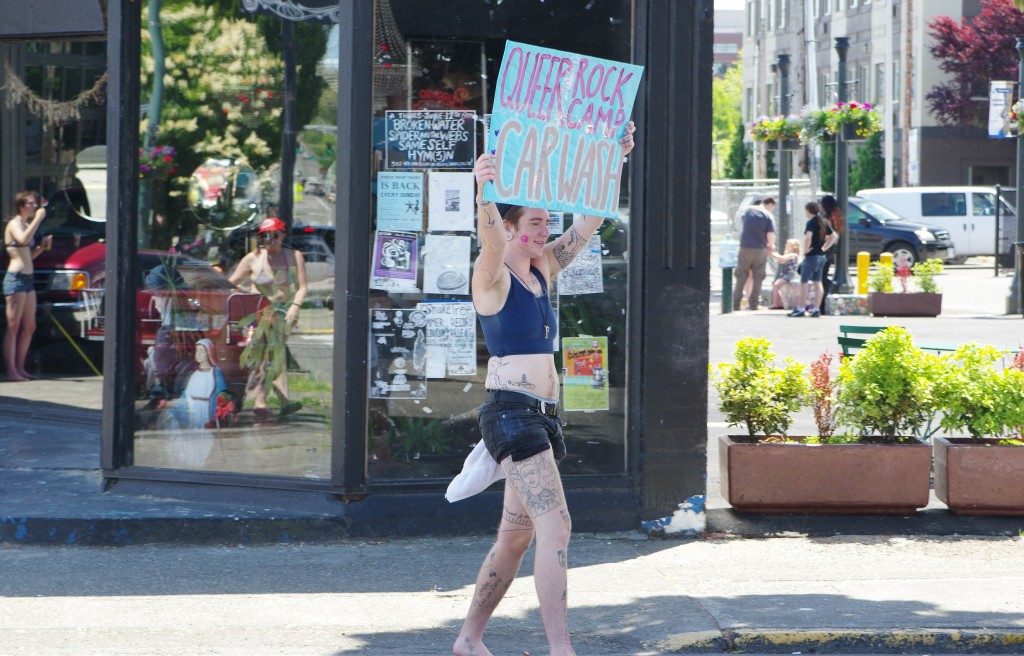
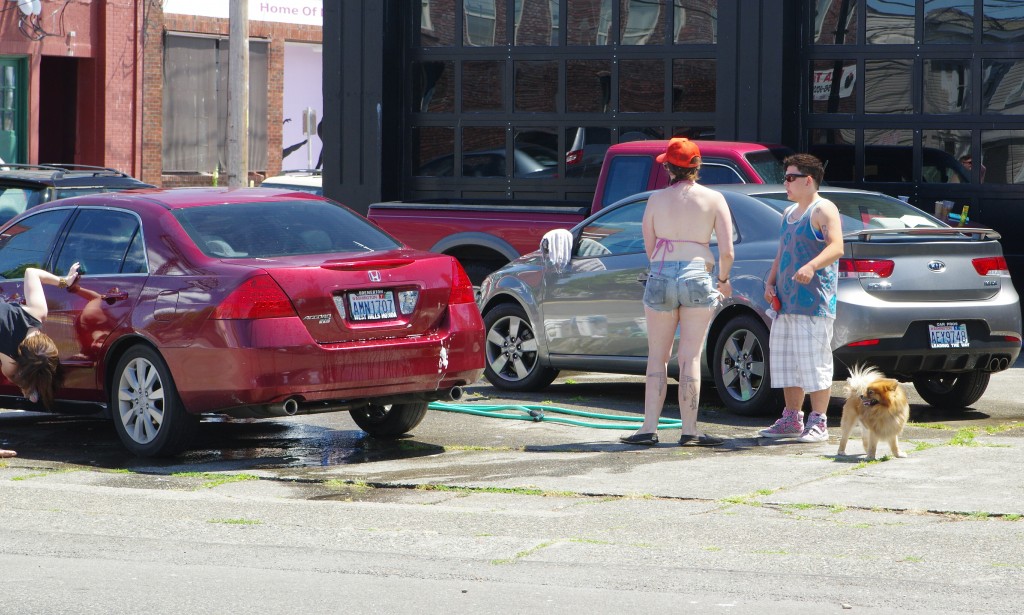
Only 50 feet from the Artesian at 4th & Jefferson were the Queers Rock Camp Carwash offering a quick vehicle bath in exchange for $5 – $20. It was a ready made photo-op, or so it seemed…at first.


The first couple of snaps went off without a hitch–good light, colorful subjects, smiles, advertising signs, tattoos. Then the encounter with the first gender bender who more often than not rely on intimidation rather than reasoned dialog or even the most rudimentary understanding of what they’re demanding…or they simply (as one admitted) don’t care.

Tow Away Zone

She/he/they/it/whatever approached the photographer who was standing firmly on the public sidewalk adjacent to the parking lot where, armed with a hose, buckets of soapy water, and a sponge, they were attempting to earn enough money for summer rock camp. There’s no doubt this beats panhandling all to hell. Their business acumen, however, was more than a little lacking.

Nervous Nellies Object to Bodies Being Photographed

“You must ask for our permission to photograph us,” she/he/they/it/whatever demanded. “No, it’s not required,” responded the photographer. “Yes, it is,” she/he/they/it/whatever rejoined.

An older teen approached the photojournalist and temporarily joined in the conversation. He opined that permission was needed when children were present. The photographer attempted to disabuse him of his misapprehensions, but he was having none of it, claiming he knew more about this area of law than the photographer who also happened to be a paralegal who specialized in this area of law. “Are you a lawyer?” he was asked. “No,” the kid responded, “but, that doesn’t mean a paralegal necessarily knows the law about this either.”
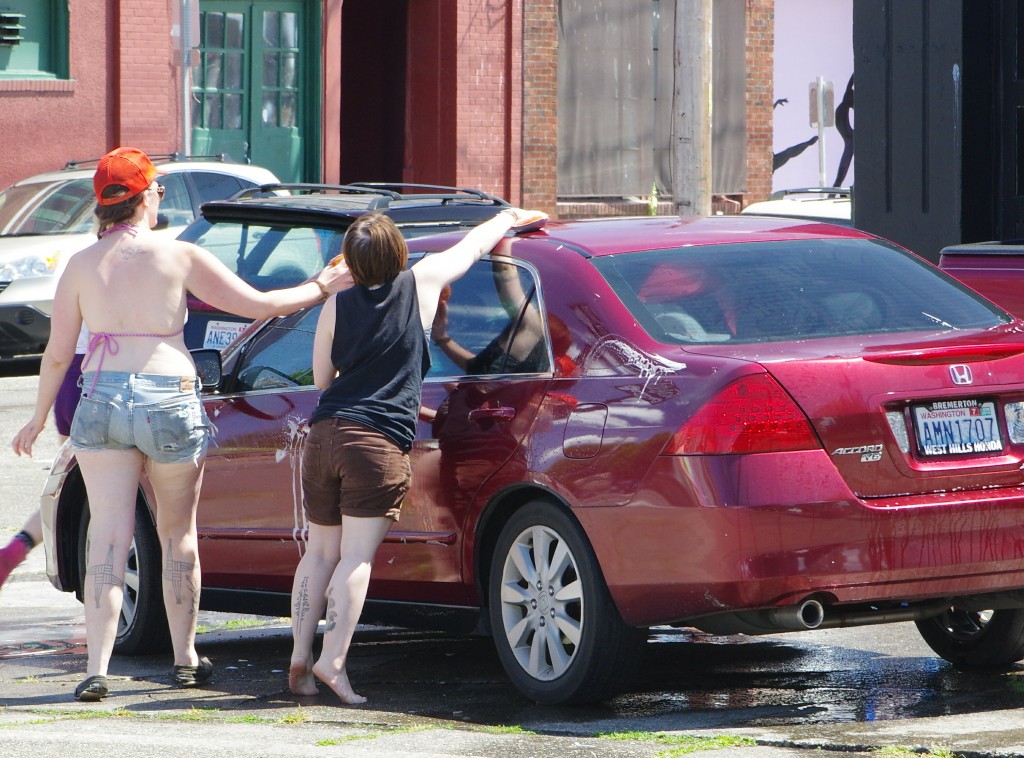
Having met so many vacuous attorneys and even judges, the kid’s point was hard to argue with. “Tell ya what,” invited the photographer, “let’s call the cops, who are charged with enforcing laws surrounding disputes such as this, and let them enlighten you.” The kid seemed taken aback, but, as it turned out, his mother must have thought this was a swell idea as she called the man (who turned out to be a woman) to arrive on the scene.

Teen LaQueefa


Having been advised by the dispatcher to protect himself, the photographer made his way across the street next to one of the bars with an open door for a better camera angle and less harassment. The Queers continued to charm the photojournalist and the public with an upraised middle finger while waving their signs seeking customers. Like a bared teeth dog wagging its tail, it was difficult to know which end to believe.


Once a few shots had been acquired, it was time to call it a day in Olympia. Walking through the Artesian, some folks (one in particular) had watched the scenario. When questioned, yours truly spoke of how photography was not a crime, but a fundamental right in public venues. Some of the more obtuse began to express differing opinions until the more civic minded guy pronounced his understanding in accordance with 1st Amendment principles.
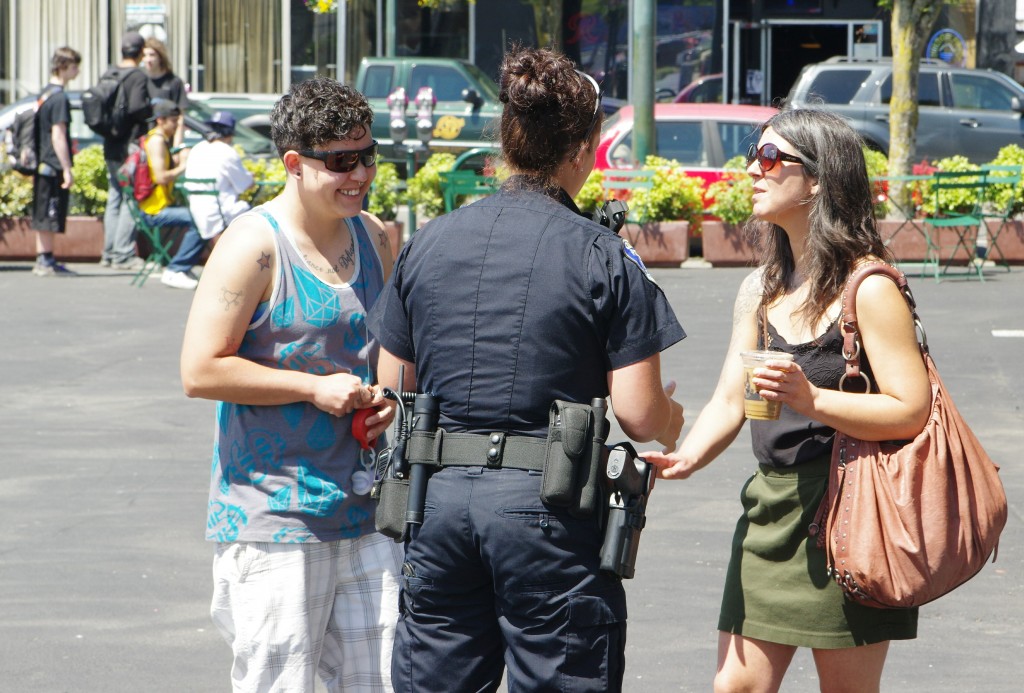
Mom argues her late teen son is too ‘young’ to have his picture taken in public.
Just then, the cavalry arrived, a young female Olympia police officer, by herself, approached the photographer. Almost immediately, the mother and her teen son closed in to express their complaint about the photographer (Photographing, [*gasp*] children in public…or so she said, though the teen son had disavowed being a minor when asked earlier). The officer ordered them to step back so she could finish her interview with the photographer, which she did.

Wearing Bullet Proof Vest & Explaining the law to one of the lesser lights in the universe
After listening to his explanation and the importance of preventing force and fraud, not just reporting it, she cut the dialog short by emphasizing, “I get it!” “I’m finished with you,” she advised before turning her attention to the mother in waiting, and to give her a clue.

It is what it is!
A full shot of the LEO’s face, name tag, and badge wasn’t made because she declined to have her picture taken while admitting she had no legal right to prohibit it. Prudence suggested, under the circumstances, not to push the point since her responding to the situation was largely discretionary.
Having struck a blow for exercising our rights to avoid losing them, the photographer left the scene to write this story. The obtuse and aggressive continue to dominate the downtown streets of Olympia. Belligerence and intimidation continue to be the order of the day there. It is hoped the Olympia police department will add more emphasis on drawing bright lines where the boundaries of fundamental liberty interests lie.

Queen LaTifah
The police do not have the inclination (the above referenced officer made that clear) or resources to control the streets and our public spaces. The public itself will have to assume some responsibility to reclaim them. Today, everyone has a camera. Today, we are the press! Today, we can reclaim our public spaces by exercising that responsibility, that right.
Yielding to arrogant bullies and the violently obtuse only encourages the abuse. The abuse will only get worse until the public puts a stop to corruption, both in government AND in the people!
Posted in Uncategorized
3 Comments
WA Justice System Sux says public–meeting called
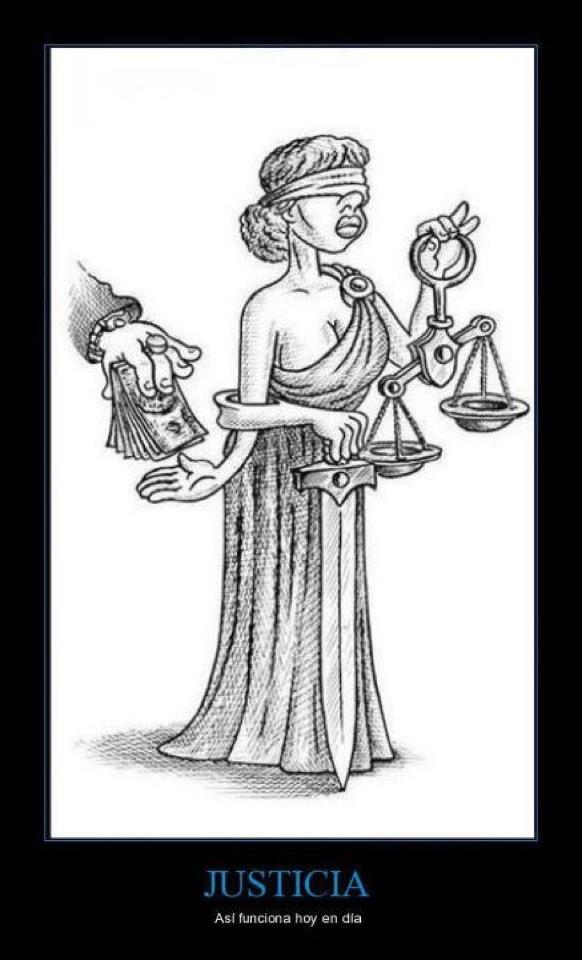
Public Vote of No Confidence
Olympia, WA (6-8-14) — Washington residents think the State’s justice system really blows. It has gotten so bad an overwhelming majority of the public feel it’s intrinsically unfair. Though most judges have never met a cop they didn’t like or a pro se litigant they do, there’s an uneasy epiphany in the State’s high court about the low esteem in which citizens hold our court system–a virtual cesspool of corruption, incompetence, and routinely turning a blind eye to perjury by public officials. If Benjamin Franklin’s concerns have come to pass, we have entered the land of oppression and gilded miscarriages of justice. (“When the people are afraid of the government, that’s tyranny. When the government is afraid of the people, that’s liberty!” -B. Franklin-)
Today, our courts have become mere extensions of a police state, a tool for state sponsored terrorism and oppression. But, not to worry, a meeting has been called to TALK about it. After all, the same justices set on sucking up to a system designed to threaten/intimidate the masses into submission will do the right thing, once they’ve been enlightened?–umm, Right!
Actually, even the U.S. Supreme Court, normally exceedingly deferential to the lower courts has said Washington’s suck–big time. (In Troxel v. Granville, calling the State’s predilections in custody disputes “…breathtaking in scope”!) Richard Fellows, the director of Media Island in Olympia and a father who was caught up in a custody/visitation dispute had a Minnesota judge opine (again, uncharacteristically berating another court) Washington’s court system appeared to be all about the money rather than the child’s best interests. Yeah, you heard that right. Even other courts think ours suck! In a conglomeration of mutual backscratching, this kind of castigation among sister courts is highly unusual. Space does not allow for the exceedingly long litany of examples.
You can throw in your 2 cents or just come for a dark comedy if you can make it to DSHS headquarters in Olympia this Monday (tomorrow) morning @ 8:30 am – noon. Cynthia DeLosTrinos (cynthiadelostrinos@courts.wa.gov) would like folks to ‘register’, so drop her a line or risk getting in without. The Law & Order (e.g. Agnew) crowd would like guns and public events attendees registered because both are equally dangerous. Whether the fear factor indicates we’re already free is anyone’s guess. Feel free to come.
Location: DSHS Headquarters Bldg @ 1115 Washington St, Olympia, WA.
Internet survey: Public says Justice System Unfair
by Brad Shannon
A public opinion survey done for Washington courts shows a sharp racial divide in public views of how fair the justice system is in the Evergreen State.
The report, which used an Internet-based survey of 1,500 residents in 2012, was done for the state Supreme Court’s Minority and Justice Commission and is scheduled for a public presentation and discussion Monday in Olympia.
Among the findings, the report shows more than 40 percent of the public does not think the justice system treats people “fairly and equally.” More than 65 percent of all respondents thought a black person would be more likely to be convicted of a crime he or she did not commit than a white person charged with the identical crime.
While just 11 percent of whites reported disrespectful treatment by police on at least one occasion, the figures show up to 62 percent of African-Americans reported a negative experience.
The survey also found Latinos report more “contentious contacts” with police and the courts than whites, but “somewhat fewer” than do blacks, while experiences of Asian-Americans are comparable to those of whites.
The sample was weighted to increase its match to the state’s population, according to the report. Researchers said group differences were noted only when the odds of them occurring by chance were less than 1 in 20.
“The report provides an excellent opportunity for us to continue our work toward enhancing confidence in our courts,” newly appointed state Supreme Court Justice Mary Yu, who is co-chairwoman of the Minority & Justice Commission with Justice Charles Johnson, said in a statement. “We look forward to working collaboratively with all of the other entities in our criminal justice system on improving the delivery of justice and addressing these findings on how the wider community experiences us.”
Monday’s session, which includes a forum with questions, runs from 8:30 a.m.-noon at the Department of Social and Health Services headquarters building, 1115 Washington St., Olympia. Attendees are asked to register by email to cynthia.delostrinos@courts.wa.gov.
“My guess is that it will be a lively conversation,’’ said Ed Prince, director of the Washington State Commission on African American Affairs, who was helping to organize the forum. “My hope is that a larger conversation about this gets started. The data don’t tell me anything I didn’t already know as far as perception.’’
Prince said he thinks the involvement of the high court can make a difference in broadening the discussion. The commission plans to report its findings to the nine-member state Supreme Court.
Uriel Iniguez, director of the Washington State Commission on Hispanic Affairs and a member of the justice commission, offered a similar assessment.
“To me this is nothing new. But how do we mainstream this issue so people are aware of it and what’s going on? We sometimes tend to isolate it, segregate it — (we say) it’s not my problem,” Iniquez said.
Iniquez said that getting people to acknowledge what the public perceptions are may lead to a better conversation and eventual changes in the system.
“These discussions are not easy — at times they bring out some hurtful feelings,” Iniquez said. “People jump to conclusions, ‘you’re calling me racist.’ No … this is what people are saying. It may not be reality, but it’s what they are saying, and we have to come to terms with it.”
The research was done by a team of investigators that included professor Jon Hurwitz of the University of Pittsburgh, professor Jeffery Mondak of the University of Illinois, and professor Mark Peffley of University of Kentucky.
Posted in Uncategorized
Leave a comment
Mason Co. Sheriff’s Militarization Continues Unabated

6-wheel drive @ 56,000 pounds
Shelton, WA (6-6-14) — One war toy (an incredibly heavy armored personnel carrier) wasn’t enough for Sheriff Casey of Mason County. When asked why the tank was needed during an interview a couple of years ago at the county fair where it was on display, one deputy opined it would be used to serve warrants…along with the black ninja-style uniforms, body armor, automatic weapons, tear gas, battering rams, flash grenades, attack dogs, tasers, combat gloves–you get the idea: overwhelming force, shock & awe to control an enemy all around the ‘thin blue line’. Nothing–no, really–NOTHING is too good for our boys in blue/black. And that’s just for serving warrants, let alone actual desperadoes. If they’d had the bad sense to consider it, the Taliban is well advised not to mess with Mason County.
The Sheriff has taken ownership of yet another imposing armored dinosaur through a U.S. Department of Defense program that transfers surplus vehicles and equipment to local law enforcement agencies. Or, for “FREE” according to a Sheriff’s spokesman. Not to put too fine a point on it, but “free” is killing us, not to mention the advisability of a virtual military garrison instead of a police agency that is bankrupting Mason County.
The Sheriff’s latest assault and combat vehicle acquisition?–Yeah–he got it for FREE! But, it only cost over $8,500 to transport it here. That may be for the reason it weighs over 56,000 pounds. We can only imagine whether it is even capable of getting from one gas station to the next. Each door on it weighs 600 pounds. Only a couple of deputies are qualified to drive the thing. But, they say it’ll be useful in a hostage situation and driving the back roads in the Olympics for rescue operations.
Having seen some of the trails (Rose Mountain, Staircase, Mt. Ellinor, etc.) the claim is doubtful. Sheriff Casey already has an armored personnel carrier that should serve for any hostage crisis. Ummm…just how many have we had in Mason County?
Yep, it was ‘free’ too, and equally fuel thrifty. Not to worry about repair expenses, though–they’re gonna do that over at the Ft. Lewis army base near Tacoma, according to a sheriff’s staffer. No doubt, that’s going to be ‘free’ too! (Yeah, right–the army is just dying to blow money on Sheriff Casey’s ego.) And then there’s that little detail of it costing over $8,500 to transport this war toy each time…what, $17,000 round trip? Still, money should be no object when it comes to treating Americans like the enemy.
No wonder the Sheriff is always grousing about his budget and neighborhoods now have to sign contracts for police services. Having bankrupted most area taxpayers, the Sheriff now is working on the gated communities.
One can imagine what this behemoth would do to the collapsing bridge in the Skokomish Valley. It’s sitting there rotting into oblivion until some hapless motorist/truck driver falls through it, but we have the money for another of Sheriff Casey’s Armory war museum boondoggles!
Don’t blow your dough.
“When the people are afraid of the government, that’s tyranny. When the government is afraid of the people, that’s liberty!” -B. Franklin-

Collapsing Bridge Sole Ingress/Egress for Skokomish Valley residents

Though Collapsing, Logging Trucks Continue to Pound This Bridge
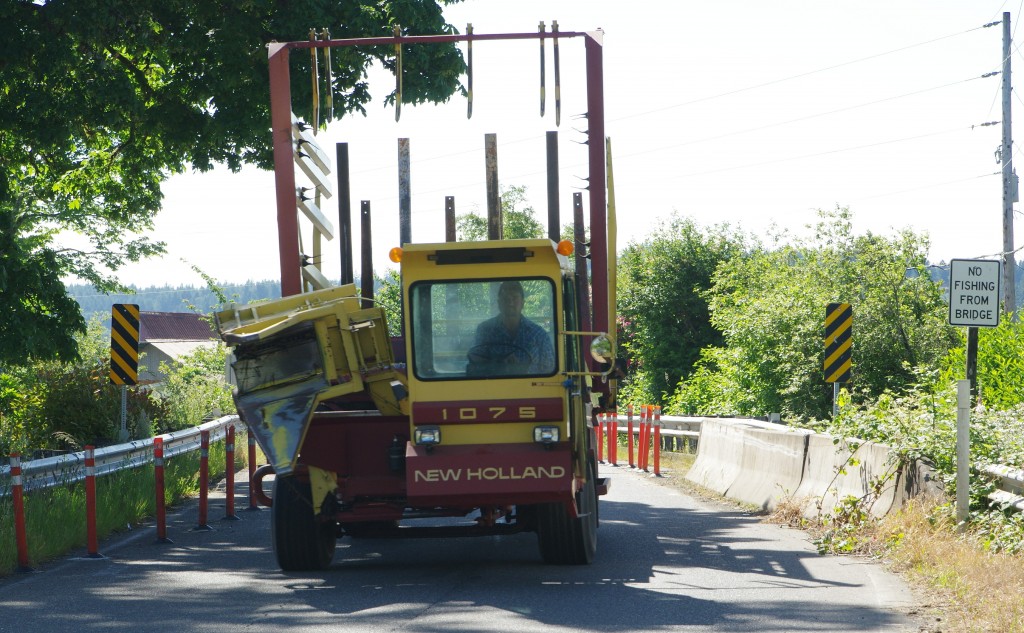
Over 3-years on, nothing but barriers for this collapsing county bridge in the Skokomish Valley

Skokomish Valley Roulette
Posted in Uncategorized
Leave a comment
Why (A)narchy?: State Sponsored Terrorism!
“Those who make peaceful revolution impossible make violent revolution inevitable.”
Posted in Uncategorized
Leave a comment
FL Judge Punches Public Defender
No Arrests Made In Incident
by Erik Sandoval (reporter), Daniel Dahm (editor)
A judge allegedly struck a public defender Monday after a verbal confrontation in a Brevard County courtroom.
Judge John Murphy is accused of hitting Andrew Weinstock, according to the public defender’s office.
During a court session, Murphy asked Weinstock to waive his client’s right to a speedy trial, but Weinstock refused, the public defender’s office said.
The confrontation leading up to the fight was captured on video.
“If I had a rock, I would throw it at you right now,” Murphy said. “Stop pissing me off. Just sit down. I’ll take care of it. I don’t need your help. Sit down.”
“I’m the public defender, I have the right to be here and I have a right to stand and represent my clients,” Weinstock said.
“Sit down,” Murphy said. “If you want to fight, let’s go out back and I’ll just beat your (expletive).”
“Let’s go right now,” Weinstock said.
The two went into a hallway, where Murphy allegedly grabbed Weinstock by the collar and started hitting him, according to the public defender’s office.
Although off camera, the two can still be heard yelling at each other, with one of them saying, “You want to (expletive) with me?”
A Brevard County sheriff’s deputy stopped the fight.
The participants refused to press charges and no arrests were made.
The video also shows the judge being applauded as he returned to the courtroom.
Local 6 legal analyst Luis Calderon said both men could face disciplinary action for what happened in court, simply because of the attention the case is getting.
Calderon said worst cast scenarios for both men could result in them losing their jobs and possibly being disbarred.
Posted in Uncategorized
Leave a comment
Shaun Goodman Deal Provokes Courthouse Protest

Blind Justice?…or Payola?
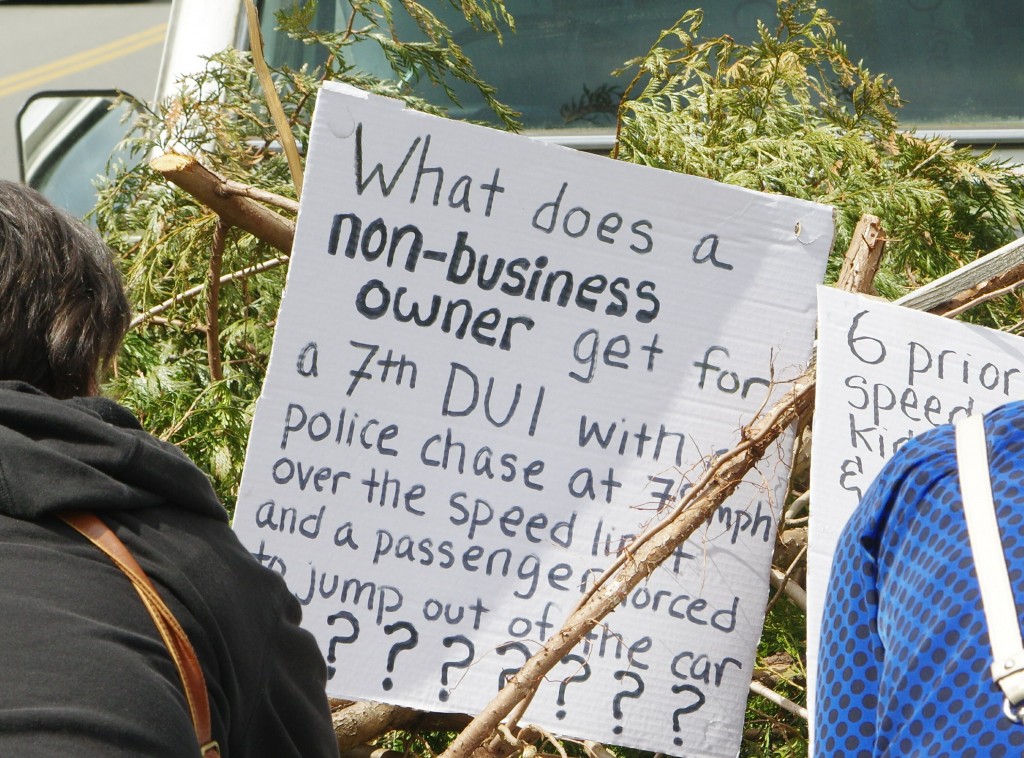
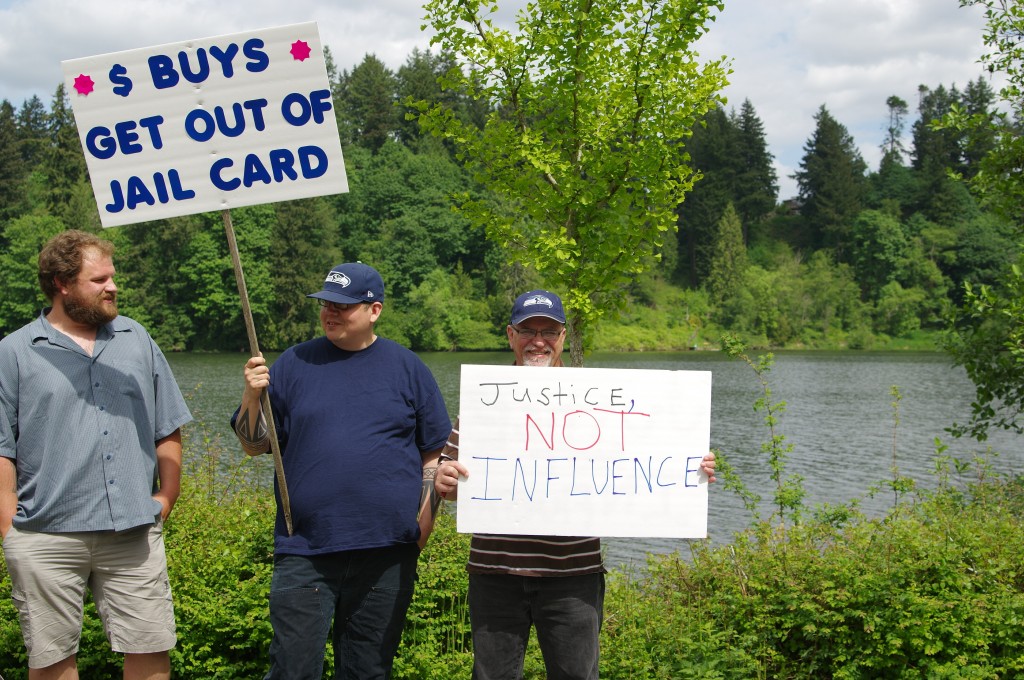
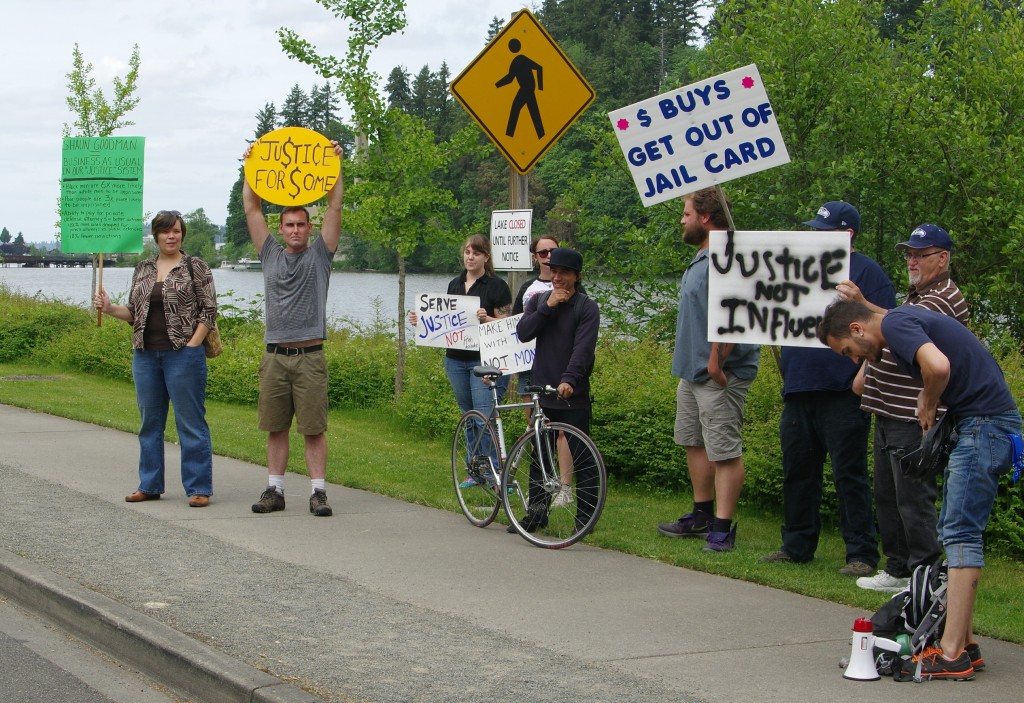
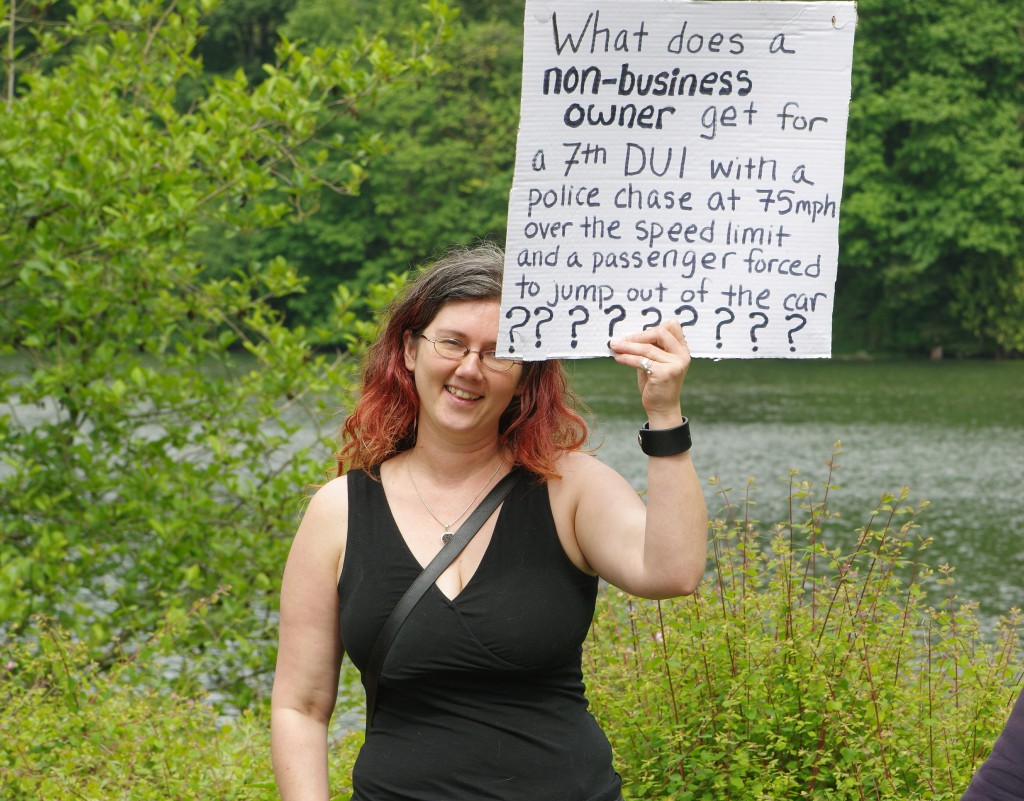
Olympia, WA @ County Courthouse Complex (5-16-14) — It was a bright sunny Friday afternoon as the crowd slowly assembled at the foot of the hill crowned by the County’s courthouse complex by Capitol Lake. Ages ranged from teens to grandparents, all white except for one gentleman of color (Henry Griffin) who had been victimized by Shaun Goodman, a local wealthy businessman owning Vantage Communications, a Ferrari, and a Lamborghini. During Goodman’s high speed chase, said to have exceeded 100 mph, he eluded police, racing through the heart of Olympia while drunk driving his sports car and Mr. Griffin to the point of causing the captive passenger to leap from the speeding automobile to save his life.

Shaun Goodman, Owner of Vantage Communications, a Ferrari, and a Lamborghini

Pay to Play Justice?
THE WEIGHT
Griffin got into the Ferrari voluntarily, having no idea of how drunk Goodman was or his long history of drunk driving offenses. “Yeah he didn’t even have a blow and go in the car or I would have not got in,” commented Griffin. Henry now sees a chiropractor 3 times per week and a doctor every week to treat the pain from his injuries.

Henry Griffin

Griffin shares body art
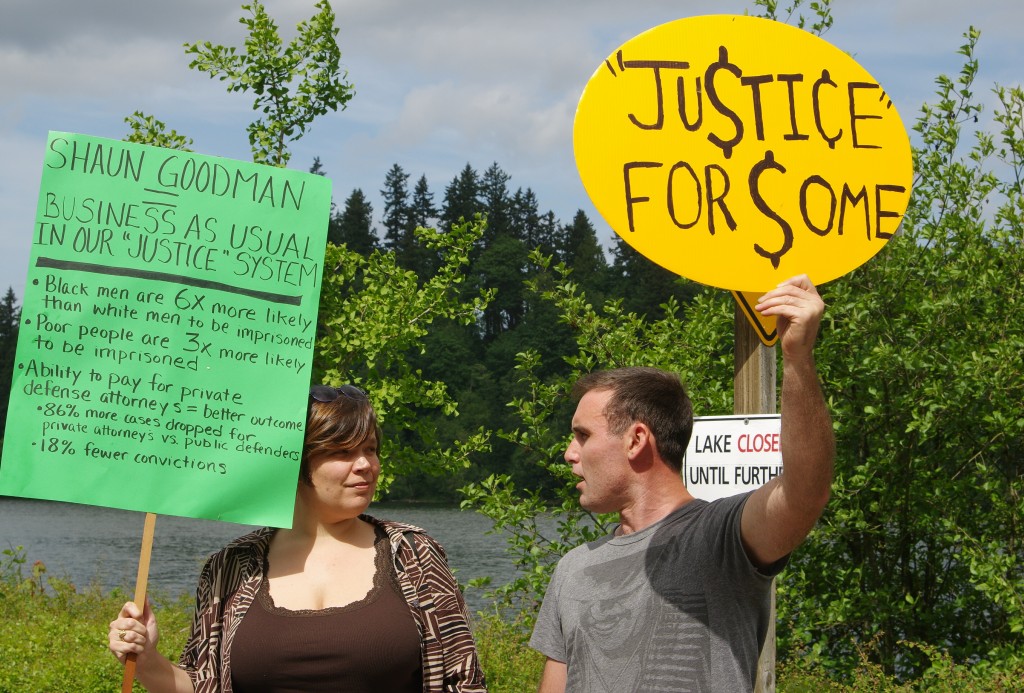
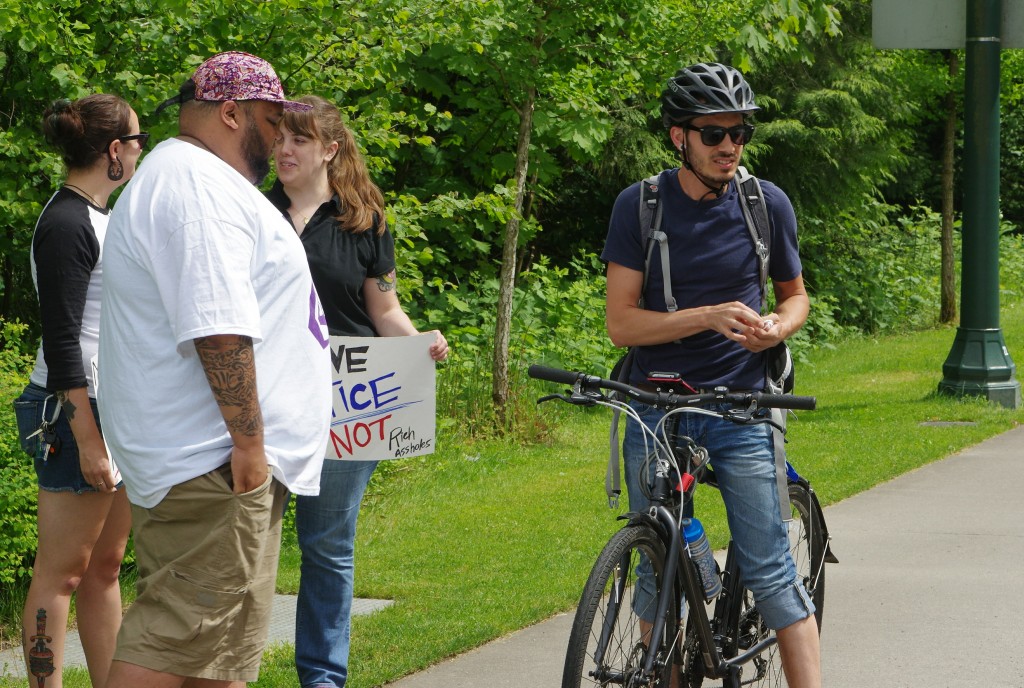
Sam Miller, who organized the demonstration, cautioned protesters the issue was larger than Goodman, but “…about inequality. The amount of money you make and the color of your skin should not determine your punishment,” he stated. In a Face Book posting inviting community participation in the demonstration, he characterized the event as follows:
On Friday May 9th Thurston County Judge Christine Schaller and prosecuting attorney James Powers agreed to allow Shaun Goodman a man with no less than 7 alcohol related charges to serve 1 year of work release. After leading police on a drunken chase in his Ferrari through Downtown Olympia all while holding a man hostage. We will meet at the corner of Lakeridge Drive SW and Descutes Parkway SW. and march to the courthouse Bring Noise (drums, megaphones, elephants, trumpets, loud neighbors) and signs (Anti-corruption, pro-justice)
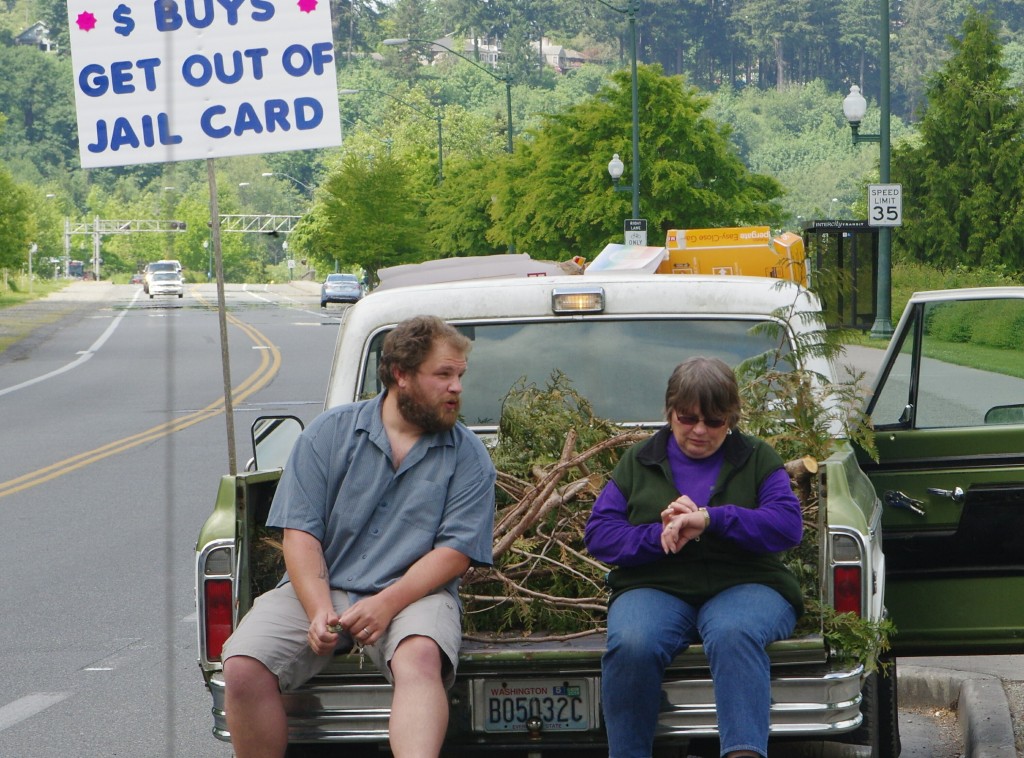
Sam Miller organizes get tough on crime rally
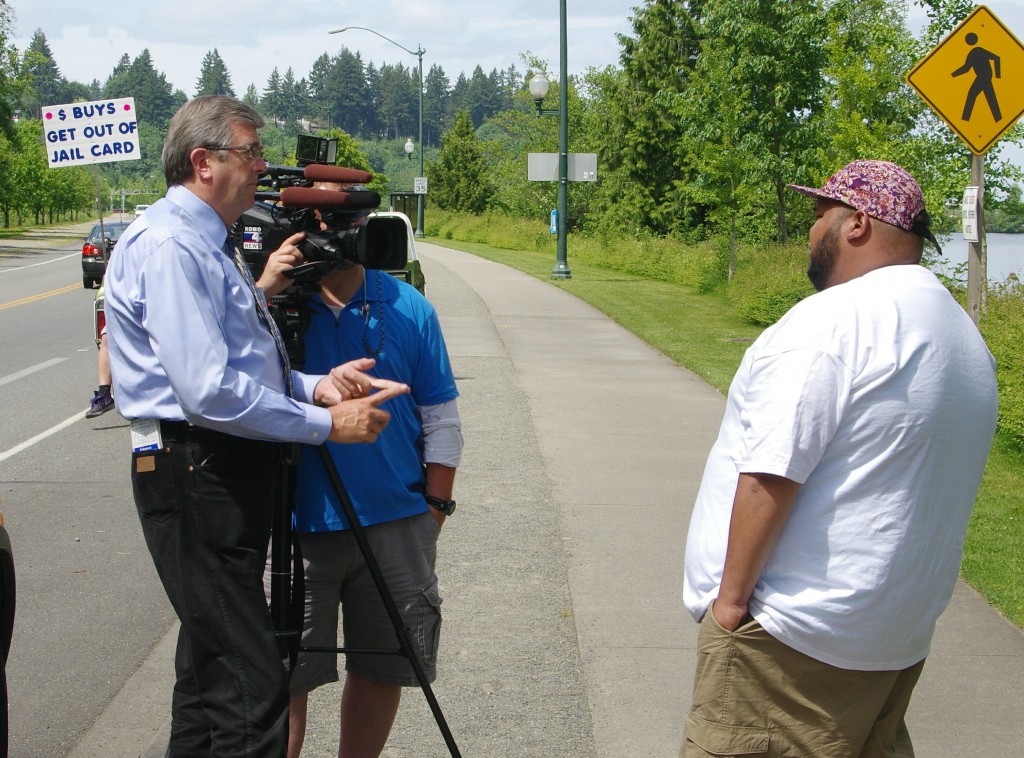
KOMO interviews Griffin
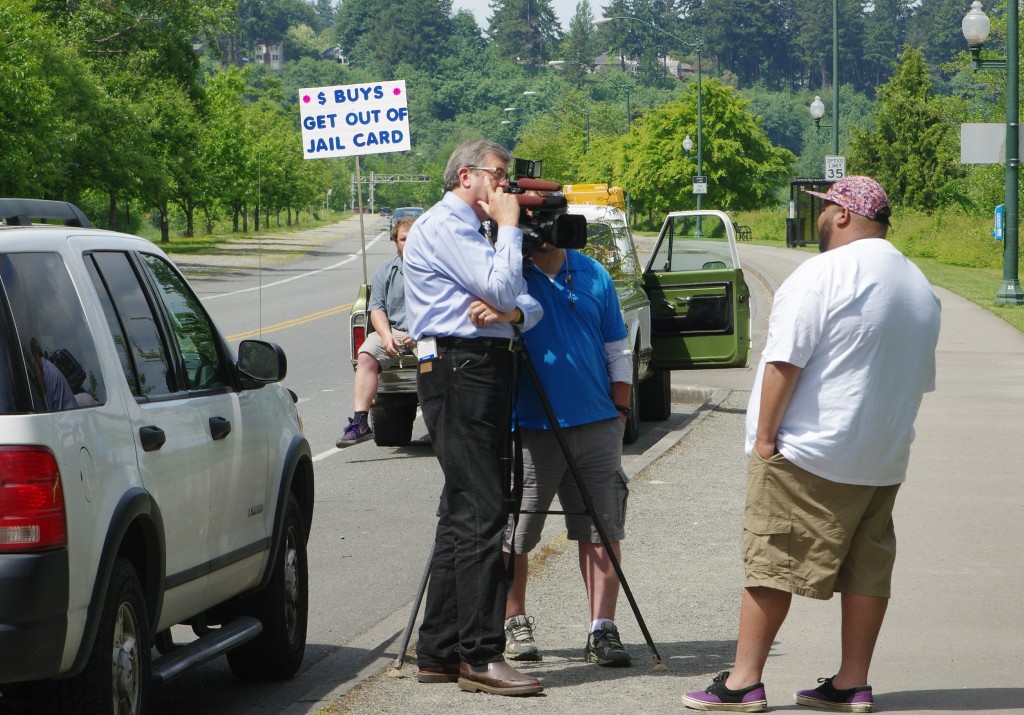
Still, Shaun Goodman was too good a poster child symbolizing the injustice routinely meted out by the Thurston County criminal (and family, some would argue) justice system for citizens to ignore given their misapprehensions regarding how it functions, by design/intent.

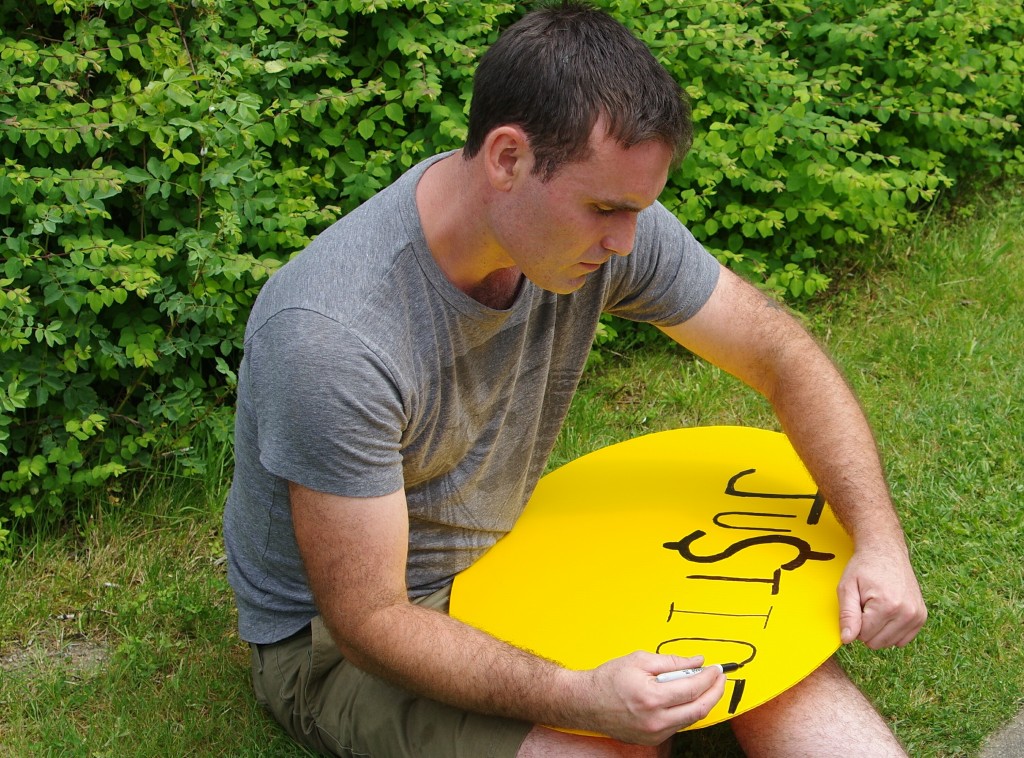
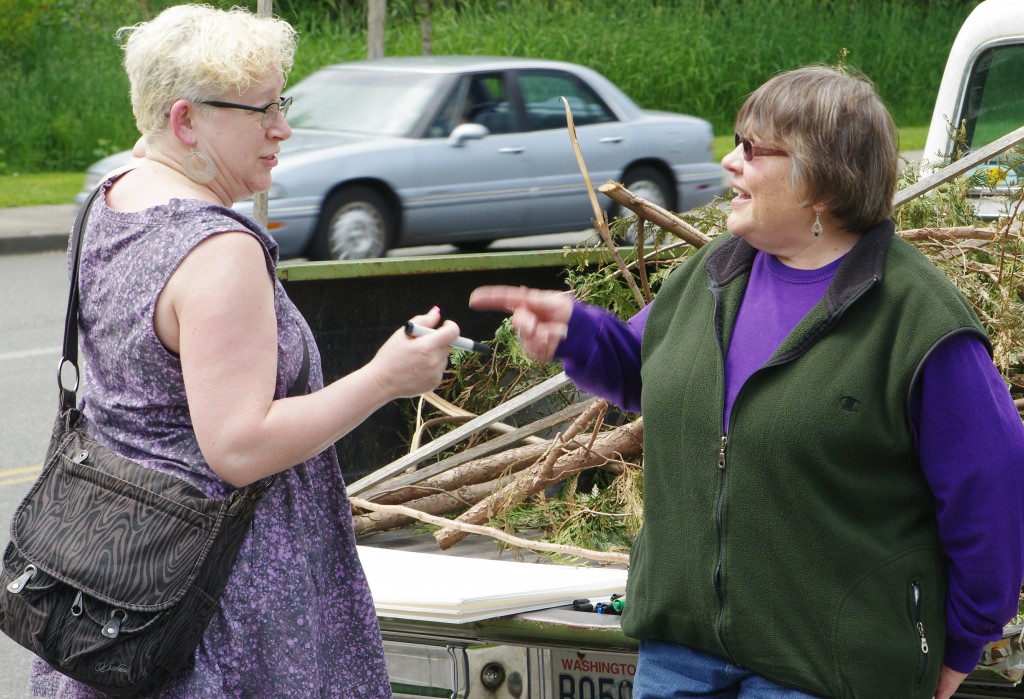
As more residents gathered at the bottom of courthouse hill by Capitol Lake to make impromptu protest signs for the rally, Henry Griffin himself appeared and would join the march to protest a criminal justice system seemingly out of touch with the community it’s, in theory, supposed to protect WITHOUT FEAR NOR FAVOR. Griffin was questioned and claimed the prosecutor never consulted him prior to Goodman’s sentencing, nor was he provided an opportunity to address the court before sentencing or given a restitution hearing for the injuries he’d sustained during the high speed chase. Upon fact checking, an interview with the deputy prosecutor who handled the case, James Powers, esq. yielded somewhat contradictory information.

Was this limo transporting Shaun Goodman to the Courthouse/Jail?
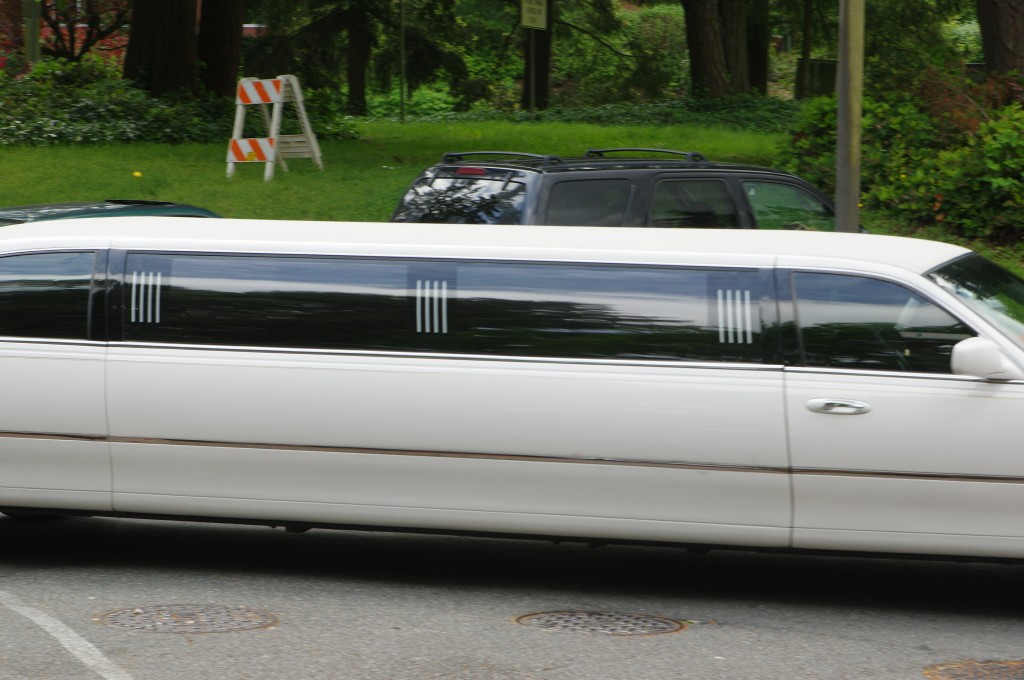
Jailhouse limo?

The attorney for the State (Powers) admitted he had not, in fact, consulted about sentencing with the victim because, Powers says he reasoned, Goodman was getting the maximum sentence for his crime(s) allowed for under Washington law–1 year. This included the conviction for DUI and felony eluding (a class ‘C’ criminal offense). Because most of Goodman’s prior DUI’s had not occurred within a 10-year span, they were barred from triggering a felony classification of this 6th/7th repetition of the offense. Likewise, the felony eluding sentencing guidelines precluded Goodman’s being taken into custody by Washington’s prison system. However, Powers claimed he had discussed the case, in general, with the victim and had asked how he felt about it.

What kind of justice?
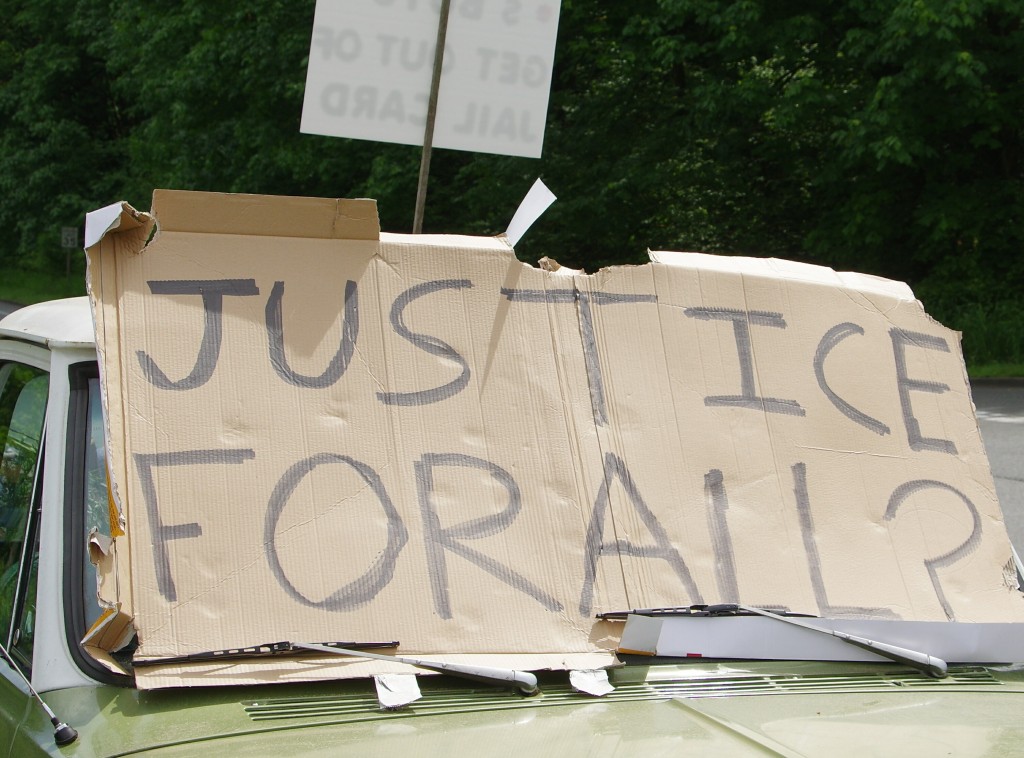

The prosecutor also argued he had sent Griffin necessary forms to fill out before the restitution hearing could be scheduled. As of the time of the interview, Griffin had not returned them to the prosecutor’s office. Powers allowed as to how restitution was appropriate provided the State had the facts and sworn statement from the victim to pursue such a remedy.
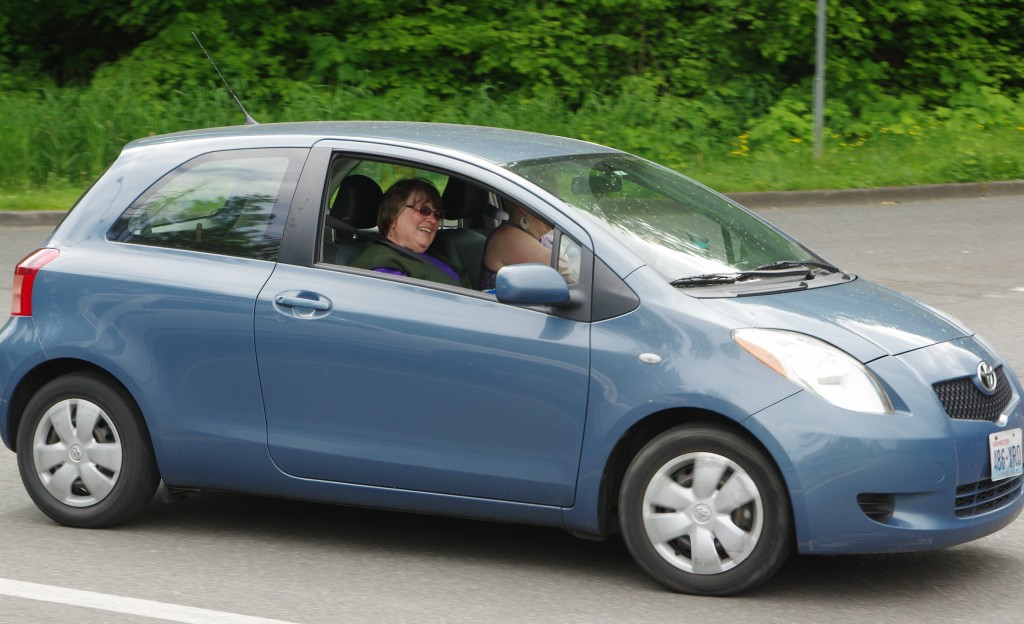
Supporters honk their approval
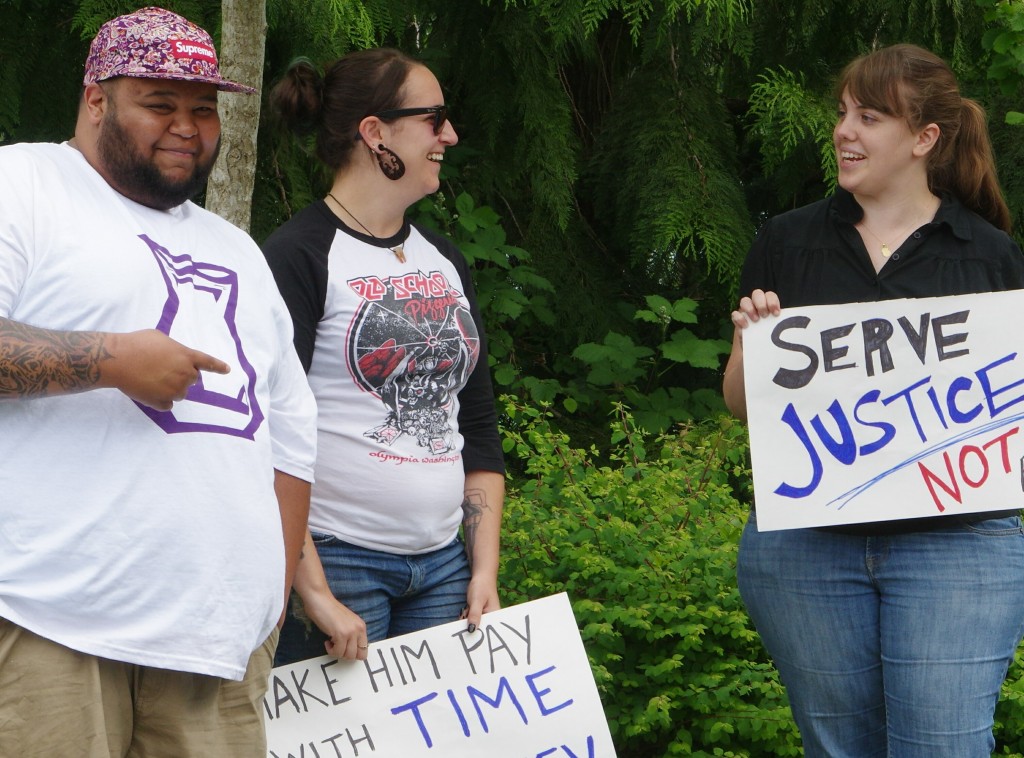
Henry Griffin w/supporters

Powers agreed victim impact sessions were of mutual benefit to the offender and the community, but despite Goodman’s having been ordered to undergo them in his sentencing for prior DUI convictions, none had been requested in this case because the prosecutor believed they could not be imposed as part of probation since no probation could be required if the maximum sentence was being ordered allowable under law. Still, he admitted he hadn’t considered the possibility of making such victim impact sessions a part of the sentence itself, not part of ‘probation’, much like the fines imposed, perhaps even in lieu of a portion of the fines–not that prior victim impact sessions appeared to have influenced Goodman’s subsequent behavior much. Still, this ignores the benefit to the community in having an opportunity in a controlled environment to confront the miscreant and hold him accountable to the court of public opinion. The community was very angry, in this instance, for feeling as though it had been excluded from the process–and it had!

The Ink Spots

Ganish: God of Mischief

Body Art

Cornucopia

Low Calorie Art
Jon Tunheim, Thurston’s elected County Prosecutor, had been approached almost 3 years ago with the suggestion his office needed a citizens’ board which met monthly with him to discuss his office’s performance/priorities. That suggestion was blown off by Tunheim as though it had been made by a panhandler. Similarly, there is no citizens accountability board for Thurston’s Sheriff’s office or Olympia’s Police department. It wouldn’t hurt Thurston’s judges to have a monthly powwow with citizens about the measure of justice (or NOT) meted out by these elected officials. That none of this exists speaks volumes to why our criminal justice system is so out of touch with residents. If it looks like they’re not listening, it’s because they aren’t. If it looks like money, status, race, and a high priced lawyer makes a difference, it’s because they do. George W. Bush might have given sage advice to those destined to face such systemic inequality by counseling them to grow up in a white wealthy family and with enough money to afford an expensive lawyer–assets that make powdering one’s nose as a ‘youthful indiscretion’ no bar to the highest office in the land.
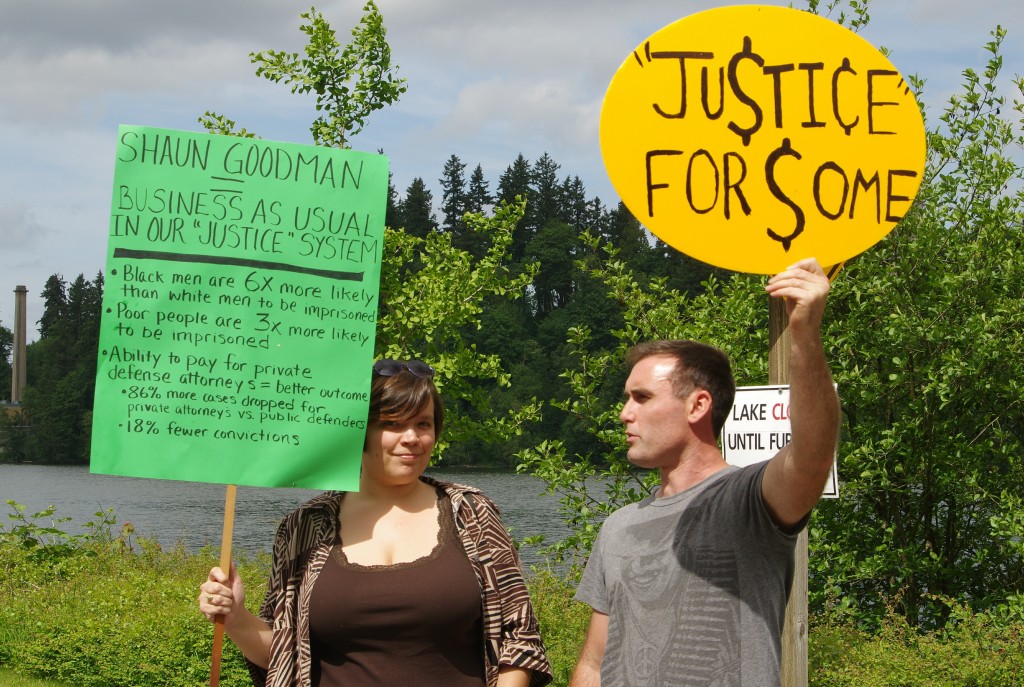
Money Talks
Room, Board, and a rec room TV?
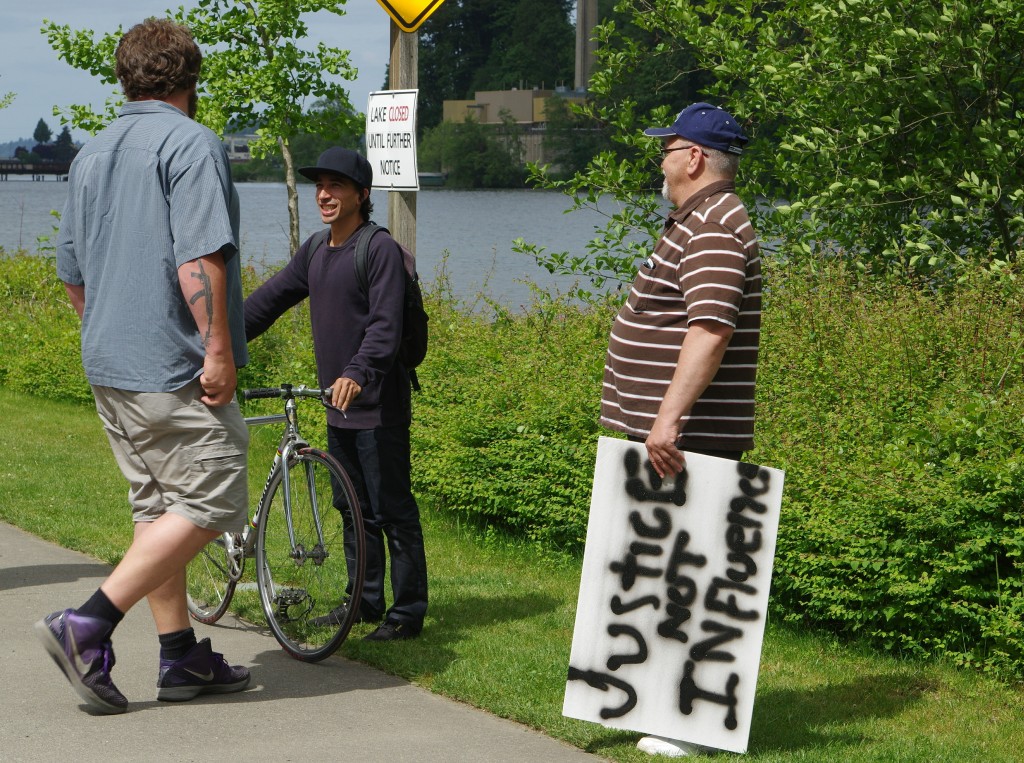
Affluenza: Is it Contagious?
Having said all this (stating the obvious), the case of Shaun Goodman’s walk on the sunny side of the street in Thurston’s criminal justice system stirs mixed emotions. Many @ctivists passionately believe our prison system is an inhumane anachronism and should be abolished (along with police). Most judges have never met a cop they didn’t like as evidenced by how they routinely turn a blind eye to perjury from the same. Most judges are far more inclined to throw the book at a defendant than the leniency Schaller (the presiding judge in Goodman’s case) is alleged to have ordered. But, let’s examine the facts and see if they support these pronouncements castigating what, by all accounts in the legal community, is a competent, hard working, popular new superior court judge on the bench in Thurston.
A judge’s powers, in law, are not infinite, but are circumscribed by law as passed by our legislature. If the law is inadequate, a judge cannot, ad hoc, impose what does not exist. Stiffer DUI penalties than currently exist were proposed to Washington’s legislature. It refused to pass them into law. Virtually all judges almost always go along with plea bargains between the parties (State and defendant in a criminal action), as refusing to do so would quickly lead to no plea bargains being consummated at all–something neither the court’s budget, nor the prosecutor’s, nor the public defender’s could long sustain. Plea bargains are made not only in the interest of justice, but for expedience and practical considerations. Here, while a kidnapping/hostage taking charge could have been filed, Griffin did enter the vehicle voluntarily before the subsequent high speed chase began. He was able to escape the speeding Ferrari by leaping from it while it was in motion, sustaining serious resulting injuries.


Ultimately, Goodman (through his counsel’s negotiations) did plead to the DUI misdemeanor and the felony eluding. The law and sentencing guidelines, such as they are, do not provide for a greater sentence than the year Goodman was given. Work release is considered, in law, to be time in custody, i.e. ‘jail’ time, just as home monitoring is. Goodman was NOT given home monitoring. He must return to the jail each day after work and is monitored closely while away from the jail work release facility. Schaller’s remarks prior to sentencing about Goodman’s importance to his employees was dicta, not terms of her order or sentencing. She can recommend some conditions of confinement, such as work release, but cannot mandate them. The Sheriff is part of the executive branch of government. Schaller is part of the judicial branch. Each of the 3 branches (executive, legislative, judicial) are co-equal in law and judges do not attempt to supersede the authority of the other branches. It is the Sheriff’s prerogative to determine who will or won’t be admitted to a work release program which his office (not the judge’s) administers. It is within the Sheriff’s legal authority to determine when a prisoner will be released, the conditions of their confinement, or even if they will be accepted into custody at all. What, after all, is ‘good time’ and the added time off for the work trustees do if not an alteration of the time prescribed by the sentence according to the administrative judgment of the Sheriff? Nor are the Sheriff’s guidelines completely arbitrary. They have factors (e.g. escape risk, recidivism, cooperation, history of infractions while in custody, risk to the community, seriousness of the offense, notoriety, etc.) which will be considered, in theory, without respect to race, income, or other immaterial ancillary issues. But, people are human, they know each other or of each other. Who you are in the community remains as important as what you are.


If the prosecutor erred, he did so by failing to include the community (also a victim of Goodman) in the deliberative/sentencing phase or the restorative justice phase of this case. If Schaller erred, it was her glib remarks from the bench in the face of such a serious crime by a multiple repeat/incorrigible offender. The ‘maximum’ penalty in law is NOT a synonym for justice rooted in reconciliation or a community accountability process. It is rooted in another anachronism–adversarial justice, a modern equivalent of trial by combat where might (or MONEY in this instance) makes right. In the 21st century, we must quickly evolve away from such barbaric traditions as torture, imprisonment (initially conceived as more humane than floggings), adversarial proceedings, and due process riddled with perjury. An offender’s wealth or social status or race should not be dominant factors in the kind of justice expected.


THE MARCH
Sam Miller and a couple of women supporting his cause were waiting, sitting on the pickup truck tailgate at the bottom of the courthouse hill by Capitol Lake around 2:30 pm, Friday. Others began to arrive, including Henry Griffin, the victim in the wild ride, to support the march on the Thurston County Courthouse. Major mainstream media teams began to appear including KOMO (from Seattle), the Daily Olympian, et ux. Sam was interviewed, as was Mr. Griffin. Impromptu signs were hastily and artfully made. The sky was blue, the photographic light was fantastic.

Scott Yoos, journalist, shows to cover event
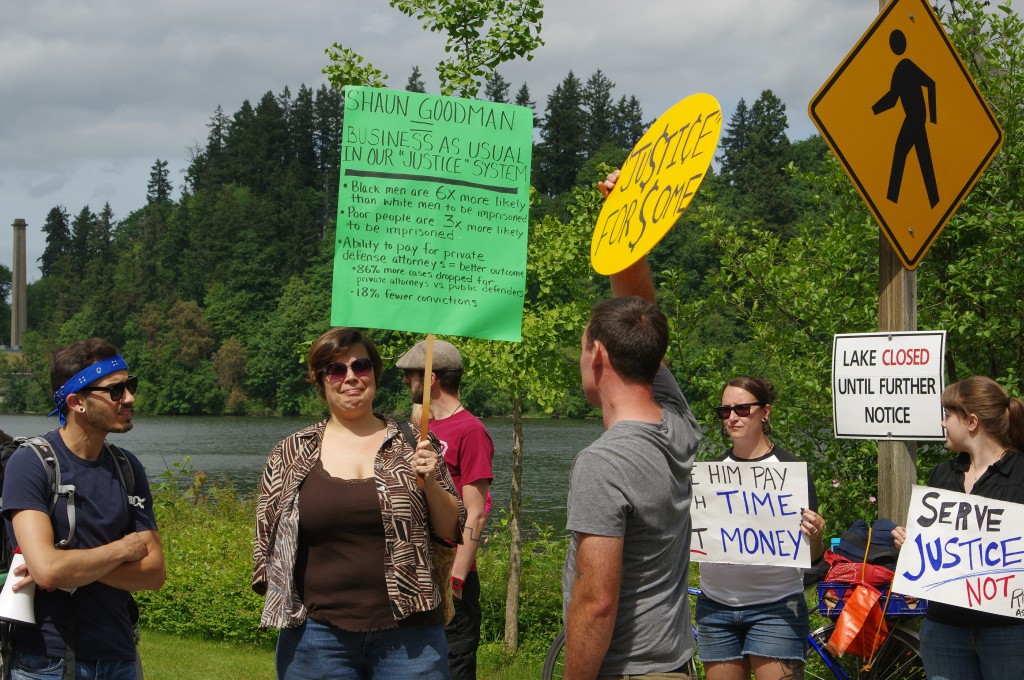

A lot of glad handing and words of mutual support were exchanged. The crowd began to line the curb, holding their signs aloft for traffic to see. Honks of acknowledgement were heard as drivers sounded their encouragement. Nobody was heard yelling, “Someone get a rope,” but the angst of the group was palpable, their anger toward Thurston’s DOA criminal justice system was unmistakable. They’d had enough.
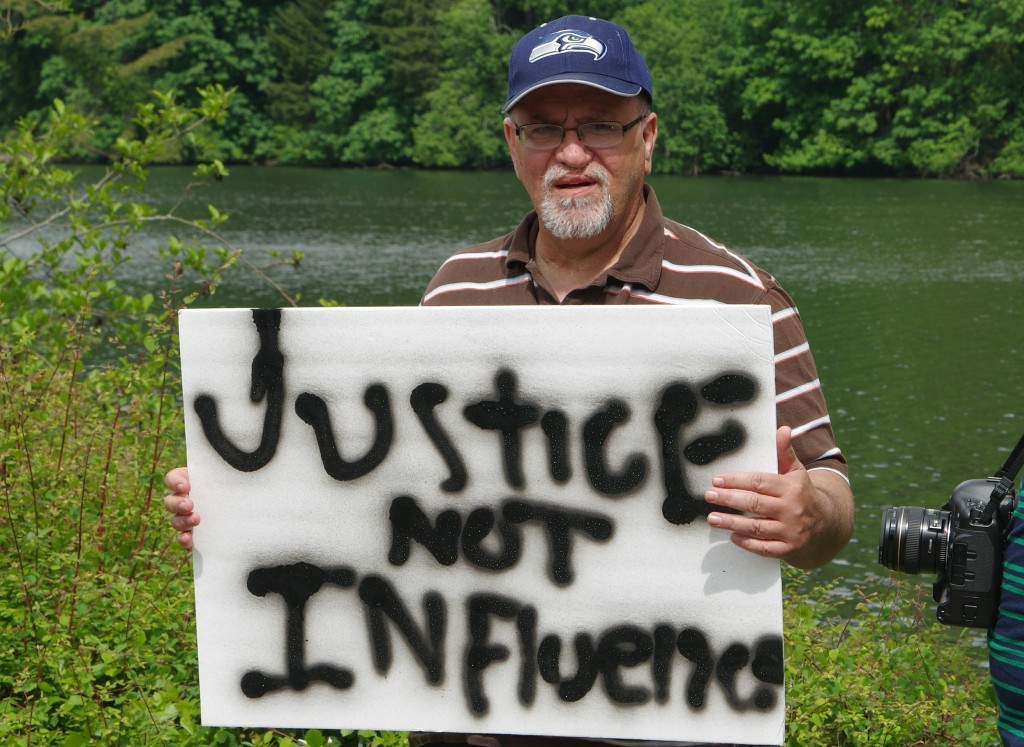
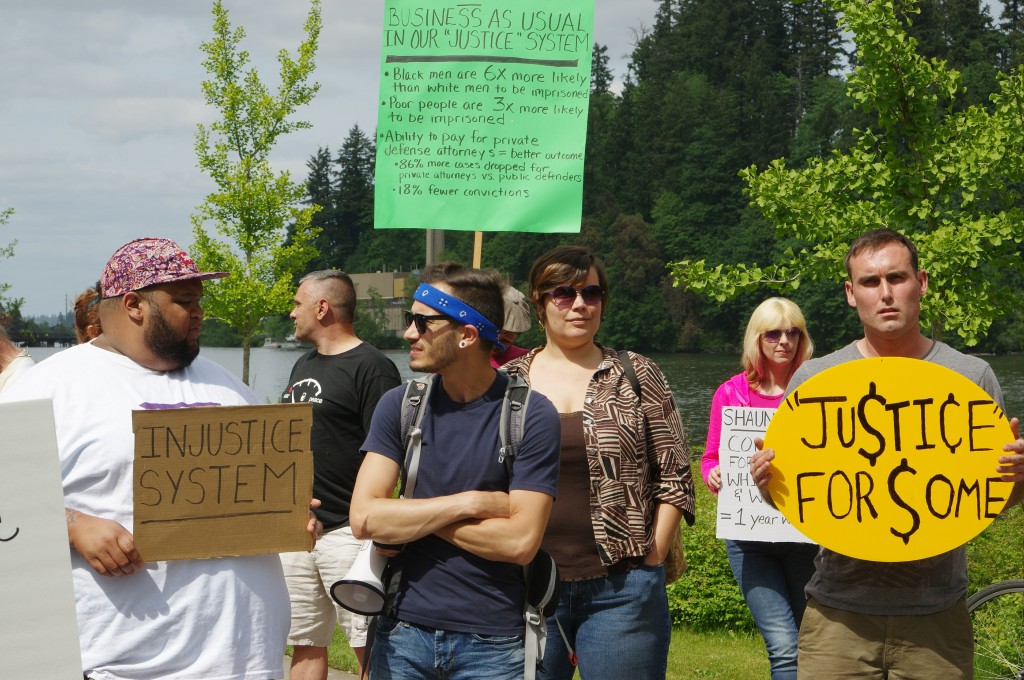
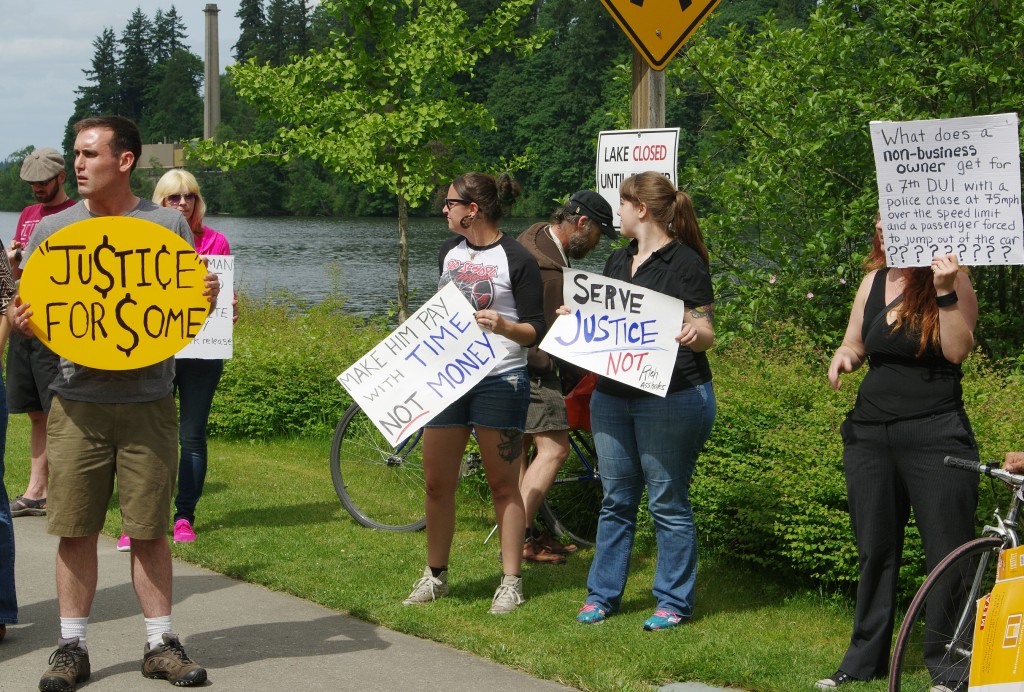
At a couple of points during the vigil, a gleaming white stretch limo was seen driving up courthouse hill. Speculation was made it might be transporting Shaun Goodman, given he’d been relieved of his driver’s license following his DUI conviction. It later appeared to be delivering an occupant to the courthouse parking lot. The identity of its passenger was never confirmed. What was confirmed is Shaun Goodman had yet to begin serving his sentence. He was not in custody.
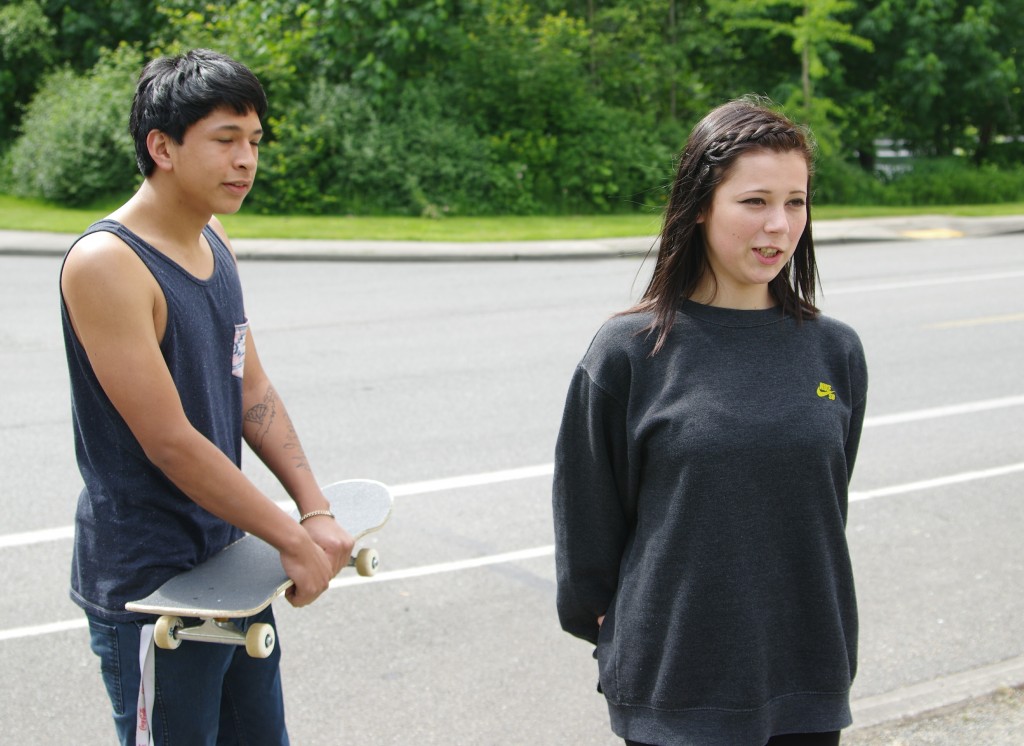
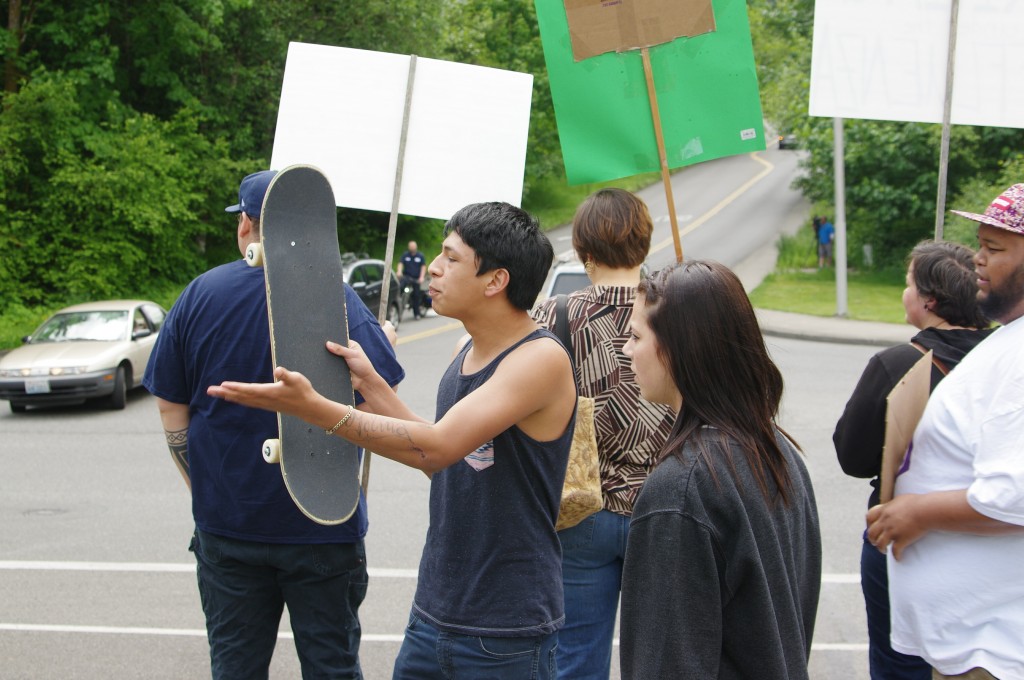
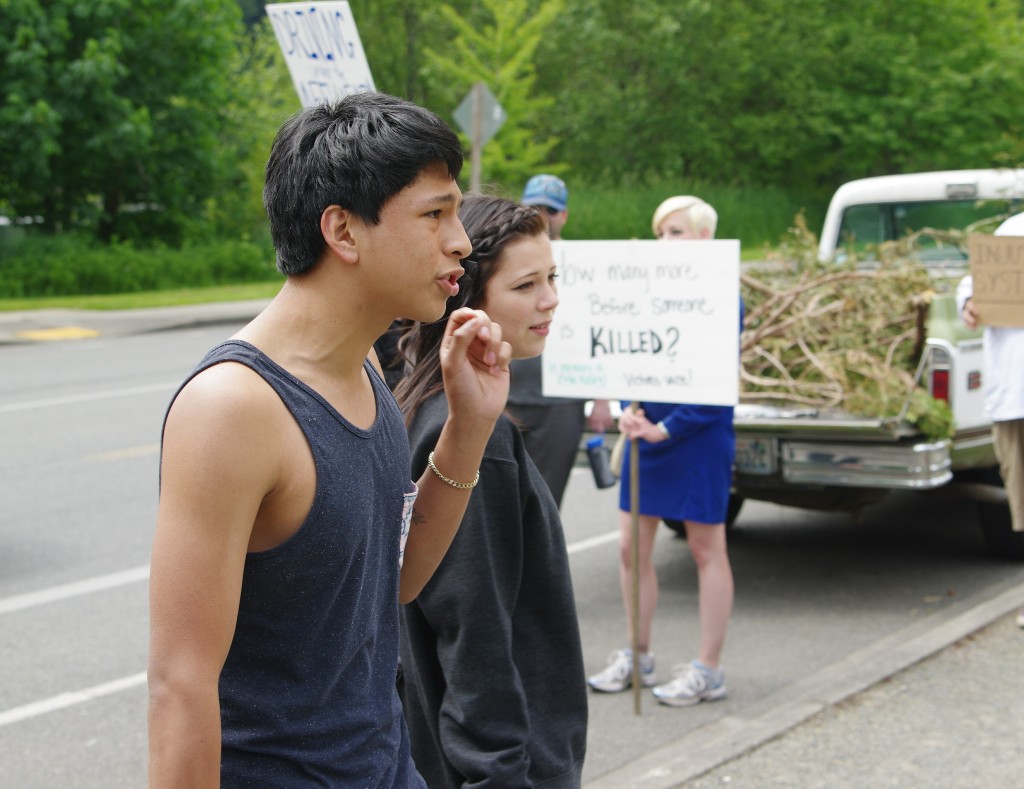
At one point, a young man on a skateboard arrived in the company of a young lady and another male. He began to scold the crowd, invoking arguments that their protest would be futile and Goodman was an asset to the community and his employees–a sentiment judge Schaller had made before sentencing which clearly provoked the protesters then–AND NOW!
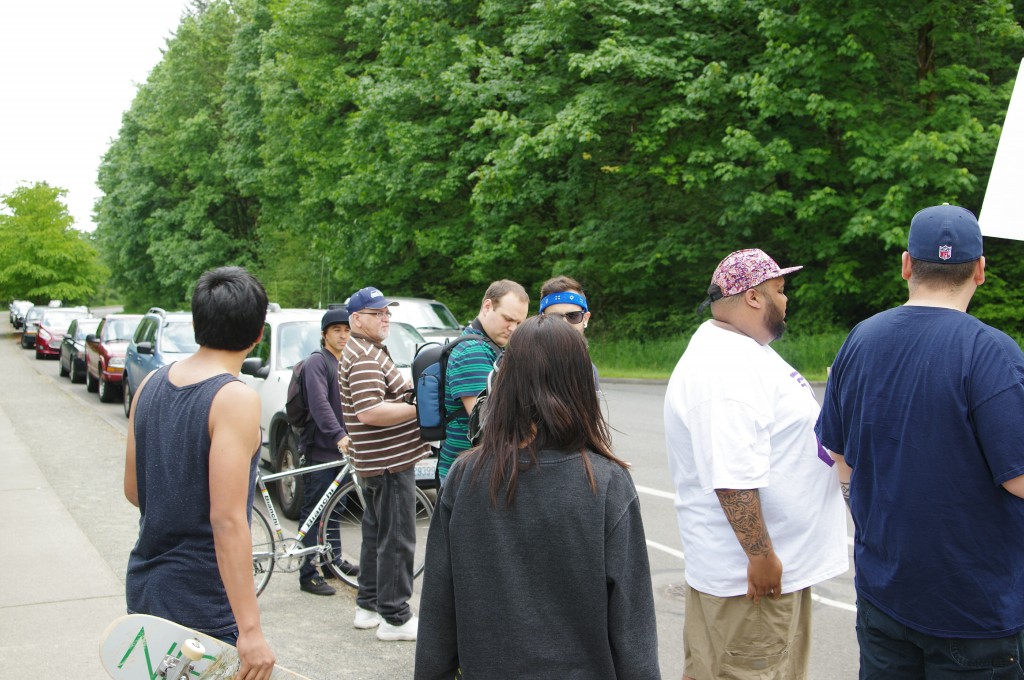
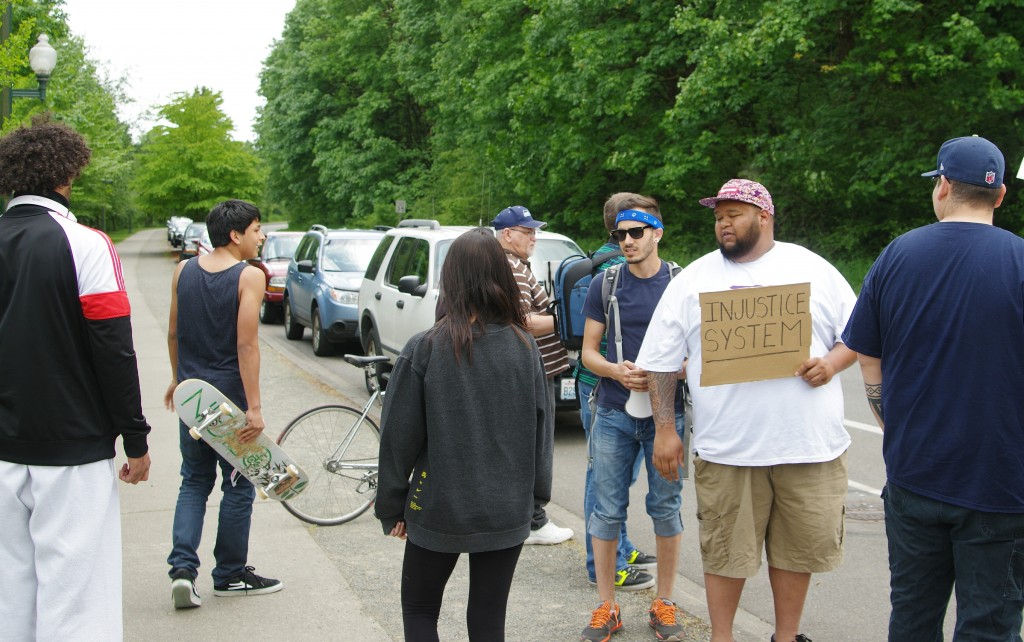

Protesters began to yell at the younger man. He began to yell louder. The crowd was urged to step past him to line the road for oncoming traffic. He stepped in front of them yet again. The yelling grew in intensity and insults were exchanged. He began to flip off the demonstrators. Sam Miller, the organizer, urged the group to turn their back on their antagonist and march up the hill toward the courthouse–which they did.
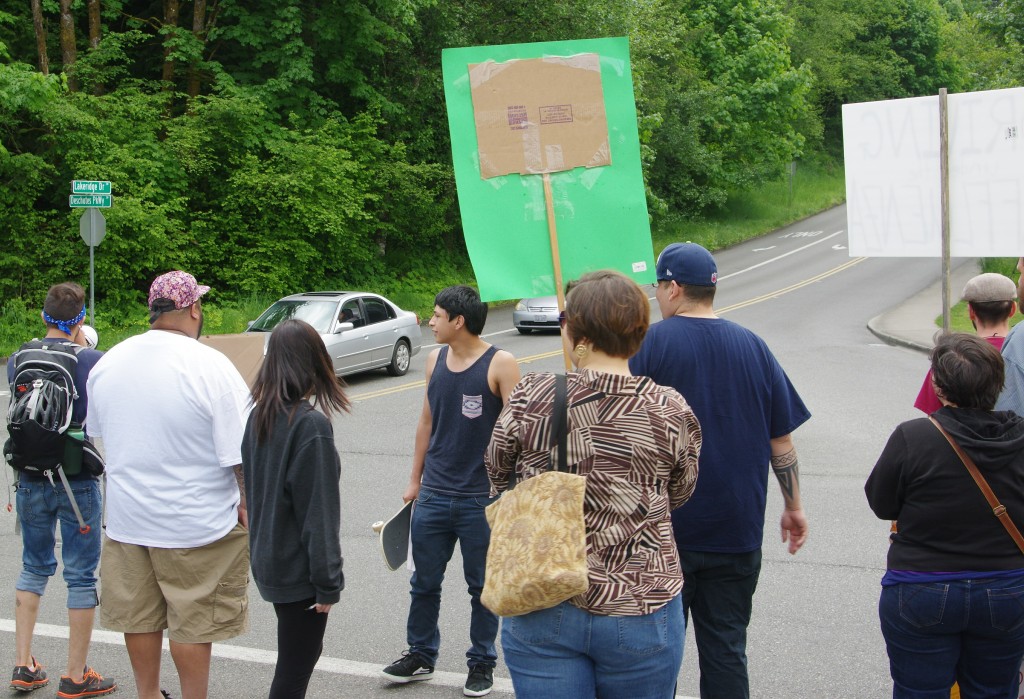


The young challenger was invited to come to the courthouse to be interviewed, but demurred. His young friends tried to avoid being photographed. He seemed more interested in confrontation than dialog or providing a reasoned statement for public consumption.
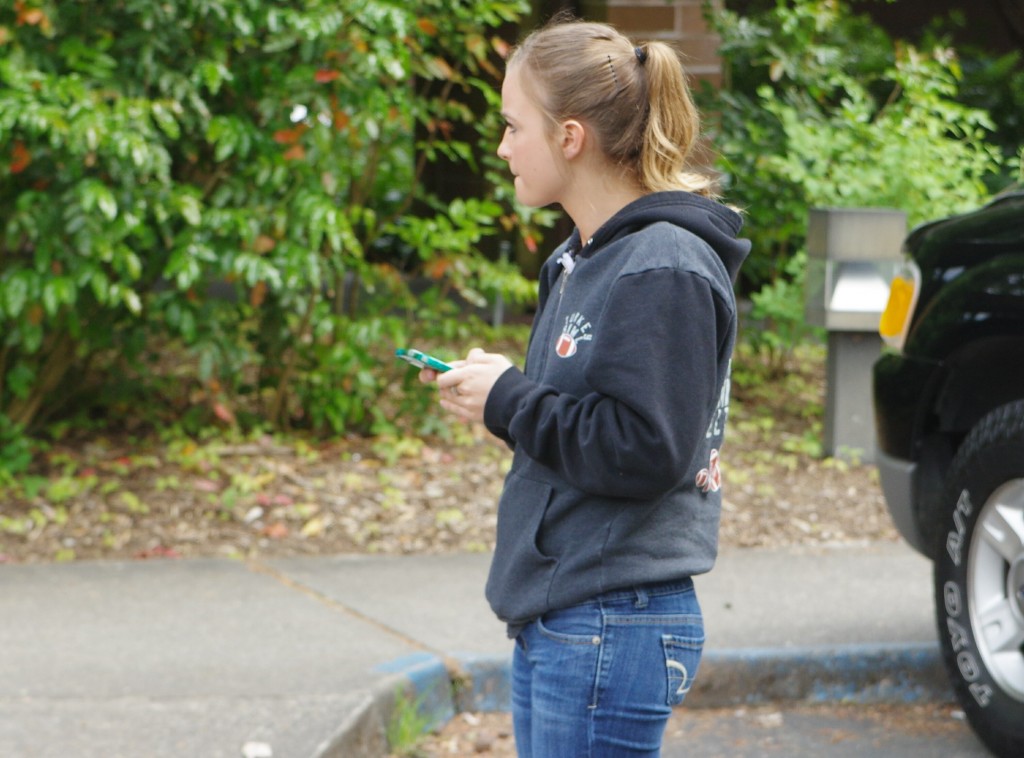


Driving up the hill was easier than walking it, and as luck would have it, a parking spot opened up adjacent to where the protesters would take their stand, just in time to gear up and video record their arrival into the entryway of the courthouse complex. Signs held high, the spirit of camaraderie was irrepressible, their cause just. Their erstwhile nemesis from a few minutes prior was nowhere in sight. A megaphone was on hand, used to announce their purpose and complaint. Sensing a lull in the drama, a quick foray into the covered walkway captured the image of three Thurston deputy sheriffs conferring about the demonstrators. They immediately shrank from the camera, shy for those charged with taking mug shots and searching body cavities. Sgt Matthew, one of their number, was less shy. He greeted the photographer with a kind of impertinent familiarity stemming from an incident of official abuse circa 2011 instigated by one of his peers. “I haven’t seen you for a while,” he offered. “Maybe that’s a good thing?” the photojournalist parried. “Why are you taking my picture?” he challenged. “Press,” came the obvious reply. “Oh?–you mean that little [PRESS] button you like to wear?” he guffawed. “Uh, yeah! If government ‘permission’ was a requirement, a ‘FREE PRESS’ wouldn’t mean much, now would it?” rejoined the journalist non grata. Matthew wasn’t going to gain the upper hand in this exchange and knew it. He retreated into the bowels of the Superior Court building beyond the security checkpoint.
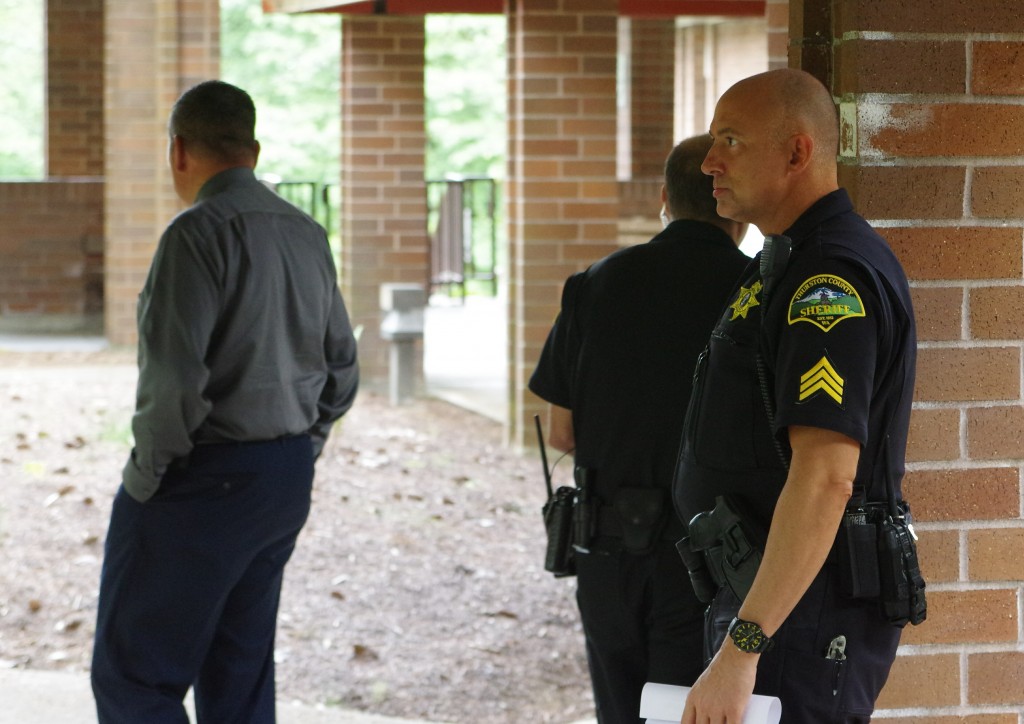
Sgt Matthew

Courthouse Cop Glares at Camera
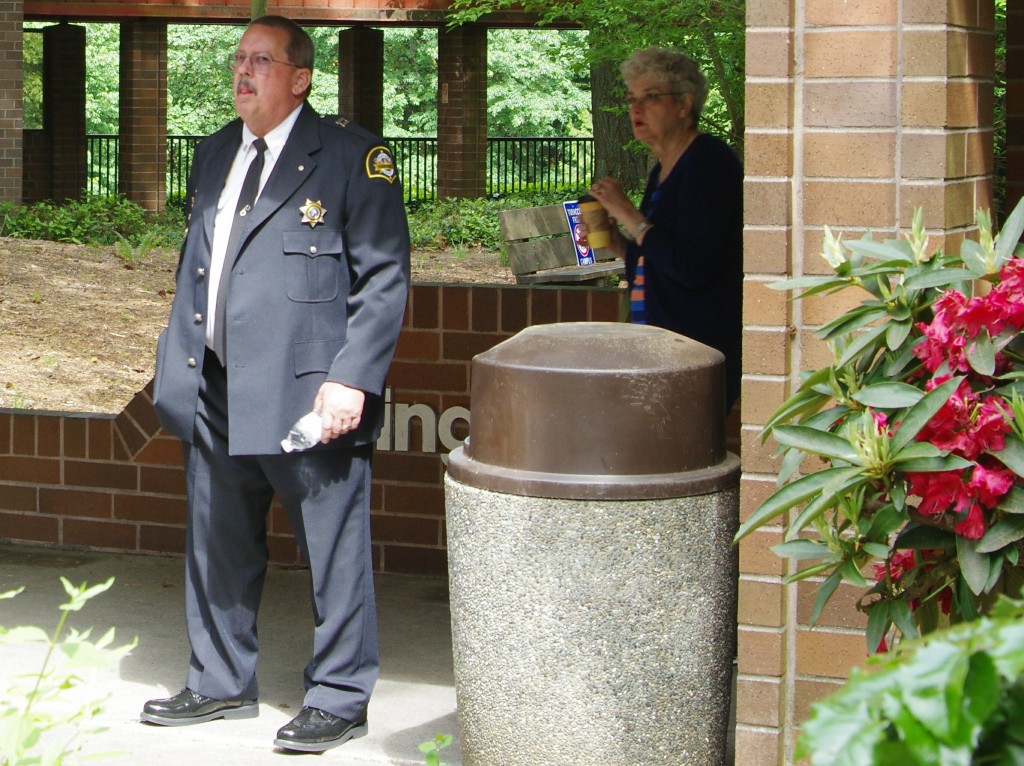
After snapping a few more shots of casual denizens of the courthouse complex, a return to the group found uniformed deputies sniffing suspiciously at the demonstrators and resentfully glaring at the camera. It wasn’t a marriage made in Heaven.
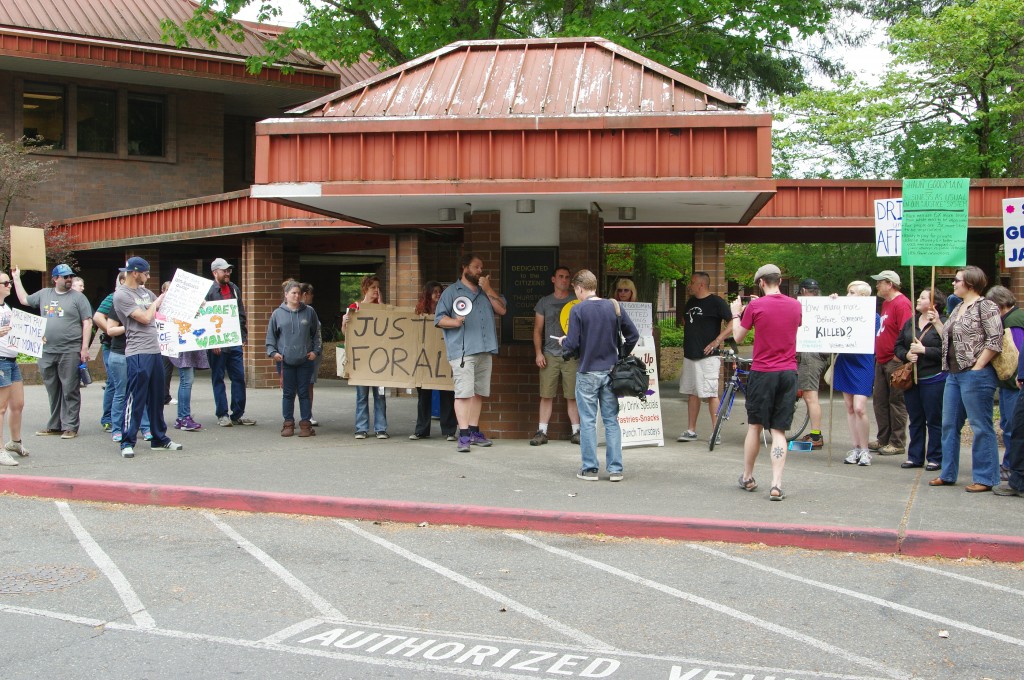

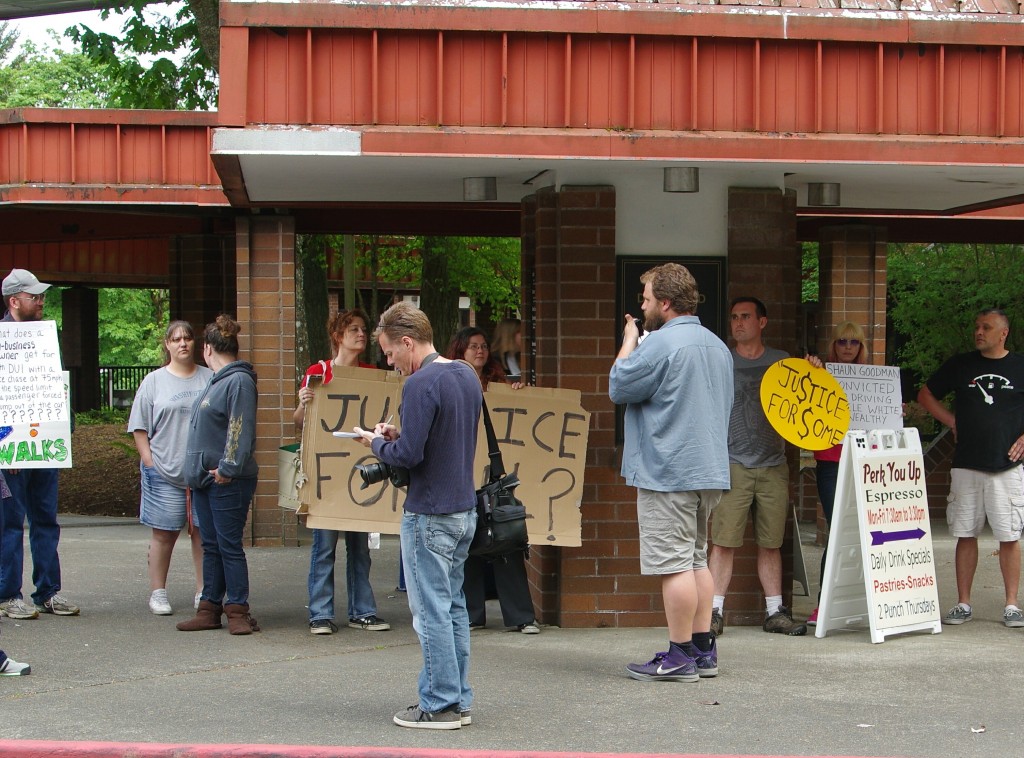
Finally, after what seemed all too brief a stay, Sam Miller thanked the crowd for its support and restraint. He’d asked them to respect the premises by not venturing inside the courthouse building itself. The rally broke up and the group disbanded. There were many cameras present, both from the mainstream media and by we the people. There were no arrests and no confrontations other than the brief altercation described above which had taken place at the foot of the courthouse hill by Capitol Lake.
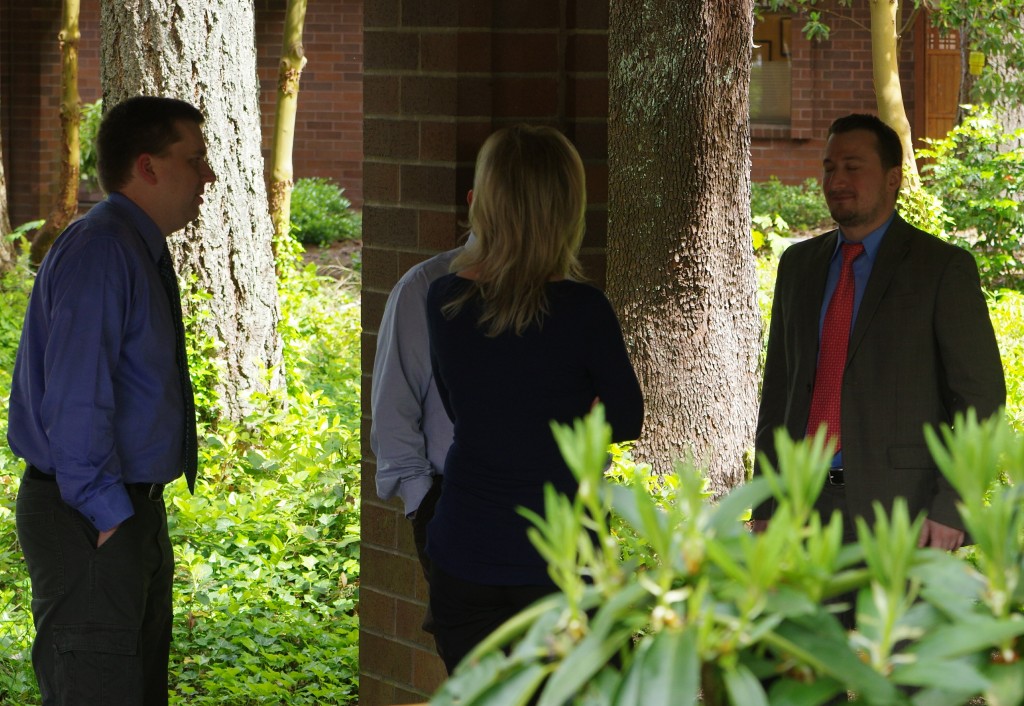
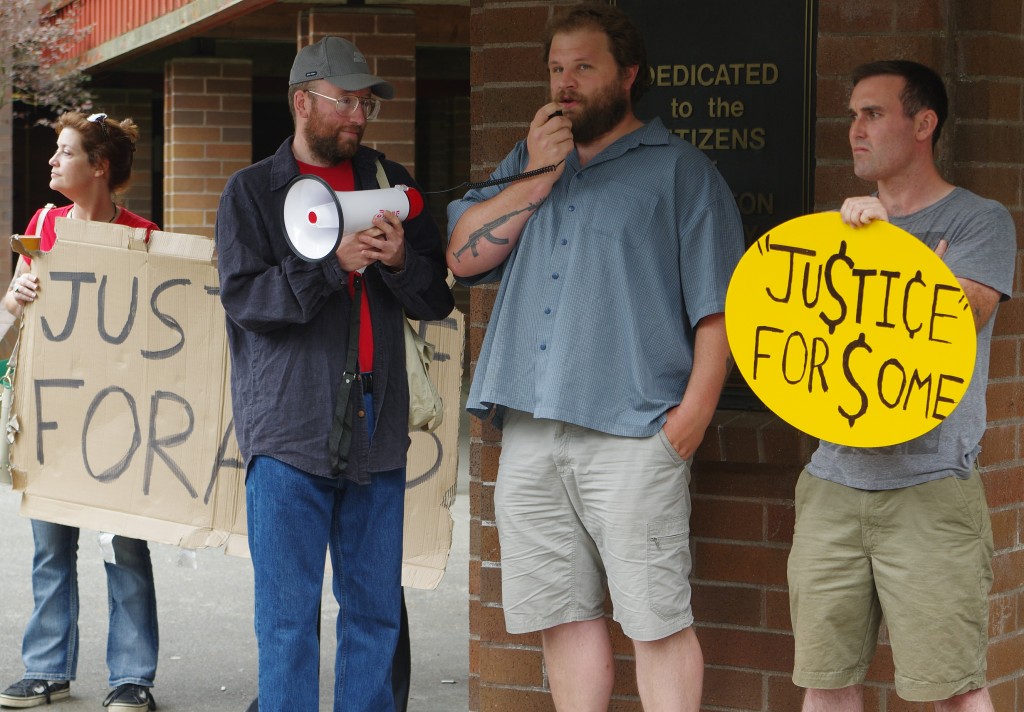
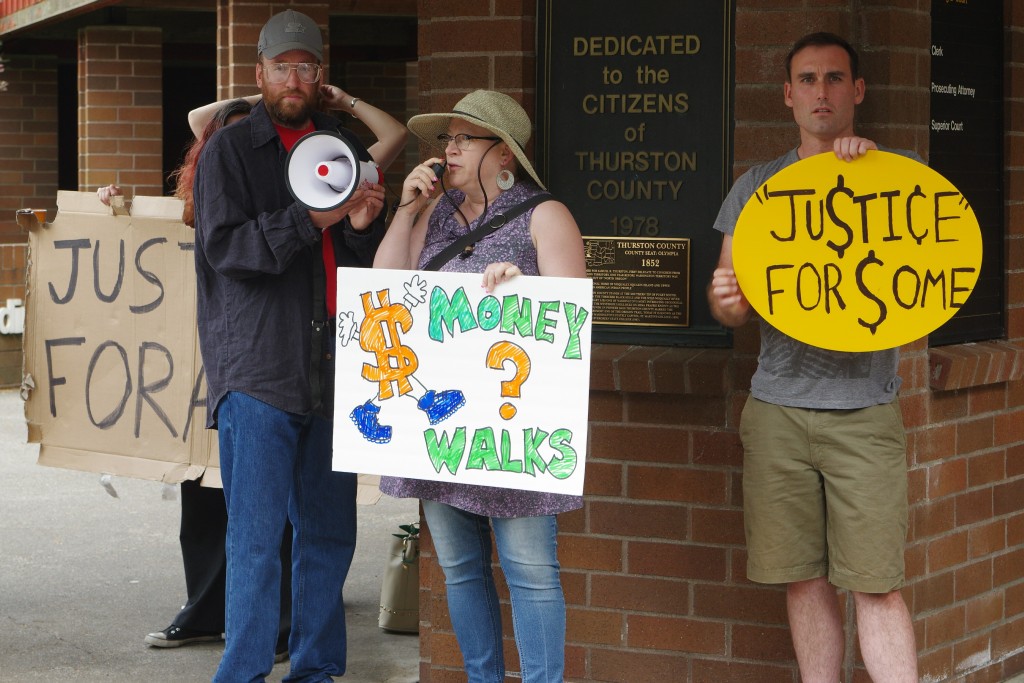
It may not have been Olympia’s finest hour, but it was civilized and a good start.


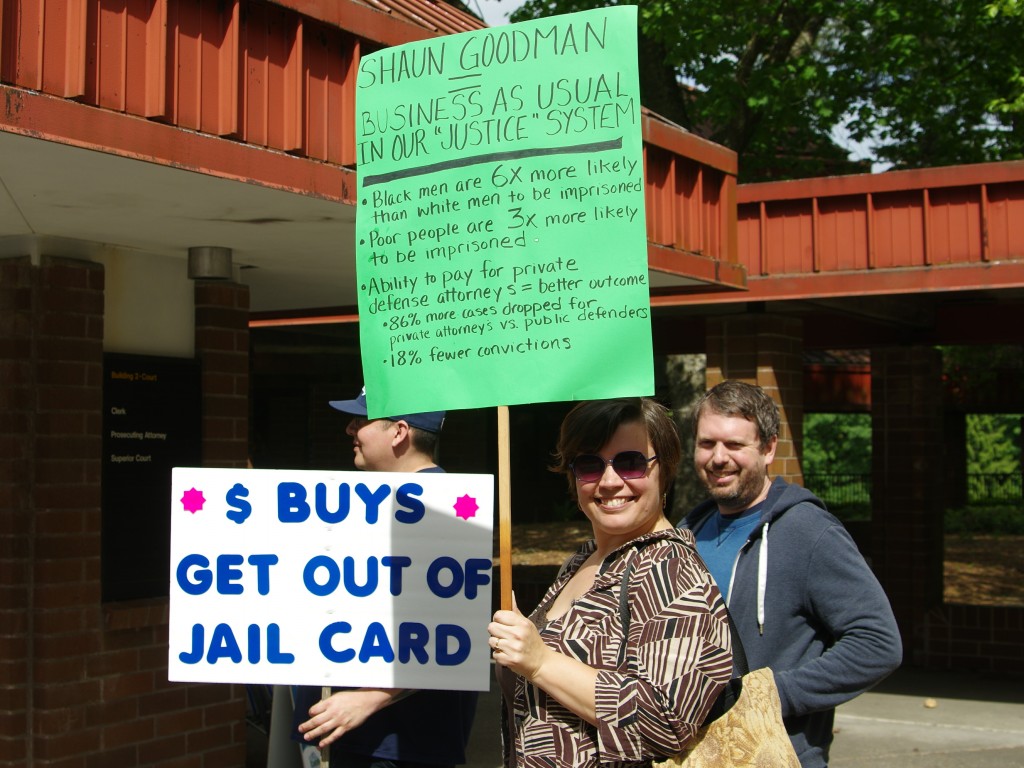

Posted in Uncategorized
Leave a comment