TESC 4-20-13 Strong (A)rm Robbery-Assault on Photojournalist

Dr. Brett Weinstein: Brilliant Defender of Academic Freedom

Close Encounters of the TESC Police Kind

form action=”https://www.paypal.com/cgi-bin/webscr” method=”post” target=”_top”>The PAYPAL button(s) that follow may also be used to pay for paralegal/process services, et al.

(No PAYPAL account is required to make Paypal payments, it will accept credit cards.)

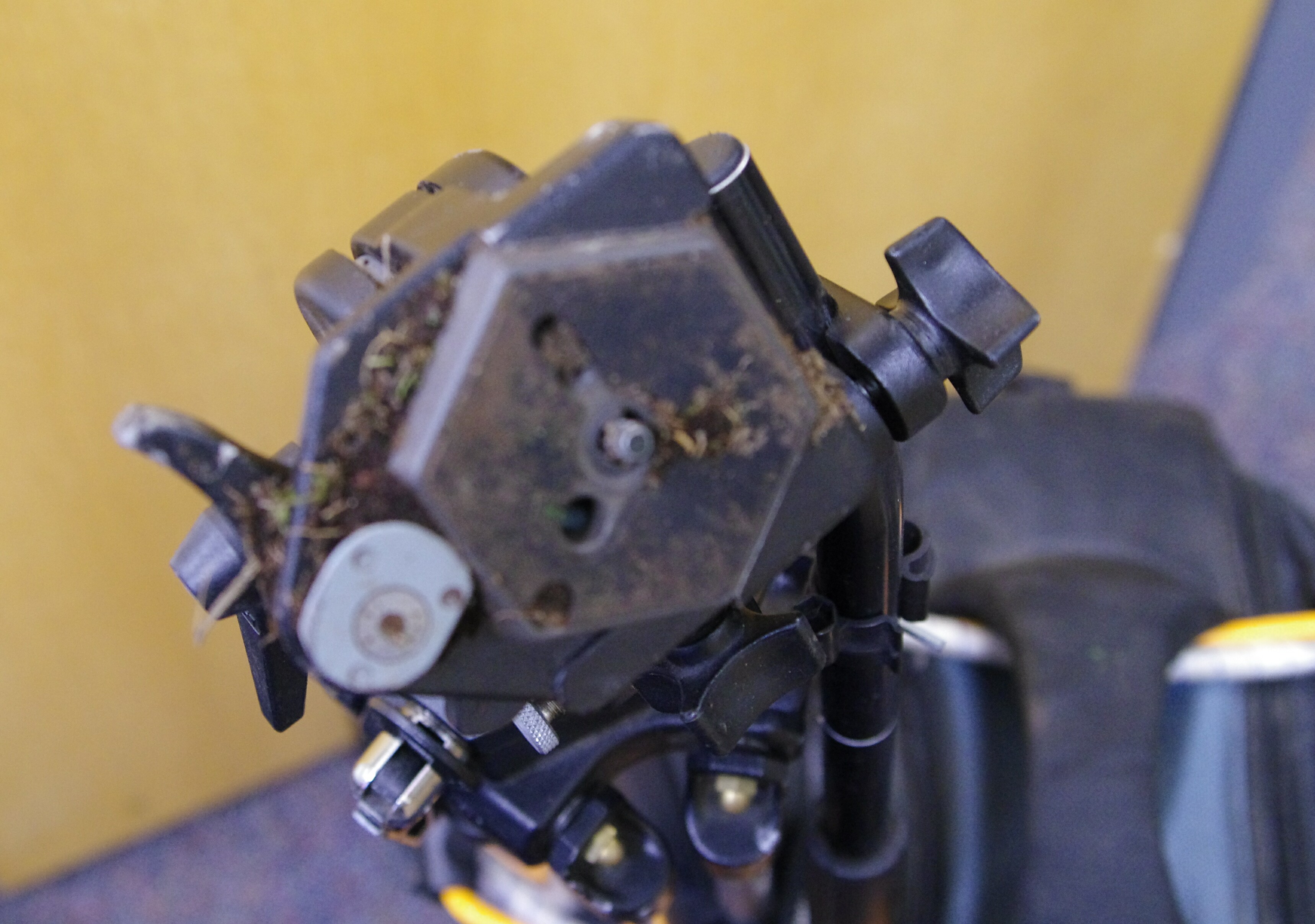
Donations are being sought here to help replace that which was, at the ‘Anarchists Convergence‘, destroyed/stolen in a Strong (A)rm Robbery-Assault on this reporter attempting to cover a public event involving Pacific NW region (A)narchists at The Evergreen State College (TESC) in Olympia on 4-20-13. You can help by donating to the cause of 1st Amendment principles, a free press, and not allowing thugs/petty traitors to succeed in their efforts to bully/assault photojournalists. Any amount would be appreciated as a vote for the public’s right to a free press covering what is going on in its public spaces/venues.

–> DONATE for Cause/Services <–

Click DONATE if the above link fails/returns an error prompt, OR mail a check made out to Amicus Curia, PO Box 1711, Shelton, WA 98584 unless time is of the essence.

If the above fails AND if you have a PAYPAL account, try the following QR code and instructions below:

Paypal Amicus qrcode
  1. Show your QR code to your customer. (the above image w/all the dots)
  2. Ask your customer to open the PayPal app– they will tap Scan/Pay, and line up the QR code in their camera frame. Or they can scan the QR code right from their camera.
  3. Have your customer enter the amount to be paid.
  4. Ask the customer to tap Send.

That’s it! You’ll both get a notification when the purchase is complete.

It was a sunny Saturday morning unusually warm for the Pacific NW. Evergreen’s Sabot Infoshop and a loose coalition of regional (A)narchists had been advertising the workshops scheduled for 4-20-13 & 4-21-13 for several weeks, billing them as free, open to the public, and handicap accessible. No one questioned the paradoxical utilization of a State owned college campus as the venue for a group (Sabot Infoshop in tandem w/SDS @ TESC) trumpeting its desire to ‘smash the state’, eliminate all laws, while basking in the largess and well appointed facilities of that very same government.

No Rights, No Remedy

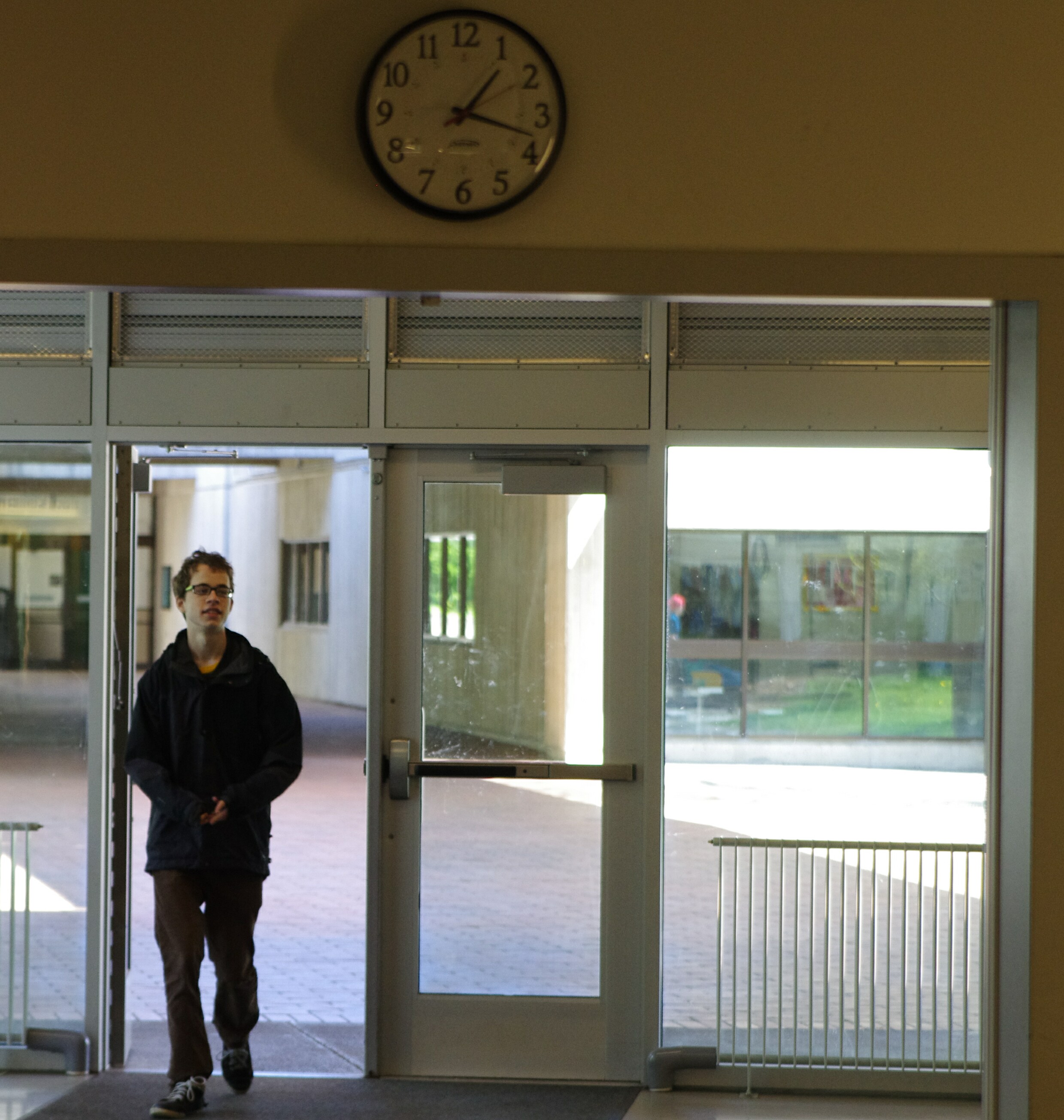
The anti-state, anti-capitalist workshops scheduled over the course of the next 2 days sounded interesting if controversial. Some invited open discussion, others promoted beefing up personal computer security to defeat increased state surveillance or a dissertation on why insurrection and ‘direct action’ (property destruction, vandalism, arson, et al) attacking the state and/or corporate interests is ‘necessary’. Still, TESC was fundamentally conceived as a non-violent public forum to discuss, debate, and exchange opposing views. The parking lot adjacent to the Seminar II complex (Building ‘C’, 3rd floor) appeared nearly full.  A couple of attendees helped the reporter locate the space where the presentations would be held over the weekend. Armed only with his camera and an abiding commitment/trust in 1st Amendment principles guaranteeing the public’s right to know about such gatherings in venues such as this, he made his way up the maze of elevators and upper story walkways. Naively ignoring an ongoing stream of online threats, arriving unaccompanied, and supposing the assault on and stalking of Daily Olympian photojournalist Tony Overman as well as the bloodying of Seattle news photographers covering the 2012 May Day street violence had been aberrations, he arrived too late to cover the 10:00 – 11:30 workshop just as it had broken up for lunch.

Malicious Mischief
Malicious Mischief
IMGP7206crp
IMGP7207crp

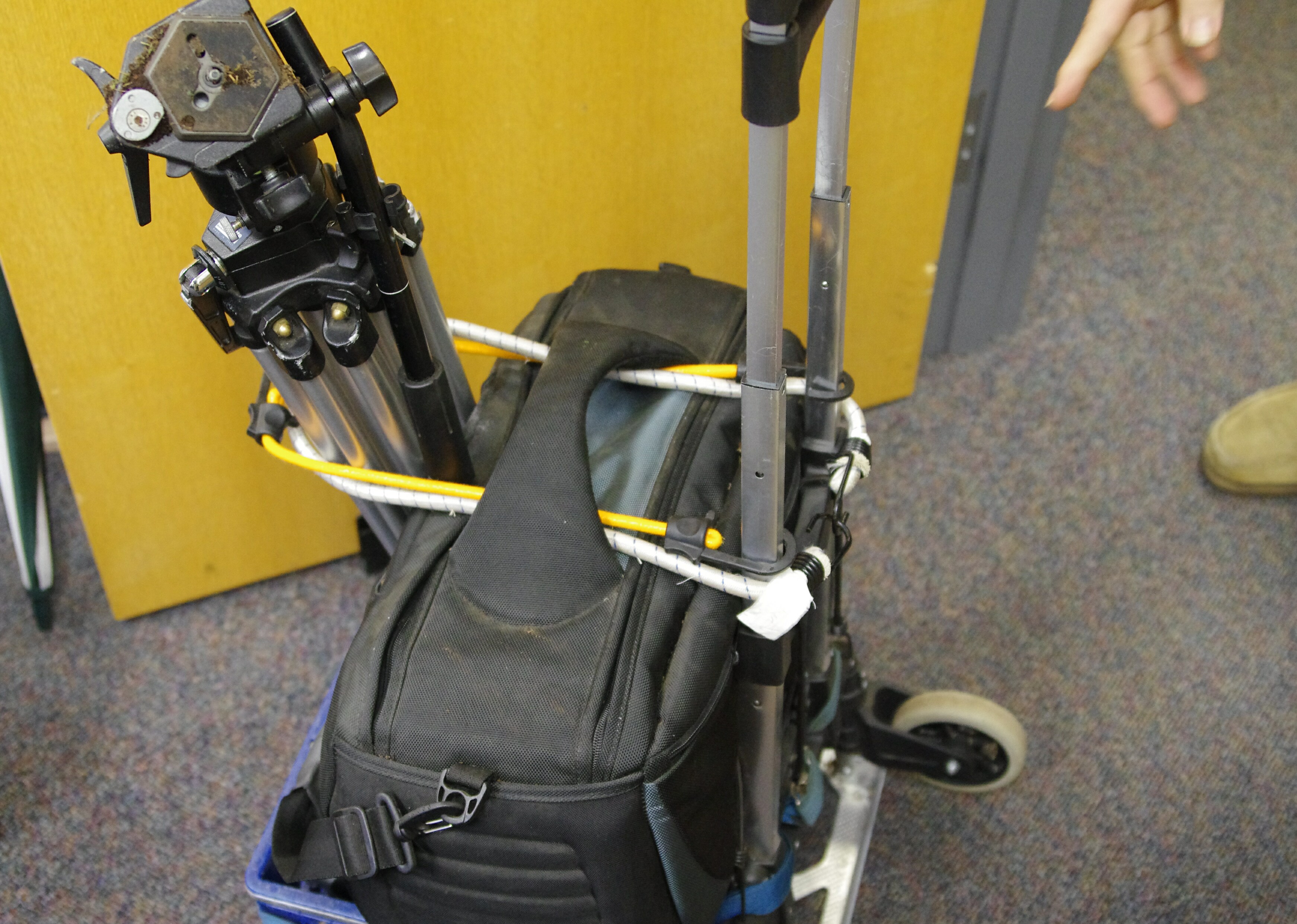
Not having unpacked his camera/video gear and tripod, Amicus Curia pulled it behind in a 2-wheeled kit resembling a hand-truck because it was heavy. After passing through the main entryway door, it was noted there was anarchist literature spread on a table immediately inside to the right ranging from topics like the need for insurrection to arguments attacking the effects of capitalism. Those near the entryway were young adults, white, and apparently privileged judging from their fashionable clothing. The poor and homeless who might have been their most natural audience seemed absent–no doubt tending to the daily struggle to survive in a hostile middle class dominated environment. But wishing to document all of this for public consumption proved problematic.

IMGP7215crp
In Your Face
IMGP7211crp
IMGP7212crp
IMGP7213crp
IMGP7214crp
IMGP7217crp
In Your Face
In Your Face

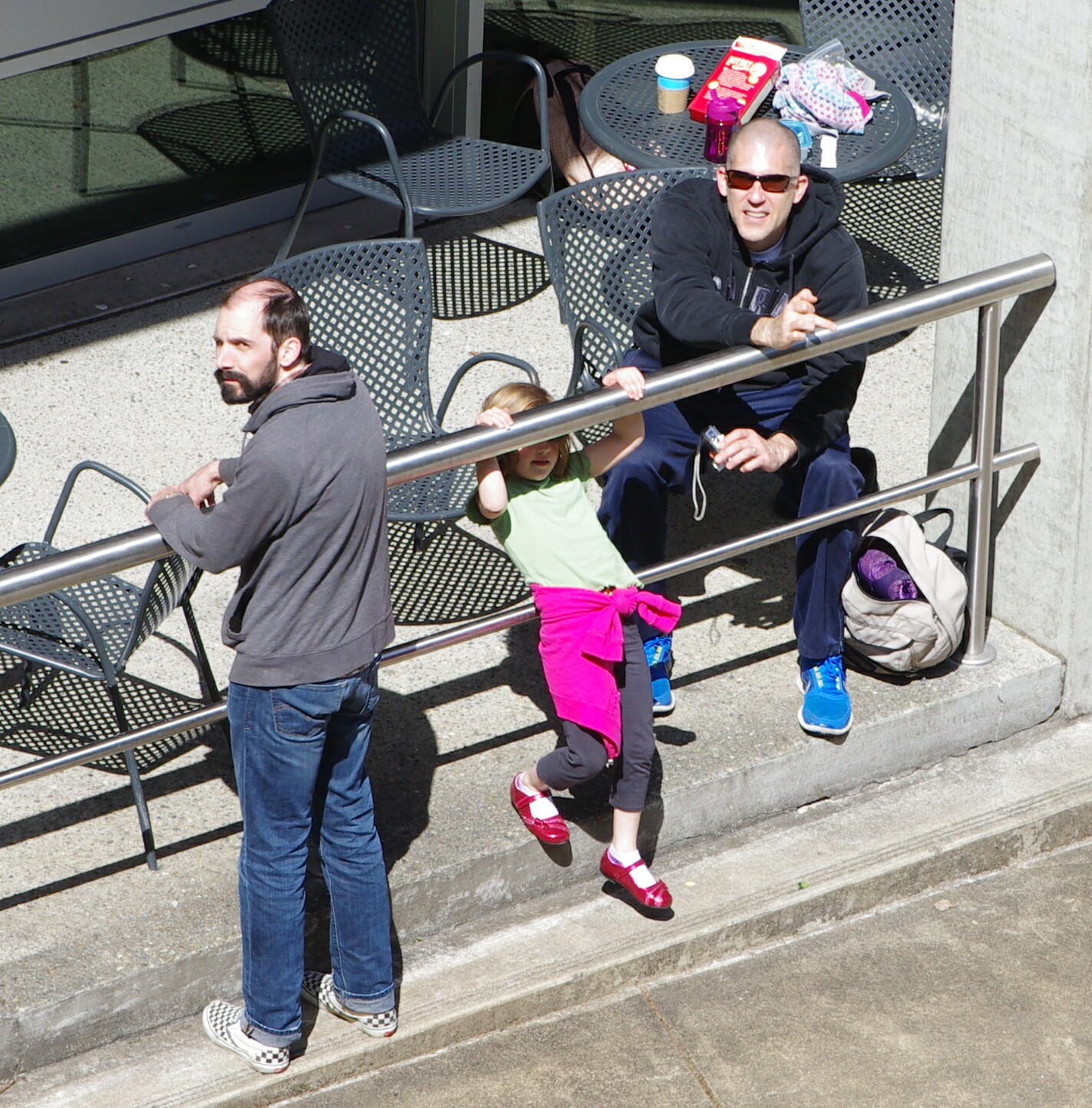
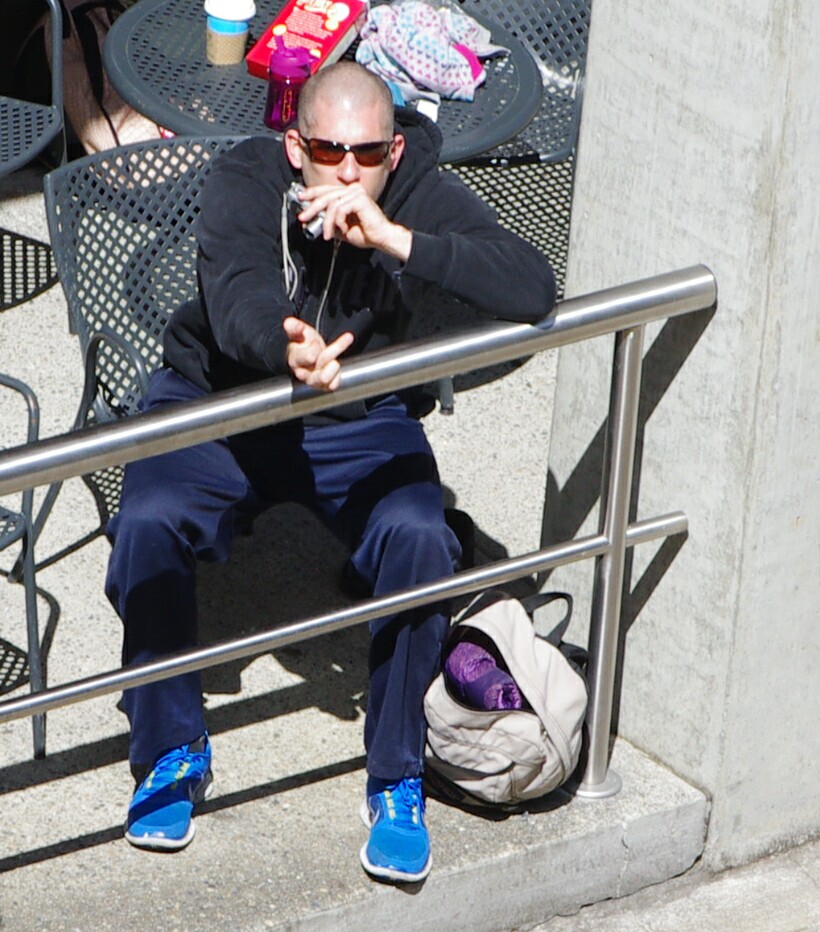
Upon attempting to proceed further into the building’s interior, the reporter was at first blocked, then harangued by several present being told he was ‘not welcome’. Fully grasping a visitor to the Evergreen campus need not be welcome to be entitled to enter its public spaces or attend public events, he ignored the verbal abuse. Then the touching began. There were perhaps 8-10 people pushing close (kissing distance) to the reporter, bullying and intimidating in hopes of discouraging his entry. He pulled his small camera out of a side pocket and began taking pictures of the perpetrators engaged in the criminal harassment. He reached for his cell phone to call the campus police and report the assault. He retreated outside the door to place the call but the crowd pressed him, at one point pushing his gear from inside the building to immediately outside the doorway. A couple of young men demanded to know what the reporter was doing with his cell phone. Besides the obvious, he declined to respond other that telling them it wasn’t their business.

Suddenly, a young guy grabbed the journalists arm/hand and wrenched his camera from his grasp, then fled down the 3rd floor passageway with it. Immediately after, while the campus operator was on the line, another slightly older young man grabbed the 2-wheel hand-truck and gear, throwing it over the 3rd floor banister to the ground below. He immediately fled as well. TESC officer Garland witnessed the moment of impact, but was sufficiently intimidated by the violence and knowledge of the group involved, she summoned the Thurston County Sheriff’s office for backup to provide for her own safety as she was the only officer on duty on campus at that time. Thus, the reporter stood near his vandalized gear for around 5 minutes before she made personal contact. Clearly citizens must rely on their right to self defense based on this example of too little too late.

Eventually, after some discussion and giving  the group (Sabot Infoshop) which organized the event an opportunity to cooperate (impertinently rejected) in locating the stolen camera and/or those responsible for the robbery, the event and organizers was to be banned from campus. Overhearing this, those behind the event voluntarily left the campus for a private venue despite their rhetoric abhorring the very concept of ‘private property’, arguing they enjoyed the greater luxury of drinking beer and getting high anyway.

In the aftermath, on the various (A)narchist websites around the region, hasty afterthoughts justifying the criminality were posted. More than a few of self described anarchists applauded the attack while a number actually present participated in it.

After signing a police report statement, this reporter contacted Peter Bohmer, who he’d known for over 45 years. Peter admitted he knew (in general) many of the organizers and likely attendees. But, when asked for help retrieving the stolen camera, Peter demurred with an unsettling offer: Pete agreed to help retrieve the camera (which he opined he could likely accomplish) IF the reporter agreed not to press charges against those involved in its theft, robbery and the malicious mischief. The photojournalist listened closely as his self-admitted privileged professor ‘friend’ with the generous State salary sought to protect criminals engaged not only in vandalism under the pretext of anti-statism and anti-capitalism, but theft and assault. A recording was made of the conversation lasting over an hour on Peter’s front porch, and Professor Bohmer was alerted to the fact early on. Those involved in the earlier assault on the journalist were NOT alerted to the fact they were recorded in the midst of their assault. [NOTE: Several years later (2015) in the wake of a police shooting hospitalizing 2 young black men in Olympia, Professor Peter Bohmer not only minimized their crime of shoplifting while encouraging others to follow suit…arguing there was nothing wrong with it…while noting he routinely shoplifted himself, during the Olympia City Council meeting where his remarks were recorded and videotaped.]

The audio of the assault, for any who care to listen, is included below in this retelling of the circumstances. Any member of the public who recognizes any of the voices is urged to contact TESC officer Marron at (360)866-6000, or this reporter. Full cooperation will continue to be given to those LEO’s investigating this crime including photographs of suspects and/or those providing criminal assistance after the fact.

You can listen to the audio of the assault by clicking Strong Armed Robbery.

The Daily Olympia carried a story reporting the outline of the incident on page 5 of their Sunday edition, 4-21-13 as well as their online publication. Local (A)narchist websites have published pieces/opinions typically justifying the assault as they generally do for individuals engaged in such behavior. The sites are saturated with taunts, gloating, and continuing threats directed at the reporter, much as Tony Overman, the Daily Olympian photojournalist, had experienced from the same crowd of miscre@nts years earlier. Some posts resembled the fatuous self absorbed amusement associated with narcissist juveniles and their prank phone calls…infantile minds with adult bodies.

Ironically, some of the more violent elements calling themselves anarchists and their supporters feign concern about their *safety* in the face of photojournalists capturing their image or that of their associates. It’s a bit like Dillinger complaining his getaway car didn’t come equipped with airbags. It is the public whose ‘safety’ is at risk! The violent anapunks merely risk getting caught. It’s a valid fear…as the number of folks who’d like to catch them grows daily.

IMGP7230crp
IMGP7229crp
Mom & Baby
Mom & Baby

Posted in Uncategorized | 20 Comments

(A) History of Grand Jury Abuse & Resistance

“Co-operating with the state is like eating potato chips – once you start, you can’t stop” – Michelle Whitnack, PNW grand jury resister, 1977.

Michele Whitnack

by (A)non

I gleaned the attached articles from a Vancouver, BC based (A)narchist news journal, Open Road. The journal published from 1976-1990. Open Road was really fucking interesting and focused of a plethora of anarchist issues, not shirking away from anarchists who crossed the lines of legality and weathering “controversial” issues such as the Direct Action bombing of the Vancouver 5.

Attached are two articles on grand jury resistance in 1977. An example of our non-linear existence here again we encounter grand juries, again we call them witch hunts, again defiant statements are released. Again we resist. Not to say that this is done by rote, conversely it is likely done with careful consideration and with much courage.

One of the two articles, Whitnack out of deep freeze, focuses on recently released 21 year old Pacific Northwest grand jury resister, Michelle Whitnack. Whitnack was released after 6 months for refusing to testify in the grand jury probe into the George Jackson Brigades’ bombing of a Seattle Safeway – she also refused to give her fingerprints. Upon release Whitnack stated, “Was six months in jail worth it? You bet it was. The thing they didn’t realize was when my energy runs out, my stubbornness switches in.”

The other article, Grand Juries: The New American Inquisition. points out that between 1971-1977 over 200 people refused to testify at Grand Juries. The article claims that in a new phenomena people across the US people have begun “to respond to grand jury attacks.. (through) absolute non-collaboration…” The article offers a point form synopsis of the dangers of testifying, examples of the impacts of defiance and discussions of specific examples of resistance, as in one case in which grand jurors were delivered a document warning them that their “safety will be in great peril (if they continued to participate).”

Congratulations to 2013 PNW grand jury resister Maddy Pfeiffer just released yesterday, April 10th! And to KteeO and Matt Duran released February 28th! Solidarity with Kerry Cunneen who is currently defying a subpoena and to others who have avoided being subpoenaed through evasion. In silence we roar!

*ps: Thank you to a kind friend who found a nearly complete stack of Open Road issues at an (A)narchist book fair last year and held on to them.

Grand Juries: The New American Inquisition
By Harry Gombe
Open Road, Spring, 1977, page 12

“What is your sexual preference?”
— Question asked by Lexington, Kentucky grand jury.

You can’t hardly get out of a jam in America anymore by “taking the “Fifth.” That once-hallowed refuge of civil libertarians and other believers in the essential beneficence of the State has been rendered a virtual dead letter by an intensified grand jury offensive across the country.

Scores of individuals have gone to jail for refusing to cooperate with politically-motivated grand juries, and thousands of others have had their personal lives and political priorities disrupted in combating the aura of criminality that the authorities have attempted to bestow on all dissenters.
In the process, these resisters have shown that the scope of political activity in a society depends not on the “rights” guaranteed by the government nor on the good will or good intentions of high officials and media managers, but on how well groups and individuals can mobilize to protect their own interests.

The resistance to the grand juries has had only marginal luck in legal and bureaucratic challenges of the grand juries’ patently unconstitutional abuses. The main successes up to now have been due to the personal courage of individual “martyrs” and to the organizing skills and energies of local anti-grand jury coalitions and defense committees across the U.S.

Nixon’s relatively minor tampering with the U.S. Constitution during the Watergate farce provoked anguished and outraged protests from his “enemies” among the ruling elite of government and the media. But a much graver breach of popular rights–in fact, the outright subversion of such key elements of liberal democracy as the Bill of Rights’ Fifth Amendment guarantee against self-incrimination–is being carried out with hardly a murmur of discontent from the established opinion-makers.

Maybe it’s because the targets (for now, at least) of this new Inquisition are merely the dispossessed and the dissident, including native people, militant unionists, Chicanos, Puerto Ricans, gays, feminists, anti-war activists, single mothers and urban guerrillas.

Under the pretext of a war on organized crime and “terrorism,” the grand jury has been transformed into a powerful investigatory body completely subservient to the FBI and other police agencies aiming to destroy the broad progressive and Left communities. Prosecutors routinely use grand juries to extort information behind closed doors to which police investigators have little access and no legal right.

As things stand now, a grand jury witness is in as much or more jeopardy as the ostensible “target” against whom the prosecutor is supposed to be seeking line indictment. The witness is given little or no warning to appear; he or she has no right to know the crimes being investigated and no right to have a lawyer present in the grand jury room; the regular rules of evidence and other due process safeguards don’t apply; there is no public presence at the proceedings.

But the grand jury’s main bludgeon is its power of civil contempt. Witnesses can be compelled, on pain of being sent to prison to answer literally any question about their political ideas and associations, about their conversations and activities, and those of their friends, neighbors and relatives. Jail terms can last up to 18 months–the term of the grand jury.
In a chilling new wrinkle, the grand jury has been put to work on what can only be described as anthropological research. It’s the sort of research that the CIA has been funding for years in Latin America and elsewhere in an effort to anticipate, divert and control the forces of social change. Only now, the “subjects” are home-grown communities living in self-sufficient ways outside the sanctioned mainstream.

This happened clearly in Lexington, Kentucky, where the FBI thought it had tracked down political bank robbers Susan Saxe and Katherine Power. Agents started asking heavy-handed questions in the small Lesbian community there and were baffled to find they were getting nowhere.

One of the people questioned in Lexington said the FBI was thoroughly spooked to learn there were whole groups of people in America whose internal dynamics were a mystery to it, whose members spontaneously nurtured and supported each other and built solidarity outside the pale of the Welfare State. “For them, it was a bureaucrats’ nightmare,” she says. “They just assumed there was a national network of Lesbians moving people around, and they had to find out how it worked. They got the grand jury to ask all sorts of personal and irrelevant questions: who people had lived with in the past few years, who they met when they went to meetings, what they majored in college.

“It was tremendously destructive of the political community in Lexington. People became burned out and paranoid. It caused tremendous rifts. You never knew what was happening.”

Similar research is being conducted in Seattle (see accompanying article), where, as one lawyer put it, most of the subpoenas issued “obviously don’t know shit from shinola” about any illegal political activities.

The grand jury is ostensibly probing the activities of the George Jackson Brigade, a clandestine group that pulled off six political bombings, a bungled bank robbery and a successful jailbreak during 1975 and 1976. (The courthouse bomb has been claimed by the New World Liberation Front, based in the San Francisco Bay area.)

Civics textbooks say the grand jury system was established way back when, in order to protect the individual against capricious prosecution by the government. In truth, the grand jury–mostly male, white, middle-aged and middle-class–has almost always been a rubber stamp in criminal prosecutions and political persecutions, and in times of acute domestic stress or of abrupt or profound changes in official policy, most federal administrations–even “liberal” or “progressive” ones–have allowed or encouraged grand juries to stifle the voices of opposition.

Abraham Lincoln used grand juries to silence critics of the Union cause; Woodrow Wilson to illegally imprison and deport hundreds of radicals to Russia following the Bolshevik Revolution; Franklin Roosevelt to put down Nazi sympathizers; and Harry Truman to provide a cover for the anti-liberal crusade waged by Joe McCarthy and the young and hungry Richard Nixon in their congressional committee.

Nixon was following in this American tradition when he got the cooperation of a supine and supposedly liberal Congress and the U.S. Supreme Court to rewrite the Bill of Rights and fatally weaken one of the more cherished liberal freedoms–the right against self-incrimination. High government officials had been looking for new methods to stem the Vietnam-era tide of popular discontent after the great conspiracy trials (Dr_ Spock, Chicago Eight, Wounded Knee, etc.), and 1984-type legislation, such as no-knock laws and preventive detention, had failed to turn the trick.

Nixon’s brainstorm, embodied in the Organized Crime Control Act of 1970, was “use immunity.” This meant that a witness could be compelled to testify if he or she were “granted” immunity from prosecution based, directly or indirectly, on that evidence. This dubious protection was obviously open to subversion by unscrupulous prosecutors.

The first wave of witchhunts was coordinated by the Internal Security Division (ISD) of the “Justice” Department. ISD prosecutors jetted around the country, appearing in more than 100 cities, subpoenaing more than 2,000 people sympathetic to or active in radical causes, or people who were simply friends or acquaintances of activists, forcing many of them to journey, often on little or no notice and with no explanation, hundreds or thousands of miles from their homes to answer a series of wide-ranging questions relating to their friends, political associations and activities.

Sample question in Tucson, where the grand jury was investigating the theft of a quantity of explosives (the woman who refused to answer it got seven months in jail):

“I want you to tell the grand jury what period of time during the years 1969 and 1970 you resided at 2201 Ocean Front Walk, Venice (California); who resided there at the time you lived there, identifying all persons you have seen in or about the premises of that address; and tell the grand jury all of the conversations that were held by you or others in your presence during the time that you were at that address.”

Stalled by Watergate

The government’s offensive got stalled temporarily as a result of Watergate and various court challenges, but these impediments have now been largely swept away, setting the stage for a new initiative. Nixon, Mitchell and that gang are gone now, and the FBI has taken over from the ISD as the main investigatory agency, but most of the politically-motivated prosecutors are still on the job.

Among the more active grand juries in recent months have been:

* New York–a campaign is being waged to smear the Puerto Rican independence movement by linking the Puerto Rican Socialist Party (PSP), with the Armed Forces of Puerto Rican Liberation (FALN), a clandestine group which has carried out a series of bombings. PSP militant Luerida Torres was jailed for four months last summer for refusing to talk, and she was only released when the grand jury’s term expired.

* Rapid City–as part of the continuing government repression of the native movement following Wounded Knee, three people were jailed for refusing to talk about a shoot-out in which two FBI agents who invaded the Pine Ridge Reservation were killed. An elderly couple was jailed for three months; they agreed to talk only because they had to get out to care for their young children. Joanna Ledieux, a tribal worker and mediator in the shootout, spent eight months in jail, and was only released because of public outrage: she was unable to nurse her newborn infant. In a related case; a Wounded Knee lawyer successfully resisted a subpoena in Des Moines which called on her to give evidence against her client.

* Washington, D.C.–a grand jury is helping the Washington Post attempt to bust the militant Pressmen’s Union. Eighty-eight unionists have been subpoenaed to find out how Post presses got wrecked during a 1975 strike. Fifteen unionists have been indicted for rioting, destruction of machinery and other offenses.

* Scranton-Harrisburg, Pennsylvania three separate grand juries are attempting to probe the underground “network” that harbored Patty Hearst and other Symbionese Liberation Army members in their travels. Two local activists, Jay Weiner and Phil Shinnick, went to jail in December after tying up the panel for months on procedural challenges and’ on direct “outreach” appeals to the jurors to take an independent stand against the prosecutor.

* Seattle–a fishing expedition against the entire Left community resulted in the jailing of Michelle Whitnack for six months. Ten other people–most of them women, including four single mothers–have been threatened with jail for refusing to talk.

* Denver FBI-police-vigilante offensive against the Chicano movement is being aided by a grand jury, which is purportedly investigating a 1974 bomb explosion that killed six Chicano men (Los Seis) in a car, Veronica Vigil, a Chicana activist, spent seven months in jail for refusing to talk.

* New Haven–two formerly non-political women, Terri Turgeon and Ellen Grusse, went to jail for seven months as part of a grand jury inquisition of the Women’s and Lesbian communities in Connecticut. This investigation is linked to a similar witchhunt in Lexington, Kentucky, ostensibly aimed at ferreting out Susan Saxe and Katherine Power. In Lexington, Jill Raymond spent 17 months in jail.

* Tucson–four Chicana women have been indicted for aiding “illegal” immigrants from Mexico as part of a grand jury attempt to scapegoat undocumented workers for the high rate of unemployment.

The strategy of resistance to grand juries is summed up in the slogan, Community–Not Immunity. It’s a strategy that depends on the personal courage, discipline and commitment of individuals called to testify, but also on the willingness of diverse elements in the Left community to unite behind a political movement that will put intolerable pressure–mainly in the form of public opinion–on the authorities.

After a period of initial confusion over how to respond to grand jury attacks, a nationwide consensus has now developed (with only one significant exception–more of that later) that absolute non-collaboration is the starting point. In the past six years, nearly 200 people have refused to talk in the face of government coercion, compared to maybe 25 in the previous 20 years. As one anti-grand jury coalition puts it:

“What happens if you testify?

1. You have been one person who does not resist.
2. You may have made real what they were only guessing.
3. You have increased your chances of being called again.
4. Without knowing it, you may have made connections they did not know.
5. You have increased the momentum for more grand juries.
6. However innocently, you may be responsible for someone, perhaps yourself, going to prison.”

This tactic applies to dealings with the FBI as well. The watchword is Don’t Talk.

There is no federal law requiring anyone to answer questions of the FBI, but it is against the law to lie to the FBI or other police agencies. Don’t try to outsmart them, either; they are professionals at their work. The suggested line is, “I have nothing to say. Goodbye,” and keep repeating that till they go away.

The jailings have provided the main focus for organizing activities. But, except for a few cases, the resistance has not been all that successful in actually springing people from jail. The courts have run roughshod over just about every legal objection, and it takes a unique set of circumstances for the government to cave in to public pressure. Example: Joanna Ledieux of Pine Ridge got out after eight months because the government was placed in the embarrassing position of denying her access to her newborn baby.
However, the intense public campaigns around these cases has almost assuredly prevented the heavier use of jailings by the authorities, who are beginning to find this tactic counterproductive. Most of those who went to jail were threatened with new subpoenas on their release, but the government rarely followed through on the threat.

In many cities, after someone had been jailed, the subpoenas for subsequent witnesses were quietly dropped, especially if the witnesses made a public show of resistance. In Los Angeles last June, widespread public protest in the entertainment industry led to the dropping of subpoenas against three filmmakers working on Underground, a major documentary about the Weather Underground Organization.

All forms of media have been used to bring the message home. There have been mass demonstrations, public meetings, cultural events featuring everything from specially- created operas to puppet shows, public statements inside and outside of court, torrents of letters and telegrams to public officials, letter-writing campaigns to local newspapers, establishment of “Peoples’ grand juries” to investigate crimes by those in public office.

The mass media has been used effectively in a number of cities to educate the public on the broader usages of repression. This has been especially so when there has been a “martyr” (usually female) involved. Two examples: when Jill Raymond came out of jail, three of the four leading papers in the State editorialized that the grand jury investigation should lay off; and when Michelle Whitnack went in, the local red-neck rag in Seattle ran an extremely sympathetic interview and profile letting her mention the word “anarchist” and talk about her prison movement work and even running a poignant photo of her peering through the jail-house visitors’ peephole.

Another type of educational campaign has been directed at the grand jurors themselves. Nearly all uncooperative witnesses issue statements or hand them to the jurors pointing out the various sins of the government and advising them they don’t have to be in the thrall of the prosecutor. In a few cases, this has resulted in juries taking a somewhat more independent tack.
However, a “courier” for the underground New World Liberation Front was charged with threatening a federal grand jury last October in San Francisco for handing the jurors a document warning them their “safety will be in great peril” if they persisted in their investigation of the NWLF. She beat the charge after several jurors testified in court that they did not feel frightened or intimidated by the warning.

The NWLF is the only major group that has a policy of talking to the grand juries. NWLF above-ground couriers say they have no direct connection with or knowledge of the underground, so it can’t hurt for them to talk. They also warn others who communicate with them to bear in mind that “nothing is secure” at their above-ground headquarters. The rationale for this strategy is that it’s better to keep politically active and free rather than tied down in legal battles or locked-down in jail.

This strategy is nothing if not controversial. The Bay Area Research Collective (BARC), a Berkeley-based above-ground guerrilla support group with strong anti-authoritarian tendencies, calls it arrogant, individualistic and dangerous. BARC asks, “Can anyone know so well what information is useful or will be used–even illegally in a set-up?… Doesn’t this move at once undercut the strength of non-collaboration while also under-cutting support for the NWLF? Many people simply don’t want their enemy, the State, to be privy to either the fact or content of correspondence and/or conversations with (even above-ground) members of the NWLF.”

Attempts to reform the grand jury system through legislation are also being made. The most comprehensive reform bill is one sponsored by liberal Rep. John Conyers of Michigan and 24 others. It would abolish use of immunity, strengthen the independence of the jurors and give witnesses more procedural protections. This bill is now stalled in Congress, and has been for the past couple of years.

However, Congress is also considering another bill which represents a grave threat to civil liberties, the freedom of the press, and the right to mobilize for social change. Formerly called Senate Bill S-1, this legislation would, among other things, reinstate the death penalty, expand federal criminal jurisdiction, establish a new category of classified “national defense information” more sweeping than anything now on the books, and beef up prison sentences and the obscenity and insanity laws.

Canada has its own version of the grand jury. It may not have been used as much as the Nixon grand jury (up to now), but it has potential for even greater abuse.

As the result of a decision last year by the Supreme Court of Canada, the provinces have the power to establish “special crime inquiries” to probe organized criminal activities. These commissions, which are composed of government appointees, can subpoena witnesses, authorize wiretaps and house searches and seize books and records.

There is no limit to the length of time the commission can sit nor to the types of questions it can ask, and there is no necessary accountability to the public. Protections against self-incrimination are already considerably weaker in Canada than in the U.S., since a witness in a Canadian court can be compelled to testify without immunity from prosecution.

The Supreme Court decision involved an investigation by Quebec into Mafia-style criminal operations in the Montreal area. Other provinces, especially British Columbia, are considered likely to move against the heroin trade and the organized trafficking in stolen property. But, as the Nixon experience proves, they could hardly stop there when they have such a powerful weapon for combating “subversives,” organized or otherwise.
(For more information contact the Grand Jury Project, Room 1415, 853 Broadway, New York, N.Y. 10003.)

Whitnack out of deep freeze
OPEN ROAD, Spring, 1977, page 13

For Michelle Whitnack, last December 20th started out like every other long and boring day in the Seattle City Jail. But it got worse, and then better, in a hurry.

Whitnack, a 21-year-old prison activist and anarchist, had been held in the jail since July for refusing to testify or even give her fingerprints to a grand jury probing Seattle’s Left community. As things stood, she faced another 12 months inside.

On the morning of the 20th, without warning, six federal marshals dragged her out of her cell, choked her into unconsciousness, and forcibly took her prints and mug-shot. Then, without further ceremony, they gave her walking papers.

The prosecutor’s office issued a press release saying that the prints were obtained “without injury to the prisoner,” and then went on to state that the evidence would be compared to prints taken from an unexploded bomb found a year earlier in the Seattle courthouse.

“Why did they let me out just before Christmas? I don’t know,” says Whitnack. “I’d like to say it was because of the big public campaign around my case, and their embarrassment at having me in jail, and they were looking for a face-saving way out, but that would be speculation.

“All I know is they picked a day when both my lawyers were out of town and the magistrate and the head marshal, both of whom would have stopped the forcible fingerprinting, were on vacation.”

Whitnack points out as well that the reference to the unexploded bomb doesn’t make much sense since it would have been more logical to keep her in jail until the comparison of prints had been completed.

The press release by the prosecutor’s office was, in fact, part of a continuing official campaign to discredit the Seattle Left among the general population, by creating an aura of criminality around political activists.
That wasn’t the first time the prosecutor had attempted to discredit Whitnack when she refused to give in to his threats. Months earlier, he had announced that he had discovered a housewife who claimed to have seen a woman vaguely fitting Whitnack’s description lodged in a tree near a suburban power station that was bombed the next day.

Whitnack recalls: “When I first heard about this housewife’s statement, I ran up to Ed Mead (a GJB member then and now in prison), and I said to him, ‘Ed, I wouldn’t ask you this if I didn’t need to know, but was there anybody who looked like me in the Laurelhurst bombing?’

“He told me, ‘nope, there were no women involved.’ Now, since then, friends have gone to look at the tree and they have told me there was no reason to climb the tree to see the power station, and that only one tree thereabouts would hold my weight I’m neither slender nor athletic–and it lacks branches for its first ten feet.”

To this date, Whitnack has yet to be charged for either the Laurelhurst or the courthouse bomb. But the guilt-by-association tactic has had some success in splitting the Seattle Coalition against Grand Jury abuse by driving a wedge between those who give critical support to armed struggle and those who oppose it out of principle or out of fear of a repressive backlash.
The Left Bank Book Collective (of which Whitnack is a member), the main anti-authoritarian voice in the area, has quit the coalition rather than stifle its outspoken critical support of the GJB. The move to muzzle Left Bank came not from the nervous liberals, but from the Leninists, many of whom are Weather Underground Organization camp-followers who were peddling the WUO’s mass party-building line at the time.

Whitnack herself has been critical of those GJB actions which endangered innocent people–like the bombing of a Safeway during business hours.
“Except for the Safeway action, I would rate the GJB’s actions as good to real good,” she says. “The real good was breaking out John Sherman (GJB member) who was in a hospital prison ward after a bank shoot-out.”
The authorities decided to Make an example and a warning of Whitnack after six months of failure in their witchhunt. Every witness, with only one minor exception, has steadfastly refused to talk to the FBI or the grand jury.
In all, 11 individuals have been subpoenaed, many of whom have only marginal connection to the Left or underground scenes. Four of those subpoenaed have been single mothers with very young children–an obvious attempt to intimidate a vulnerable group. Police search-and-seizure raids on people’s homes have followed the same random pattern.

Despite its internal conflicts, the Grand Jury Coalition has mounted an effective campaign, including fairly favorable coverage in the news media and energetic intervention by the National Lawyers’ Guild.

“Our basic line is ‘Co-operating with the State is like eating potato chips–once you start, you can’t stop,”‘ says Whitnack.

“They (the authorities) have it in their minds that there’s one big conspiracy going on. I think it’s more comforting for them to think it’s coming from some sort of central command than that folks are acting independently.”

Safeway Bombing

Whitnack was subpoenaed because of her friendship with Ralph “Po” Ford, a Left Bank member who was killed in late 1975 when a bomb he was attempting to place in a closed Safeway blew up prematurely. (The GJB Safeway bombing came in response to Po’s death.)

She had lived in Seattle about two years, and before that lived in Sacramento, where she was involved in outside support work for prisoners’ struggles in Folsom and San Quentin.

After she went to jail herself, the grand jury offensive seemed to stall, probably because of the adverse publicity over the jailing. Since July, there have been no new subpoenas, although the grand jury continues to sit.
But that’s not all: as soon as she went inside, Whitnack got busy helping organize a propaganda barrage about the lack of health care facilities in the jail. When, as a result,; she was transferred to the Tacoma jail in punishment, the Seattle women prisoners staged a hunger strike to demand her return. She finally made it back, but mainly because of the string-pulling of her lawyer.

Now that she’s out, Whitnack has to try to pick up the pieces of her totally-disrupted personal life. She had been sharing a house with Laurie Raymond (sister of Jill Raymond, who spent 17 months in jail resisting the Lexington, Kentucky, grand jury), and Laurie’s two young children. But now Raymond is in jail and could remain there until summer on two convictions: destroying federal property at the Trident nuclear submarine base, and “assaulting” six marshals at Whitnack’s contempt hearing. Raymond’s two children are temporarily staying with friends.

“My immediate priorities are to settle my home life and to transform my defense committee, Deep Freeze Life Support Systems (P.O. Box 12497, Seattle, Washington 98111), into a defense committee for Laurie,” says Whitnack.
“Was six months in jail worth it? You bet it was. The thing they didn’t realize was when my energy runs out, my stubbornness switches in.”

Attachment Size
 1977 – Anarchist Grand Jury Resistance – Open Road @ journal 7.07 MB
 Grand Juries, 1977.doc 90.5 KB
Posted in Uncategorized | Leave a comment

Olympia Police Abuse Incontinent Crippled Homeless Man

His name is David and he’s homeless. He’s incontinent, crippled, and has extreme needs which have exhausted local social services. He’s also an irritant to the poorly trained Olympia Police as Monica Peabody reports from an incident she witnessed next to the POWER office–an organization which attempts to help the poor and families forced to apply for welfare.

David of Olympia

David was one of the disabled homeless who stayed with Occupy in Heritage Park during the 2011 encampment.

Monica Peabody

Monica Peabody:  Wow, Oly could have really used [a competent police officer] last night. I was at the POWER office when a cop pushed a guy in a wheelchair into our parking lot, then stood away from him with his arms folded. We realized the guy’s pants were pulled down. We went outside to see what was going on, and heard the cop saying things to him like, “I’m not taking you to jail because you’re just trying to get a free bed and meal, and besides the jail doesn’t want you because you smell like shit and piss.” “Pull up your pants, no one wants to see your junk.” It was obvious that the man was trying to pull up his pants, but couldn’t. I helped him pull up his pants and it was fairly clear that this disabled man did not have the assistance to go to the bathroom anywhere else besides in his pants. As soon as I began helping him, the cop left.
April 9 at 9:51am

Posted in Uncategorized | Leave a comment

NYPD Cop Charged w/Hiring Hit Man to Kill Witness

New York (CNN) — A veteran New York policeman, jailed since October after being accused of involvement with drug dealers, is now charged with plotting to kill a witness who was to testify against him.

NYPD Cop Jose Ramos & John Sandleitner, esq. in Bronx Supreme Court 10-28-11

Officer Jose Ramos, from the NYPD’s 40th Precinct in the Bronx, was charged Thursday along with his wife, Wanda Abreu, who is accused of using Ramos’ pension money to pay off a hit man. The district attorney’s office did not identify the hit man or the witness.

“Ramos once said, without him (the witness), there is no case. And so they began conspiring to have that witness killed,” Omer Wiczyk, assistant Bronx district attorney, testified in court. “He said explicitly: Go ahead, do it; but do it right away.”

Both Ramos and Abreu pleaded not guilty.

“We’re very shocked and my client denies all these charges, and we’re going to fight them,” Dawn Florio, Ramos’ defense attorney, said Thursday.

The Bronx district attorney’s office said in a news release that the couple attempted to arrange the killing “through face-to-face meetings and telephone calls, some of which were recorded at a detention facility on Rikers Island, where Ramos is awaiting trial.”

Court papers say the conversations took place between September and May.

Ramos and Abreu were charged with three counts of conspiracy in the second degree, and one of criminal solicitation in the second degree. If convicted of conspiracy, the most serious of the charges, they could be sentenced to up to 25 years in prison, officials said.

Ramos already faced numerous charges of attempted robbery, attempted grand larceny, transportation of what he believed to be drugs to drug dealers and revealing the identity of a confidential source. Those actions are alleged to have occurred from March to November 2009.

He was investigated after an anonymous tip to police.

Prosecutors say they also stumbled upon an alleged ticket-fixing scandal over the course of the investigation of Ramos, and officials have since accused 16 other police officers of getting rid of tickets for friends or family.

The ticket-fixing charges are unrelated to Ramos.

Bail for Ramos from the charges filed against him in October remains at $500,000 cash.

Officer Jose Ramos, assigned to the 40th Precinct, made his real money inside two Bronx barber shops – without ever touching a pair of scissors.

Ramos, using his businesses as a front and his badge for protection, turned his small corner of the borough into a haven for drug-dealing, robbery and stolen goods, law enforcement sources said.

“He was the king, to some degree,” one source involved in the ticket-fixing probe said of Ramos’ Soundview operation. “He had a hand in everything.”

The two Who’s First barber shops were a gift from Ramos’ father, a former NYPD officer now retired in Texas.

One shop sat just two blocks from the precinct stationhouse where Ramos, a 17-year police veteran, worked the midnight shift.

The 26 counts against Ramos – ordered held on a staggering $500,000 cash bail – barely hint at the breadth of his criminal empire, sources said.

From behind the storefronts, the Operation Desert Storm veteran dealt in marijuana, bootlegged movie DVDs and music CDs.

Accused drug dealer Lee King, indicted Friday along with Ramos, helped convert the tonsorial parlors into lucrative drug dens.

The cop eventually developed a fairly sophisticated network of cohorts, drug-dealing pals and snitches in the Bronx neighborhood, the sources said.

“He got away with it for years,” said the source. “He carved himself a nice little niche.”

To protect King and their business, Ramos reportedly rented him an apartment, bought him a car and gave him an NYPD placard.

“They had some territory and the protection [Ramos’\] job afforded him,” one source said. “There was plenty of money coming in.”

When King was robbed of drugs while driving Ramos’ car, he turned to the officer for advice about what to tell police.

“You tell them you were going to Queens to drop off my son,” Ramos said in a wiretapped conversation. “Just play it cool.”

Ramos’ criminal involvement soon became more hands-on. He drove his squad car from the Bronx to Brooklyn, believing the trunk was filled with kilos of heroin, cops said.

“I could drive a dead body in the trunk of my car where I want and no one would stop me,” he bragged to an undercover cop.

Prosecutors said they captured many of Ramos’ crooked escapades on video during their lengthy probe, including his rip-offs of a drug trafficker and an electronics dealer.

Both the “victims” were actually undercover cops.

Ramos apparently invested much of his take on illegal gambling, using a bookie to make John Gotti-sized sports bets.

Unlike the hard-luck “Dapper Don,” Ramos was a winner: At one point, his account was $54,000 in the black.

His lawyer insisted prosecutors overreached with their case against Ramos, who has no previous criminal record.

“The majority of the things he’s charged with are misdemeanors,” lawyer John Sandleitner said yesterday. “Talk is cheap. Just because they say it doesn’t make it so.”

Posted in Uncategorized | Leave a comment

Another NYPD Cop Busted in 100+ Drug Dealer Robberies

By Jonathan Dienst and Shimon Prokupecz

A 17-year veteran of the NYPD has been indicted on charges of armed robbery, narcotics trafficking and illegal use of a firearm, and prosecutors say he allegedly committed at least one of the crimes while on duty in his Harlem precinct.

Dirty NYPD Cop Emmanuel Tavarez – Part of Tejada Stickup Crew

Jose Tejada, 45, was taken into custody at Kennedy Airport Wednesday after returning from the Dominican Republic, officials said. He was off-duty at the time of his arrest.

The indictment adds Tejada as a defendant to a previously filed indictment against a violent robbery crew responsible for more than 100 armed robberies of narcotics traffickers in New York City.

NYPD Officer Jose Tejada mugshot

Authorities say Tejada has been linked to three robberies in the Bronx in 2006 and 2007 that netted thousands of dollars in cash and cocaine. During one of the robberies, Tejada was on duty and in uniform and used his status as a police officer to gain access to a private residence in the Bronx where drug dealers were believed to be living, according to the indictment.

According to court documents, Tejada allegedly helped members of a violent robbery crew pose as police officers by supplying them with NYPD equipment. He also allegedly used his status as a police officer to search confidential law enforcement databases and see if his crew members had outstanding warrants.

More than 20 members of Tejada’s alleged crew have been convicted in connection with the ongoing case, including another NYPD officer and an auxiliary officer, prosecutors said.

If convicted of the narcotics and firearms charges, Tejada faces a maximum sentence of life in prison. Attorney information for him was not immediately available.

The Drug Enforcement Agency task force helped NYPD and Port Authority make the arrest.

New York (CNN) — A veteran New York police officer accused of equipping a robbery crew with state-of-the art police equipment and helping them loot drug dealers out of $1 million pleaded not guilty in federal court Thursday.

Jose Tejada, 45, also is accused of allowing the robbery crew to use his Manhattan apartment for their enterprise.

In court documents filed Wednesday, federal prosecutors said the crew posed as police officers and used fake warrants to arrest drug traffickers.

The crew then robbed those it arrested of their money and their stashes of marijuana, heroin, ecstasy and cocaine, authorities said.

In all, the group — comprising Tejada and at least 21 others — is responsible for more than 100 armed robberies throughout New York City since 2001, according to officials.

The New York Police Department officer, arrested Wednesday, faces multiple counts of robbery, drug dealing and weapons charges.

A U.S. magistrate on Thursday ordered Tejada to remain in custody.

Prosecutors said they had “overwhelming evidence” and argued the man presented a continuing danger to the community.

But the officer’s court-appointed attorney, Zachary Margulis-Ohnuma, said his client was not a flight risk and had remained on the force while on modified duty.

“If there was a danger, what’s been going on the last four years?” Margulis-Ohnuma asked, referring to the length of the investigation.

Margulis-Ohnuma said that Tejada “adamantly denies” the charges and said they will be “vehemently challenging them.”

It is unclear what made police begin to investigate Tejada, who started with the department in 1996.

In 2006 and 2007, Tejada participated in three robberies, prosecutors say, stealing thousands of dollars while dressed in his police uniform. In one of the cases, the crew stormed a Bronx home searching for cocaine.

“The crew mistakenly believed the residents to be drug dealers,” court documents said. “In fact, the residents were a family of three, including a teenager, who had no involvement in drug dealing.”

The crew did not find drugs but searched the home while Tejada held the family at gunpoint, prosecutors allege. Once they left, the family called 911.

Tejada, a father of two, faces a minimum of 17 years in prison if convicted. His wife cried throughout the court proceedings Thursday and left without speaking to reporters.

Police Commissioner Raymond Kelly said Thursday, “Obviously it’s sad and disappointing any time a police officer is arrested, but this officer has been on modified duty for three years, so this investigation has taken a long time to come to fruition, and it’s still not over. … the officer has been arrested, suspended, and we’ll see what the outcome of the trial is.”

Posted in Uncategorized | Leave a comment

West Virginia Sheriff Shot to Death in his Car eating lunch

By Lee Mueller

WILLIAMSON, W.Va. – A drug-fighting West Virginia sheriff was shot to death as he ate lunch in his car on Wednesday and the suspected gunman was wounded and captured after a chase, police said.

Mingo County Sheriff Eugene Crum

Mingo County Sheriff Eugene Crum was at a parking lot in the city of Williamson when a man ran up and shot him, then fled in his own vehicle, Williamson Police Chief Dave Rockel said at a news conference.

Authorities identified the suspect as Tennis Melvin Maynard, 37, of Ragland, West Virginia.

Maynard fled south on U.S. Route 52 about 8 miles when his vehicle crashed into a bridge, said Captain Dave Nelson of the West Virginia State Police.

After the crash, Maynard got out of his vehicle, raised his weapon and was shot by a Mingo County sheriff’s deputy, Nelson said.

Police officials did not say how seriously Maynard was injured. He was taken to a hospital in Logan, West Virginia, and then flown by helicopter to another hospital in Huntington, West Virginia, police said.

The shooting followed other recent attacks on law enforcement officials in the United States, including the killings of two prosecutors in Texas and the Colorado prisons chief.

Williamson is a coal-mining town of about 3,000 people in southwestern West Virginia.

Crum, a former magistrate, took office as sheriff at the beginning of the year. He had launched a campaign called “Zero Tolerance” to clamp down on local drug trafficking, which centers on illegal prescription drugs.

The National Law Enforcement Officers Memorial Fund said 28 officers had been killed in the line of duty in the United States since April 3, 2012, including 13 killed with firearms.

The late Mingo County Sheriff Eugene Crum on Sunday, April 7, 2013

Posted in Uncategorized | Leave a comment

84 year old Texas Woman tries hiring Hit Man to Kill local D.A.

By Amanda Orr

An 84-year-old Texas woman in jail for theft was charged on Monday with attempting to hire a hit man to kill the local district attorney who filed the theft charge and to make the killing look similar to the recent murder of a district attorney in Kaufman County.

Dorothy Canfield – jailhouse solicitor of murder for hire?

[Montgomery County District Attorney Brett Ligon said Dorothy Canfield allegedly sought to have him attacked and his assistant district attorney, Rob Freyer, slain. Neither man was injured in the alleged plot, which investigators said surfaced in early April.]

Dorothy Canfield was charged with solicitation to commit capital murder after she allegedly paid an undercover officer, posing as a hit man, $5,000 to kill Montgomery County Assistant District Attorney Robert Freyer.

Canfield was also charged with solicitation to commit aggravated assault on a public servant for allegedly agreeing to pay the undercover officer $2,500 to injure Montgomery County District Attorney Brett Ligon.

“Threats against public servants are a direct threat against criminal justice system itself,” Ligon said Monday during a news conference announcing the charges.

Dorothy Canfield confessed on Monday after Texas Rangers produced photographs from an unrelated crime scene that led her to believe that Freyer had been murdered. [An example of LEO’s being permitted, urged, and rewarded for lying to suspects.]

“She’s very cold. She’s not remorseful. I’ve never seen anything like it,” said Texas Ranger Wende Wakeman, who interviewed Canfield during the investigation.

Canfield made the solicitations from within the Montgomery County jail where she is incarcerated on second-degree felony theft charges. She is accused of stealing money from undocumented immigrants hoping to become U.S. citizens.

Montgomery County, TX, D.A. Brett Ligon and asst. D.A. Freyer

According to investigators, Canfield wanted revenge against the two prosecutors for charging her with theft.

The incident comes less than three weeks after Kaufman County District Attorney Mike McLelland and his wife Cynthia were found murdered in their Forney home, 22 miles from Dallas, two months after Assistant District Attorney Mark Hasse was gunned down execution-style.

According to audio records provided by the Montgomery County Police Department, Canfield wanted the would-be hit man to make the murder of Freyer look like the Kaufman County murders.

Posted in Uncategorized | Leave a comment

Texas Prosecutors Killed by One of Their Own?

“Never trust a cop” is an aphorism that applies to judges too. The recent assassinations of 2 prosecutors and one wife in Kaufman County, Texas has brought investigators to scrutinize one recently disgraced area justice and arrest his wife for murder. It’s a reminder of how much more ordinary citizens have to fear from their government and officials than the typical criminal element. Having so much more to lose and the power to protect it, government officials are all the deadlier/more dangerous.

Disgraced ex-judge Eric Lyle Williams

By  and EMMA G. FITZSIMMONS 4-17-13

DALLAS — Investigators in the case of two murdered Texas prosecutors have arrested the wife of a disgraced justice of the peace and charged her with murder, the authorities said on Wednesday.

Eric Lyle & Kim Lene Williams’ Hovel Sans PC Monitors

The wife, Kim Lene Williams, 46, was booked into the Kaufman County jail shortly before 3 a.m. on Wednesday, according to county jail records. She was charged with capital murder, according to law enforcement officials involved in the investigation. It was not immediately clear which murder or murders she was charged with.

The authorities have recently focused on her husband, Eric Lyle Williams, who was convicted last year of stealing computer equipment in a case handled by the two prosecutors. Investigators recently searched a storage unit that appeared to have been rented at Mr. Williams’s request and found more than 20 guns and a car that might have been used in at least one of the killings.

Law enforcement officials have not publicly named Mr. Williams as a suspect and have not formally charged him in connection to the murders of the district attorney, Mike McLelland, 63; his wife, Cynthia, 65; and his chief felony prosecutor, Mark E. Hasse, 57. But investigators from local, state and federal agencies have been focusing intensely on Mr. Williams in recent days.

Mr. Williams, 46, was already being held at the county jail on $3 million bond. He was jailed shortly after midnight on Saturday, accused of sending an anonymous e-mail to law enforcement officials threatening another attack if his demands were not met, an arrest that came as investigators from local, state and federal agencies have increasingly narrowed their focus on Mr. Williams.

Prosecutor Mike & Cynthia McLelland, gunned down at home

[A probable cause affidavit says Eric Williams, 46, sent an email one day after the McLellands’ bodies were discovered March 30 in their home implying there would be another attack if authorities didn’t respond to various demands.

The email was sent from Eric Williams’ personal computer. Authorities nabbed him Saturday and charged him with making a terrorist threat.

He is being held on a $3 million bond on that charge, and has repeatedly said he’s innocent.]

Kaufman County Asst. District Attorney Mark Hasse

A turning point in the investigation came late Saturday afternoon, when the authorities arrived at a self-storage business a short drive from Kaufman. There, investigators found a large storage unit where Mr. Williams had kept a white sedan and more than 20 guns, including handguns and assault rifles. He had attempted to conceal the existence of the shed, the car and the guns from investigators, law enforcement officials said.

The car, which he had purchased under someone else’s name, was a white Ford Crown Victoria that resembled an unmarked police car and was similar to the silver or gray Ford Taurus that witnesses had described fleeing the scene of the shooting of Mr. Hasse in January. The shed itself had been rented by an associate of Mr. Williams, at Mr. Williams’s request, law enforcement officials said. It was unclear Wednesday if the associate who had rented the unit was his wife.

Mr. Williams and his wife have been married for 15 years, and they live in a beige-brick house in Kaufman down the street from her elderly parents. In court documents, Mr. Williams had described his wife as ill and on disability

Mr. Williams had been a sought-after lawyer, member of the chamber of commerce and newly elected justice of the peace when he was accused of stealing computer monitors from a county building in May 2011. The two prosecutors’ aggressive work on the case helped persuade a jury to find him guilty in March 2012. He was removed from office and his law license was suspended. His nearly two decades of law enforcement training came to an end when his state-issued peace officer license was revoked. Without a county salary or the ability to practice law in the state, he was unemployed and under financial stress, and he and his lawyers were convinced that evidence used to convict him had been tampered with and that Mr. McLelland had gone after him to settle a political grudge, according to court documents.

Shortly before he was sentenced last year, Mr. Williams told the state prison agency in a pre-sentencing report that he had taken the computer equipment to test a video magistration system that would allow him to conduct hearings on the Internet. “I did not steal anything,” Mr. Williams said in the report written in April 2012. “This incident has become a tragic misunderstanding that has taken my livelihood and reputation.”

He spoke of the stress the case had put on his wife and her parents. “My life has taken a drastic turn,” he said according to the report. “My wife of 14 years is ill and on disability. My father and mother-in-law are elderly and in need of medical attention; they moved to Texas so I could be a resource to them. If I do jail time, they and my wife will be the ones being punished.”

Posted in Uncategorized | Leave a comment

Olympia (A)narchist Convergence 4-20-13 & 4-21-13 @ TESC

Event Date (Friday, 19th: 8 pm – ?:Drag Show/Opening Party, location tbd)

Saturday, April 20, 2013 – 10:00am to Sunday, April 21, 2013 – 6:00pm

Olympia on April 20th & 21st of 2013:  a gathering of (A)narchy accompanied by presentations, books and conversations

3rd floor of Sem II C building @ TESC – workshops

Why Insurrection? 10:00 am-11:30 am

On Branden Darby and the RNC (Repub Nat Conv) 10 am-11:30 am

Lunch Break (11:30am-12:30 pm)

The Prison Doula Project 12:30 pm-2:00  pm

Anarchist Response to Overall Crisis (John Zerzan) 12:30 pm-2:00 pm

Internet and Tech Security 2:30 pm-4:00 pm (browse the internet anonymously, encrypting files and e-mail)

Permanent Counter-Revolution: (A) Conversation 2:30 pm-4:00 pm (Counter-revolution as a feature of capitalist life)

Revolt, Repression, and Grand Jury Resistance in the Northwest 4:30 pm-6:00 pm

(the current wave of intensified state repression and resistance)

Ecology of Growing Up – (A) Discussion on the Nature of Childhood & Parenting 4:30 pm-6:00 pm

(8 pm – ?: something fun)

 Sunday: panel and group discussions

An Incomplete History of (A)narchist Activity in the Pacific Northwest 9:30 am-11:00 am

(panel of (A)narchists w/astute familiarity or experience, Q/A session afterward)

(11:00 am-noon) Lunch Break

The Past Doesn’t Pass; The Constellation of Subversive History (Noon – 1:30 pm)

( the subversive “culture/community” & hidden histories)

Identity and Attack! (2:00 pm-3:30 pm) the trap of identity politics

What Is To Be Done? (4:00 pm-5:30 pm)

Tabling both days from the following:
BC Blackout (Vancouver, BC [occupied Coast Salish territory])
Black Banner Distro (Vancouver, BC [occupied Coast Salish territory])
Black Coffee Coop (Seattle)
Black Spring Press (Olympia)
NW Grand Jury Resistance
CrimethInc.
Eberhardt Press
Intellectual Vagabond Editions
L@s Quixotes Lending Library (Seattle)
Little Black Cart (Bay Area)
Pen and Pistol Press
Prisoners Dilemma (Seattle)
Quiver Distro
Q/i Distro
S & V Printing
The Wildcat: An Anarchist Events Space (Seattle)

Posted in Uncategorized | Leave a comment

Life After Prison Hell: Gr(a)nd Jury Resisters KteeO & Matt

From: The Stranger by Will Potter

King Solomon’s Reef, a diner and bar in downtown Olympia, was founded sometime in the 1960s and has survived several changes in ownership, two major fires, and probably scores of welcome-home-from-prison parties, although nobody has kept an official tally.

KteeO

One night a few weeks ago, it hosted its latest welcome-home party, for well-loved Reef employee Katherine Olejnik and her friend Matthew Duran. The two had been released that day from the SeaTac Federal Detention Center (FDC) after five months, including two months of solitary confinement, for refusing to answer arguably ‘McCarthyesque’ questions about other people’s politics in front of a grand jury. The federal prosecutor was ostensibly interested in some political vandalism in Seattle on May Day—but neither Duran nor Olejnik were in Seattle during the demonstration. (Olejnik had been working a shift at the Reef.) Duran and Olejnik say they were shown photographs and asked to talk about who knew whom, who lived with whom, and whether those people were anarchists. When Duran and Olejnik refused to answer, they were sent to prison for civil contempt. At the time, Olejnik’s attorney, Jenn Kaplan, said, “I’d hate for the public to think of her as an obstacle to a prosecution rather than as a principled person.”

Matt Duran

Five months later, Duran and Olejnik returned to their friends at the Reef. Both looked dazed.

Olejnik said so many people wanted to talk to her when she arrived, it took nearly an hour to get from the brightly lit front half of the Reef back into the dimly lit bar (which looks like a cozy dive from the late Victorian era, with dark wood columns and a stuffed deer head). There were hugs all around, and someone asked, “Whiskey or champagne?” After so many months of not being allowed to make everyday choices, she said, being decisive felt almost impossible. She eventually settled on champagne.

A few days later, Duran and Olejnik came to Seattle for an interview. They brought gifts: some prison chocolate, flowers, and a pen Olejnik was issued in solitary, which has a bendy stem, supposedly so it can’t be used as a weapon. They still seemed shell shocked—just a few days prior, they had been in solitary confinement with no idea when they’d get out. Because they hadn’t been charged with any crime, they were simply waiting for federal judge Richard Jones to release them. The office of US Attorney Jenny Durkan has declined to answer questions about who decided that Duran and Olejnik should be hauled in front of a grand jury in the first place, saying the office will “not discuss the status of investigations or the deliberative process.” (Durkan’s office also says it will not communicate directly with The Stranger—or at least me—because we have become an “active litigant” by filing motions with the Ninth Circuit asking to unseal some court documents.)

Duran and Olejnik said it was difficult to eat—because of stress and because their calorie intake had dropped in prison—or to stand social situations for very long. Both said that just the sound of a door locking could trigger panic and sobbing. Duran added that almost any noise behind him makes him jump against the nearest wall. He said he felt most comfortable in the bathroom, because “it’s about the same size as the SHU,” aka Special Housing Unit, the prison’s solitary cages.

Duran and Olejnik are keenly aware that they are lucky compared to their fellow prisoners—the two had high-profile cases, which they think resulted in more delicate treatment from prison officials, and they were released to a supportive community. Friends and family are helping with jobs and housing, acquaintances routinely buy them food and drinks, and strangers stop them on the street to shake hands. “I don’t know how other people do it without that kind of support,” Olejnik said.

‘Maddy’ Pfeiffer

And how does freedom feel? “Frustrating,” Duran answered. Because he and Olejnik are out, he said, “people think this is over.” He’s frustrated that the grand jury is still sitting and could put more people in prison. He’s frustrated that another grand-jury refuser, Maddie Pfeiffer, is still locked up at the FDC, [Maddy has since been released] and yet another has to live on the lam. [Kerry Cunneen] He’s frustrated that he and Olejnik are still living under the threat of being charged with criminal contempt. (Civil contempt, which they were doing time for, is intended to coerce testimony. Criminal contempt is punishment for not having testified.) Duran’s former employer, a small IT company, said it wouldn’t hire him back until the statute of limitations had run out. How long would that be? “Four years, 11 months, and one day,” he answered quickly.

Kerry Cunneen

Duran had been involved with prisoner-support work before becoming a prisoner himself, and both have returned with new insights—stories about how prisoners communicate from cell to cell by blowing water out of the pipes below the sinks with rolled-up magazines and talking through the plumbing. Boyfriends reconnect with girlfriends. Old pals from previous stints trade stories. But since their voices are traveling through the pipes, it’s basically an old-fashioned party line, a gossip-tube that other people can listen in on.

They talked about camaraderie and how there seemed to be more among the women, who played “beauty shop” (which mostly consisted of the beauty-shop banter, since they weren’t allowed to have scissors) and made birthday cakes for each other out of prison-issued cookies, candy bars, and potato chips. But there was some bonding among the male prisoners as well—Duran read to men with dyslexia and helped Spanish-speakers compose letters in English. They both talked about how prisoners would pass the time by teaching each other languages, math, and whatever other skills they brought from the outside. Olejnik said that prisoners drilled each other on their multiplication tables and that one woman taught the others a little Korean. Duran fumed that public defenders were so few and far between and didn’t bring translators, which resulted in plea deals that were “totally wrong,” and that the guards’ best attempts at communication with one Chinese prisoner consisted of seeing “how LOUD they can SPEAK ENGLISH” at him.

Olejnik talked about how “the guards would creep on you” while women were working out. “They know where the line is and how to keep their jobs,” she said. (A spokesperson for the FDC said, “We will take all allegations of misconduct seriously and will investigate fully. If inmates don’t make any allegations, there is nothing we can do. So, no, I have no comment on this allegation.”)

Duran and Olejnik talked about the inferior health care—how prisoners are only allowed to talk about one issue per visit to the medics (if you’ve got high blood pressure and chronic stomach pains, you have to choose).

Olejnik told a story about a pregnant prisoner who was about to give birth. She said most mothers in prison get poor prenatal care, but officials had promised this particular mother a few days with her baby after her labor. Instead, the mother was whisked back to solitary almost as soon as the baby was born. A few weeks later, her child died. “She didn’t have a cellmate,” Olejnik said, “and the prison wouldn’t let someone spend the night with her—she was locked down by herself for eight hours after her baby died.” The prison chaplain had been advocating for her, Olejnik said, but didn’t get very far. (The public information officer at SeaTac FDC couldn’t confirm that story, saying the facility would have “no records” of what happened to a prisoner’s baby after it was born and left the facility. She also said the FDC, despite multiple requests—from The Stranger as well as Duran’s and Olejnik’s attorneys—could not explain why the two were placed in solitary confinement or who made that decision.)

Despite the difficulties, both said prisoners are extraordinarily supportive of each other. “People who’ve been in prison for a long time know way better how to live communally than any anarchist collective,” she said. “Because they have to! All they have is each other.”

Posted in Uncategorized | Leave a comment