Corrupt Cops get time for Katrina Killings; targeted poor Blacks

CAIN BURDEAU | Associated Press • Published April 04, 2012

NEW ORLEANS – A federal judge sentenced five former police officers to years in prison for the deadly shootings on a New Orleans bridge in the chaotic days following Hurricane Katrina but not before lashing out at prosecutors for allowing others involved to serve lighter penalties for their crimes. The case that wrapped up Wednesday was the centerpiece of a Justice Department push to clean up New Orleans’ police department that has long been tainted with corruption.

U.S. District Judge Kurt Engelhardt expressed frustration that he was bound by mandatory minimum sentencing laws to imprison former Sgts. Kenneth Bowen and Robert Gisevius and former officers Anthony Villavaso and Robert Faulcon for decades when other officers who engaged in similar conduct on the Danziger Bridge – but cut deals with prosecutors – are serving no more than eight years behind bars.

“These through-the-looking-glass plea deals that tied the hands of this court … are an affront to the court and a disservice to the community,” he said.

Police gunned down 17-year-old James Brissette and 40-year-old Ronald Madison, who were both unarmed, and wounded four others on Sept. 4, 2005, less than a week after the storm devastated New Orleans. To cover it up, the officers planted a gun, fabricated witnesses and falsified reports. Defense attorneys have indicated they will appeal.

Engelhardt also criticized prosecutors for the different ways they charged those who didn’t cooperate with a Justice Department civil rights investigation and those who did. The charges were filed in such a way that they left judges with little discretion in handing out sentences in each set of cases, Engelhardt said.

Faulcon received the stiffest sentence of 65 years. Bowen and Gisevius each got 40 years while Villavaso was sentenced to 38. All four were convicted of federal firearms charges that carried mandatory minimum sentences ranging from 35 to 60 years in prison. Faulcon was convicted in both deadly shootings.

“The court imposes them purely as a matter of statutory mandate,” Engelhardt said.

Retired Sgt. Arthur “Archie” Kaufman, who was assigned to investigate the shootings, received six years in prison – a sentence below the federal guidelines. Kaufman wasn’t charged in the shootings but was convicted of helping orchestrate the cover-up.

During a scathing lecture that lasted roughly two hours, Engelhardt questioned the credibility of officers who cut deals and testified against the defendants during last year’s trial.

“Citing witnesses for perjury at this trial would be like handing out speeding tickets at the Indy 500,” Engelhardt said.

Justice Department attorney Bobbi Bernstein defended prosecutors’ tactics, saying the officers who cooperated with the probe gave them the breakthrough they needed to reveal the cover-up.

“Those deals are the reason that the whole world now knows what happened on the Danziger Bridge,” she said.

The sentences were significantly lower than what prosecutors had recommended. They had asked the judge to sentence the four shooters to prison terms ranging from nearly 60 years for Villavaso to 87 years for Faulcon.

Engelhardt questioned why prosecutors sought a 20-year prison sentence for Kaufman when Michael Lohman, who was the highest-ranking officer at the scene of the shooting and assigned Kaufman to investigate, got just four years after pleading guilty to participating in the cover-up. Engelhardt said Lohman had the authority to quash the cover-up and didn’t.

“The buck started and stopped with him,” the judge said.

He also questioned why prosecutors allowed a former detective, Jeffrey Lehrmann, to receive a sentence of three years in prison when his role in the conspiracy was similar to Kaufman’s.

“These sentences are, in the court’s opinion, blind,” Engelhardt said.

Steve London, one of Kaufman’s attorneys, said his client was pleased that the judge gave him a sentence below the guidelines, which had called for a sentence ranging from a little over eight years to a little over 10.

“This judge recognized that the government put liars on the stand to testify and convict other people,” London said.

Lindsay Larson, one of Faulcon’s attorneys, said the judge “laid out the blueprint” for how defense attorneys will challenge the firearms convictions and sentences.

“We have only just begun to fight,” he said.

Tom Perez, head of the Justice Department’s civil rights division, said federal investigators transformed a cold case into the “most significant police case since Rodney King.”

“We didn’t have a case in 2008 when we inherited this. We had nothing. And hindsight is 20/20. It is easy to look back in hindsight and say why did you do this, why did you do that,” he said. “You don’t go to the witness store to pick out your witnesses. You take what is dealt.”

Engelhardt heard hours of arguments and testimony earlier Wednesday from prosecutors, defense attorneys, relatives of shooting victims and the officers.

“This has been a long and painful six-and-a-half years,” said Lance Madison, whose mentally disabled brother, Ronald, was killed. “The people of New Orleans and my family are ready for justice.”

He addressed each defendant individually, including Faulcon, who shot his brother: “When I look at you, my pain becomes unbearable. You took the life of an angel and basically ripped my heart out.”

Madison also said he was horrified by Kaufman’s actions and role in the cover-up: “You tried to frame me, a man you knew was innocent, and send me to prison for the rest of my life.” Lance Madison was arrested on attempted murder charges after police falsely accused him of shooting at the officers on the bridge. He was jailed for three weeks before a judge freed him.

The Rev. Robert Faulcon Sr. told the judge his son “didn’t go looking for trouble.”

“He was on duty and he was called to do a job, and that’s what he did to the best of his ability,” the elder Faulcon said.

Twenty current or former New Orleans police officers have been charged in a series of Justice Department probes, most of which center on actions during the aftermath of Katrina. Eleven of those officers were charged in the Danziger Bridge case, which stunned a city with a long history of police corruption.

Katrina struck on Aug. 29, 2005, leading to the collapse of levees and flooding an estimated 80 percent of the city. New Orleans was plunged into chaos as residents who hadn’t evacuated were driven from their homes to whatever high places they could find.

Officers who worked in the city at the time but were not charged in the bridge case on Wednesday told Engelhardt of the lawlessness that followed the flood, and that they feared for their lives.

On the morning of Sept. 4, one group of residents was crossing the Danziger Bridge in the city’s Gentilly area to what they perceived as safety when police arrived.

The officers had received calls that shots were being fired. Gunfire reports were common after Katrina.

Faulcon was convicted of fatally shooting Madison, but the jury decided the killing didn’t amount to murder. He, Gisevius, Bowen and Villavaso were convicted in Brissette’s killing, but jurors didn’t hold any of them individually responsible for causing his death.

All five were convicted of participating in a cover-up.

Wednesday’s sentencing isn’t the final chapter in the case. The convicted officers are expected to appeal, and Gerard Dugue, a retired sergeant, is scheduled to be retried in May on charges stemming from his alleged role in the cover-up.

Posted in Uncategorized | Leave a comment

Cops: What Makes Them Tick?…or Corruption 101

They’re not all the same. Labels, even the term ‘cops’, are dangerous. Let there be no mistake, there are decent cops serving our communities–service desperately needed. But the evidence of increasing militarization of our police departments is abundant. Moreover, the general level of training is abysmal. Perhaps the WSP (Washington State Patrol) is among the best trained our State has to offer. Still, cops lie routinely, and are encouraged to act before thinking in the interest of their own safety, to kontrol a situation/person without adequate understanding of whether a legal basis to do so exists at all. The result is a mishmash of law enforcement officers pulling the law out of their backsides and steamrolling the civil rights Americans cherish. It also has the distinctly odious side effect of allowing the officer’s prejudice, bias, and bigotry to become the cat that ate the canary. So how to bell the cat?

The criminal element gets most of the press, but arrogant elected officials and ignorant/biased (or worse) law enforcement officers are bigger threats to the community than the more pedestrian crimes they’re charged with preventing. In truth, the ‘thin blue line’ has become oppressive overseers with tanks, science fiction style weapons, and battle armament–an occupying army charged to protect the rich and bully the poor.

Looking into police officers’ minds

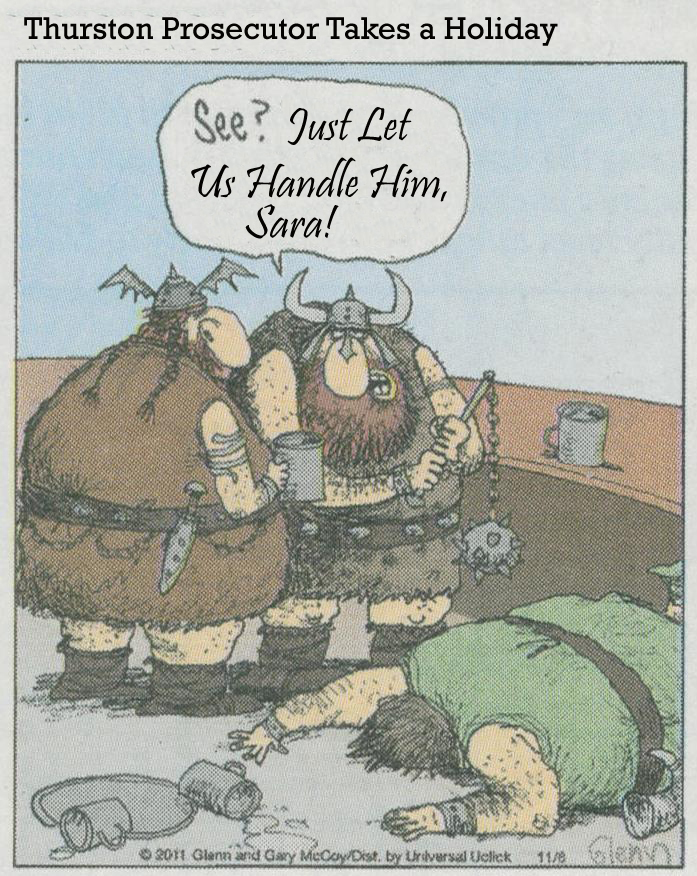
Thurston Prosecutor counsels juvenile probation officer Sara Dotson

THE OLYMPIAN • Published April 04, 2012

Racial profiling by police is notoriously difficult to prove. That’s not, as former Los Angeles Police Chief William J. Bratton used to insist, because it’s uniquely difficult to get inside an officer’s head and determine why he pulled over this suspect or that. Analyzing the intent behind offenses is actually fairly commonplace – it undergirds hate-crime prosecutions, many assaults (a murder, for instance, is distinguishable from manslaughter by the intent of the perpetrator) and even civil rights violations, which generally must be committed with the intent to deprive a person of a protected right. No, what makes racial profiling so hard to prove is that it’s usually most apparent in statistics, not individual acts.

An officer can almost always produce an explanation for why he or she pulled over a driver. A broken taillight, a failure to signal, speeding – all those are legitimate reasons to wave a driver to the curb. When it becomes obnoxious – and illegal – is when an officer sees those violations only when they are committed by people of a certain race. Long before “racial profiling” became the phrase of art, this vile habit was named for those victimized by it: “driving while black.”

Now, the Los Angeles Police Department, which once was widely suspected of engaging in racial profiling, has identified an officer it says is guilty of the offense. Tellingly, the allegations against Officer Patrick Smith – if true – include a clear sign of his intent, which was in part to deceive those who analyze statistics. According to sources in the department, Smith falsified reports to suggest that he was pulling over whites when in fact some of those he identified as white were Latino. Smith has been found guilty of nothing. Still, it is worth noting that doctoring official records would make his numbers look fine but also would suggest a need to cover up something, and could be evidence that the officer’s intent was improper. What may fool the statistics may prove the crime.

The advent of sophisticated, usually computerized, tracking has allowed police departments greater insight into the actions of officers – and, thus, clues about who may be indulging in racism – but better tools must be employed smartly. A traffic officer who stops only blacks or Latinos while working in West Los Angeles is probably missing something or covering up something; an officer working a night shift in South Los Angeles might well be fully justified in making such stops exclusively, because he might go an entire shift without seeing a single white driver. Smart analysis of that data can help officials sniff out trouble, but it won’t always be enough. Where they find deception, they may see all too clearly into an officer’s head.

Posted in Uncategorized | Leave a comment

Lacey Police Officer Guilty of Lying Under Oath to Judge

Published April 04, 2012 in the Olympian by JEREMY PALWLOSKI

A former Lacey police officer faces up to a year in jail and a $5,000 fine after pleading guilty Tuesday for lying to a judge under oath.

The most common crime in America perpetrated by cops

While applying for a search warrant by telephone Jan. 9, Emmanuel Olivo told a judge that he had pulled a car over at Carpenter and Mullen roads after conducting a random state Department of Licensing check and discovering that the car’s owner had a suspended license. [The purpose of this lie was to establish ‘probable cause’ for the warrant else a search of the vehicle would violate 4th Amendment protections. The fact the officer pulled the vehicle over and searched it w/o such a DOL check meant the evidence seized should have been suppressed. By lying, the officer intended to deny the suspect’s right to 4th Amendment protection.]

But after Olivo’s patrol supervisor checked his reports and audited the vehicle stop, she determined that Olivo had not performed a DOL check, Thurston County Chief Deputy Prosecuting Attorney Andrew Toynbee has said.

Officers typically can check a driver’s license plate number from their patrol car and determine whether its registered owner has outstanding arrest warrants or is driving with a suspended license.

After the judge granted Olivo’s search-warrant request, Olivo found suspected methamphetamine in the vehicle. A felony meth charge against the car’s occupant was dismissed after evidence emerged that Olivo had lied.

Olivo, 28, pleaded guilty to gross-misdemeanor false swearing during a brief court hearing before Judge Kalo Wilcox. His sentencing is tentatively set for April 18.

Olivo declined to comment outside court. His attorney, Michele Shaw of Seattle, said he does not have a plea agreement in place that could affect his sentencing.

Since Olivo’s arrest, a separate criminal case he investigated has been dismissed because of questions about his credibility, a prosecutor said. Toynbee has said it’s possible that defense attorneys can challenge convictions in cases in which Olivo was a witness.

Police Lt. Phil Comstock said Tuesday that Olivo resigned last week. He previously had been on paid administrative.

The Lacey Police Department is completing a separate administrative investigation of Olivo, Comstock said.

After learning of Olivo’s possible crime, Lacey police turned the investigation of it over to the Olympia Police Department. Comstock said that the incident, while unfortunate, shows that the department holds itself accountable.

Chief Dusty Pierpoint added that he can’t recall a similar incident in his 26 years with the Lacey police. [Just never met a cop ya didn’t like, eh Chief? Come to the barrio! Some of the street people, buskers, and homeless could help provide you a remedial education in Cop 101.]

“It’s unfortunate, and we don’t like anything like this to happen,” he said. “But at the same time, when it does, we have to address that. The public does expect that.”

Posted in Uncategorized | 3 Comments

An Open Letter to Mason District Court Judge Meadows

Judge Meadows resists 1st Amendment, substitutes ‘policy’ for Constitution:

We all want to believe our neighbors, our community, appreciates where the boundaries of the law lie, to grasp the importance of protection for minority  viewpoints and unpopular speech including the full exercise of 1st Amendment guarantees that allow for recording/photography in public places or of public information/documents. Unfortunately too many of the great ‘unwashed’ are ignorant or confused by the nuances of the law. But we have law enforcement officers trained in such matters, yes?–umm, maybe not.

A lot of cops pull stuff out of their @ss they claim is the law because they’re poorly trained and ignorant of what they’re supposed to enforce–THE LAW. The typical policeman or policewoman is trained first to CONTROL the situation/person and understanding the law they enforce comes in a distant 2nd…or worse. The most commonly committed felony in America today is perjury, on the witness stand (or in their reports) by cops–under oath! But that’s why we have lawyers, right?

If you can even afford an attorney, you’ll soon realize there are brighter and lesser lights in the universe–a LOT of the latter. In fact, more and more litigants, both civil and criminal, are representing themselves (who can afford an attorney today?) despite the old sop about a man who represents himself. Lawyers are understandably fond of that aphorism. Statistics show pro se litigants (without distinguishing between civil and criminal) have a higher success ratio than those represented by attorneys! That demands pause for thought about what this means. Answers aren’t clear, but it certainly creates a lot of questions. One conclusion is having an attorney is worse than no attorney at all, at least statistically.

If the doctor diagnosed you with a potentially terminal form of cancer and offered you a pill to cure it–an expensive pill–but you found those taking it had a lower survival rate than those who didn’t, would you buy the pill?

OK, so lawyers may be an illusory pacifier, but not to worry, after all–we have JUDGES. If anybody should know the law, it’s them, yes?? Before you breathe a sigh of relief, check out your local courthouse–listen to others that have–read this review and weep without wondering for  whom the bell tolls. Incredulously, too many judges don’t get it either…including one local district court judge. Read on for the grim facts if you expect more from your elected judicial officials.

A trip to Mason County District Court was brought on by an invitation from  recent Port of Shelton Commissioner Jack Miles who, it turned out, had a hearing scheduled @ 1:30pm on Monday, 3-2-12 for a stay of execution from his drunk driving conviction due to it being under appeal. A duly faxed request to utilize photojournalism to cover this story was transmitted and approved by Judge Meadows. Unfortunately, one of the guards hadn’t gotten the word and some last minute confusion resulted.

While in the courtroom, an elderly previous Port of Shelton Commissioner was seen in shackles and jail garb…no, it wasn’t Jay Hupp, but hope springs eternal. Recognizing that all such proceedings, court files, jail rosters, and charges are PUBLIC for an undeniably sound reason, efforts were made to discover the details of why the man was in custody. The resistance by court staff and the judge herself to that inquiry BECAME the story. You can listen to a small excerpt of the runaround received trying to access this public information and the efforts to chill the inquiry/reporting through the audio link at the end of this article…an audio made in a public area where no expectation of privacy existed, many were present to overhear the conversation, and it involved law enforcement of the highest order–the judge herself.

Judge Meadows grants Jack Miles a stay of execution w/o bias:

Before continuing, it must be reported that Judge Meadows treated Jack Miles fairly, impartially, and without apparent bias either at this hearing or during the earlier sentencing hearing. Meadows is a reasonably honest judge (though not perfect) and genuinely tries to insure defendants receive a fair trial while she simultaneously tries to protect the community she is a part of. Still, her reliance on the limited authority of her office to  resolve all impasses is a mistake–especially when based on her own misapprehensions about where the legal boundaries lie. Too often she has overstepped those boundaries presuming her long held authority gives her license. Judge Meadows’ efforts to do her job well (if not always her actual performance) deserves respect while conceding she remains human and subject to the vicissitudes of that condition. Jack alleges he has seen a pattern of discrimination in sentencing based on gender in her court. This claim in unconfirmed at this point and no basis is at hand to prove or disprove it. Judicial error does not necessarily imply bias. It may simply implicate being human.

The Mason County District Court clerks began by insisting this reporter complete a written request for the court file related to the ex-port commissioner seen in the courtroom in shackles. It was asserted his full (including middle) name and birth date or case # must be supplied. This was at variance with years of experience obtaining a case # by simply calling on the phone and giving the party’s first and last name. The clerk insisted. A trip to the superior court clerk’s office and its administrator yielded similar results when they called downstairs to inquire about getting the case #.

Not wanting to leave the courthouse in order to avoid re-entry through the security screening devices/process, the idea of using a cell phone to contact the county jail occurred. Sgt.  Sue LaMont was just getting off her shift, so she was no help. But a courtroom security guard did try to help. He called the jail and inquired as to the charges leveled against the man in question. Though told the jail roster would normally also supply the inmate’s date of birth along with the charges, only the charges were sought by the guard. As soon as he revealed they were Assault IV – Domestic Violence, a court clerk stepped into the hallway to chide him for giving out this information. The guard rightly pointed out it was public information.

Realizing this was insufficient to satisfy the clerk’s extraordinary demands in this instance, and raising suspicion some favoritism was at work, a walk next door to the jail produced the key to unlocking access to the court file, the case #. After writing this # on a discarded paper cup, a return to the clerk’s office eventually produced the coveted court file including the police report and comments made to the arresting officer by family members. It also produced an irritated Judge Meadows who objected to the reporter photographing the file.

Judge Meadows initially argued the 1st Amendment gave no license to photograph public information but could cite no countervailing authority herself. After a brief pause for thought, she invoked the specter of interfering with a suspect’s right to a ‘fair trial’. Knowing this was likely near and dear to the reporter’s heart/belief, she successfully defused the difference of opinion–for the moment.

After considerable afterthought, the following editorial conclusion was reached on the matter discussed with Judge Meadows:

The Sixth Amendment to the United States Constitution and article I, section 22 of the Washington Constitution each guarantee a criminal accused the right to a public trial. Cohen v. Everett City Council, 85 Wn.2d 385, 387, 535 P.2d 801 (1975). In addition, article I, section 10 of the Washington Constitution states that [j]ustice in all cases shall be administered openly, and without unnecessary delay. This provision provides the public and press a right to open and accessible court proceedings. Seattle Times Co. v. Ishikawa, 97 Wn.2d 30, 36, 640 P.2d 716 (1982).

The courts are not subject to Washington State’s Public Records Act. The requirement for public access to their records precedes that voters’ initiative–a requirement as old as this nation. The need for transparency and immediacy in court files is much more pronounced than the need for other public documents because the alternative is ‘justice’ behind closed doors–tantamount to a denial of a ‘fair trial’.

Our courts do not ‘own’ any copyright or exclusive interest in the case files stored in their facilities. They are merely a repository for safe keeping. The files properly belong to ALL citizens without qualification for the same reason we require all proceedings and trials to be public–to preserve, not to thwart, and guarantee the right to a ‘fair trial’ via the exposure to public inquiry/attendance. To interfere with such inquiry or access by any means is to chill the right to transparency and a public trial/proceeding. Even our children are not criminally tried behind closed doors.

Were the cause of a ‘fair trial’ genuinely considered without resorting to personal biases against this publication or reporter, it would be recognized that parading suspects through the courthouse in shackles and jail clothes is more likely to instill prejudice from onlookers than a full reporting of the alleged offense(s). Worse yet, the parading of our children on the sidewalk in leg, waist, and wrist shackles in orange jumpsuits between our juvenile detention center and the county courthouse is humiliating and prejudicial.

Judge Meadows’ argument about what ‘legitimate’ press coverage includes when reporting alleged crimes is mistaken. One routinely reads accounts from every major news reporting agency of indictments and criminal charges long before any trial has occurred. Unlike Canada, this country does not typically have judicial gag orders imposed on the press or photojournalists. Our 1st Amendment prohibits such judicial excess, as does our right to public hearings/trial–a right that protects us from the kind of excess/abuse that occurs more routinely in secret or behind closed doors. e.g. The Bush administration’s secret prisons and extraordinary renditions for the purpose of conducting torture out of the public view.

A judge of long standing may be tempted to substitute judicial fiat for community cooperation, but that slippery slope eventually leads to totalitarianism. In a true democracy in a nation of laws, those laws are a process done WITH  the community rather than TO the community–an important distinction lost, in this instance, on Judge Meadows.

While Meadows’ instincts are welcomes, her execution is not. The sound judgement of our founding fathers in making the 1st Amendment the foremost of our Constitutional protections is based on principles not subject to the second guessing of our local district court magistrate. There is no statute, common law, or precedent supporting the notion that public information/records cannot be photographed. No disruption of the court clerk’s office took place and the total file size was approximately 6-7 pages. There were no lines or people waiting. Judge Meadows’ invocation of ‘fair trial’ principles was an ill considered afterthought revealing disapproval of this publication’s style and content–effectively a ‘prior restraint’ if you will.

Victoria Meadows is a decent, politically popular, well intentioned judge. This report intends no disrespect to her personally or professionally. It is intended to educate the public, and possibly herself, to the broad implications of our Constitution and its 1st Amendment. There is much room for shared values and respect within its ambit.

Click HERE to hear Audio of Reporter remonstrating with Judge Meadows to respect the 1st Amendment and her oath of office.

Click HERE to see the court file in contention and decide in your own mind if Judge Meadows is justified in 2nd guessing our founding fathers’ wisdom in drafting the 1st Amendment. Is transparency in government and our courts consistent with the right to a ‘fair trial’? Your comments are welcome.

Posted in Uncategorized | Leave a comment

Schizoid Woman wants Open Marriage, Hiking Partner

A local mentally ill woman (w/schizo-affective disorder) clever enough to have bilked SS disability for over a decade under the pretext of being unemployable or unable to earn an income, feels so put upon by her older husband’s poor health, she’s publicly declared she wants an ‘open marriage’ and a ‘hiking partner’: Click HERE for full story.

Two weeks ago I told my husband I want an open marriage and he agreed to it. Ahhh freedom… I’ve really been resenting my husband starting smoking again and getting out of shape so he could not hike with me. My husband is a lot older than me and he smokes and he is very feeble from a smoking related illness. I’ve promised to stick it out and support him until he dies. He is very lucky to have such a dedicated and young wife and I deserve to have a hiking partner other than my dog.” [Woof!]

The Princess

This sweetheart is a little on the high maintenance side, though, and quite litigious. Click HERE for more on that. She characterized her last husband as being nothing but a ‘sperm donor’ and implicitly a slut because he has children by more than one woman, never mind the 2 fathers of her own 2 daughters. But she also wanted to increase his child support payments for being ‘care free’.

Be sure to check this hot little number’s history and read a few of her own Court affidavits before bidding…slightly used but guaranteed to make your life ‘interesting’!

1 Vedder, Shawnie
Respondent
King Co Superior Ct 90-2-19990-8 10-03-1990
2 Vedder, Shawnie A
Petitioner
Kitsap Superior 98-2-00591-4 02-24-1998
3 Vedder, Shawnie Ann
Respondent
Kitsap Superior 98-3-00438-5 04-15-1998
4 Vedder, Shawnie Ann
Petitioner
Kitsap District 99-001027 03-05-1999
5 Vedder, Shawnie Ann
Respondent
Kitsap Superior 07-3-00180-3 02-07-2007
6 Vedder, Shawnie Ann
Petitioner
Mason District Court 10CV01404 12-10-2010

Or you can click HERE to do your own WA. court docket search.

Psych Ward Antipathy

UPDATE:

Recently (6-16-12) the ‘unemployable/disabled’ Miss Piggy published the following complaint in her http://mosswalks.blogspot.com online journal documenting her taxpayer funded sojourns into the Olympics:

“Obama cut off my Pell grants. I’m way over the newly imposed limits [Gosh! This is only her 2nd bachelor’s degree at public expense.] and they are not grandfathering in anyone. So no more Pell grants for me. I got my degrees[s] while the getting was good. Tuition is also going up by 14% again this year. If this went into effect a year earlier, I would never have learned moss or fungi microscopy.”

Miss Piggy has been on the dole for over the last decade on the pretext that her mental condition is so disabling, she can’t support herself or find work–notwithstanding her ‘registered business’ (photographs), launching numerous forays into the deep woods and mountain peaks of the Olympics, and raising 2 children. (Averring her husband does little toward this end)

Perhaps tuition goes up at such a pace because the State can’t keep up with all the leeches bankrupting Social Security Disability entitlements…or ‘crazy’ like a fox, as they say.

Posted in Uncategorized | 6 Comments

Copyright: When Stealing Isn’t Stealing

NY Times Published: March 28, 2012 By STUART P. GREEN

THE Justice Department is building its case against Megaupload, the hugely popular file-sharing site that was indicted earlier this year on multiple counts of copyright infringement and related crimes. The company’s servers have been shut down, its assets seized and top employees arrested. And, as is usual in such cases, prosecutors and their allies in the music and movie industries have sought to invoke the language of “theft” and “stealing” to frame the prosecutions and, presumably, obtain the moral high ground.

No harm, no foul!

Whatever wrongs Megaupload has committed, though, it’s doubtful that theft is among them.

From its earliest days, the crime of theft has been understood to involve the misappropriation of things real and tangible. For Caveman Bob to “steal” from Caveman Joe meant that Bob had taken something of value from Joe — say, his favorite club — and that Joe, crucially, no longer had it. Everyone recognized, at least intuitively, that theft constituted what can loosely be defined as a zero-sum game: what Bob gained, Joe lost.

When Industrial Age Bob and Joe started inventing less tangible things, like electricity, stocks, bonds and licenses, however, things got more complicated. What Bob took, Joe, in some sense, still had. So the law adjusted in ad hoc and at times inconsistent ways. Specialized doctrines were developed to cover the misappropriation of services (like a ride on a train), semi-tangibles (like the gas for streetlights) and true intangibles (like business goodwill).

In the middle of the 20th century, criminal law reformers were sufficiently annoyed by all of this specialization and ad hoc-ness that they decided to do something about it.

In 1962, the prestigious American Law Institute issued the Model Penal Code, resulting in the confused state of theft law we’re still dealing with today.

In a radical departure from prior law, the code defined “property” to refer to “anything of value.” Henceforth, it would no longer matter whether the property misappropriated was tangible or intangible, real or personal, a good or a service. All of these things were now to be treated uniformly.

Before long, the code would inform the criminal law that virtually every law student in the country was learning. And when these new lawyers went to work on Capitol Hill, at the Justice Department and elsewhere, they had that approach to theft in mind.

Then technology caught up.

With intangible assets like information, patents and copyrighted material playing an increasingly important role in the economy, lawyers and lobbyists for the movie and music industries, and their allies in Congress and at the Justice Department, sought to push the concept of theft beyond the basic principle of zero sum-ness. Earlier this year, for example, they proposed two major pieces of legislation premised on the notion that illegal downloading is stealing: the Preventing Real Online Threats to Economic Creativity and Theft of Intellectual Property Act (PIPA) and the Stop Online Piracy Act (SOPA).

The same rhetorical strategy was used with only slightly more success by the movie industry in its memorably irritating advertising campaign designed to persuade (particularly) young people that illegal downloading is stealing. Appearing before the program content on countless DVDs, the Motion Picture Association of America’s much-parodied ad featured a pounding soundtrack and superficially logical reasoning:

You wouldn’t steal a car.

You wouldn’t steal a handbag.

You wouldn’t steal a mobile phone.

You wouldn’t steal a DVD.

Downloading pirated films is stealing.

Stealing is against the law.

Piracy: It’s a crime.

The problem is that most people simply don’t buy the claim that illegally downloading a song or video from the Internet really is like stealing a car. According to a range of empirical studies, including one conducted by me and my social psychologist collaborator, Matthew Kugler, lay observers draw a sharp moral distinction between file sharing and genuine theft, even when the value of the property is the same.

If Cyber Bob illegally downloads Digital Joe’s song from the Internet, it’s crucial to recognize that, in most cases, Joe hasn’t lost anything. Yes, one might try to argue that people who use intellectual property without paying for it steal the money they would have owed had they bought it lawfully. But there are two basic problems with this contention. First, we ordinarily can’t know whether the downloader would have paid the purchase price had he not misappropriated the property. Second, the argument assumes the conclusion that is being argued for — that it is theft.

So what are the lessons in all this? For starters, we should stop trying to shoehorn the 21st-century problem of illegal downloading into a moral and legal regime that was developed with a pre- or mid-20th-century economy in mind. Second, we should recognize that the criminal law is least effective — and least legitimate — when it is at odds with widely held moral intuitions.

Illegal downloading is, of course, a real problem. People who work hard to produce creative works are entitled to enjoy legal protection to reap the benefits of their labors. And if others want to enjoy those creative works, it’s reasonable to make them pay for the privilege. But framing illegal downloading as a form of stealing doesn’t, and probably never will, work. We would do better to consider a range of legal concepts that fit the problem more appropriately: concepts like unauthorized use, trespass, conversion and misappropriation.

This is not merely a question of nomenclature. The label we apply to criminal acts matters crucially in terms of how we conceive of and stigmatize them. What we choose to call a given type of crime ultimately determines how it’s formulated and classified and, perhaps most important, how it will be punished. Treating different forms of property deprivation as different crimes may seem untidy, but that is the nature of criminal law.

Stuart P. Green is a professor at Rutgers Law School in Newark and author of the forthcoming “13 Ways to Steal a Bicycle: Theft Law in the Information Age.”

Posted in Uncategorized | Leave a comment

Denouement: Thurston County Prosecutor Folds Tent

‘JUSTICE’ ala Thurston County:

State's Complaining Witness

Live by the ex parte, Die by the ex parte. Sara Dotson’s (Drama Queen) reign ends!

Do you know the way to San Jose?

Get out of jail free card

Love, pro se

Posted in Uncategorized | 4 Comments

Justice Denied by Thurston judge, Commissioner

If you’re on the dance floor, near the hot trombone, it ain’t no sin, take off your skin & dance around in your bones!

Thurston County Superior Court judge Anne Hirsch was once the director of the Office of Assigned Counsel–a public defender creature of the courts. Christine Schaller is a Commissioner in her Court. And Rick Fallows is an unwed father whose young daughter is being denied his companionship because Thurston Court officials can’t seem to get the law they enforce figured out.

Rick fathered his daughter with her mother, Colleen. They co-parented their child until the relationship soured to the point Colleen invited a notorious local personality, Arthur West, to befriend her.

Arthur, a self styled ‘paralegal’ sued Rick in the latter’s capacity as the director of a non-profit, Media Island. Rick successfully defended against the suit.

Colleen sued Rick–seeking a domestic violence protection order and the termination of Rick’s parental rights. Commissioner Indu Thomas dismissed the suit as without merit. Rick initiated a petition seeking a parenting plan so he could continue to visit & raise his daughter. Commissioner Indu Thomas heard this action as well. The mother, Colleen moved to have Rick’s petition dismissed. Thomas denied the motion. Colleen timely filed a motion to revise the Commissioner’s ruling and that motion was heard by Judge Anne Hirsch while Rick, pro se, and Colleen, represented by counsel, argued the motion’s merits.

Judge Hirsch denied the motion to revise as it cited no error and argued no basis in law for overturning the Commissioner’s ruling. Thus, Rick’s petition for a parenting plan remained viable. But contrary to local court rule LSPR 90.14 which prohibits arguing issues not listed in the Motion to Revise or jurisdiction over any issue not in the record or ruled on by the Commissioner, Judge Hirsch improperly allowed a Motion for a Change of Venue to Minnesota (where Colleen had absconded w/the child once the legal confrontation with the father began) to be brought, argued, and granted.

A Change of Venue under Washington State law is discretionary. What is not is the requirement a judge have subject matter jurisdiction before granting such a request. Judge Hirsch had no such jurisdiction, presiding over a statutorily mandated review of the record only, to become the trial court inasmuch as her function was solely, in law, to provide a review de novo of the record. Her ruling was not simply voidable, but void from the outset, i.e. void ab initio. All subsequent actions flowing from that void ruling wherein Judge Hirsch had no subject matter jurisdiction were void and without force of law as well. Hirsch gave Colleen 30 days in her erroneous ruling to file an action regarding custody or a parenting plan in Minnesota. Colleen served Rick with a Minnesota summons and petition before that window of time closed.

Rick was (rightly as it turns out) still under the impression Washington State remained a proper venue to seek relief. He filed yet another pleading requesting his daughter be returned to her birthplace and his access be restored. Commissioner Schaller sanctioned him for filing a ‘specious’ motion under Rule 11, reasoning ignorance was no excuse for thinking venue remained in Washington. Schaller fined Rick $225. The trouble was, Rick was right. Venue did remain in Washington because Judge Hirsch had no basis in law for subject matter jurisdiction or to grant Colleen’s motion for a change of venue to Minnesota–a State that requires both parties to pay filing fees in a civil action such as this.

The upshot is Rick has been saddled with a punitive fine for a ‘specious’ motion when it is the Court’s own ignorance of the law that lead to the fine. A challenge for lack of jurisdiction is always timely at any stage of the proceedings or on appeal. Rick appealed.

Rick also plans to file a motion for reconsideration in which he hopes to educate Commissioner Schaller and possibly gain Judge Hirsch’s notice for her void ab initio ruling when she granted the improperly docketed Motion for a Change of Venue to Minnesota. Washington Courts disfavor, though they are discretionary, changes of venue. Thurston County judges are no exception–except, it’s well known, for Judge Hirsch. Colleen’s counsel surely was aware of this fact when he improperly calendared the motion for a change of venue.

CONCLUSION:  Don’t assume the person beneath that black robe is smarter than you are or understands the law. The reason a court of review is not allowed to review matters never made a part of the record is transparently obvious–judge shopping, prohibition from doing so in law, and mooting the entire court of record proceedings. By doing so, Judge Hirsch not only violated the prohibitions in law and local court rule, but she rewarded the mother’s bad behavior when she absconded to Minnesota for the very reason of denying the father access to his daughter when the father had properly sought relief from the Washington Court to preserve said access through a parenting plan.

“I don’t care what the law says, just tell me who the judge is!” -Roy Cohn-

“The monarchists will hide in the judiciary.” -Ben Franklin-

Posted in Uncategorized | 1 Comment

Devious Conniving Women – Flanagan v. Flanagan

In Flanagan v. Flanagan (2002)27 Cal.4th 766 , — Cal.Rptr.2d –; — P.3d –[No. S085594. Mar. 14, 2002.] a tawdry tale of love, betrayal, impatient greed, and deceit unfolds as a loyal husband, mortician, and business success is rewarded with an attempt on his life by his darling wife. A ready made movie script is revealed in this California Appellate Court opinion:

Opinion by J. Kennard.

California prohibits the recording of a telephone call without consent from all parties, but only if the call includes a “confidential communication.” (Pen. Code, § 632, subd. (a).) fn. 1 Violation of the law is a misdemeanor (ibid.) and may entail a civil penalty of $5,000 or three times the actual damages, whichever is greater (§ 637.2). Our Courts of Appeal have disagreed over the meaning of the critical term “confidential communication.” We granted review to resolve that disagreement.

One line of authority holds that a conversation is confidential if a party to that conversation has an objectively reasonable expectation that the conversation is not being overheard or recorded. (Frio v. Superior Court (1988) 203 Cal.App.3d 1480 (Frio)Coulter v. Bank of America (1994) 28 Cal.App.4th 923.) Under the other line of authority, a conversation is confidential only if the party has an objectively reasonable expectation that the content will not later be divulged to third parties. (O’Laskey v. Sortino (1990) 224 Cal.App.3d 241 (O’Laskey); see Deteresa v. American Broadcasting Companies, Inc. (9th Cir. 1997) 121 F.3d 460(Deteresa).) We endorse the standard established in Frio and Coulter.

I. THE CALIFORNIA PRIVACY ACT
 The California Invasion of Privacy Act (§ 630 et seq.) was enacted in 1967, replacing prior laws that permitted the recording of telephone conversations with the consent of one party to the conversation. (See [27 Cal.4th 769] Electronic Surveillance in California (1969) 57 Cal. L.Rev. 1182, 1191.) The purpose of the act was to protect the right of privacy by, among other things, requiring that all parties consent to a recording of their conversation.

This case involves subdivisions (a) and (c) of section 632. Subdivision (a) provides: “Every person who, intentionally and without the consent of all parties to a confidential communication . . . eavesdrops upon or records the confidential communication, whether the communication is carried on among the parties in the presence of one another or by means of telegraph, telephone, or other device, except a radio, shall be punished by a fine not exceeding [$2,500] or imprisonment . . . not exceeding one year. . . .” (Italics added.)

Subdivision (c) of section 632 addresses the term “confidential communication.” It states: “The term ‘confidential communication’ includes any communication carried on in circumstances as may reasonably indicate that any party to the communication desires it to be confined to the parties thereto, but excludes a communication made in a public gathering or in any legislative, judicial, executive or administrative proceeding open to the public, or in any other circumstance in which the parties to the communication may reasonably expect that the communication may be overheard or recorded.” (Ibid., italics added.)


II. THE FACTUAL AND PROCEDURAL BACKGROUND
 [1] Because this is an appeal from a judgment notwithstanding the verdict, we state the facts in the light most favorable to the verdict. (Quintal v. Laurel Grove Hospital (1964) 62 Cal.2d 154, 159.)

John and Honorine T. Flanagan married in 1969. John had two children from a prior marriage — J. Michael (Michael) and Carol. He had also adopted Terri Ann, Honorine’s daughter from a previous marriage. At the time of the marriage, John was a successful businessman who owned and operated several mortuaries in Southern California. His estate was valued to be at least $22 million.

In 1992, after John had been diagnosed with prostate cancer, his physician prescribed medication to slow the spread of the cancer. In 1993, Honorine began to give John his prescribed monthly injections.

Under John’s 1990 estate plan, upon his death Honorine would receive all his property for life, with a power of appointment over the remainder. In [27 Cal.4th 770] default of appointment, the property would go to Terri Ann. In April 1995, John and Honorine amended the trust to give his grandchildren (Michael’s and Carol’s children) a remainder interest in his share of the property, but they did not provide anything for Michael or Carol directly.

Sometime in the spring of 1995, Honorine told her manicurist, Dale Denels, that she would pay $100,000 for someone to kill John. In September 1995, Honorine told Denels that she was injecting John with water instead of medicine. Denels began taping her telephone conversations with Honorine.

In March 1996, Denels told Michael that John’s life was in danger and she played a tape recording of one of her conversations with Honorine. Michael then met with John and played the tape for him. John moved out of the home he shared with Honorine and moved in with Michael. Soon thereafter he was taken to the University of Southern California’s Norris Cancer Clinic. The clinic physician prescribed increased medication, which led to a dramatic decline in the blood marker measuring the spread of John’s cancer. This led the physician to conclude that John had not been receiving the prescribed medication during the months before his arrival at the clinic.

John changed his will to divide all his property between Carol and Michael, excluding Honorine and her daughter. In April 1996, he filed for dissolution of the marriage and termination of the trust established by his previous estate plan.

In August 1996, however, John and Honorine reconciled. John returned to the family residence and executed a new estate plan leaving Michael and Carol $150,000 each, with Honorine and Terri Ann receiving the balance of the estate. This was the plan in effect on March 19, 1997, when John died of cardiovascular disease unrelated to his prostate cancer.

Honorine filed this lawsuit against Michael and manicurist Denels, alleging conspiracy, invasion of privacy, and infliction of emotional distress. Honorine alleged Denels violated section 632 by recording her telephone conversations with Honorine without the latter’s consent. Michael cross-complained, alleging that after John’s return to the family home in the summer of 1996, Honorine, without Michael’s knowledge or consent, taped all of Michael’s telephone conversations with John.

The case went to trial in 1998. In the first part of a bifurcated trial, the jury rejected all counts of Honorine’s complaint against Michael and Denels. It then heard the evidence on Michael’s cross-complaint against Honorine.

Honorine testified that she installed a voice-activated tape recorder either at the end of 1995 or the beginning of 1996. She said that she installed the [27 Cal.4th 771] machine with John’s consent and that she did not know her conduct might be illegal. She listened to the tapes daily, keeping those she considered useful and recording over the remainder. She based her suit against Michael partly on the communications on the tapes.

Relying on telephone company records, Michael testified that Honorine had recorded 27 telephone calls between him and his father. He placed nine calls from a cellular phone. fn. 2Some of the cellular phone calls appeared to be redials when a connection was lost.

Michael introduced into evidence the tapes of three of the telephone calls. He described some of the other calls: one was to get directions to a place where he was to meet with John, four were to remind John to notify the gatekeeper that Michael was coming to visit, and two were to confirm the times and places for meetings. Michael testified that Honorine had forbidden John to speak with him, and Michael considered all of his conversations with his father to be confidential. He did not know his calls were being recorded.

The jury found that 24 calls were confidential fn. 3 and awarded Michael $5,000 for each call, for a total of $120,000, plus punitive damages of $1.2 million. On Honorine’s motion for a new trial or for judgment notwithstanding the verdict, the trial court limited Michael’s statutory damages to $5,000 and struck the punitive damages award. The court reasoned that multiple conversations involving the same subject should be considered a single violation, and that absent proof of actual damages in excess of the statutory civil penalty of $5,000 (§ 637.2), the constitutional prohibition against excessive fines (see Hale v. Morgan (1978) 22 Cal.3d 388) limited Michael’s general damages to $5,000. Michael appealed.

The Court of Appeal rejected both the trial court’s reasoning that constitutional principles limited damages to $5,000, and Honorine’s contention that the statute should be construed to provide a single $5,000 award per victim irrespective of the number of recorded conversations. It held that two of the three conversations played to the jury were confidential, but that [27 Cal.4th 772] because Michael had presented no evidence of the specific content of the remaining conversations, he had failed to prove they were also confidential. It therefore found Michael was entitled to statutory damages of $5,000 for each of the two confidential conversations, for a total of $10,000. Finally, it held that the statute’s provision for treble damages excluded recovery of punitive damages.

Michael petitioned this court for review, raising only the conflict in certain Court of Appeal decisions concerning the definition of the phrase “confidential communication” under section 632. He did not question whether section 632 excluded punitive damages. Honorine did not petition for review. Thus, the matter before us is limited to interpreting the phrase “confidential communication” in section 632 and does not include other issues raised in the Court of Appeal.

 III. PRIOR DECISIONS CONSTRUING SECTION 632

 As noted earlier, some decisions of our Courts of Appeal have arrived at conflicting definitions of confidentiality. Frio, supra, 203 Cal.App.3d 1480, was the first decision to address directly the meaning of “confidential communication” in section 632. During discovery in an action for breach of contract, Richard Frio acknowledged that he had tape-recorded some telephone conversations. He took notes based on the tapes, then rerecorded over the tapes. In a pretrial ruling, the court barred Frio from introducing his notes into evidence, citing section 632, subdivision (d), which provides that “[e]xcept as proof in an action or prosecution for violation of this section, no evidence obtained as a result of eavesdropping upon or recording a confidential communication in violation of this section shall be admissible . . . .” Frio sought pretrial review by petitioning the Court of Appeal for a writ of mandate.

The Court of Appeal observed that “[t]he legislative history of section 632 reveals the Legislature’s intent to strengthen then existing law by ‘prohibiting wiretapping or “electronic eavesdropping” without the consent of all parties to the communication which is being tapped or overheard.’ [Citations.]” (Frio, supra, 203 Cal.App.3d at p. 1487, italics omitted.) Viewing the test of confidentiality as “an objective one defined in terms of reasonableness” (id. at p. 1488) the court reasoned that the nature of Frio’s business and the character of the communications showed that the parties would not expect their communications to be simultaneously disseminated to an unannounced second auditor (id. at pp. 1489-1490). The court then stated what has become known as the “Frio test”: “under section 632 ‘confidentiality’ appears to require nothing more than the existence of a [27 Cal.4th 773]reasonable expectation by one of the parties that no one is ‘listening in’ or overhearing the conversation.” (Id. at p. 1490, italics added.)

In O’Laskey, supra, 224 Cal.App.3d 241, however, the Court of Appeal set out a competing standard. Phillip O’Laskey sought to oppose Mike Sortino’s summary judgment motion, based on the statute of limitations, by producing a tape recording of a telephone conversation in which Sortino admitted that he had stayed outside the State of California for two weeks. If the statute were tolled during this period, O’Laskey’s complaint would have been timely. After reviewing cases discussing reasonable expectations of privacy in criminal and civil contexts, the O’Laskey court said: “[W]e distill from this comparison the basic rule that the statute means what it says — and we thus examine whether Sortino reasonably expected, under the circumstances of the investigator’s call, that the conversation would not be divulged to any one else.” (Id. at p. 248, italics added.) The Court of Appeal concluded that the call was not confidential because Sortino would expect the content of the call to be revealed to other persons. (Id. at pp. 248-249.)

Four years later the Court of Appeal in Coulter v. Bank of America, supra, 28 Cal.App.4th 923, followed the Frio standard. Christopher Coulter, a bank employee who had complained of harassment, secretly recorded his conversations with 11 other employees. Appealing a summary judgment against him, Coulter claimed the conversations were not confidential because he believed the parties knew the substance of the discussion would be passed on to others at the bank. Citing Frio, the court in Coulter responded that whether “the subject matter might be later discussed has no bearing on whether section 632 is violated.” (Id. at p. 929.)

Thereafter, in 1997, the United States Court of Appeals for the Ninth Circuit, in a case applying California law, followed the O’Laskey standard in Deteresa, supra, 121 F.3d 460. Beverly Deteresa was a flight attendant on the flight that O. J. Simpson, a suspect in the murders of Nicole Simpson and Ronald Goldman, took from Los Angeles to Chicago. Anthony Radziwill, a producer for defendant American Broadcasting Corporation (ABC), interviewed Deteresa about appearing on a television show. Unknown to her, he recorded the conversation. When she later declined to appear on the show, ABC used the recorded conversation in its television program. After examining the pertinent California decisions and finding them in conflict, the Ninth Circuit had to predict how our court would resolve that conflict in state authority, and it did so: “[W]e predict that the California Supreme Court would adopt theO’Laskey standard, not the Frio standard.” (121 F.3d at p. 464.) Applying the O’Laskey test, the Ninth Circuit held that the conversation between Deteresa and Radziwill was not confidential because [27 Cal.4th 774] “no one in Deteresa’s shoes could reasonably expect that a reporter would not divulge her account . . . .” (Id. at p. 465.)

The case before us here illustrates the difference between the two standards. Under the Friotest, Michael could prove that his conversations with his father were confidential simply by showing that he had an objectively reasonable expectation that they were not being recorded. Under the O’Laskey test, he would also have to prove the content of each conversation, and show that he had an objectively reasonable expectation that no one would divulge that content to a third party.

IV. THE DEFINITION OF “CONFIDENTIAL COMMUNICATION” IN SECTION 632

[2a] Section 632, subdivision (c), has two clauses. The first clause states that ” ‘confidential communication’ includes any communication carried on in circumstances that may reasonably indicate that any party to the communication desires it to be confined to the parties thereto”; the second clause “excludes a communication made in a public gathering or in any legislative, judicial, executive or administrative proceeding open to the public, or in any other circumstance in which the parties to the communication may reasonably expect that the communication may be overheard or recorded.” (Italics added.)

O’Laskey’s conclusion that a conversation is confidential only if a party has an objectively reasonable expectation that its content will not be disseminated to others does not conform with the import of the first clause. [3] “Includes” is “ordinarily a term of enlargement rather than limitation.” (Ornelas v. Randolph (1993) 4 Cal.4th 1095, 1101.) The “statutory definition of a thing as ‘including’ certain things does not necessarily place thereon a meaning limited to the inclusions.” (People v. Western Air Lines, Inc. (1954) 42 Cal.2d 621, 639.) [2b] Thus theO’Laskey standard, under which the phrase “confidential communication” not only includes but is limited to conversations whose content is to be kept secret does not conform to the inclusive language of section 632, subdivision (c). This incompatibility disappears, however, if the phrase “confined to the parties” in the first clause of subdivision (c) is interpreted to refer to the actual conversation, not its content. So construed, the first clause includes within the statutory protection any conversation under circumstances showing that a party desires it not to be overheard or recorded. The second clause then excludes a conversation under circumstances where the party reasonably believes it will be overheard or recorded. Under this construction, the two clauses of section 632 do not conflict nor [27 Cal.4th 775] leave any uncertainty; they act together in harmony to prohibit unconsented-to eavesdropping or recording of conversations regardless of whether the party expects that the content of the conversation may later be conveyed to a third party.

This construction of section 632 draws support from our discussion of the California Invasion of Privacy Act in Ribas v. Clark (1985) 38 Cal.3d 355 (Ribas). Ribas explained: “In enacting [the Privacy Act], the Legislature declared in broad terms its intent ‘to protect the right of privacy of the people of this state’ from what it perceived as ‘a serious threat to the free exercise of personal liberties [that] cannot be tolerated in a free and civilized society.’ (Pen. Code, § 630.) This philosophy appears to lie at the heart of virtually all the decisions construing the Privacy Act.” (38 Cal.3d at p. 359.)

Ribas also drew a critical distinction between eavesdropping upon or recording a conversation and later disseminating its contents. We explained: “While one who imparts private information risks the betrayal of his confidence by the other party, a substantial distinction has been recognized between the secondhand repetition of the contents of a conversation and its simultaneous dissemination to an unannounced second auditor, whether that auditor be a person or a mechanical device.” (Ribassupra, 35 Cal.3d at pp. 360-361.) We repeated that language in Shulman v. Group W Production, Inc. (1998) 18 Cal.4th 200, 234, and Sanders v. American Broadcasting Companies (1999) 20 Cal.4th 907, 915.

By focusing on “simultaneous dissemination,” not “secondhand repetition” (Ribas, supra, 35 Cal.3d at p. 360), the Frio definition of “confidential communication” that we here endorse better fulfills the legislative purpose of the Privacy Act by giving greater protection to privacy interests than does the O’Laskey standard. The latter protects against recording or eavesdropping only if a party seeks to keep the content of the conversation secret.

We also find support for the Frio definition of “confidential communication” in the actions of the Legislature when it amended the Privacy Act to take account of privacy issues raised by the increased use of cellular and cordless telephones. (See § 632.5, added by Stats. 1985, ch. 909, § 3, p. 2902; § 632.6, added by Stats. 1990, ch. 696, § 4, p. 3269; § 632.7, added by Stats. 1992, ch. 298, § 6, p. 1216.) In enacting the first of these amendments, the Legislature found that “the advent of widespread use of cellular radio telephone technology means that persons will be conversing over a network which cannot guarantee privacy in the same way that it is guaranteed over landline systems.” (Stats. 1985, ch. 909, § 2, p. 2900; similar [27 Cal.4th 776] language as to cordless telephones appears in Stats. 1990, ch. 696, § 2, p. 3268.) Responding to the problem of protecting the privacy of parties to calls involving cellular or cordless telephones, the Legislature prohibited the malicious interception of calls from or to cellular or cordless phones (§§ 632.5, 632.6) and the intentional interception or recording of a communication involving a cellular phone or a cordless phone (§ 632.7).

Significantly, those statutes protect against interception or recording of any communication. When the Legislature determined that there was no practical means of protecting cordless and cellular phone conversations from accidental eavesdropping, it chose to protect all such conversations from malicious or intentional eavesdropping or recording, rather than protecting only conversations where a party wanted to keep the content secret. The scope of this prohibition indicates, as we suggested in Ribas, supra, 35 Cal.3d at pages 360-361, that the Legislature’s ongoing concern is with eavesdropping or recording of conversations, not later dissemination. It would be anomalous to interpret the Privacy Act as protecting all cellular or cordless phone conversations, but only those landline conversations that the parties intended to keep secret — especially because, as here, many conversations take place between persons using different types of telephones.

Under the construction adopted here, the Privacy Act is a coherent statutory scheme. It protects against intentional, nonconsensual recording of telephone conversations regardless of the content of the conversation or the type of telephone involved. In contrast, the O’Laskeystandard urged by Honorine and adopted by the Court of Appeal would provide significantly less protection from surreptitious eavesdropping or recording when both telephones are landline telephones, a distinction that lacks any justification in terms of the purpose of the privacy act. fn. 4

 V. DISPOSITION OF THE APPEAL

 There were 27 telephone calls between Michael and his father. The jury found that 24 of the calls were confidential and awarded $5,000 in damages for each call, a total of $120,000. The Court of Appeal’s conclusion that only two of the 27 telephone calls were confidential was based on the standard of O’Laskey, supra, 224 Cal.App.3d 241, which we have rejected in this opinion. The Court of Appeal must now reconsider the issues on appeal in light of our conclusion that a conversation is confidential under section 632 if a party to that conversation has an objectively reasonable expectation that the conversation is not being overheard or recorded. [27 Cal.4th 777]

The judgment of the Court of Appeal is reversed, and the case is remanded for further proceedings consistent with this opinion.

George, C.J., Baxter, J., Werdegar, J., Chin, J., Brown, J., and Moreno, J., concurred.

FN 1. All statutory citations are to the Penal Code.

FN 2. Section 632.7, enacted in 1992, prohibits intentionally intercepting or recording communications involving cellular telephones and cordless telephones. This prohibition applies to all communications, not just confidential communications. Michael’s complaint, however, asserted only a cause of action under section 632, not under section 632.7. Honorine does not claim section 632 is inapplicable to the calls Michael placed from a cellular telephone to a landline telephone.

FN 3. The record before us does not reveal why the jury found only 24 of the 27 calls confidential. There was evidence that three calls were re-dials after a cellular phone connection was lost, so it is possible that the jury considered those calls to be a continuation of the previous calls.

FN 4. We disapprove language in O’Laskeysupra, 224 Cal.App.3d 241 that is contrary to the views expressed in this opinion.

Posted in Uncategorized | Leave a comment

Dead Dad Exposes Corrupt Thurston Probation Officer

To hear Thurston County’s juvenile probation officer Sara Dotson tell it, she’s a modicum of restraint, a shy calm under fire peace maker who’s exceptionally gifted at defusing tense situations with ‘difficult’ personalities. While not the only variance from the facts by any stretch, her sworn statement of 10-12-11, wherein she declares a Good Samaritan accommodating a disabled young mother ‘threatened/intimidated’ her, says his behavior goes beyond any sort of normal reasoning–especially because he was not even a party to the case in question! [A case in which Sara Dotson was coaching/advising a rebellious teenager and assisting in terminating her handicapped mother’s parental rights without investigation/justification] “I have dealt with difficult people for many, many years and NEVER had any type of interaction like this before,” she dissembles. 

Click: Perjury Under Fire for a peek at the entire stinking mass of corruption in AH11-0208 cooked up/orchestrated by the man behind the curtain, detective Roland Weiss, esq., dissembling drama queen juvenile probation officer Sara Dotson, and the head hunting emasculating persecutor bent on letting no good deed go unpunished in Thurston County, Jennifer Lord, esq. This 3 stooges rat pack couldn’t work within closer proximity of one another unless they were literally sitting in each other’s lap–which may often be the case! If one sneezes, the other 2 catch cold.

But wait! One little detail is the dysfunctional origins of this ‘pillar of the community’. Dotson’s recently deceased father had quite a different opinion of her. Here’s his take on this light of his life who ‘NEVER had any any type of interaction like this before’:

Dead Father Reveals the underbelly of his ‘virtuous’ princess.

Her response? It’s been said people invariably return to what they know. And so it is here in Sara Dotson’s sworn response sounding very much like what she swore in #AH11-0208 and now #11-1-01711-1! Someone’s always ‘blocking’ her path, it would seem–this beacon of calmness under fire and unmitigated virtue. Perhaps her pals in the courthouse just don’t know her well enough–or maybe they know her entirely too well. The folks that really knew her were close at hand–her family. When asked during an interview on 3-12-12 about the petition, Sara lied, claiming her father hadn’t filed it, but her sister, Betsy Prehm. Betsy did file a lawsuit against her sister for a loan of $4,000 Sara hadn’t repaid, but that was much later–though similar to the father’s complaint of being out $100,000 to Sara. Don’t buy a used car from this woman.

Sara Dotson’s Tried & True attack/defense

Compare the above to the audio of her sworn statement in open Court in AH11-0208 on 10-25-11, about 20 seconds in–sound familiar? Click HERE.

But Sara won’t have to kick her dad around anymore, or her mother for that matter. They’re gone. They died within 4 days of each other and received a joint service for their family and mourners.

   Donald J.  RolstadView Guestbook
Keepsake Page
Birth: 12/25/1925Death: 7/7/2010

Interred:

Service Information:
A joint celebration of life for Donald and Mary Rolstad will be held on July 24th, 2010 at 1:00 pm at the Westwood Baptist Church at 333 Kaiser Rd NW, Olympia, WA 98502.

Interment:

Visitation Information: Obituary:
Donald J. Rolstad
December 25, 1925 ~ July 7, 2010

A forty year resident of Olympia, Washington, Don Rolstad (84) passed away on July 7, 2010 from complications sustained in a fall.

Don was born in Bremerton, Washington on December 25, 1925. Following his high school graduation in 1944, he was drafted into the United States Army. Don earned his Bachelor’s degree from the University of Washington and a Master’s in Social Work from Indiana University. Don served as President of the Thurston County Soccer Association for several years as well as President of the Western Correctional Association and Chairman of the National Council on Crime and Delinquency Planning Commission. He was also a Deacon for Englewood Christian Church in Yakima, Washington.

Don enjoyed operating/collecting/repairing and selling old model trains. He also enjoyed fishing, gardening and playing poker!

His wife, Mary, survived him by four days. He is further survived by his sister, Karen Rolstad, His four children, Peter, Sara (Randy) Dotson, David and Betsy Prehm. His eight grandchildren, Derik, Carissa, Lindsey, Reece, Joseph, Riley, Amanda and Jake, two great grandsons, Eladio and Elies and was expecting his first great grand-daughter in August.

Don suggests any donations be made to Community Youth Services or Haven House.

Please leave your memories of Don or condolences for the family by clicking on the “view guestbook” link below.
View Guestbook
Keepsake Page

Posted in Uncategorized | Leave a comment