Right 2 Dream/Survive in Portland

Portland, OR (6-18-14) — A Tent City for the Homeless has existed for 3-years in Portland despite the City’s animosity, shepherded by a good Samaritan who goes by ‘Ibrahim’ Muhammad Mubarak. This street interview is an illustration of how street people can come together to create a community in the face of oppressive municipal policies. One may note there are portable toilets and a policy of no weapons or drugs in this respite adjacent to the Fu Dogs entrance to Portland’s Chinatown.

IMGP5286

Gateway to Chinatown & Portland’s Homeless

Right 2 Survive is a homeless advocacy group made up of houseless, formally houseless folks, and their supporters. It is also a 501(c) nonprofit corporation situated in Portland, OR.  Ibrahim B. Mubarak is its chairman. (503)839-9992 i_tpop@hotmail.com

IMGP5288

Ibrahim B. Mubarak

IMGP5287

Sheltering the Poor/Destitute

www.facebook.com/profile.php?id=100000489117182
www.facebook.com/pages/Right-2-Dream-Too/291307830880922?sk
Blog: www.right2survive.wordpress.com

IMGP5290

Portable Toilets, 8-12 hours rest without Harassment

Word was the vacant lot was gifted to the poor as a public resource for the homeless after the previous owner had a dispute with City officials over his adult bookstore. Eventually, that store was hounded out of business by Portland’s guardians of public morality and, quite possibly, the proliferation of pornography on the internet. The owner then attempted to license a restaurant on the premises but was rebuffed in this effort and every other proposal he made to City officials. Finally, seeing no way to salvage his holdings profitably, he demolished the structure (eliminating tax liability and City revenue) and gifted it to Ibrahim’s organization which has operated it in its current configuration for the past 3 years in the face of great municipal animosity, but with the help of a successful local pro bono lawyer.

At any rate, the property is now well used, 24/7 for the stated purpose in a tough neighborhood with many windows to abandoned storefronts broken out. Food is not always available on the lot and neither tobacco, booze, drugs, or weapons are welcome. The homeless, however, are! The Union Gospel Mission is next door.

Posted in Uncategorized | Leave a comment

Dynamite: A Story of Cl@ss Violence in America

Smuggler-Union mine, Colorado

by Louis Adamic (Battles in the Telluride Mines, 1901-1903)

A short history of the striking workers who took over the mines in Telluride, Colorado, and the illegal methods the state used to eventually defeat them:

On May 1, 1901, a strike was called in the gold and silver mines at Telluride, in Colorado. The local union, affiliated with the Western Federation of Miners (W. F. of M.), demanded a uniform workday with a minimum wage instead of the contract or piecework system.

For a month the mines were idle. Then Arthur L. Collins, superintendent of Smuggler-Union mines, opened a mine with scabs, most of whom were armed and sworn in as deputies.

The strikers were incensed. Vincent St. John, a local union official, took a piece of union stationery and wrote out an order for 250 rifles and 50,000 rounds of ammunition and sent it to a firm in Denver, enclosing a check in payment, also signed by himself.

On the morning of July 3, as the scabs of the night shift were leaving the mine, the strikers attacked them from ambush. Several men dropped; others returned fire. A brother-in-law of Superintendent Collins was seriously wounded. A few strikers were killed.

The battle lasted several hours. Finally, the scabs at the mine, outnumbered and outclassed in arms, put up a white flag, whereupon a parley was arranged between St. John and the agents of the employers, just as in real war. In the negotiations, the union secured the possession of the mines on the condition that the scabs should be allowed to depart in peace with their wounded.

But before the scabs finally left, there was another battle, in which a few more were wounded; whereupon “the rest of the gang,” as miners’ union organiser Bill Haywood put it, “was escorted over the mountains.”

The Governor of Colorado sent a commission to Telluride, which reported, correctly enough, that “everything is quiet in Telluride; the miners are in peaceful possession of the mines.”

The report created a sensation.

One day Haywood was at the bank in Denver with which the W. F. of M. did business, when the vice-president of the institution approached him. “Is this report true, Bill,” he asked, “that comes from Telluride, about the miners being in possession of the mines?”

Bill answered that it was.

“If that’s the case, what becomes of the men who have invested their money in these properties?” said the indignant banker.

“If we follow your question to its logical conclusion,” replied Bill, “you’d have to tell me where the owners got the money to invest in the mines. Who has a better right to be ‘in possession’ of the mines than the miners?”

A year later, after the trouble was apparently over, Superintendent Collins of the Smuggler-Union mines was shot dead by an unknown assassin while sitting at a lighted window one evening in his home. The union, of course, disclaimed any knowledge of the killing. In his book, Bill Haywood records the fact, simply: “Some one fired a load of buckshot into him.”

There was no end of trouble in Colorado. In 1903 the miners struck in the Cripple Creek district for the eight-hour workday. The governor of Colorado then was James Peabody, a banker closely associated with the conservative business of the State. He was determined to end this radical union movement and, therefore, proclaimed that in the Cripple Creek district there existed a “condition of anarchy in which civil government had become abortive and life and property unsafe,” and declared the place “in a state of insurrection and rebellion,” the only cure for which was martial law. Later he extended his measure to include the Telluride district as well.

Certain newspapers criticized the State government for such an action, declaring it unconstitutional, and to this criticism the Judge Advocate of the State replied : “To hell with the Constitution; we are not following the Constitution.”

More mining bosses were assassinated and mines and mills were dynamited. Law and order broke down completely. The militia paid even less attention to legal provisions or moral rights of others than the unions or corporations. The militia commander at Victor seized a privately owned building for his headquarters and then, marching his army to the City Hall, informed the mayor and the chief of police that unless they obeyed his orders, he would occupy the City Hall as well.

He strutted into the office of The Record and established military censorship.

It was military despotism. Miners, most of them native Americans1 were picked up in the streets, dragged from their homes, locked up in hastily constructed bull-pens, and there held incommunicado for weeks. When their friends instituted habeas corpus proceedings in civil court and the district judge ordered the bull-pen prisoners brought before him for an orderly inquiry as to whether innocent men were deprived of their liberty, the military surrounded the courthouse, posted riflemen on the roofs roundabout and a Gatling gun in the street outside. When the judge appeared, a trooper aimed a bayonet at his chest.

The Record was printed with black-bordered blank columns. One night General Chase, the ranking military officer in the State, appeared with a troop of cavalry before the newspaper office, arrested the editor for an alleged criticism of the martial-law administration, and took him to the bull-pen, along with all the employees he found in the building.

Small boys and women were put into bull-pens for sticking tongues out at the soldiers or speaking disparagingly of them. Private homes were entered and searched without warrants. An ex-Congressman was attacked in his law office by a squad of soldiers and shot in the arm. Shopkeepers were forbidden to sell merchandise to strikers, and the unions, lest the families starve, were compelled to establish their own commissaries. Then, quoting Mother Jones, the militia raided these stores, looted them, broke open the safes, destroyed the scales, ripped sacks of flour and sugar, and poured kerosene oil over everything… The miners were without redress, for the militia were immune.

Finally, scores of men, most of them union officials, were forcibly deported from the Telluride district, that is, taken to the county boundary line, and later even into Kansas, and told not to return. Some of these men owned homes and had their families in Telluride.

The Smuggler-Union mines were restored to the owners.

Bill Haywood was in the thick of the fight. The following conversation between him and President Moyer of the W. F. of M., recorded by Haywood in his book as having occurred when they were on the point of leaving for Cripple Creek, is indicative of the mood he was in:

“I don’t propose to spend any time in the bull-pen,” said Bill.

“Well,” said Moyer, who was not quite of the same calibre as Bill, “what are you going to do if they arrest us?”

“Let’s shoot it out with ’em.”

They put a couple of extra revolvers in a handbag. “If we don’t need these,” said Bill, “we can leave them with the boys.”

It was war, frank and open on both sides. Violence against violence.

Ultimately, of course, the strike was broken. The A. F. of L. miners’ unions, under John Mitchell, helped the employers and the militia to break it.

Posted in Uncategorized | Leave a comment

Oly Artesian & Queer Carwash Sw@p Spit, (A)ttitude

IMGP4852crp

Olympia, WA @ Artesian Well (6-9-14) — It was a balmy Saturday, but the hectic competition for parking at Oly’s Farmers Market made alternatives more inviting despite a stage with talented buskers and fresh produce vendors. Sylvester Park had comfortable benches, trees, shade, a manicured lawn, and a more casual pace. It also turned out to have a lot of trash on the grass, an assortment of sleeping homeless secure in the knowledge the park, belonging to the State, had none of the anti-poverty laws targeting the homeless during daylight hours, the only time the park is open. It’s gazebo continues to be fenced off from public access, and while there’s a water fountain, there are still no public restrooms. The State would love to give it to the City of Olympia, but the council is having none of it, the cost of maintenance being prohibitive.

IMGP4849

A lot of money and arrogant social engineering had piqued interest in the gentrification of the Artesian. It’s hard to pinpoint who the most obnoxious culprits in Oly’s downtown corridor are: Steve Hall (city manager) & Co., the city council, the drug addicts leaving hypodermic needles in the park and on the Artesian’s asphalt, the black marketeers in the town’s tenderloin district surrounding the Artesian, or the queer brigade now bent on becoming the dominant lords of the streets.

IMGP4855crp

For all the hoopla and promises of a nicer more gentrified Artesian, it looked more like the dark side of the moon than ever. Fences (now augmented by steel posts/barricades) still made it feel like a forward base in a war zone. Rather than ANY grass, the City has laid down fresh layers of asphalt and painted over the tasteful graffiti art on the surrounding walls with black. The masonry dog watering trough for thirsty animals in a concrete desert has been replaced with a styrofoam box. A handicapped capable Sanican toilet has, however, been installed replete with accompanying steel posts designed for errant drivers. The fact it accommodates wheelchairs provides hope it’s going to be permanent rather than a temporary convenience for tradesmen during the construction phase.

IMGP4853crp IMGP4855crp2

There continued to be homeless sleeping on the pavement leaning against the unshaded black walls despite the threatening signs warning of video surveillance. Lots of symbols of authority/exclusion had been erected, but not a single blade of grass. Despite the best voluntary efforts of some local artists, it had all the charm of a bomb shelter.

IMGP4854crp

SS Largess

Yet, the well has more friends than ever. It continues to receive a constant stream of visitors, 24/day, in their quest for water. Like the wide array of species sharing some African waterhole in the Serengeti, denizens from every social, economic, marginalized and ethnic class recognized/respected their mutual dependency on this wet stuff of life. In that sense, it served as a rare point of mutual accommodation as it had for many centuries before the arrival of white settlers.

IMGP4856crp


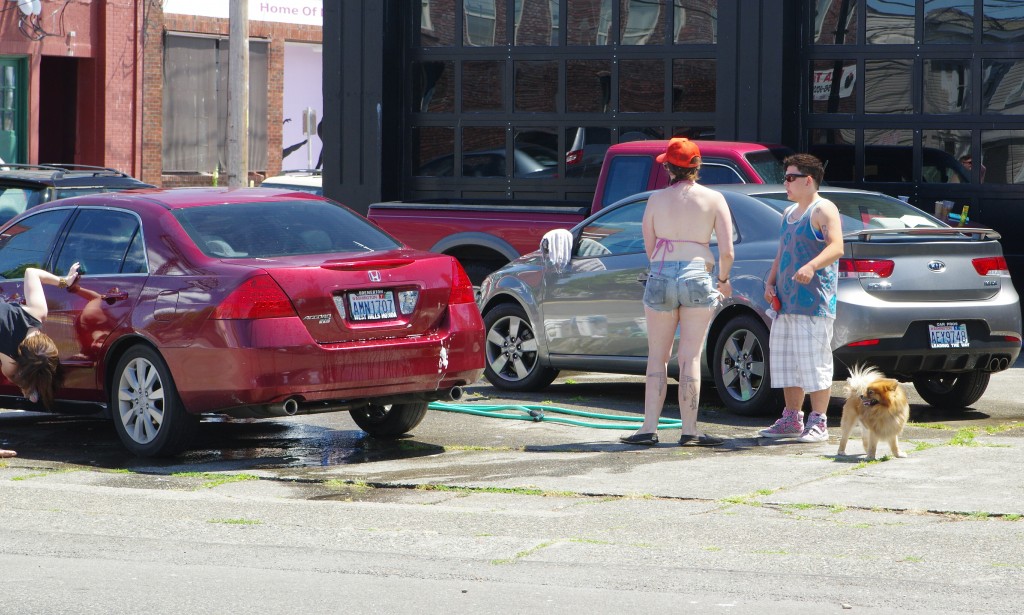
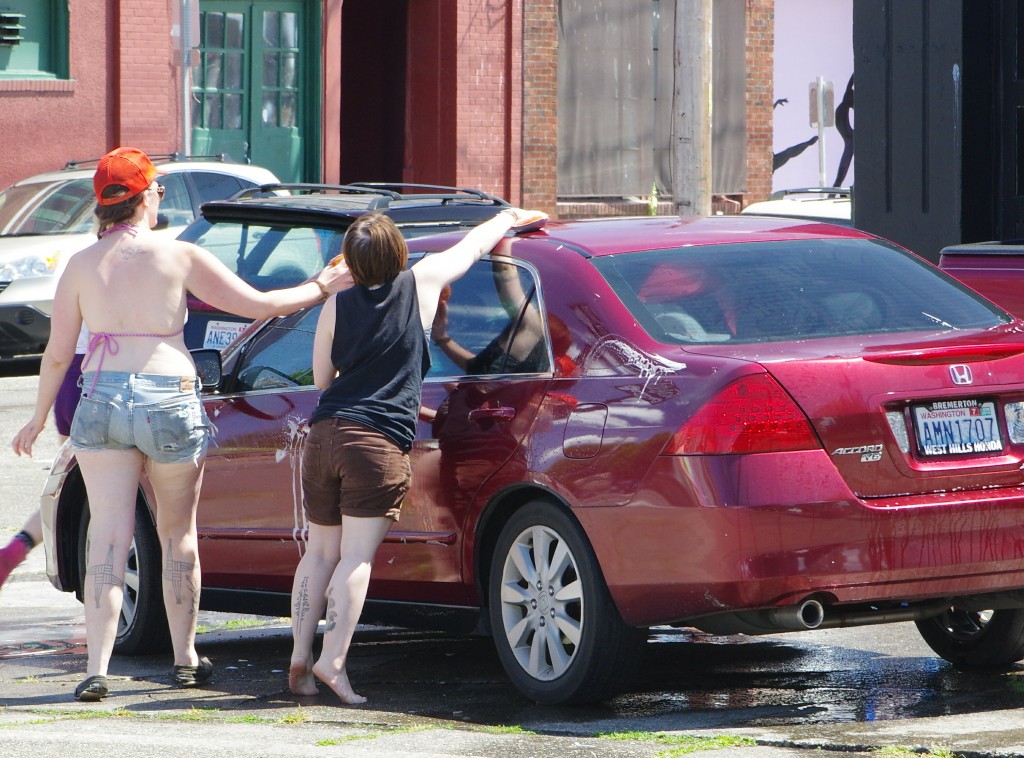
Only 50 feet from the Artesian at 4th & Jefferson were the Queers Rock Camp Carwash offering a quick vehicle bath in exchange for $5 – $20. It was a ready made photo-op, or so it seemed…at first.

IMGP4857crp IMGP4858crp

The first couple of snaps went off without a hitch–good light, colorful subjects, smiles, advertising signs, tattoos. Then the encounter with the first gender bender who more often than not rely on intimidation rather than reasoned dialog or even the most rudimentary understanding of what they’re demanding…or they simply (as one admitted) don’t care.

IMGP4860crp

Tow Away Zone

IMGP4859crp

She/he/they/it/whatever approached the photographer who was standing firmly on the public sidewalk adjacent to the parking lot where, armed with a hose, buckets of soapy water, and a sponge, they were attempting to earn  enough money for summer rock camp. There’s no doubt this beats panhandling all to hell. Their business acumen, however, was more than a little lacking.

IMGP4862crp

Nervous Nellies Object to Bodies Being Photographed

IMGP4861crp

“You must ask for our permission to photograph us,” she/he/they/it/whatever demanded. “No, it’s not required,” responded the photographer. “Yes, it is,” she/he/they/it/whatever rejoined.

IMGP4863crp IMGP4864crp

An older teen approached the photojournalist and temporarily joined in the conversation. He opined that permission was needed when children were present. The photographer attempted to disabuse him of his misapprehensions, but he was having none of it, claiming he knew more about this area of law than the photographer who also happened to be a paralegal who specialized in this area of law. “Are you a lawyer?” he was asked. “No,” the kid responded, “but, that doesn’t mean a paralegal necessarily knows the law about this either.”

IMGP4865crp IMGP4866crp

Having met so many vacuous attorneys and even judges, the kid’s point was hard to argue with. “Tell ya what,” invited the photographer, “let’s call the cops, who are charged with enforcing laws surrounding disputes such as this, and let them enlighten you.” The kid seemed taken aback, but, as it turned out, his mother must have thought this was a swell idea as she called the man (who turned out to be a woman) to arrive on the scene.

IMGP4869crp

Teen LaQueefa

IMGP4867crp IMGP4868crp

Having been advised by the dispatcher to protect himself, the photographer made his way across the street next to one of the bars with an open door for a better camera angle and less harassment. The Queers continued to charm the photojournalist and the public with an upraised middle finger while waving their signs seeking customers. Like a bared teeth dog wagging its tail, it was difficult to know which end to believe.

IMGP4870crp IMGP4871crp

Once a few shots had been acquired, it was time to call it a day in Olympia. Walking through the Artesian, some folks (one in particular) had watched the scenario. When questioned, yours truly spoke of how photography was not a crime, but a fundamental right in public venues. Some of the more obtuse began to express differing opinions until the more civic minded guy pronounced his understanding in accordance with 1st Amendment principles.

IMGP4872crp

Mom argues her late teen son is too ‘young’ to have his picture taken in public.

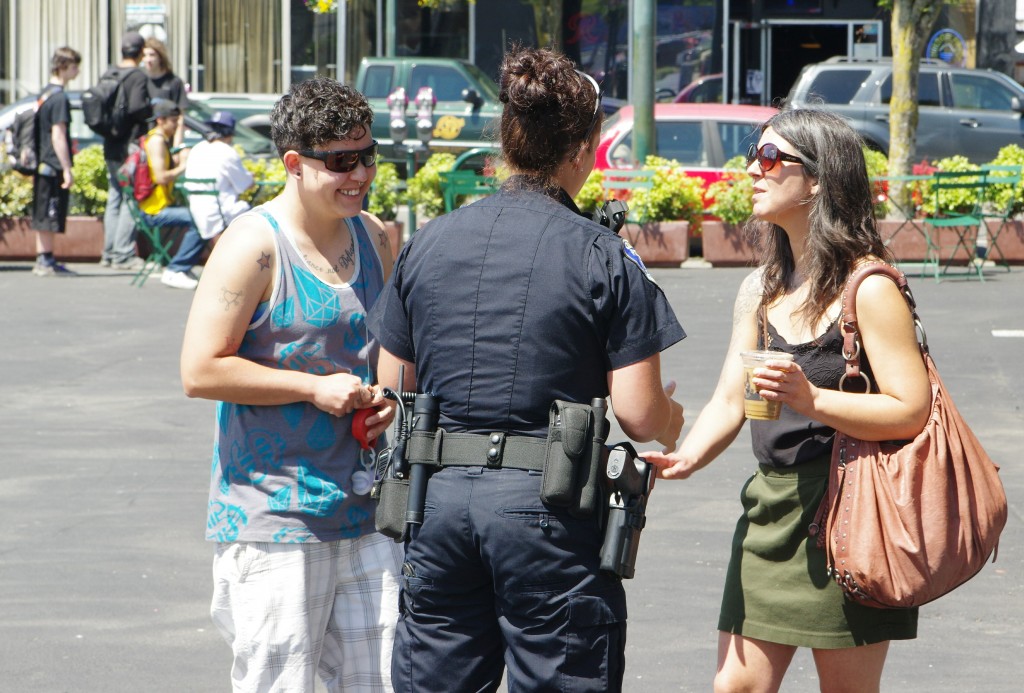
Just then, the cavalry arrived, a young female Olympia police officer, by herself, approached the photographer. Almost immediately, the mother and her teen son closed in to express their complaint about the photographer (Photographing, [*gasp*] children in public…or so she said, though the teen son had disavowed being a minor when asked earlier). The officer ordered them to step back so she could finish her interview with the photographer, which she did.

IMGP4873crp

Wearing Bullet Proof Vest & Explaining the law to one of the lesser lights in the universe

After listening to his explanation and the importance of preventing force and fraud, not just reporting it, she cut the dialog short by emphasizing, “I get it!” “I’m finished with you,” she advised before turning her attention to the mother in waiting, and to give her a clue.

IMGP4874crp

It is what it is!

A full shot of the LEO’s face, name tag, and badge wasn’t made because she declined to have her picture taken while admitting she had no legal right to prohibit it. Prudence suggested, under the circumstances, not to push the point since her responding to the situation was largely discretionary.

Having struck a blow for exercising our rights to avoid losing them, the photographer left the scene to write this story. The obtuse and aggressive continue to dominate the downtown streets of Olympia. Belligerence and intimidation continue to be the order of the day there. It is hoped the Olympia police department will add more emphasis on drawing bright lines where the boundaries of fundamental liberty interests lie.

IMGP4875crp

Queen LaTifah

The police do not have the inclination (the above referenced officer made that clear) or resources to control the streets and our public spaces. The public itself will have to assume some responsibility to reclaim them. Today, everyone has a camera. Today, we are the press! Today, we can reclaim our public spaces by exercising that responsibility, that right.

Yielding to arrogant bullies and the violently obtuse only encourages the abuse. The abuse will only get worse until the public puts a stop to corruption, both in government AND in the people!

Posted in Uncategorized | 3 Comments

WA Justice System Sux says public–meeting called

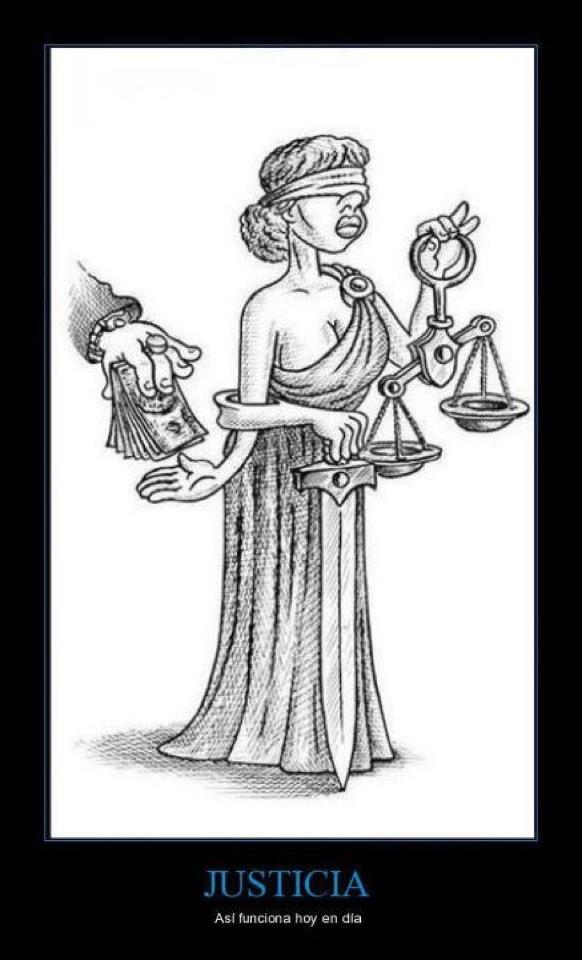
justice

Public Vote of No Confidence

Olympia, WA (6-8-14) — Washington residents think the State’s justice system really blows. It has gotten so bad an overwhelming majority of the public feel it’s intrinsically unfair. Though most judges have never met a cop they didn’t like or a pro se litigant they do, there’s an uneasy epiphany in the State’s high court about the low esteem in which citizens hold our court system–a virtual cesspool of corruption, incompetence, and routinely turning a blind eye to perjury by public officials. If Benjamin Franklin’s concerns have come to pass, we have entered the land of oppression and gilded miscarriages of justice. (“When the people are afraid of the government, that’s tyranny. When the government is afraid of the people, that’s liberty!” -B. Franklin-)

Today, our courts have become mere extensions of a police state, a tool for state sponsored terrorism and oppression. But, not to worry, a meeting has been called to TALK about it. After all, the same justices set on sucking up to a system designed to threaten/intimidate the masses into submission will do the right thing, once they’ve been enlightened?–umm, Right!

Actually, even the U.S. Supreme Court, normally exceedingly deferential to the lower courts has said Washington’s suck–big time. (In Troxel v. Granville, calling the State’s predilections in custody disputes “…breathtaking in scope”!) Richard Fellows, the director of Media Island in Olympia and a father who was caught up in a custody/visitation dispute had  a Minnesota judge opine (again, uncharacteristically berating another court) Washington’s court system appeared to be all about the money rather than the child’s best interests. Yeah, you heard that right. Even other courts think ours suck! In a conglomeration of mutual backscratching, this kind of castigation among sister courts is highly unusual. Space does not allow for the exceedingly long litany of examples.

You can throw in your 2 cents or just come for a dark comedy if you can make it to DSHS headquarters in Olympia this Monday (tomorrow) morning @ 8:30 am – noonCynthia DeLosTrinos (cynthiadelostrinos@courts.wa.gov) would like folks to ‘register’, so drop her a line or risk getting in without. The Law & Order (e.g. Agnew) crowd would like guns and public events attendees registered because both are equally dangerous. Whether the fear factor indicates we’re already free is anyone’s guess. Feel free to come.

Location: DSHS Headquarters Bldg @ 1115 Washington St, Olympia, WA.

Internet survey: Public says Justice System Unfair

by Brad Shannon

A public opinion survey done for Washington courts shows a sharp racial divide in public views of how fair the justice system is in the Evergreen State.

The report, which used an Internet-based survey of 1,500 residents in 2012, was done for the state Supreme Court’s Minority and Justice Commission and is scheduled for a public presentation and discussion Monday in Olympia.

Among the findings, the report shows more than 40 percent of the public does not think the justice system treats people “fairly and equally.” More than 65 percent of all respondents thought a black person would be more likely to be convicted of a crime he or she did not commit than a white person charged with the identical crime.

While just 11 percent of whites reported disrespectful treatment by police on at least one occasion, the figures show up to 62 percent of African-Americans reported a negative experience.

The survey also found Latinos report more “contentious contacts” with police and the courts than whites, but “somewhat fewer” than do blacks, while experiences of Asian-Americans are comparable to those of whites.

The sample was weighted to increase its match to the state’s population, according to the report. Researchers said group differences were noted only when the odds of them occurring by chance were less than 1 in 20.

“The report provides an excellent opportunity for us to continue our work toward enhancing confidence in our courts,” newly appointed state Supreme Court Justice Mary Yu, who is co-chairwoman of the Minority & Justice Commission with Justice Charles Johnson, said in a statement. “We look forward to working collaboratively with all of the other entities in our criminal justice system on improving the delivery of justice and addressing these findings on how the wider community experiences us.”

Monday’s session, which includes a forum with questions, runs from 8:30 a.m.-noon at the Department of Social and Health Services headquarters building, 1115 Washington St., Olympia. Attendees are asked to register by email to cynthia.delostrinos@courts.wa.gov.

“My guess is that it will be a lively conversation,’’ said Ed Prince, director of the Washington State Commission on African American Affairs, who was helping to organize the forum. “My hope is that a larger conversation about this gets started. The data don’t tell me anything I didn’t already know as far as perception.’’

Prince said he thinks the involvement of the high court can make a difference in broadening the discussion. The commission plans to report its findings to the nine-member state Supreme Court.

Uriel Iniguez, director of the Washington State Commission on Hispanic Affairs and a member of the justice commission, offered a similar assessment.

“To me this is nothing new. But how do we mainstream this issue so people are aware of it and what’s going on? We sometimes tend to isolate it, segregate it — (we say) it’s not my problem,” Iniquez said.

Iniquez said that getting people to acknowledge what the public perceptions are may lead to a better conversation and eventual changes in the system.

“These discussions are not easy — at times they bring out some hurtful feelings,” Iniquez said. “People jump to conclusions, ‘you’re calling me racist.’ No … this is what people are saying. It may not be reality, but it’s what they are saying, and we have to come to terms with it.”

The research was done by a team of investigators that included professor Jon Hurwitz of the University of Pittsburgh, professor Jeffery Mondak of the University of Illinois, and professor Mark Peffley of University of Kentucky.

Posted in Uncategorized | Leave a comment

Mason Co. Sheriff’s Militarization Continues Unabated

Story County adds massive new military vehicle

6-wheel drive @ 56,000 pounds

Shelton, WA (6-6-14) — One war toy (an incredibly heavy armored personnel carrier) wasn’t enough for Sheriff Casey of Mason County. When asked why the tank was needed during an interview a couple of years ago at the county fair where it was on display, one deputy opined it would be used to serve warrants…along with the black ninja-style uniforms, body armor, automatic weapons, tear gas, battering rams, flash grenades, attack dogs, tasers, combat gloves–you get the idea: overwhelming force, shock & awe to control an enemy all around the ‘thin blue line’. Nothing–no, really–NOTHING is too good for our boys in blue/black. And that’s just for serving warrants, let alone actual desperadoes. If they’d had the bad sense to consider it, the Taliban is well advised not to mess with Mason County.

The Sheriff has taken ownership of yet another imposing armored dinosaur through a U.S. Department of Defense program that transfers surplus vehicles and equipment to local law enforcement agencies. Or, for “FREE” according to a Sheriff’s spokesman. Not to put too fine a point on it, but “free” is killing us, not to mention the advisability of a virtual military garrison instead of a police agency that is bankrupting Mason County.

The Sheriff’s latest assault and combat vehicle acquisition?–Yeah–he got it for FREE! But, it only cost over $8,500 to transport it here. That may be for the reason it weighs over 56,000 pounds. We can only imagine whether it is even capable of getting from one gas station to the next. Each door on it weighs 600 pounds. Only a couple of deputies are qualified to drive the thing. But, they say it’ll be useful in a hostage situation and driving the back roads in the Olympics for rescue operations.

Having seen some of the trails (Rose Mountain, Staircase, Mt. Ellinor, etc.) the claim is doubtful. Sheriff Casey already has an armored personnel carrier that should serve for any hostage crisis. Ummm…just how many have we had in Mason County?

Yep, it was ‘free’ too, and equally fuel thrifty. Not to worry about repair expenses, though–they’re gonna do that over at the Ft. Lewis army base near Tacoma, according to a sheriff’s staffer. No doubt, that’s going to be ‘free’ too! (Yeah, right–the army is just dying to blow money on Sheriff Casey’s ego.) And then there’s that little detail of it costing over $8,500 to transport this war toy each time…what, $17,000 round trip? Still, money should be no object when it comes to treating Americans like the enemy.

No wonder the Sheriff is always grousing about his budget and neighborhoods now have to sign contracts for police services. Having bankrupted most area taxpayers, the Sheriff now is working on the gated communities.

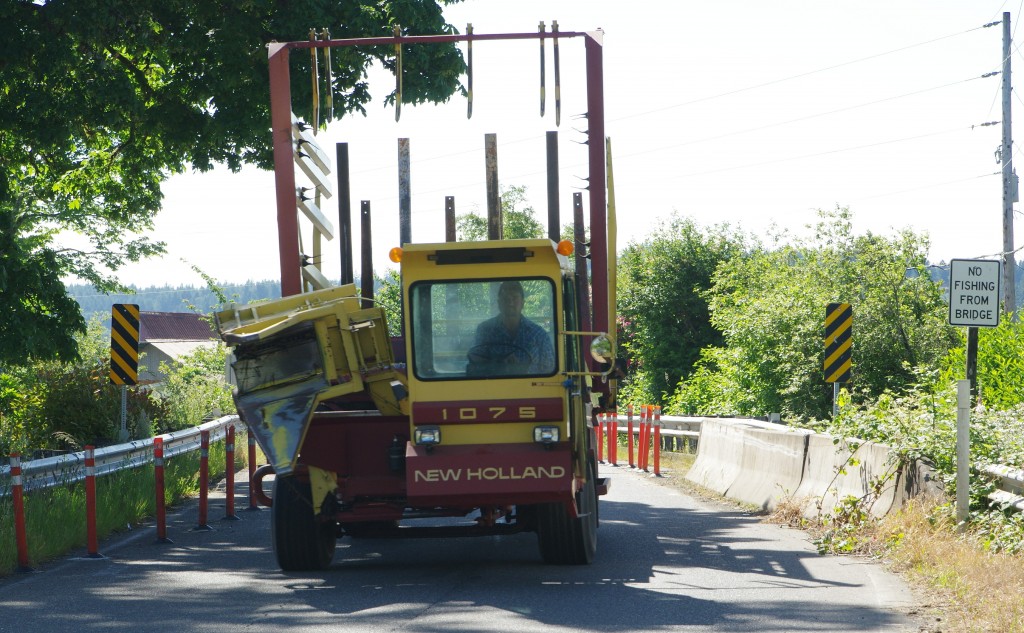
One can imagine what this behemoth would do to the collapsing bridge in the Skokomish Valley. It’s sitting there rotting into oblivion until some hapless motorist/truck driver falls through it, but we have the money for another of Sheriff Casey’s Armory war museum boondoggles!

Don’t blow your dough. 

“When the people are afraid of the government, that’s tyranny. When the government is afraid of the people, that’s liberty!” -B. Franklin-

IMGP4848crp

Collapsing Bridge Sole Ingress/Egress for Skokomish Valley residents

IMGP4842crp

Though Collapsing, Logging Trucks Continue to Pound This Bridge

IMGP4846crp

Over 3-years on, nothing but barriers for this collapsing county bridge in the Skokomish Valley

IMGP4847

Skokomish Valley Roulette

Posted in Uncategorized | Leave a comment

Why (A)narchy?: State Sponsored Terrorism!

“Those who make peaceful revolution impossible make violent revolution inevitable.”

Posted in Uncategorized | Leave a comment

FL Judge Punches Public Defender

No Arrests Made In Incident

video platformvideo managementvideo solutionsvideo player

by Erik Sandoval (reporter), Daniel Dahm (editor)

VIERA, Fla. – A judge allegedly struck a public defender Monday after a verbal confrontation in a Brevard County courtroom.

Judge John Murphy is accused of hitting Andrew Weinstock, according to the public defender’s office.

During a court session, Murphy asked Weinstock to waive his client’s right to a speedy trial, but Weinstock refused, the public defender’s office said.

The confrontation leading up to the fight was captured on video.

“If I had a rock, I would throw it at you right now,” Murphy said. “Stop pissing me off. Just sit down. I’ll take care of it. I don’t need your help. Sit down.”

“I’m the public defender, I have the right to be here and I have a right to stand and represent my clients,” Weinstock said.

“Sit down,” Murphy said. “If you want to fight, let’s go out back and I’ll just beat your (expletive).”

“Let’s go right now,” Weinstock said.

The two went into a hallway, where Murphy allegedly grabbed Weinstock by the collar and started hitting him, according to the public defender’s office.

Although off camera, the two can still be heard yelling at each other, with one of them saying, “You want to (expletive) with me?”

A Brevard County sheriff’s deputy stopped the fight.

The participants refused to press charges and no arrests were made.

The video also shows the judge being applauded as he returned to the courtroom.

Local 6 legal analyst Luis Calderon said both men could face disciplinary action for what happened in court, simply because of the attention the case is getting.

Calderon said worst cast scenarios for both men could result in them losing their jobs and possibly being disbarred.

Posted in Uncategorized | Leave a comment

Shaun Goodman Deal Provokes Courthouse Protest

Blind Justice?…or Payola?

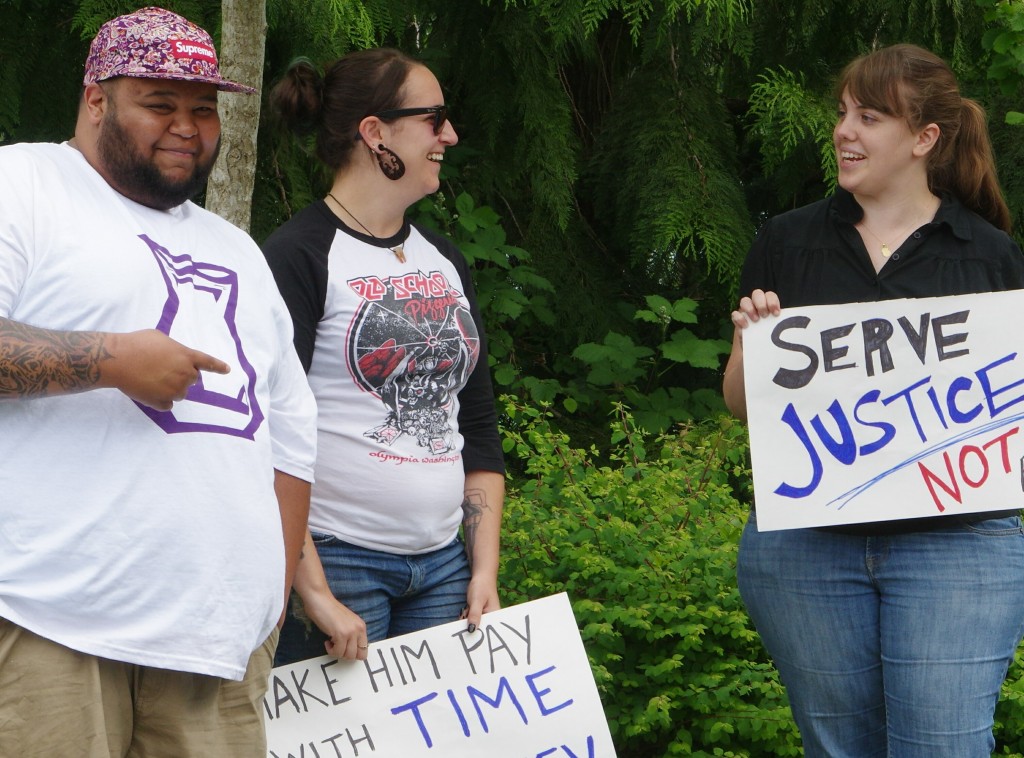
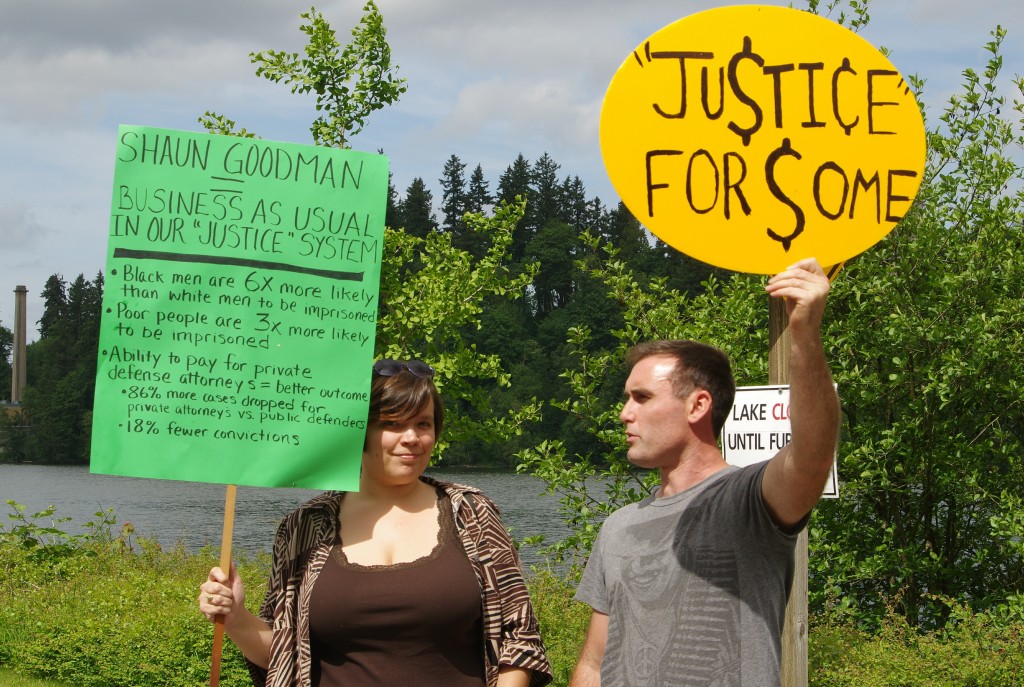
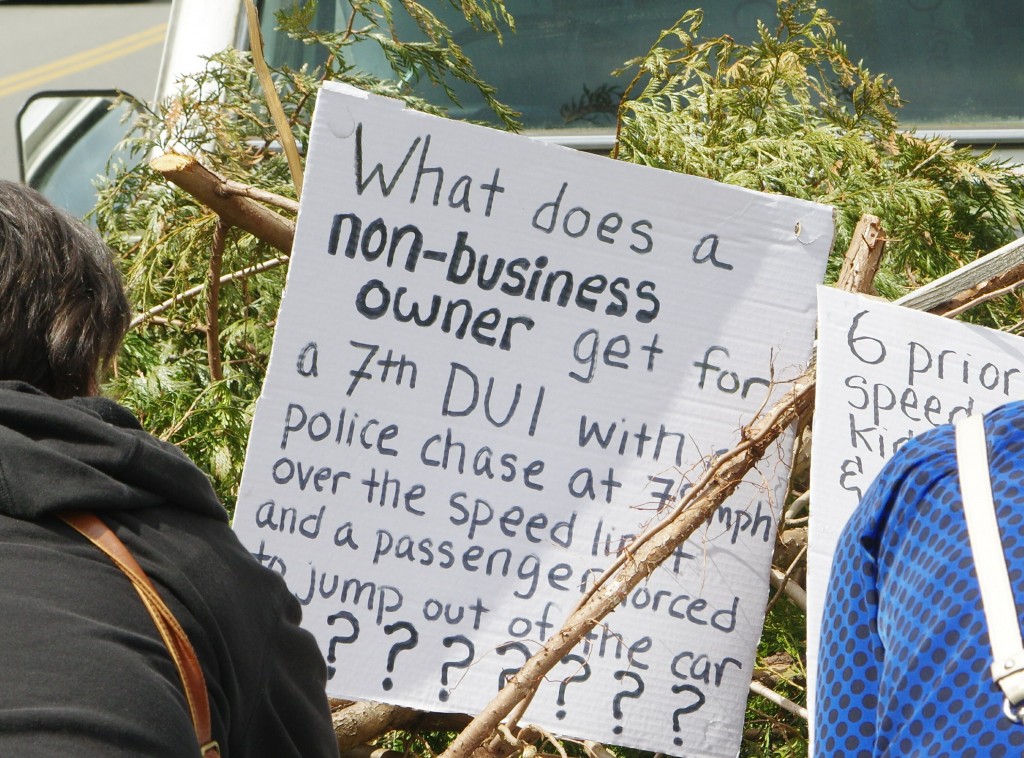
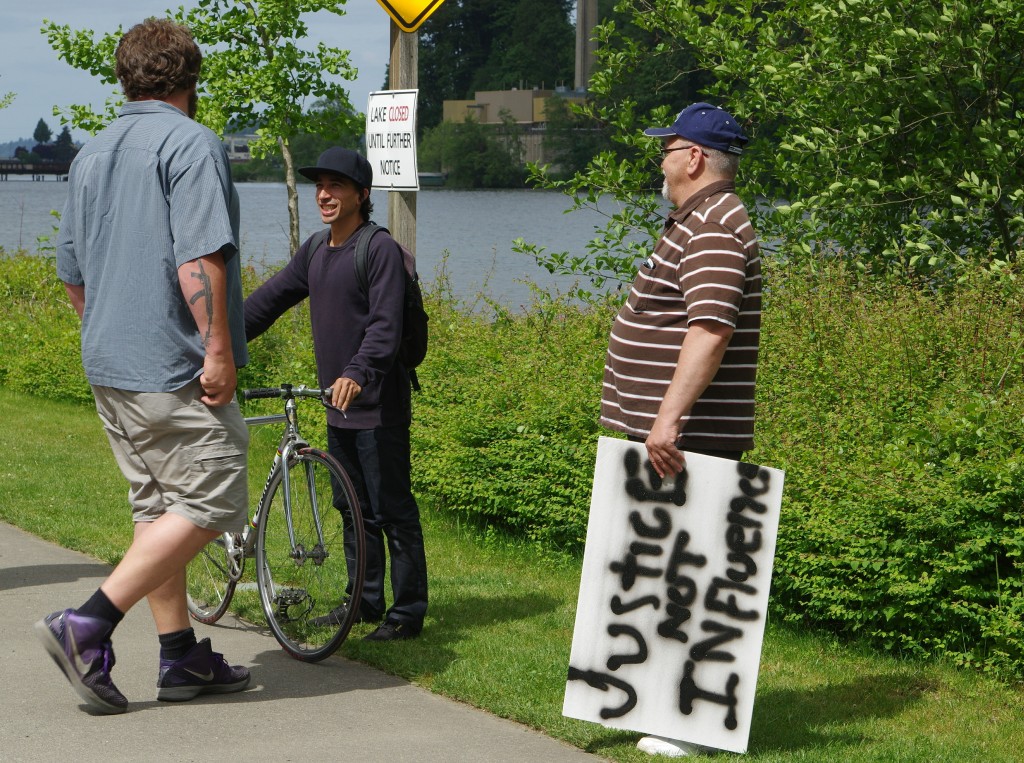
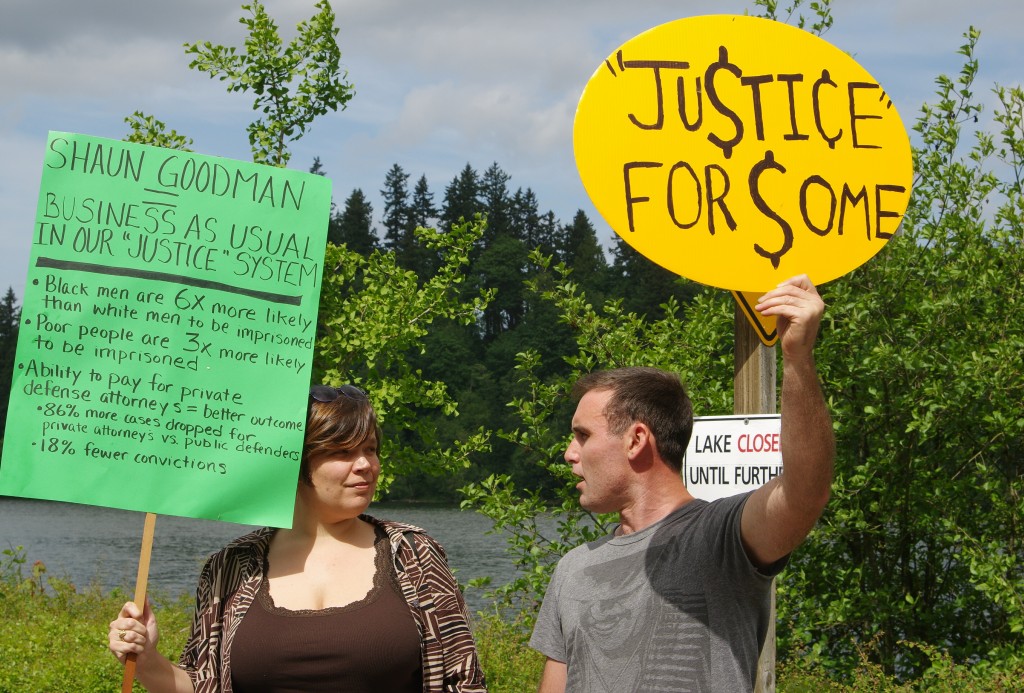
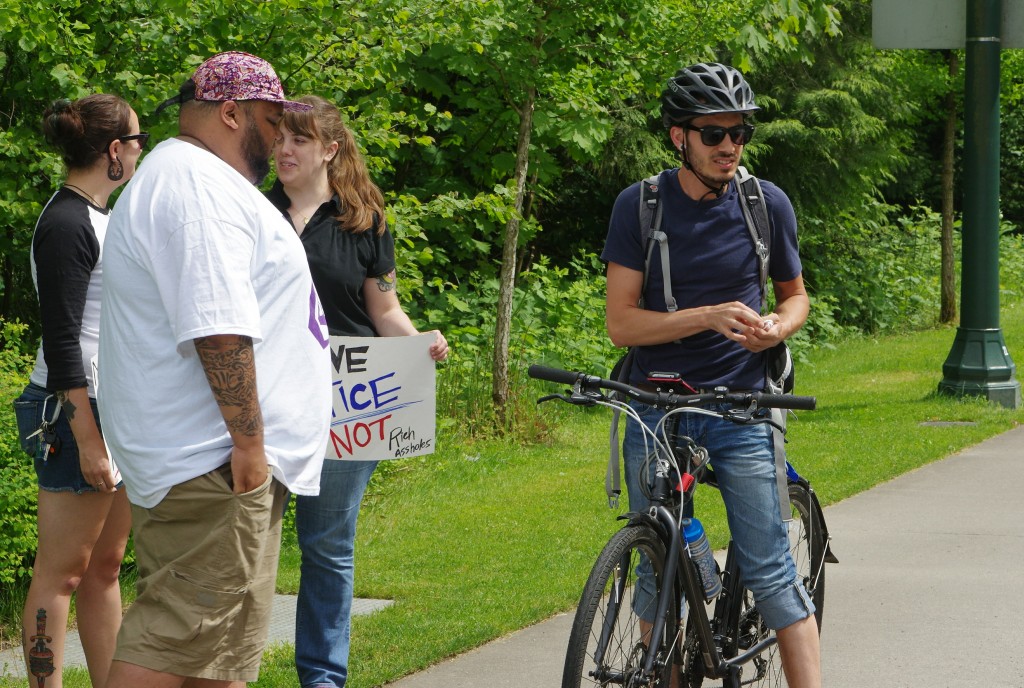
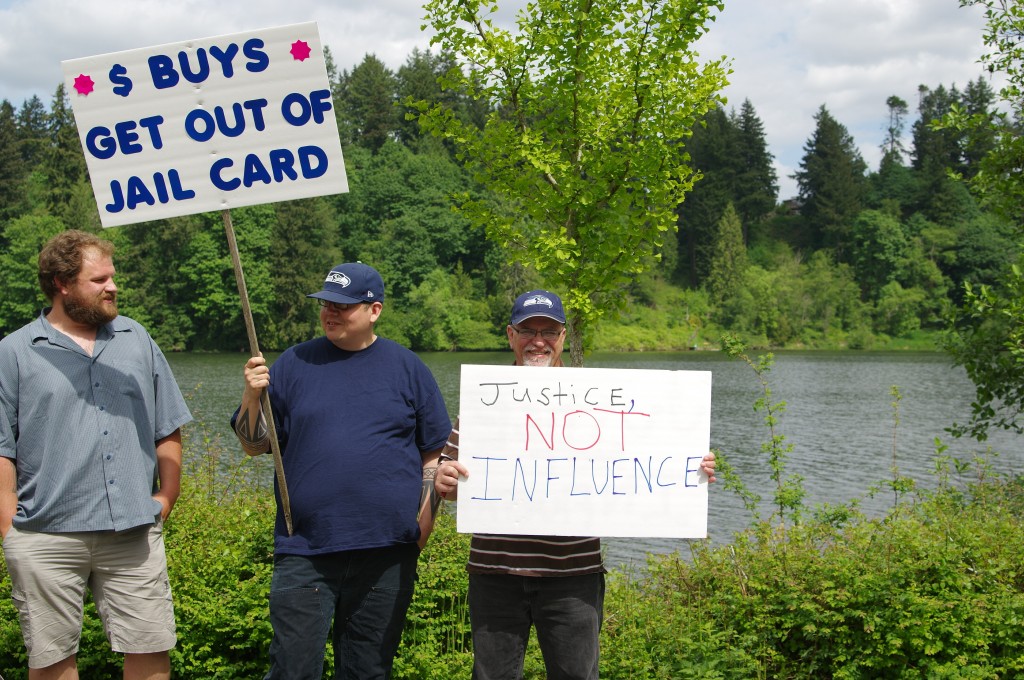
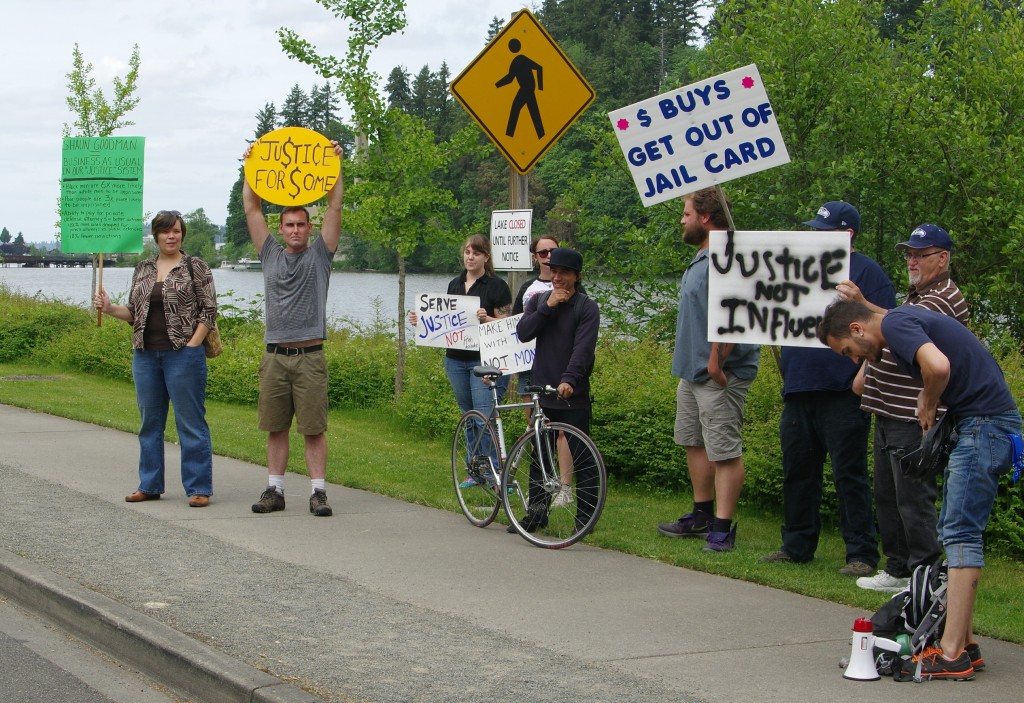
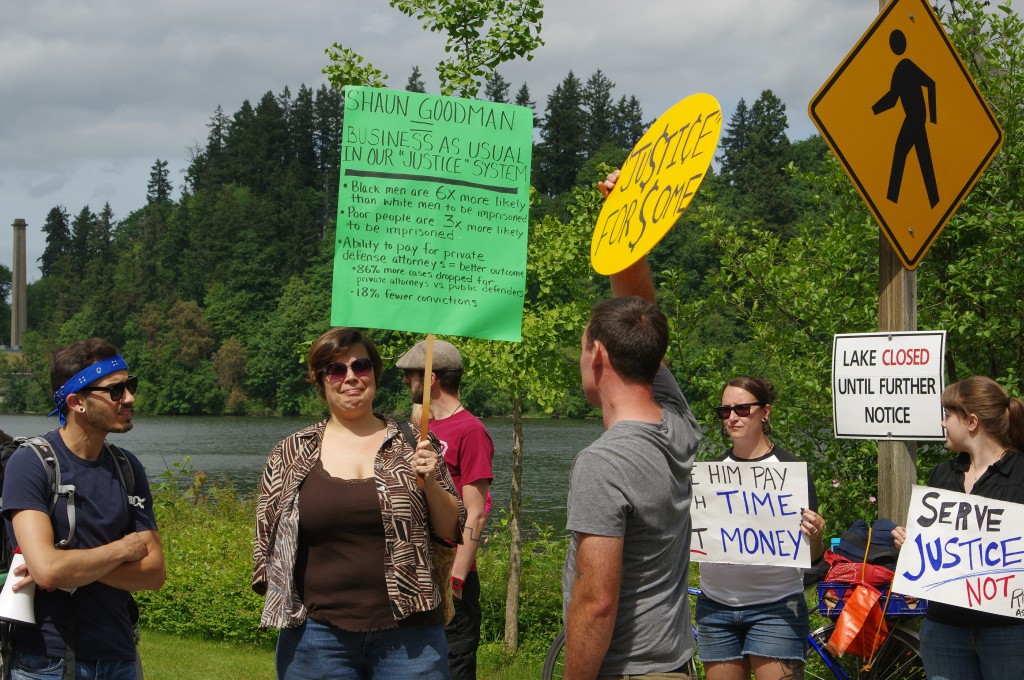
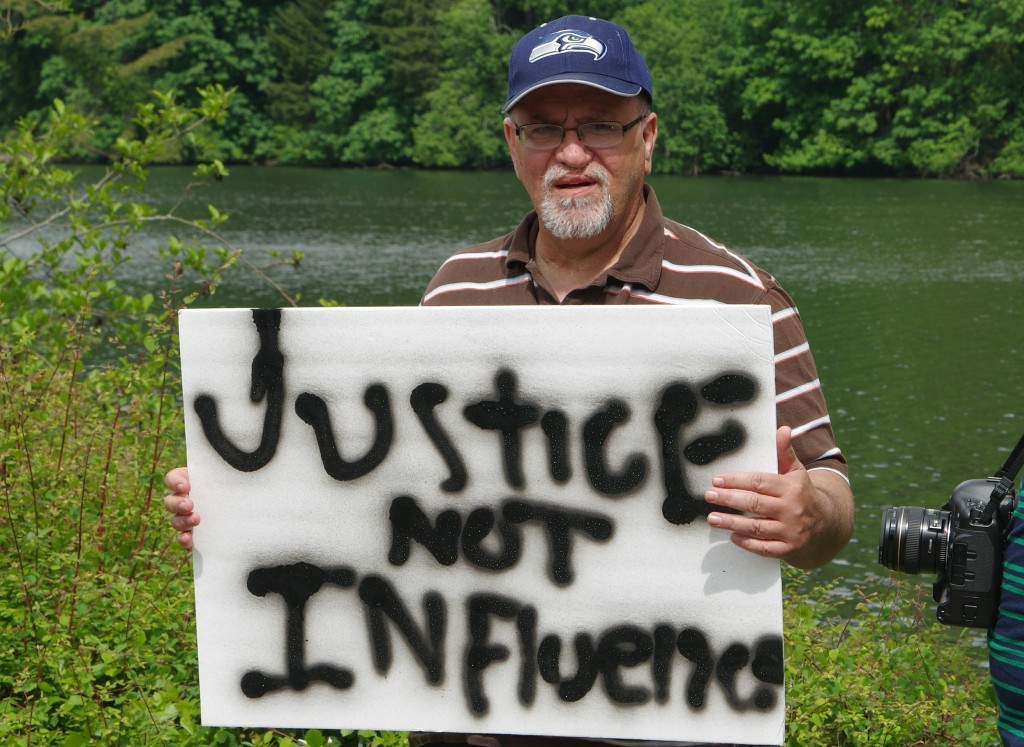
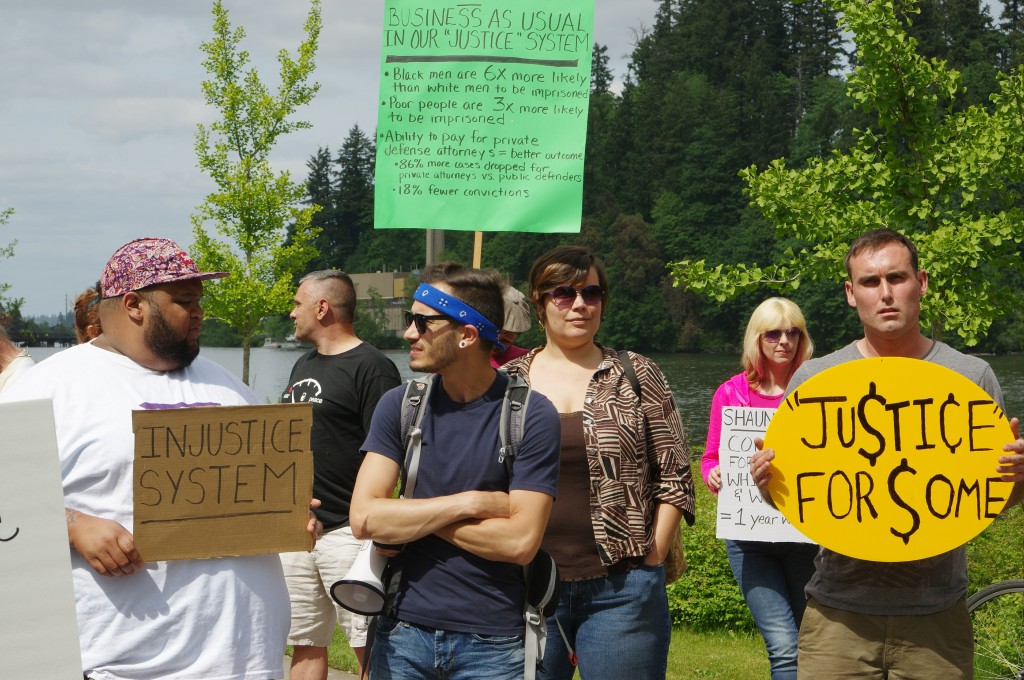
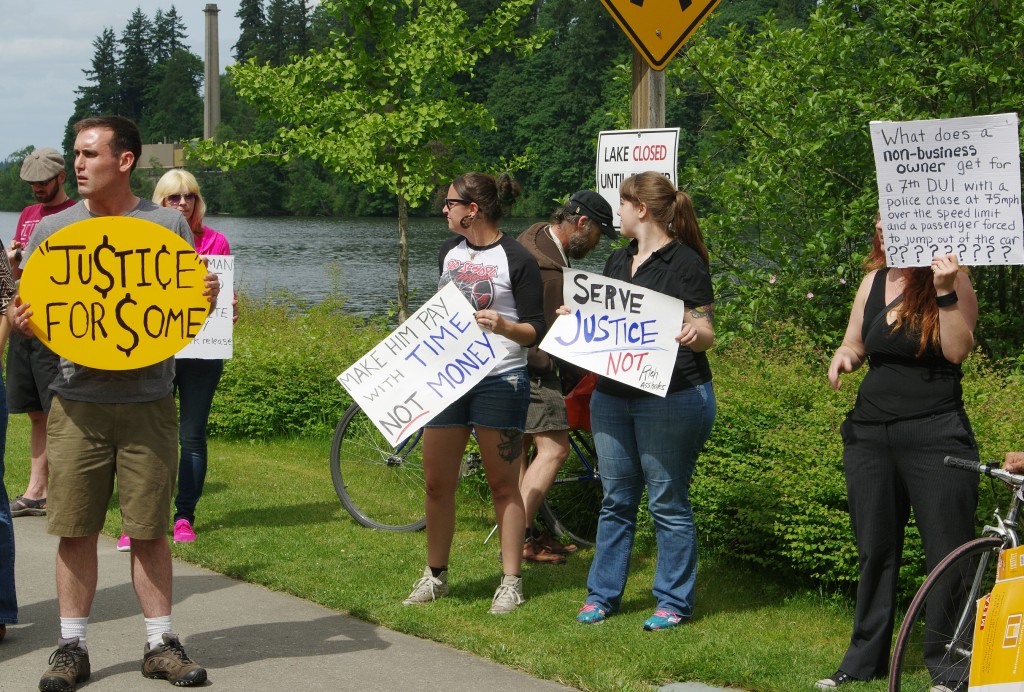
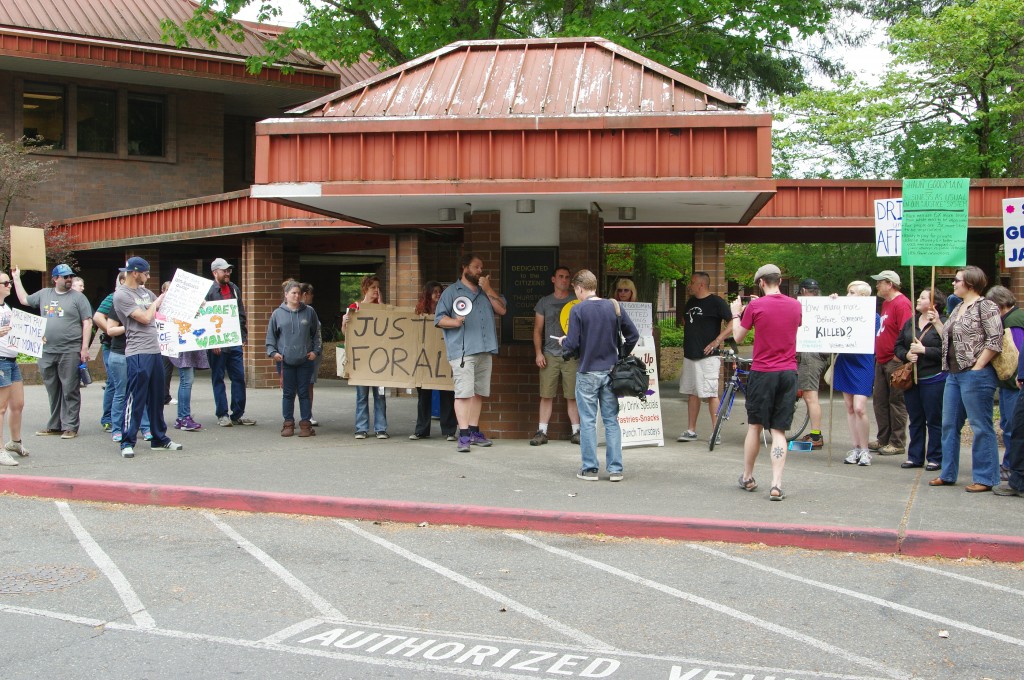
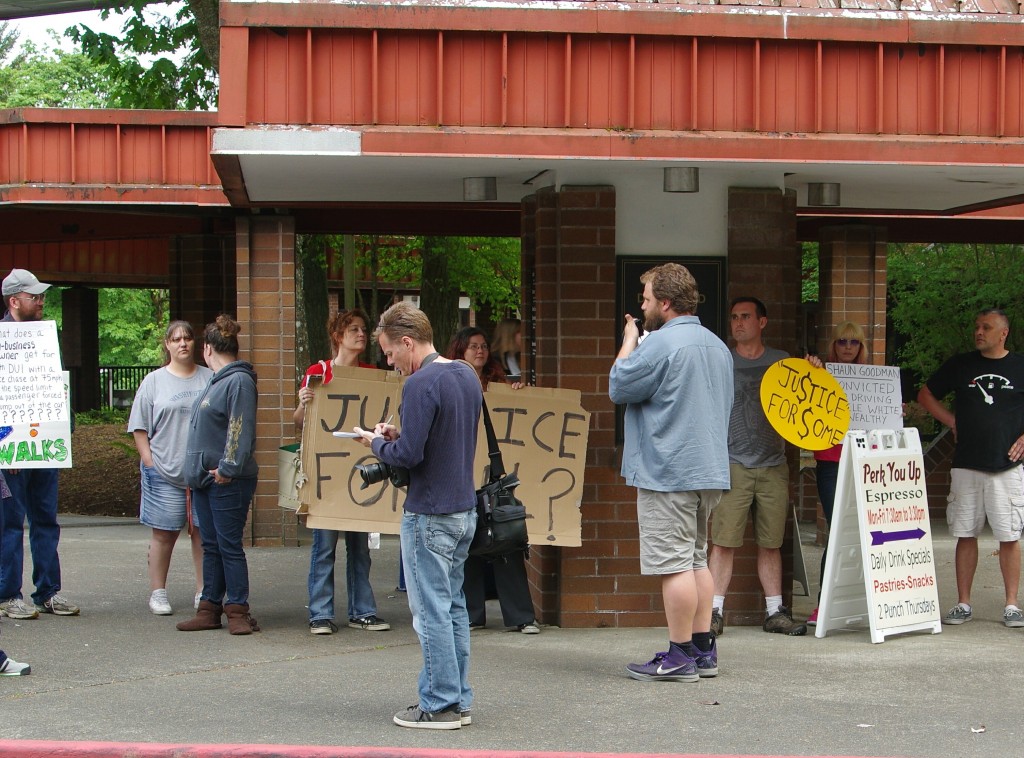
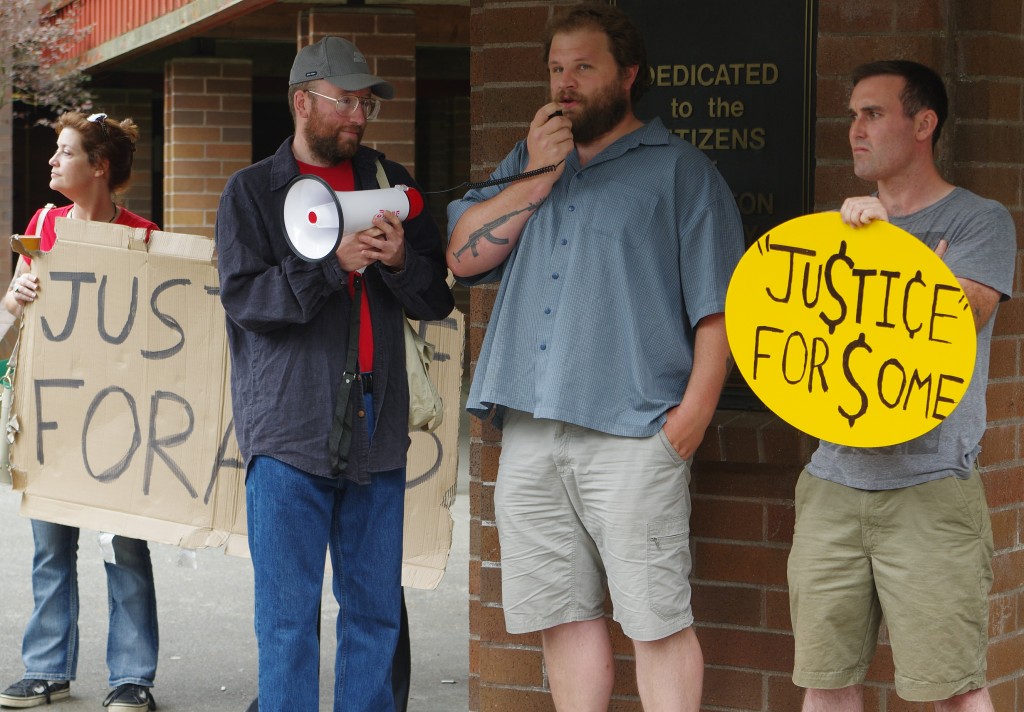
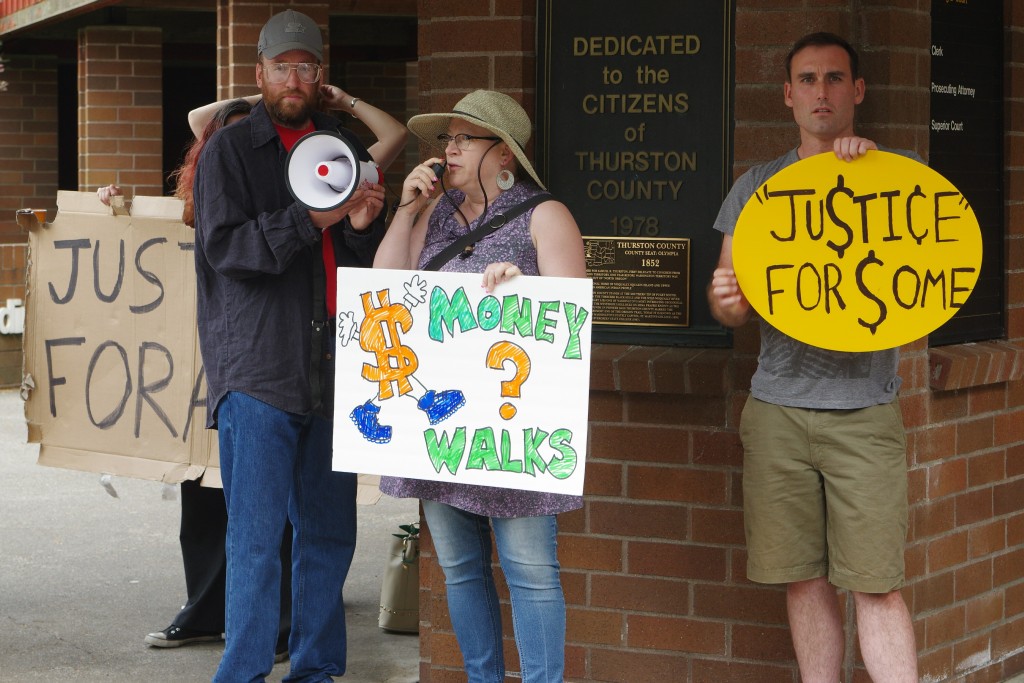
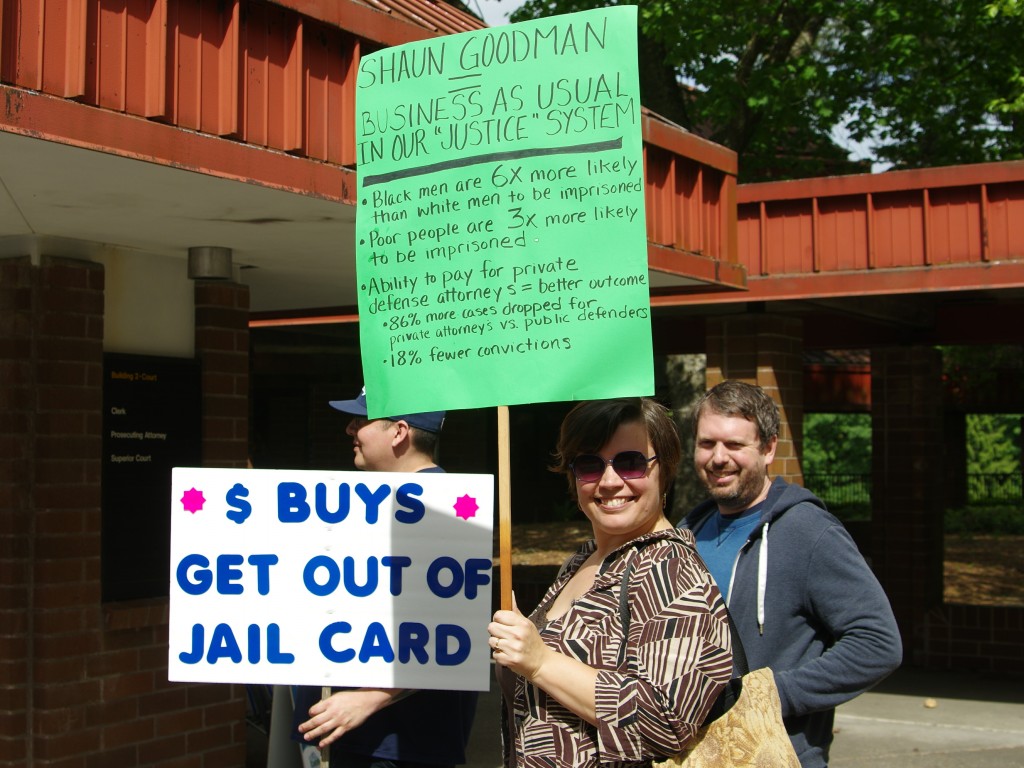
Olympia, WA @ County Courthouse Complex (5-16-14) — It was a bright sunny Friday afternoon as the crowd slowly assembled at the foot of the hill crowned by the County’s courthouse complex by Capitol Lake. Ages ranged from teens to grandparents, all white except for one gentleman of color (Henry Griffin) who had been victimized by Shaun Goodman, a local wealthy businessman owning Vantage Communications, a Ferrari, and a Lamborghini. During Goodman’s high speed chase, said to have exceeded 100 mph, he eluded police, racing through the heart of Olympia while drunk driving his sports car and Mr. Griffin to the point of causing the captive passenger to leap from the speeding automobile to save his life.

Drunk driver's light sentence triggers protest in Olympia

Shaun Goodman, Owner of Vantage Communications, a Ferrari, and a Lamborghini

Pay to Play Justice?

THE WEIGHT

Griffin got into the Ferrari voluntarily, having no idea of how drunk Goodman was or his long history of drunk driving offenses. “Yeah he didn’t even have a blow and go in the car or I would have not got in,” commented Griffin. Henry now sees a chiropractor 3 times per week and a doctor every week to treat the pain from his injuries.

IMGP3103crp

Henry Griffin

IMGP3124

Griffin shares body art

Sam Miller, who organized the demonstration, cautioned protesters the issue was larger than Goodman, but “…about inequality. The amount of money you make and the color of your skin should not determine your punishment,” he stated. In a Face Book posting inviting community participation in the demonstration, he characterized the event as follows:

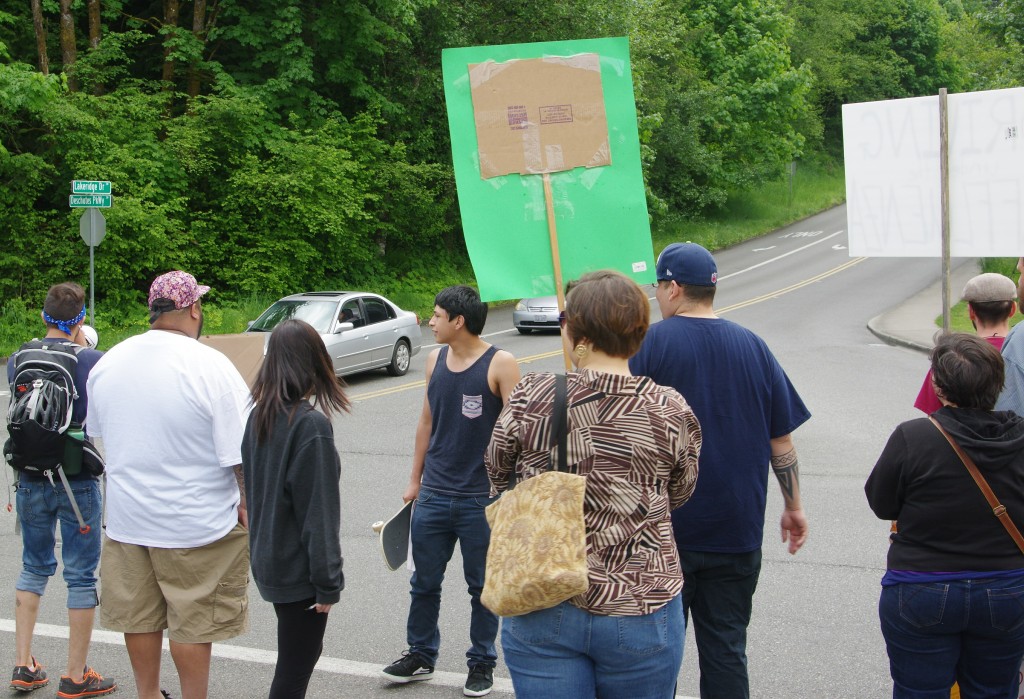
On Friday May 9th Thurston County Judge Christine Schaller and prosecuting attorney James Powers agreed to allow Shaun Goodman a man with no less than 7 alcohol related charges to serve 1 year of work release. After leading police on a drunken chase in his Ferrari through Downtown Olympia all while holding a man hostage. We will meet at the corner of Lakeridge Drive SW and Descutes Parkway SW. and march to the courthouse Bring Noise (drums, megaphones, elephants, trumpets, loud neighbors) and signs (Anti-corruption, pro-justice)

IMGP3104crp

Sam Miller organizes get tough on crime rally

IMGP3102crp

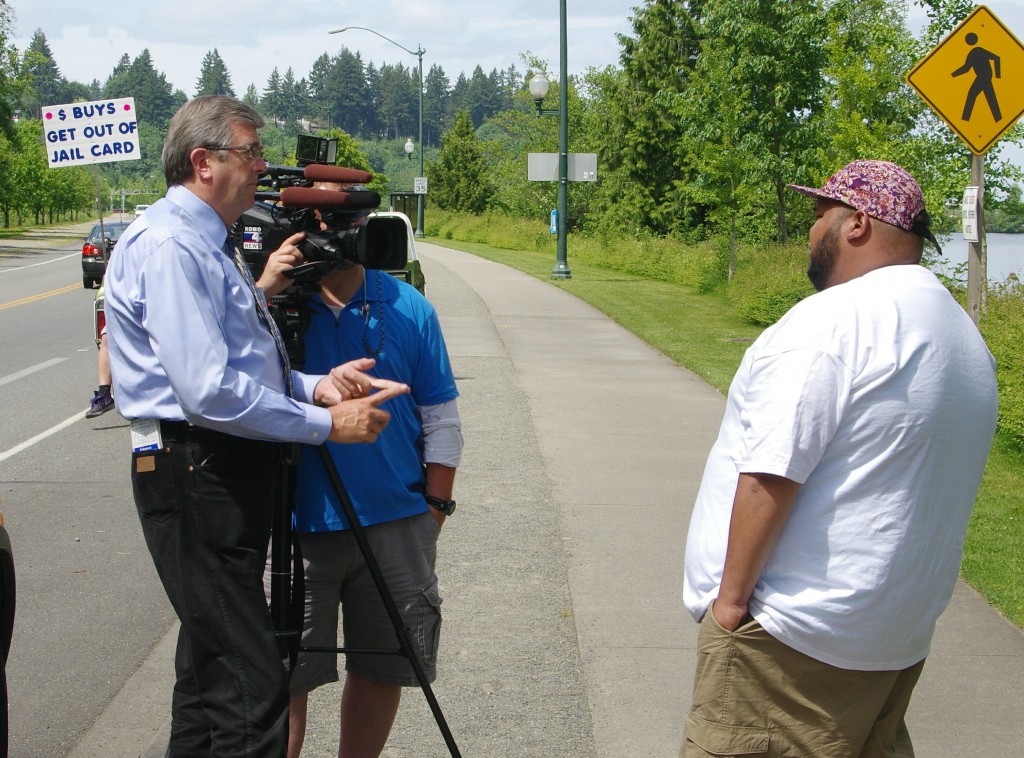
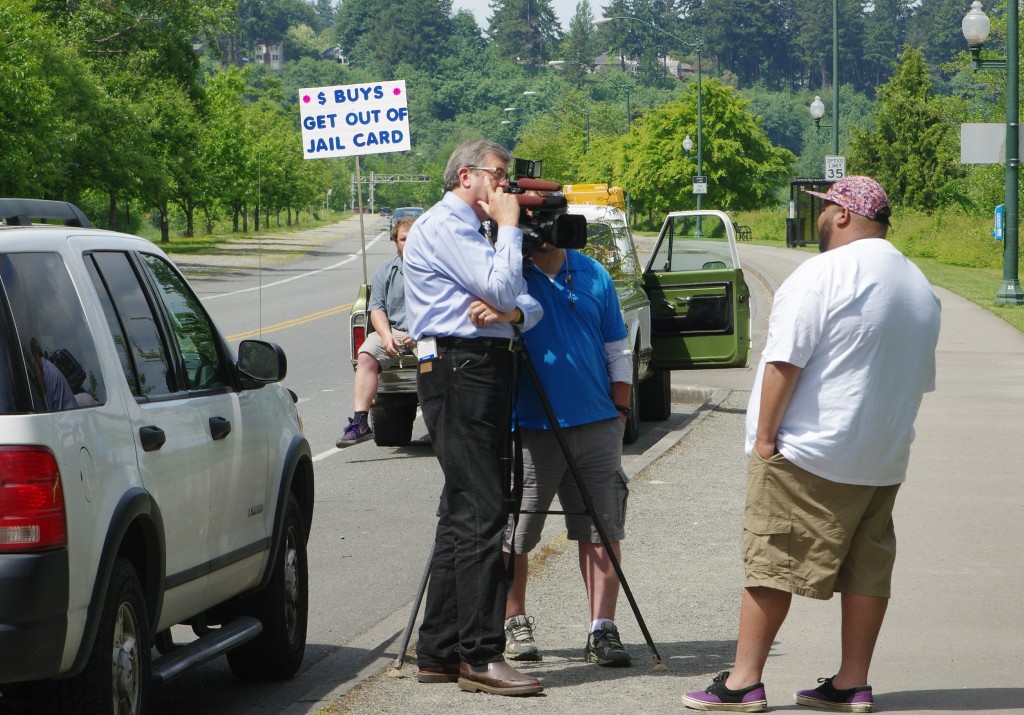
KOMO interviews Griffin

IMGP3101crp

Still, Shaun Goodman was too good a poster child symbolizing the injustice routinely meted out by the Thurston County criminal (and family, some would argue) justice system for citizens to ignore given their misapprehensions regarding how it functions, by design/intent.

IMGP3109crp IMGP3112crp IMGP3111crp

As more residents gathered at the bottom of courthouse hill by Capitol Lake to make impromptu protest signs for the rally, Henry Griffin himself appeared and would join the march to protest a criminal justice system seemingly out of touch with the community it’s, in theory, supposed to protect WITHOUT FEAR NOR FAVOR. Griffin was questioned and claimed the prosecutor never consulted him prior to Goodman’s sentencing, nor was he provided an opportunity to address the court before sentencing or given a restitution hearing for the injuries he’d sustained during the high speed chase. Upon fact checking, an interview with the deputy prosecutor who handled the case, James Powers, esq. yielded somewhat contradictory information.

IMGP3174crp

Was this limo transporting Shaun Goodman to the Courthouse/Jail?

IMGP3175

Jailhouse limo?

IMGP3176crp

The attorney for the State (Powers) admitted he had not, in fact, consulted about sentencing with the victim because, Powers says he reasoned, Goodman was getting the maximum sentence for his crime(s) allowed for under Washington law–1 year. This included the conviction for DUI and felony eluding (a class ‘C’ criminal offense). Because most of Goodman’s prior DUI’s had not occurred within a 10-year span, they were barred from triggering a felony classification of this 6th/7th repetition of the offense. Likewise, the felony eluding sentencing guidelines precluded Goodman’s being taken into custody by Washington’s prison system. However, Powers claimed he had discussed the case, in general, with the victim and had asked how he felt about it.

IMGP3114crp

What kind of justice?

IMGP3113crp IMGP3115crp

The prosecutor also argued he had sent Griffin necessary forms to fill out before the restitution hearing could be scheduled. As of the time of the interview, Griffin had not returned them to the prosecutor’s office. Powers allowed as to how restitution was appropriate provided the State had the facts and sworn statement from the victim to pursue such a remedy.

IMGP3116crp

Supporters honk their approval

IMGP3118crp

Henry Griffin w/supporters

IMGP3117crp

Powers agreed victim impact sessions were of mutual benefit to the offender and the community, but despite Goodman’s having been ordered to undergo them in his sentencing for prior DUI convictions, none had been requested in this case because the prosecutor believed they could not be imposed as part of probation since no probation could be required if the maximum sentence was being ordered allowable under law. Still, he admitted he hadn’t considered the possibility of making such victim impact sessions a part of the sentence itself, not part of ‘probation’, much like the fines imposed, perhaps even in lieu of a portion of the fines–not that prior victim impact sessions appeared to have influenced Goodman’s subsequent behavior much. Still, this ignores the benefit to the community in having an opportunity in a controlled environment to confront the miscreant and hold him accountable to the court of public opinion. The community was very angry, in this instance, for feeling as though it had been excluded from the process–and it had!

IMGP3123crp

The Ink Spots

IMGP3122crp

Ganish: God of Mischief

IMGP3121crp

Body Art

IMGP3120crp

Cornucopia

IMGP3119

Low Calorie Art

Jon Tunheim, Thurston’s elected County Prosecutor, had been approached almost 3 years ago with the suggestion his office needed a citizens’ board which met monthly with him to discuss his office’s performance/priorities. That suggestion was blown off by Tunheim as though it had been made by a panhandler. Similarly, there is no citizens accountability board for Thurston’s Sheriff’s office or Olympia’s Police department. It wouldn’t hurt Thurston’s judges to have a monthly powwow with citizens about the measure of justice (or NOT) meted out by these elected officials. That none of this exists speaks volumes to why our criminal justice system is so out of touch with residents. If it looks like they’re not listening, it’s because they aren’t. If it looks like money, status, race, and a high priced lawyer makes a difference, it’s because they do. George W. Bush might have given sage advice to those destined to face such systemic inequality by counseling them to grow up in a white wealthy family and with enough money to afford an expensive lawyer–assets that make powdering one’s nose as a ‘youthful indiscretion’ no bar to the highest office in the land.

IMGP3127crp

Money Talks

IMGP3126crp

Room, Board, and a rec room TV?

IMGP3125crp

Affluenza: Is it Contagious?

Having said all this (stating the obvious), the case of Shaun Goodman’s walk on the sunny side of the street in Thurston’s criminal justice system stirs mixed emotions. Many @ctivists passionately believe our prison system is an inhumane anachronism and should be abolished (along with police). Most judges have never met a cop they didn’t like as evidenced by how they routinely turn a blind eye to perjury from the same. Most judges are far more inclined to throw the book at a defendant than the leniency Schaller (the presiding judge in Goodman’s case) is alleged to have ordered. But, let’s examine the facts and see if they support these pronouncements castigating what, by all accounts in the legal community, is a competent, hard working, popular new superior court judge on the bench in Thurston.

IMGP3128crp IMGP3130crp IMGP3129

A judge’s powers, in law, are not infinite, but are circumscribed by law as passed by our legislature. If the law is inadequate, a judge cannot, ad hoc, impose what does not exist. Stiffer DUI penalties than currently exist were proposed to Washington’s legislature. It refused to pass them into law. Virtually all judges almost always go along with plea bargains between the parties (State and defendant in a criminal action), as refusing to  do so would quickly lead to no plea bargains being consummated at all–something neither the court’s budget, nor the prosecutor’s, nor the public defender’s could long sustain. Plea bargains are made not only in the interest of justice, but for expedience and practical considerations. Here, while a kidnapping/hostage taking charge could have been filed, Griffin did enter the vehicle voluntarily before the subsequent high speed chase began. He was able to escape the speeding Ferrari by leaping from it while it was in motion, sustaining serious resulting injuries.

IMGP3131crp IMGP3133crp IMGP3132crp

Ultimately, Goodman (through his counsel’s negotiations) did plead to the DUI misdemeanor and the felony eluding. The law and sentencing guidelines, such as they are, do not provide for a greater sentence than the year Goodman was given. Work release is considered, in law, to be time in custody, i.e. ‘jail’ time, just as home monitoring is. Goodman was NOT given home monitoring. He must return to the jail each day after work and is monitored closely while away from the jail work release facility. Schaller’s remarks prior to sentencing about Goodman’s importance to his employees was dicta, not terms of her order or sentencing. She can recommend some conditions of confinement, such as work release, but cannot mandate them. The Sheriff is part of the executive branch of government. Schaller is part of the judicial branch. Each of the 3 branches (executive, legislative, judicial) are co-equal in law and judges do not attempt to supersede the authority of the other branches. It is the Sheriff’s prerogative to determine who will or won’t be admitted to a work release program which his office (not the judge’s) administers. It is within the Sheriff’s legal authority to determine when a prisoner will be released, the conditions of their confinement, or even if they will be accepted into custody at all. What, after all, is ‘good time’ and the added time off for the work trustees do if not an alteration of the time prescribed by the sentence according to the administrative judgment of the Sheriff? Nor are the Sheriff’s guidelines completely arbitrary. They have factors (e.g. escape risk, recidivism, cooperation, history of infractions while in custody, risk to the community, seriousness of the offense, notoriety, etc.) which will be considered, in theory, without respect to race, income, or other immaterial ancillary issues. But, people are human, they know each other or of each other. Who you are in the community remains as important as what you are.

IMGP3134 IMGP3138crp IMGP3137crp

If the prosecutor erred, he did so by failing to include the community (also a victim of Goodman) in the deliberative/sentencing phase or the restorative justice phase of this case. If Schaller erred, it was her glib remarks from the bench in the face of such a serious crime by a multiple repeat/incorrigible offender. The ‘maximum’ penalty in law is NOT a synonym for justice rooted in reconciliation or a community accountability process. It is rooted in another anachronism–adversarial justice, a modern equivalent of trial by combat where might (or MONEY in this instance) makes right. In the 21st century, we must quickly evolve away from such barbaric traditions as torture, imprisonment (initially conceived as more humane than floggings), adversarial proceedings, and due process riddled with perjury. An offender’s wealth or social status or race should not be dominant factors in the kind of justice expected.

IMGP3138crp IMGP3140crp IMGP3139crp

THE MARCH

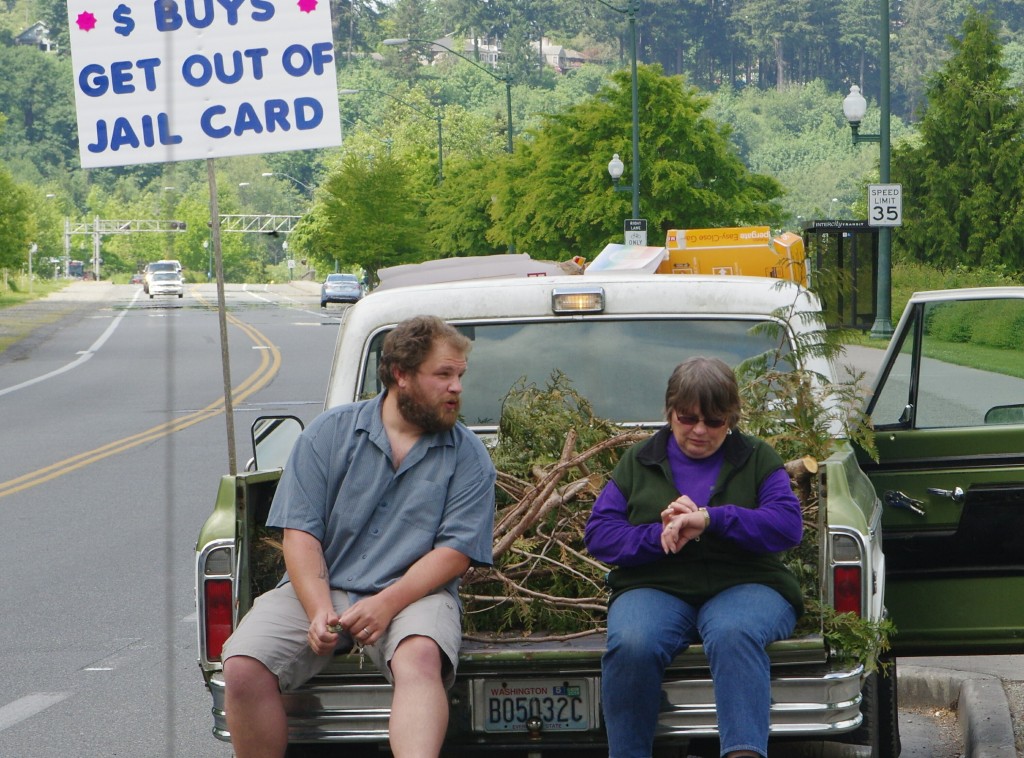
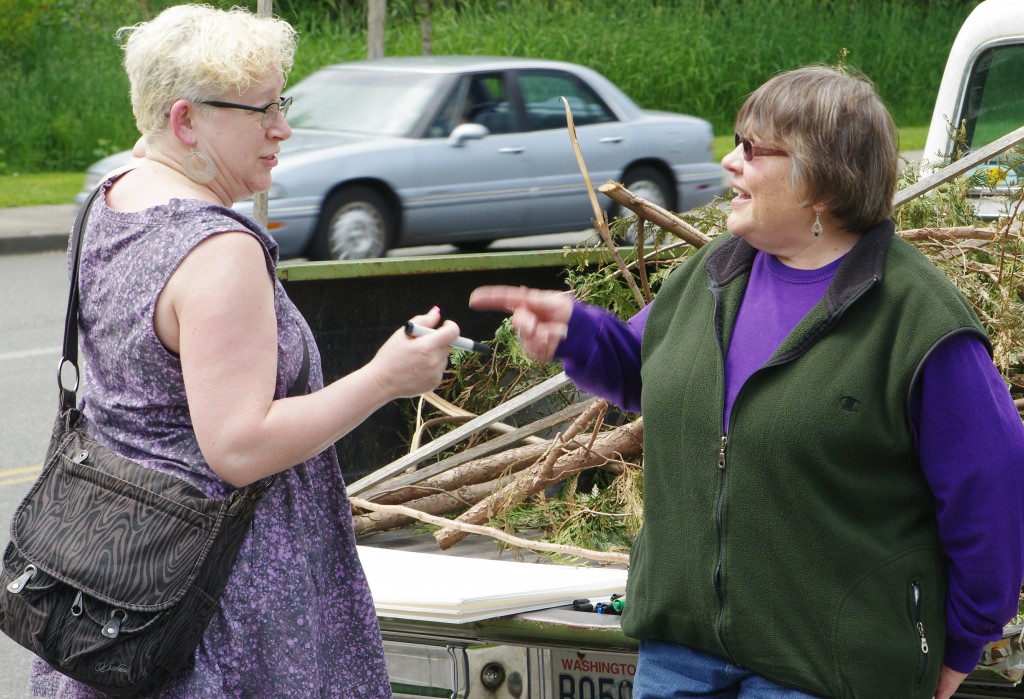
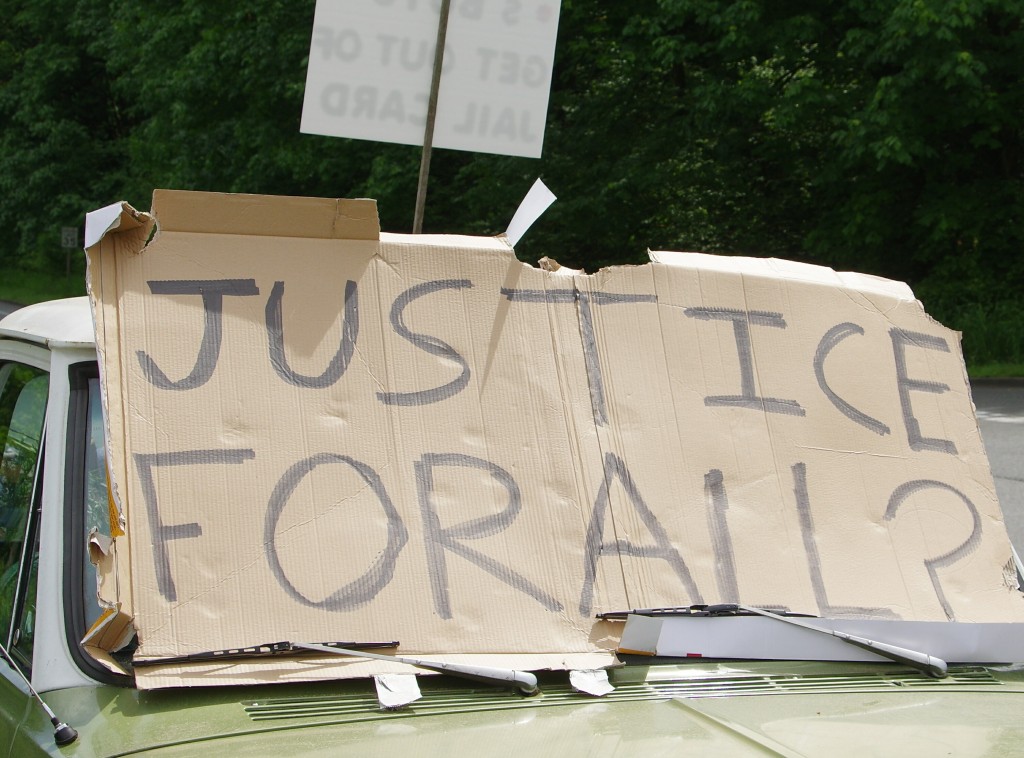
Sam Miller and a couple of women supporting his cause were waiting, sitting on the pickup truck tailgate at the bottom of the courthouse hill by Capitol Lake around 2:30 pm, Friday. Others began to arrive, including Henry Griffin, the victim in the wild ride, to support the march on the Thurston County Courthouse. Major mainstream media teams began to appear including KOMO (from Seattle), the Daily Olympian, et ux. Sam was interviewed, as was Mr. Griffin. Impromptu signs were hastily and artfully made. The sky was blue, the photographic light was fantastic.

IMGP3142crp

Scott Yoos, journalist, shows to cover event

IMGP3141 IMGP3143crp

A lot of glad handing and words of mutual support were exchanged. The crowd began to line the curb, holding their signs aloft for traffic to see. Honks of acknowledgement were heard as drivers sounded their encouragement. Nobody was heard yelling, “Someone get a rope,” but the angst of the group was palpable, their anger toward Thurston’s DOA criminal justice system was unmistakable. They’d had enough.

IMGP3144crp IMGP3146 IMGP3145crp

At a couple of points during the vigil, a gleaming white stretch limo was seen driving up courthouse hill. Speculation was made it might be transporting Shaun Goodman, given he’d been relieved of his driver’s license following his DUI conviction. It later appeared to be delivering an occupant to the courthouse parking lot. The identity of its passenger was never confirmed. What was confirmed is Shaun Goodman had yet to begin serving his sentence. He was not in custody.

IMGP3147crp IMGP3149crp IMGP3148crp

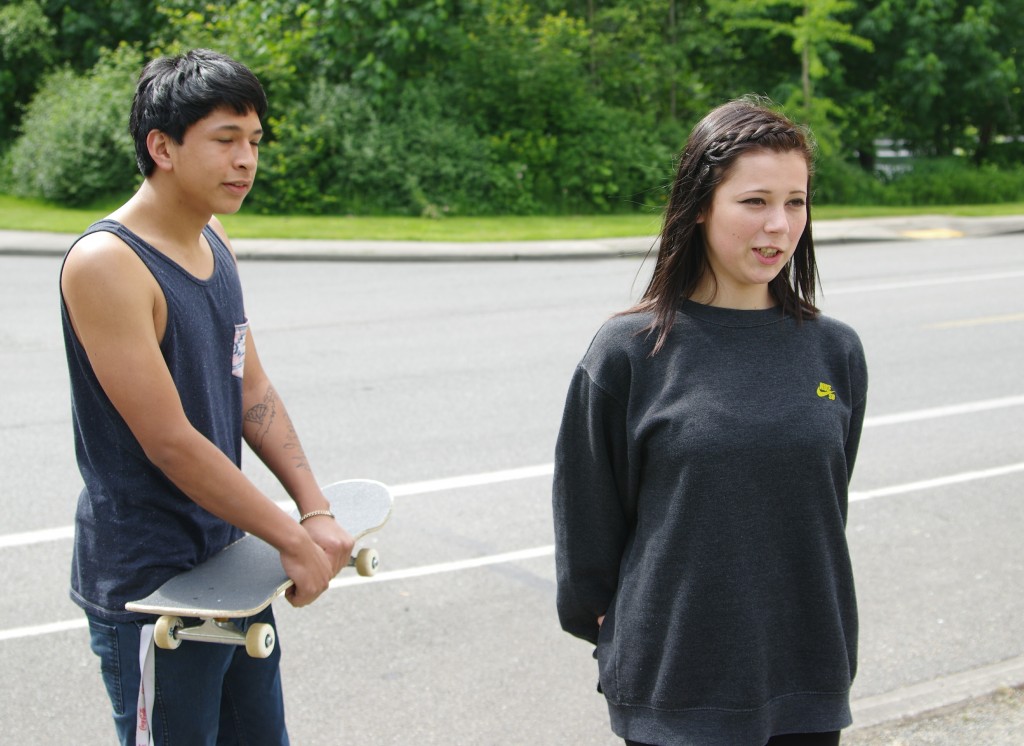
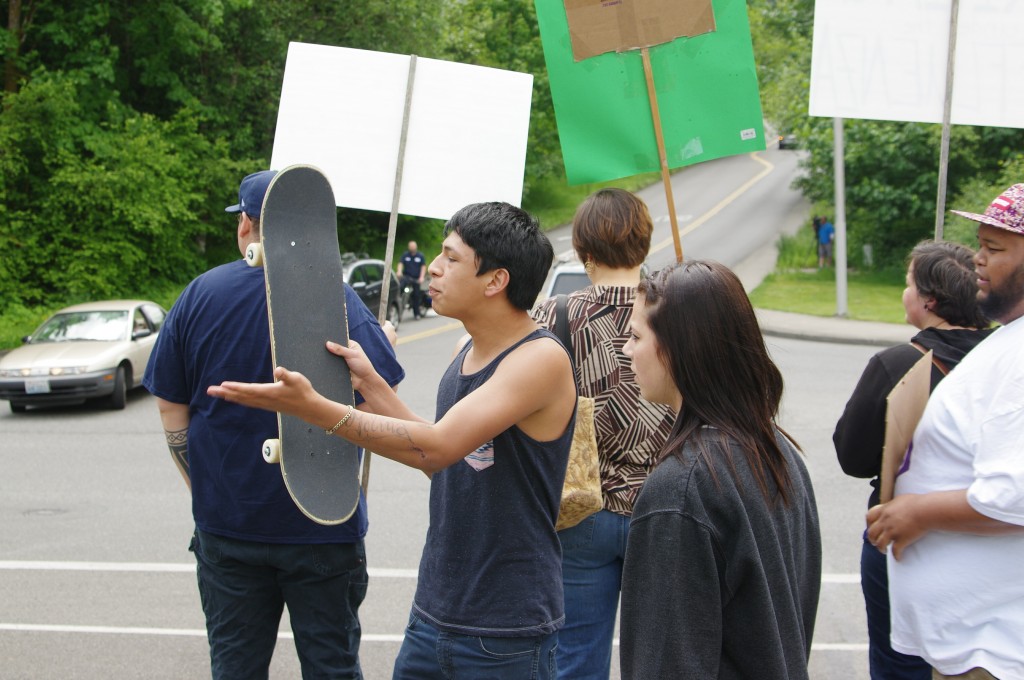
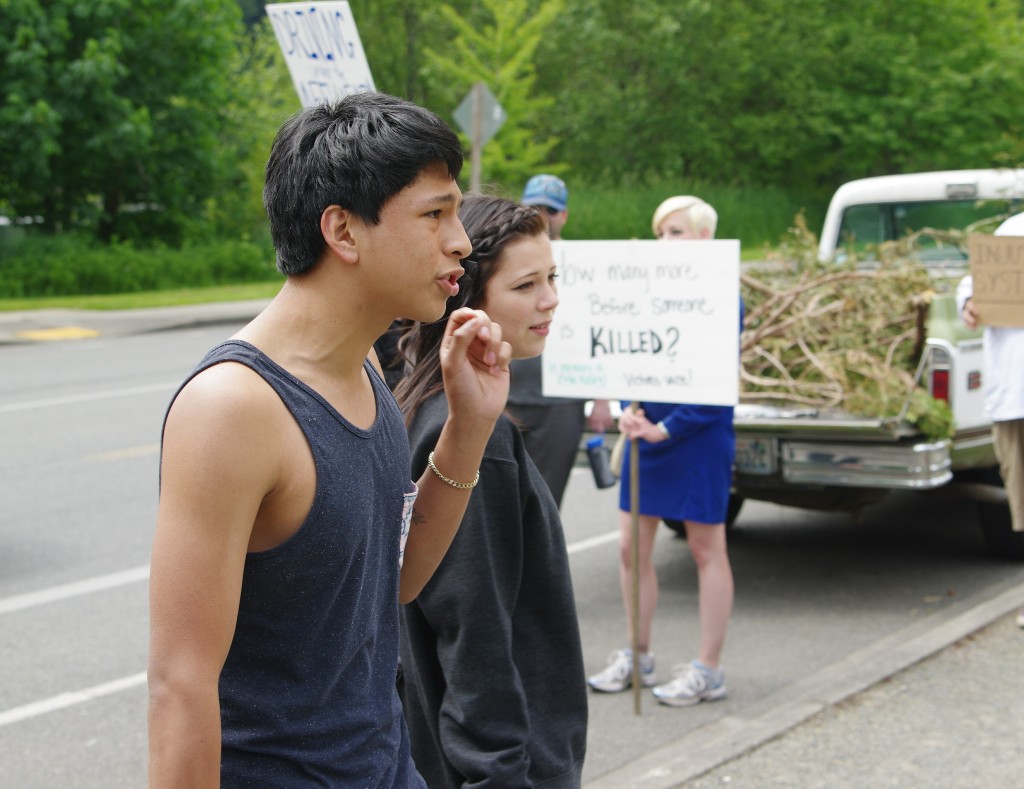
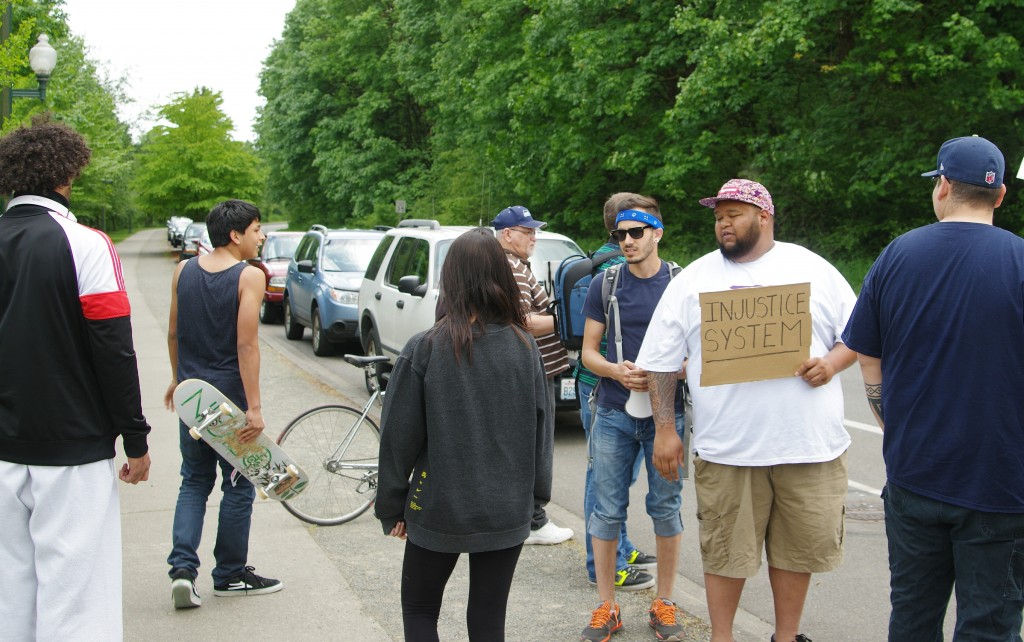
At one point, a young man on a skateboard arrived in the company of a young lady and another male. He began to scold the crowd, invoking arguments that their protest would be futile and Goodman was an asset to the community and his employees–a sentiment judge Schaller had made before sentencing which clearly provoked the protesters then–AND NOW!

IMGP3150 IMGP3152crp IMGP3151

Protesters began to yell at the younger man. He began to yell louder. The crowd was urged to step past him to line the road for oncoming traffic. He stepped in front of them yet again. The yelling grew in intensity and insults were exchanged. He began to flip off the demonstrators. Sam Miller, the organizer, urged the group to turn their back on their antagonist and march up the hill toward the courthouse–which they did.

IMGP3153crp IMGP3155crp IMGP3154crp

The young challenger was invited to come to the courthouse to be interviewed, but demurred. His young friends tried to avoid being photographed. He seemed more interested in confrontation than dialog or providing a reasoned statement for public consumption.

IMGP3157crp IMGP3160crp IMGP3158crp

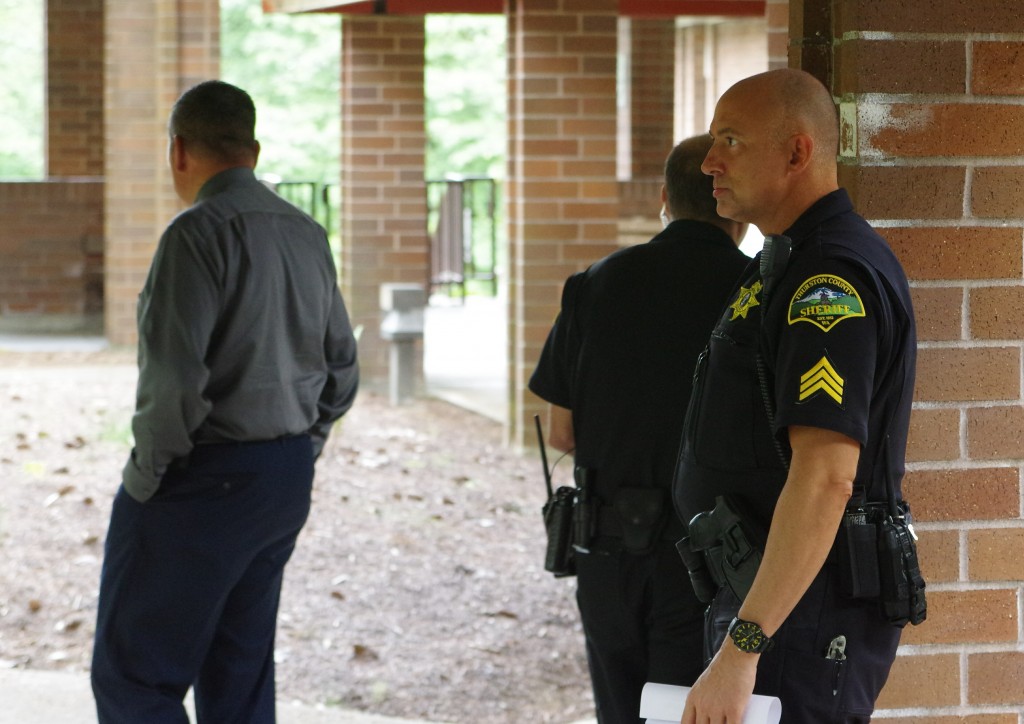
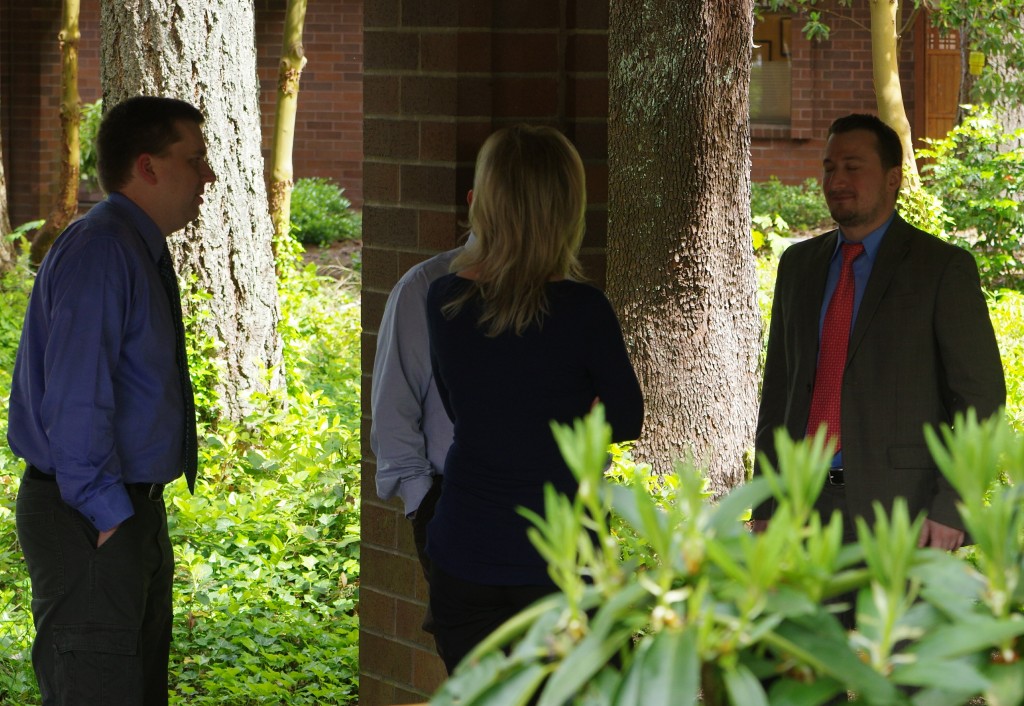
Driving up the hill was easier than walking it, and as luck would have it, a parking spot opened up adjacent to where the protesters would take their stand, just in time to gear up and video record their arrival into the entryway of the courthouse complex. Signs held high, the spirit of camaraderie was irrepressible, their cause just. Their erstwhile nemesis from a few minutes prior was nowhere in sight. A megaphone was on hand, used to announce their purpose and complaint. Sensing a lull in the drama, a quick foray into the covered walkway captured the image of three Thurston deputy sheriffs conferring about the demonstrators. They immediately shrank from the camera, shy for those charged with taking mug shots and searching body cavities. Sgt Matthew, one of their number, was less shy. He greeted the photographer with a kind of impertinent familiarity stemming from an incident of official abuse circa 2011 instigated by one of his peers. “I haven’t seen you for a while,” he offered. “Maybe that’s a good thing?” the photojournalist parried. “Why are you taking my picture?” he challenged. “Press,” came the obvious reply. “Oh?–you mean that little [PRESS] button you like to wear?” he guffawed. “Uh, yeah! If government ‘permission’ was a requirement, a ‘FREE PRESS’ wouldn’t mean much, now would it?” rejoined the journalist non grata. Matthew wasn’t going to gain the upper hand in this exchange and knew it. He retreated into the bowels of the Superior Court building beyond the security checkpoint.

IMGP3164crp

Sgt Matthew

IMGP3165crp2

Courthouse Cop Glares at Camera

IMGP3165crp

After snapping a few more shots of casual denizens of the courthouse complex, a return to the group found uniformed deputies sniffing suspiciously at the demonstrators and resentfully glaring at the camera. It wasn’t a marriage made in Heaven.

IMGP3161 IMGP3163crp IMGP3162crp

Finally, after what seemed all too brief a stay, Sam Miller thanked the crowd for its support and restraint. He’d asked them to respect the premises by not venturing inside the courthouse building itself. The rally broke up and the group disbanded. There were many cameras  present, both from the mainstream media and by we the people. There were no arrests and no confrontations other than the brief altercation described above which had taken place at the foot of the courthouse hill by Capitol Lake.

IMGP3167crp IMGP3169crp IMGP3168crp

It may not have been Olympia’s finest hour, but it was civilized and a good start.

IMGP3170crp IMGP3173crp IMGP3172crp IMGP3171crp

Posted in Uncategorized | Leave a comment

Lowest Pair @ Oly’s Farmers Market 5-16-14

IMGP3089crp

Kendl Winter & Palmer T. Lee

Olympia, WA @ Farmer’s Market State (5-16-14) — The Lowest Pair is a young bluegrass style duet who have been playing together for about 10 months. They sound as sweet as they look, which is a good thing as their harmony provides easy listening.

He’s from Minnesota and she’s from the Olympia area. They both sing, play banjo and guitar. Their repertoire isn’t huge, but it’s more than adequate and they ARE in demand, playing a full schedule of venues wherever they travel.
IMGP3094crp IMGP3090crp She’s Kendl Winter. He’s Palmer T. Lee. They look very happy together.  They SOUND happy together. They each have separate solo albums, but only one featuring both of them:

IMGP3091crp

The pear are obvious poets, but with the sweet melodic gift of music in their lyrical muse.

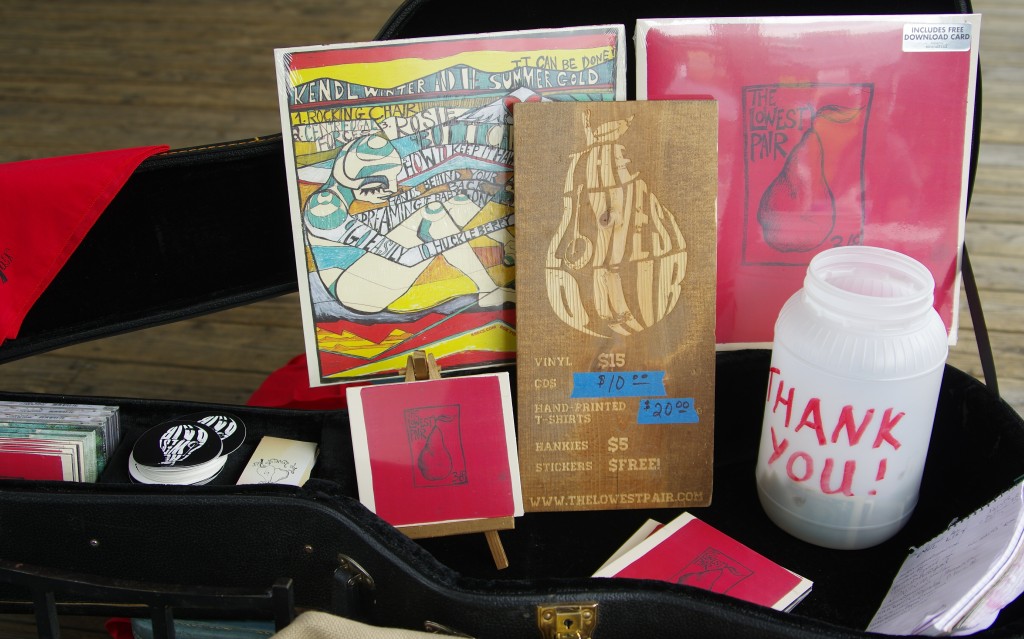
The Lowest Pair – 36¢ It has a logo (of course) of a pear on it–a Bartlett, perhaps–one of the sweeter varieties.  It includes such songs as:
1)  Oh Susanna
2)  Tuesday Morning 10:00 a.m.
3)  Living Is Dying
4)  Pear Tree [naturally!]
5)  Rumi’s Field
6)  Do You Leave The Light On?
7)  Last Summer
8)  Moving On
9)  Trying To Feel At Home
10) Magpies At Sunset
11) Dock My Boat IMGP3092crp

Contact Info:

The Lowest Pair: www.thelowestpair.com or thelowestpair@gmail.com IMGP3093crp
Drop them a “Hello” and your e-mail address so they can keep you posted on when they’ll be performing in your neighborhood. They’re well worth listening to and their $10 CD is a bargain.

The conditions leading to the following video clips were harsh at Oly’s Farmers Market with crying babies, food patrons using the foot of the stage as a sidewalk, and poor lighting from an overcast sky. Still, it should give listeners a measure of what they’re in for with this delightful duet.

Posted in Uncategorized | Leave a comment

Behind The Badge @ TESC 5-11-14

Keith LaMar (aka: Imam Saddique Hasan) & family

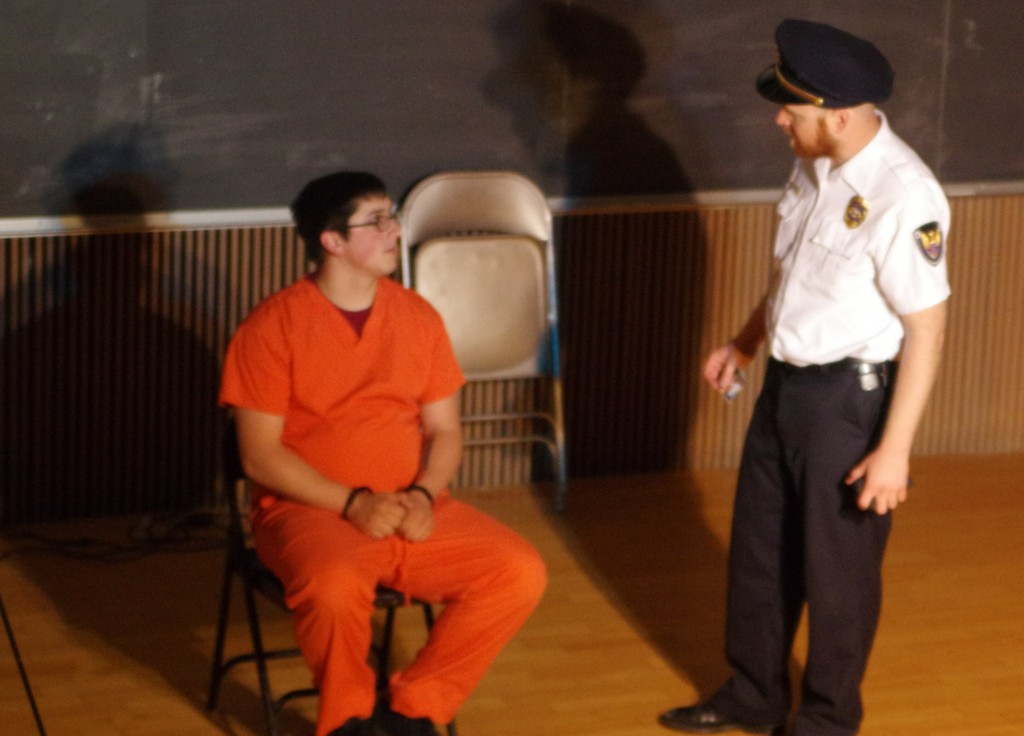
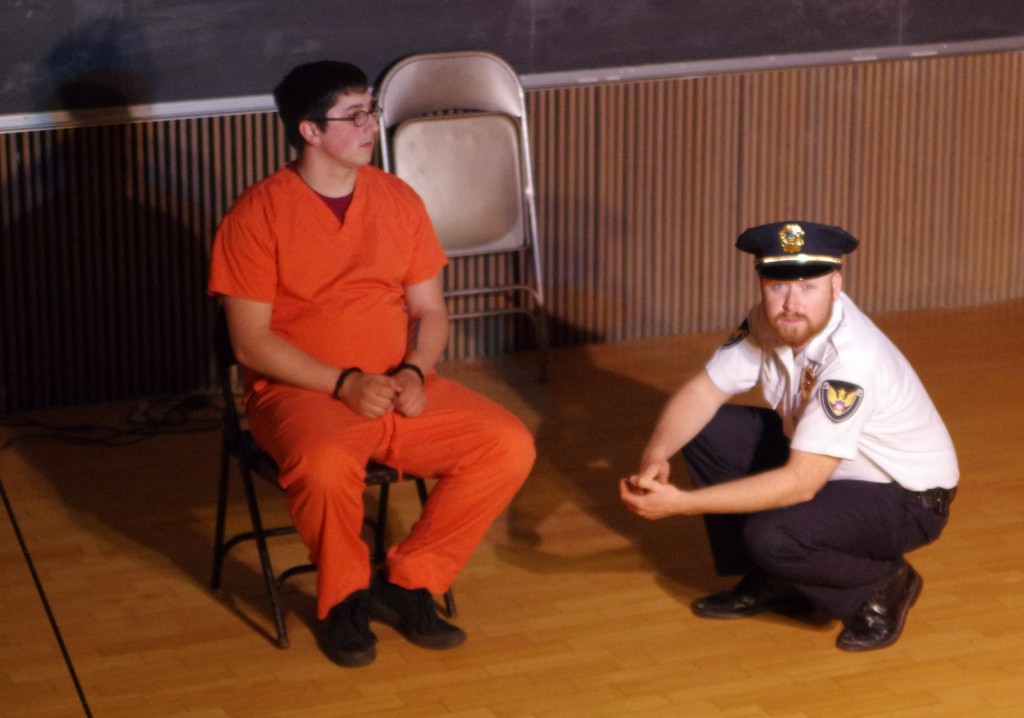
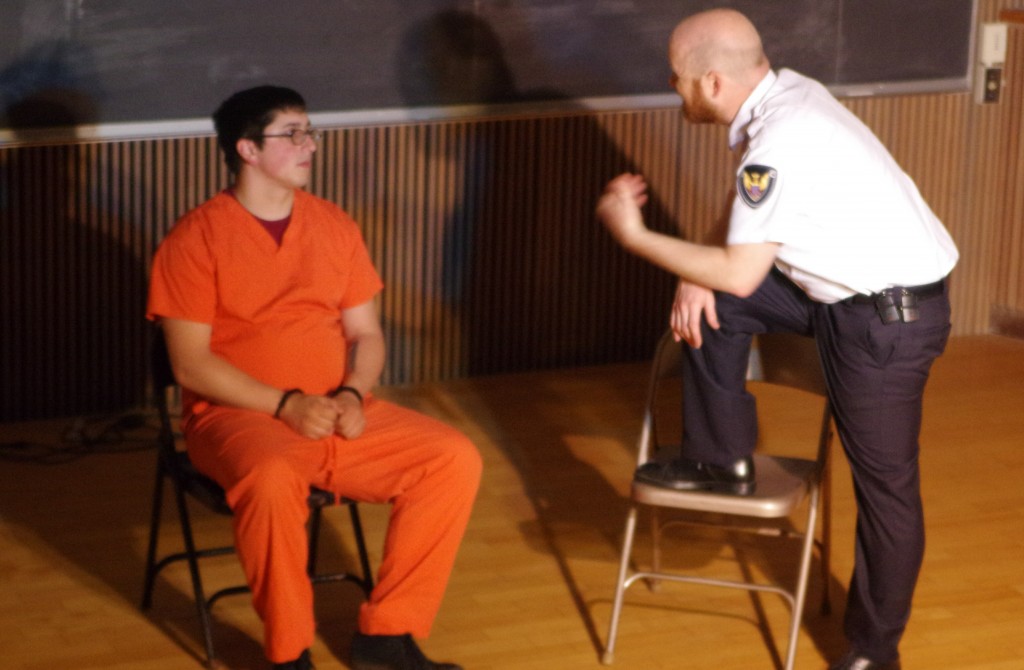
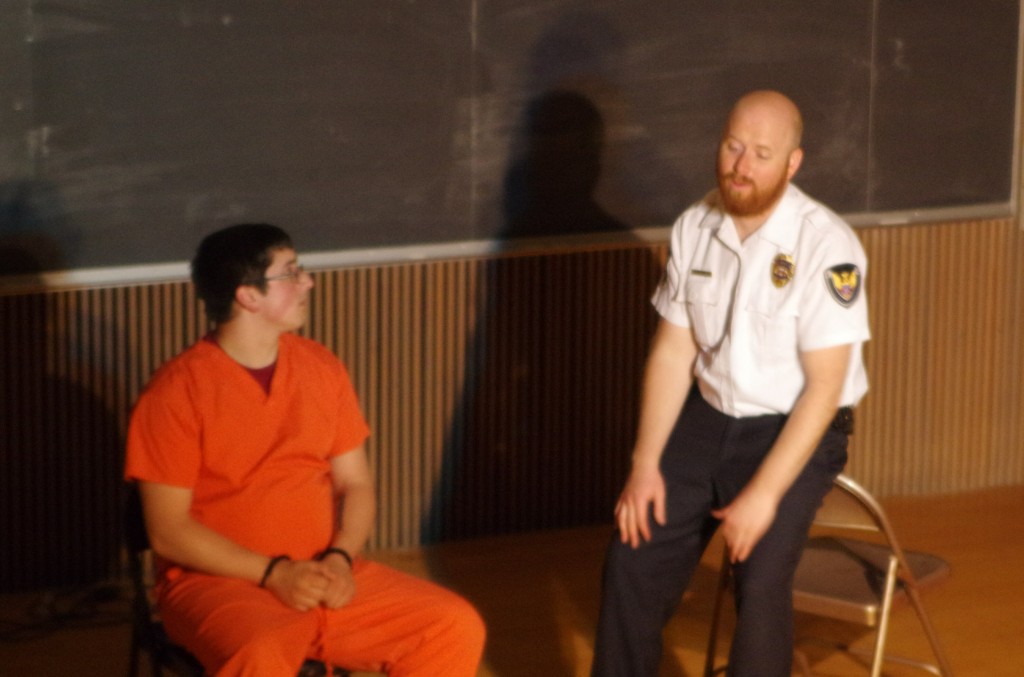
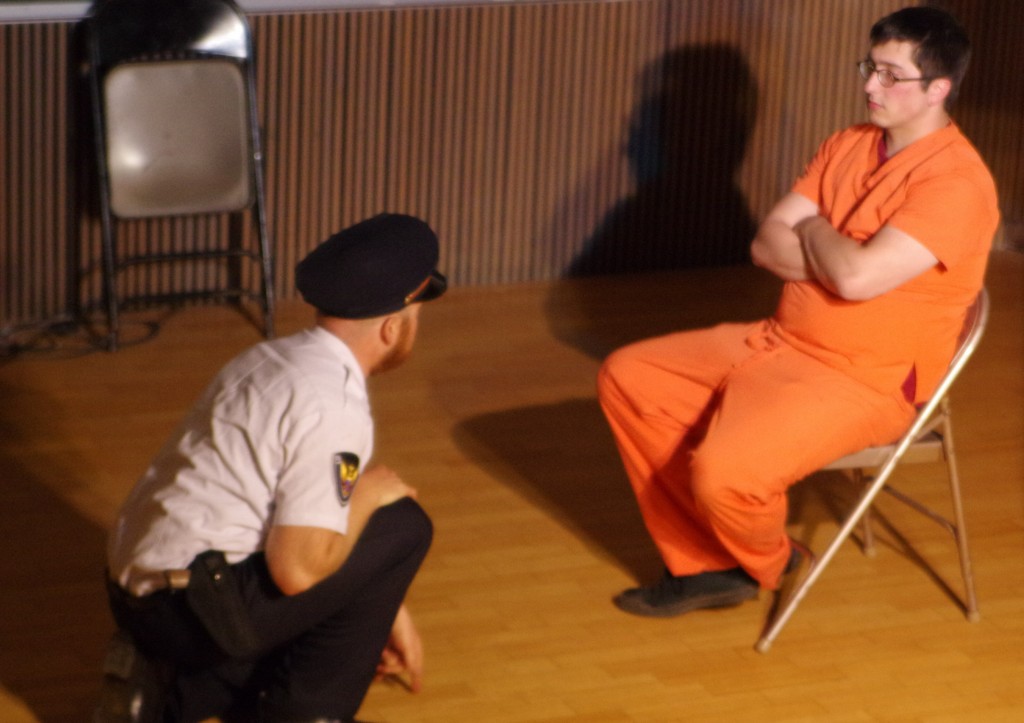
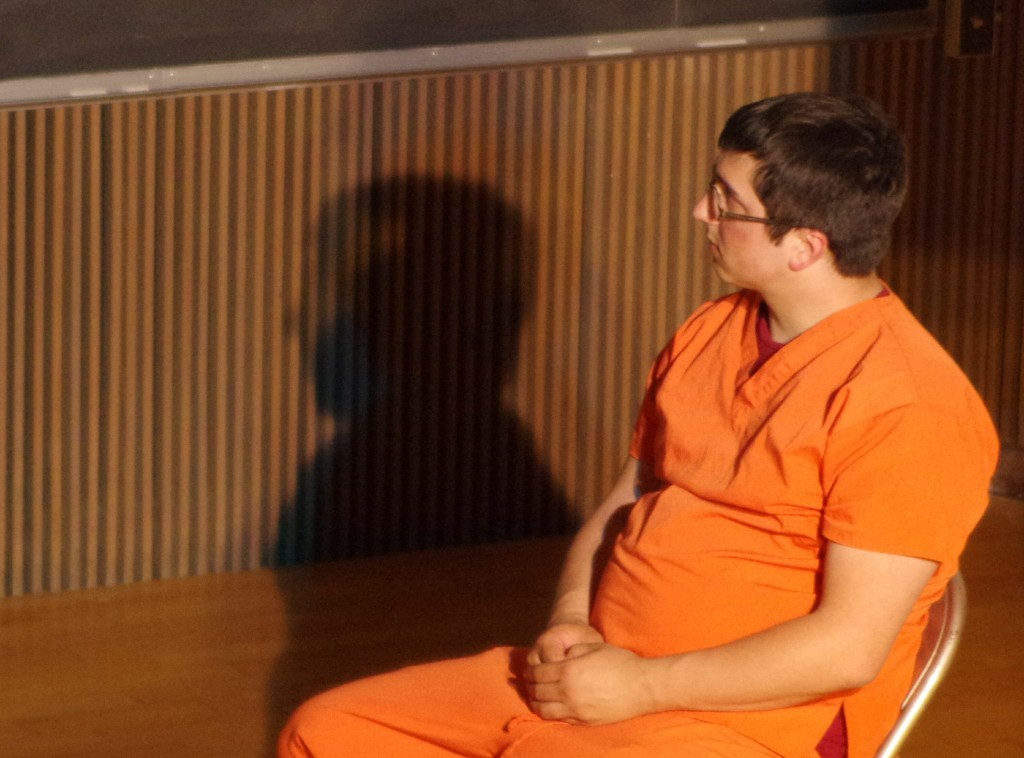
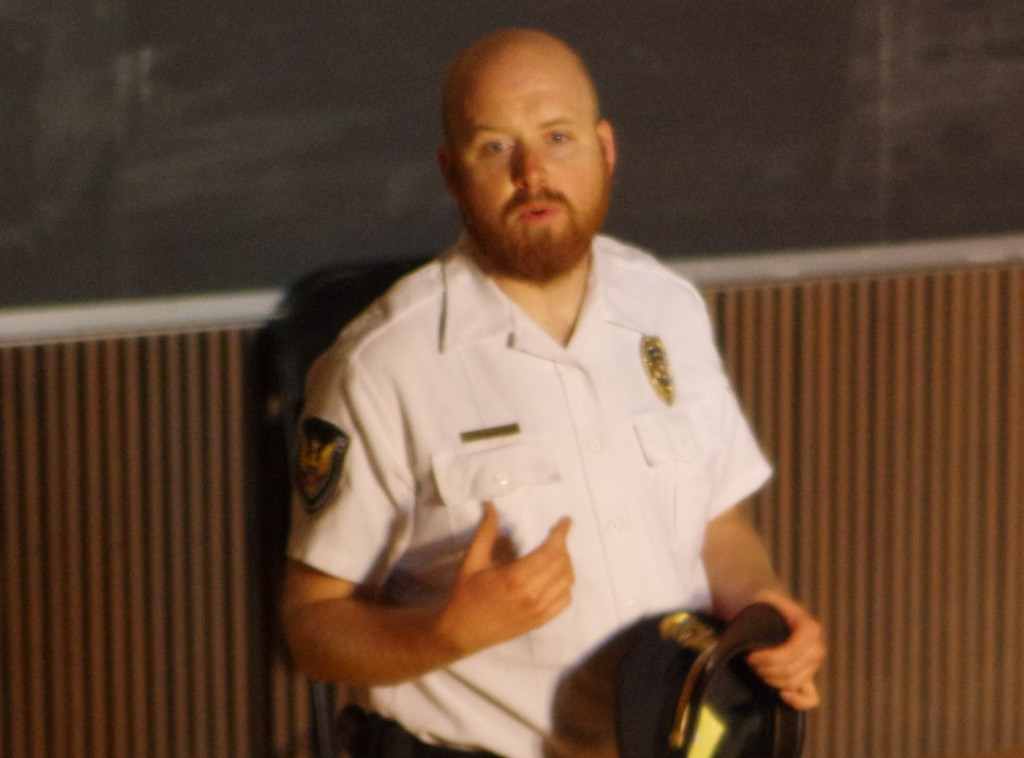
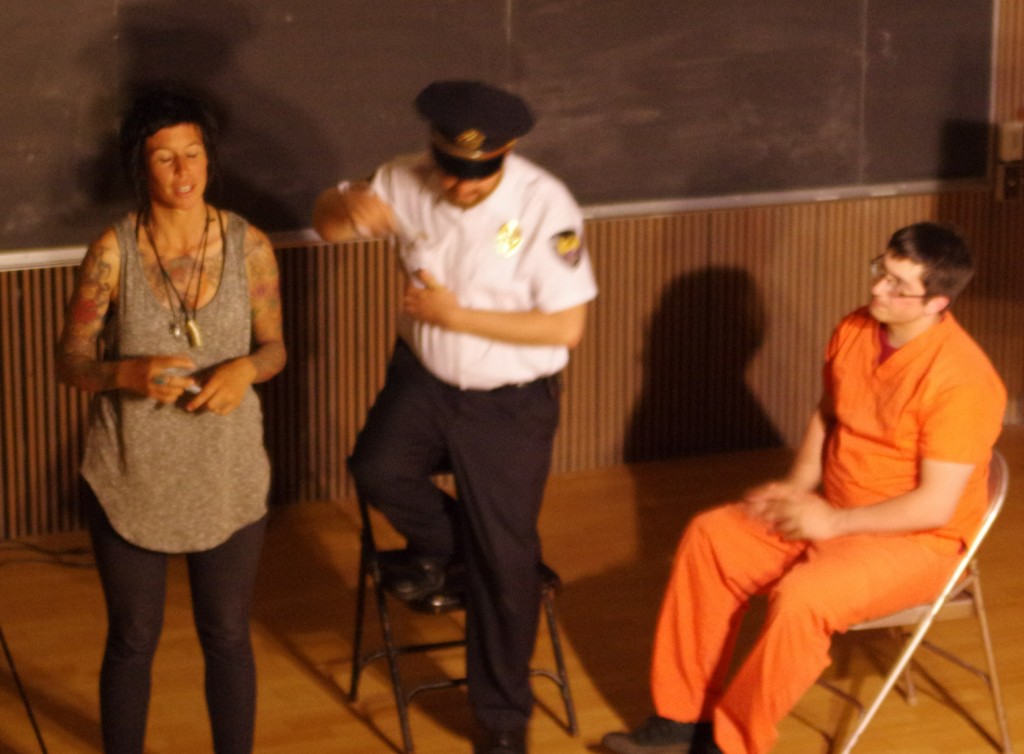
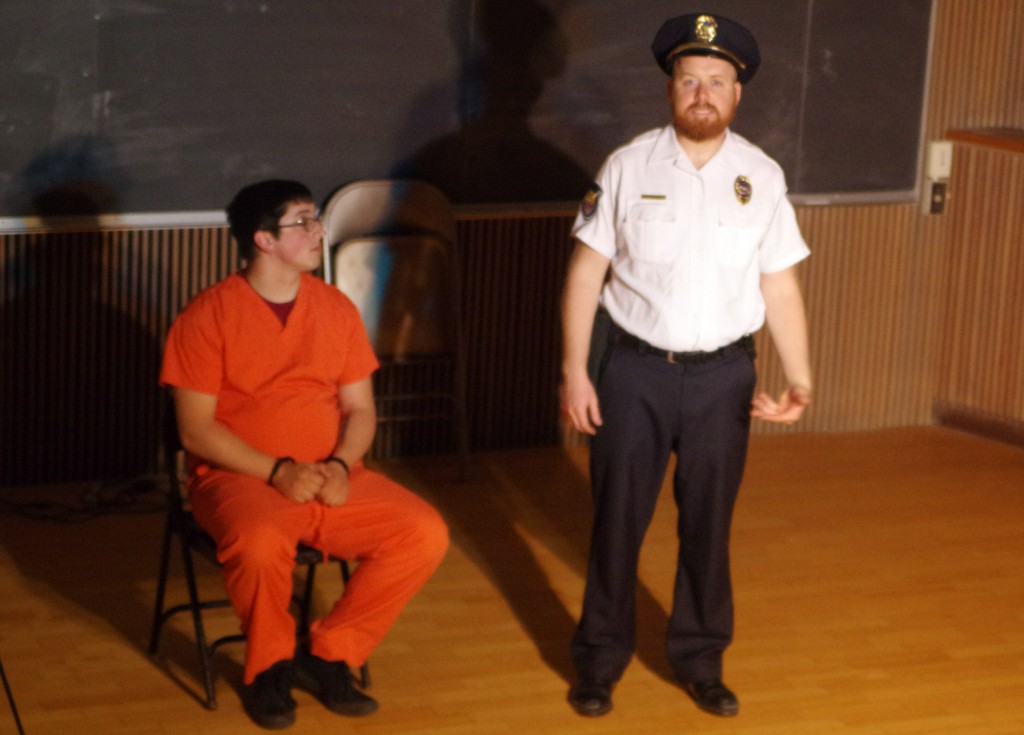
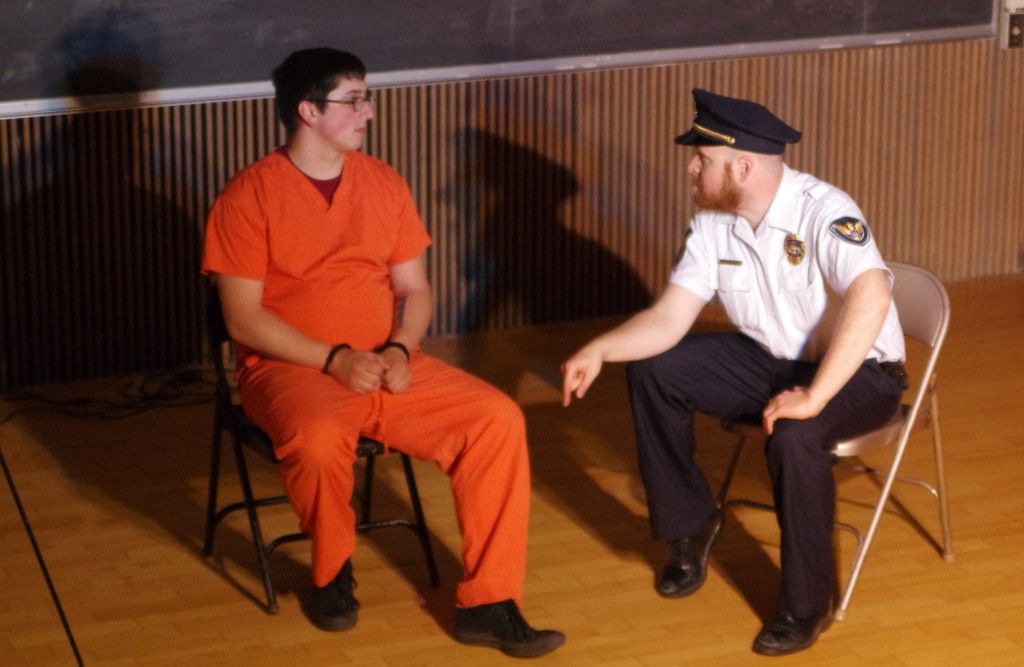
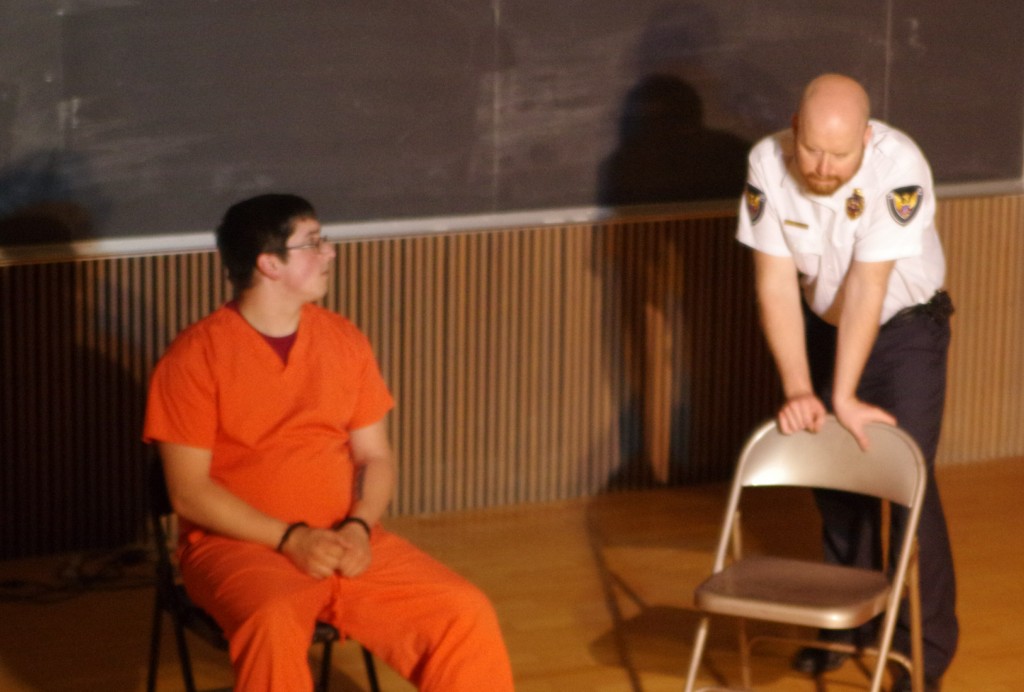
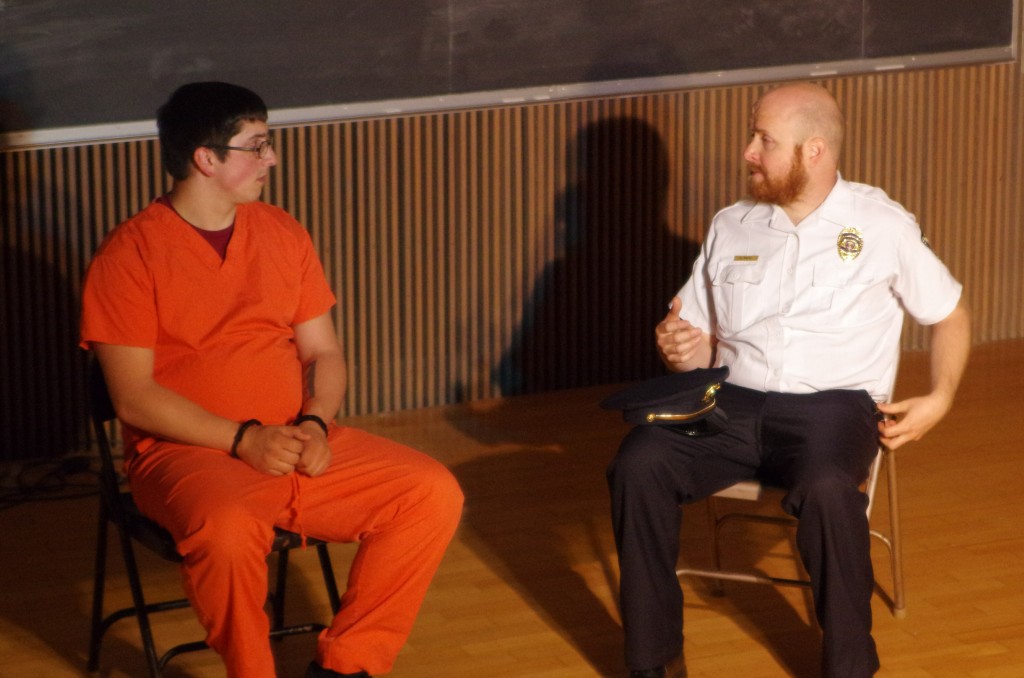
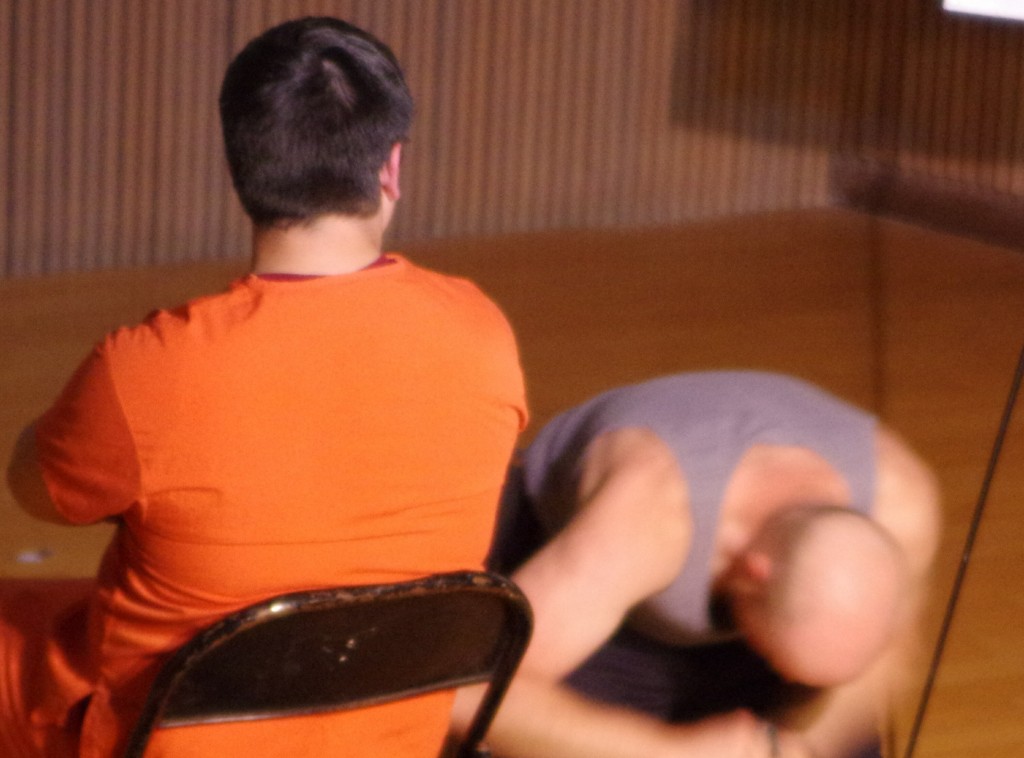
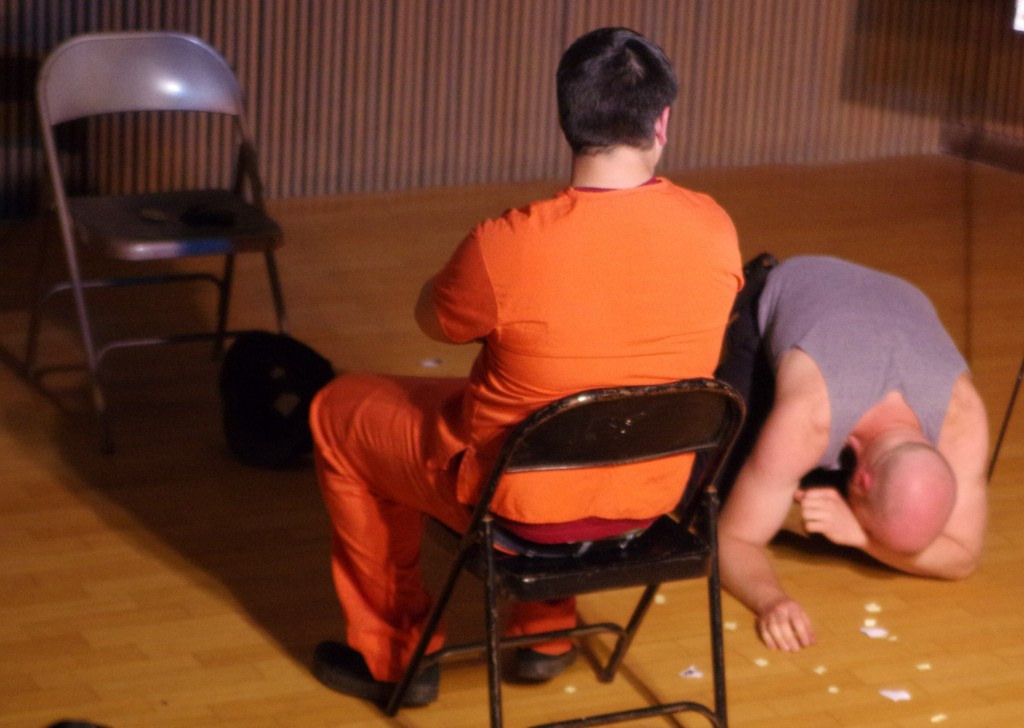
Olympia, WA  @ TESC — Behind The Badge is a theatrical examination of police and prisons in America. It’s written and performed by Ben Turk, directed by Kate Pleuss with contributions from Colleen Hackett.

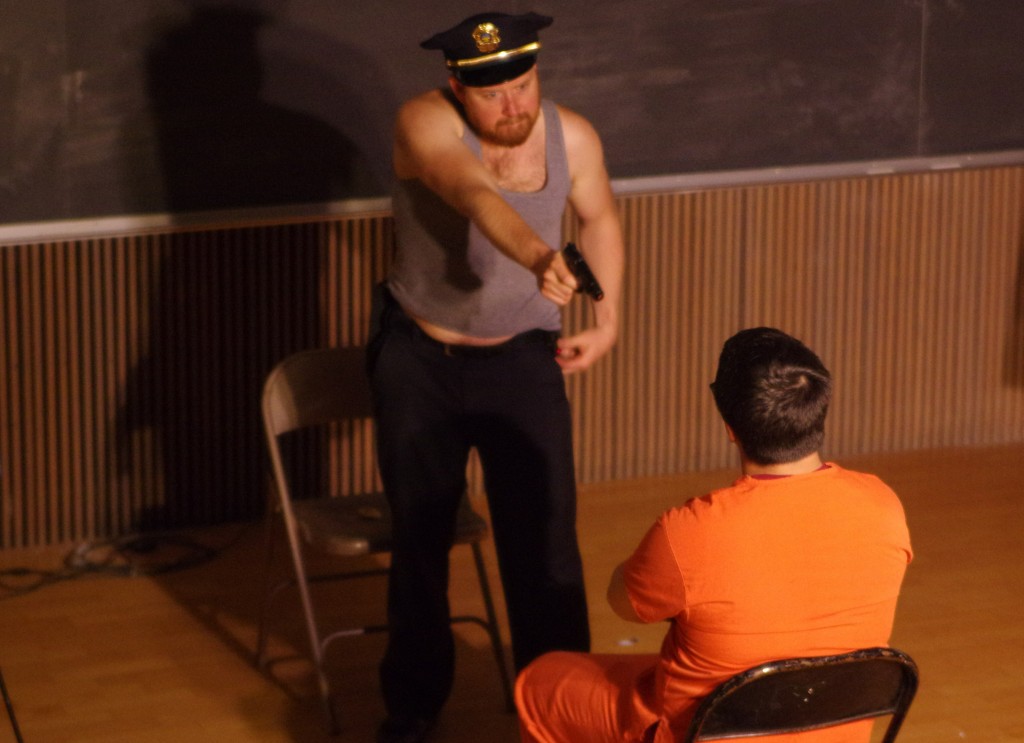
Mr. Turk admits he’s not a ‘professional’ actor, but that’s not obvious after watching his excellent performance in TESC’s Lecture Hall 1, Wednesday afternoon as a police officer interrogating a ‘suspect’ selected from the audience.

The entire presentation was scheduled from 3:00 pm – 7:00 pm including roughly an hour’s live conversation between the audience and an Ohio death row inmate whose conviction stemmed from the Lucasville prison riot circa 4-11-93 and a well produced film, The Shadow of Lucasville, a new documentary film by D Jones about the 1993 prison uprising in Lucasville Ohio, introducing the issues and participants surrounding the uprising. The film is not available online or CD, but a showing can be arranged through Mr. Turk and his organization. (Contact info: insurgent.ben@gmail.com or (614) 704-4699)

On Easter Sunday, April 11, 1993, 450 Lucasville prisoners, including an unlikely alliance of the Aryan Brotherhood and Gangster Disciples, rioted and took over the facility for 11 days. The main causes apparently were serious overcrowding and mismanagement of the facility and discontent in the general population that the authorities were going to force Muslim prisoners to undergo tuberculosis vaccinations in violation of their religious beliefs. Investigations conducted after the riot found that the gangs were also collaborating to murder inmates accused of being informants. Nine inmates and one corrections officer were killed.

During negotiations, the inmates did not feel they were being taken seriously, and there was discussion of killing a guard in retaliation. Though the group never reached a decision on the killing, one of the prisoners decided it was time to take action. According to the prosecution, Officer Robert Vallandingham, who had been taken hostage, was handcuffed and strangled with a dumbbell from the prison weight room. However, testimony by Dr. Richard Fardal, Franklin County Deputy Coroner, disputed the claim that Officer Vallandingham was killed by a weight, saying that there was “no injury to the voice box or the trachea” and that “Mr. Vallandingham died solely and exclusively as a result of ligature strangulation.” Testimonies vary as to which prisoner was responsible for his murder. During those eleven days, representatives from the Sunni Muslims, Aryan Brotherhood, and Gangster Disciples met every day in an improvised leadership council. 

During an interview shown in the above referenced film production, the Ohio State prosecutor who secured the capital convictions admitted it was unknown who actually strangled the corrections officer and it was unlikely it would ever be known. Nevertheless, several prisoners were sentenced to death based on their having debated/discussed the possibility of executing one of the hostages.

Four prisoners, Siddique Abdullah Hasan (Carlos Sanders), Jason Robb, George Skatzes, and Namir Abdul Mateen (James Were), were sentenced to death as a result. Keith LaMar (Bomani Shakur), unaffiliated with any of the above-mentioned groups, was sentenced to death for his alleged leadership of a group who killed inmates during the riot (he denies these claims and cites the State of Ohio suppressed evidence that could demonstrate his innocence). He was not present in L-6 during the majority of the riot, having been taken off the rec yard the first day by the State authorities and housed in the K block.

DEATH ROW

The Southern Ohio Correctional Facility is the location where Ohio prisoners are executed; however, prisoners awaiting execution are not housed there on a long term basis. Since the riots, death row has been relocated three times. The first relocation was to the Mansfield Correctional Institution in Mansfield with the majority of inmates being moved later to the Ohio State Penitentiary, a supermax facility in Youngstown while a few remained at Mansfield. Currently, all but eight condemned inmates are housed in a new death row unit at the Chillicothe Correctional Institution in Chillicothe. Six high security inmates, most of whom were involved in the 1993 riots, remain at OSP with two others with serious medical conditions housed at the Franklin Medical Center in Columbus.
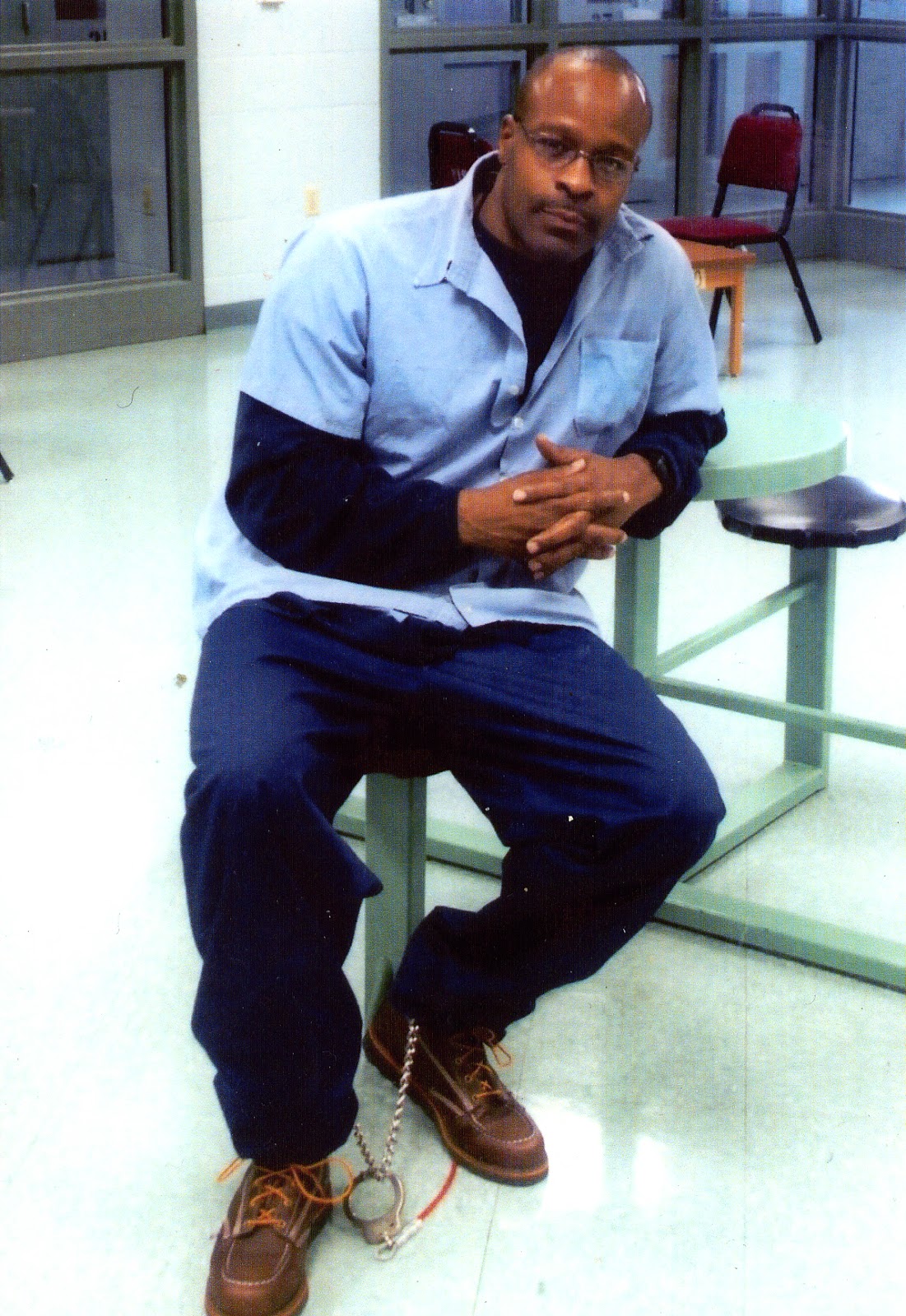
Keith LaMar (aka: Imam Saddique Hasan)

At one point during the Q&A session, the condemned man (Keith LaMar) on speakerphone was asked if he regretted the deaths of the correction officer and inmates murdered during the riot, what he would say to their families if he had the opportunity. His response may have been driven by the fact he  had one appeal left currently undergoing consideration in Ohio courts and any ‘remorse’ might be taken as an admission when his appeal is based upon a claim of innocence, not extenuating circumstances. He seemed agitated by the question and continued to focus on his own circumstances, history, and what had let up to them. He expressed anger and annoyance regarding the term ‘regret’. He also sounded nervous/scared as the days slipped by between his appeal and anticipated execution date. It was a sobering exchange for the audience. No decent human being minimizes the suffering associated with an impending execution date, yet there was little talk or consideration expressed about the suffering the inmates murdered as ‘snitches’ or the prison guard must have felt–the terror of their last moments, the tears of their families and loved ones. It was all about the injustice the condemned man felt, none of his limited time on the phone was used to express ‘regret’ over their fate. His words/reaction can, of course, be heard in the associated video captured during the event.

Prosecutors have called it “the longest prison riot in U.S. history.” More accurately, the director of the Ohio Department of Rehabilitation and Correction (ODRC) refers to “the longest prison siege in U.S. history where lives were lost.” A 1987 rebellion at the United States Penitentiary in Atlanta seems to have lasted a few hours longer.

Bobby Vallandingham holds a picture of his father, Robert, outside his home in Wheelersburg, Ohio.

The uprising took place in April 1993 in Lucasville, Ohio, a small community just north of the Ohio River. Two populations, approximately equal in number, confronted one another there. On the one hand were the maximum security prisoners at the Southern Ohio Correctional Facility (SOCF), mostly black, mostly from cities like Cincinnati and Cleveland. On the other hand was the all-white population of the town. Almost everyone in Lucasville worked at the facility or knew someone who did.

In the course of the 11-day occupation, one correctional officer and 9 prisoners were murdered by inmates.

Those 11 days in April 1993 coincided with the much-publicized siege of the Branch Davidian compound in Waco, Texas. Most Americans were barely aware of the Lucasville disturbance.

In 1996 a supermaximum security (or “supermax”) prison was being built in Youngstown. A community forum was organized at a church near the site to explore the question:
“What is a supermax prison?” Jackie Bowers from Marion, Ohio, testified about the experience of 23-hour-a-day isolation. She is the sister of George Skatzes (‘Big George’), one of the five men condemned to death after the Lucasville events.

A couple of retired attorneys took an interest in Big George’s case (post conviction), became convinced of his innocence, and volunteered to assist his post-conviction counsel. As retired attorneys, they had more time than busy practicing lawyers to read 5,000- or 6,000-page transcripts. Little by little they came to be researchers for several of the Lucasville Five defense teams.

Two things caught their attention at the outset.

First, there has been an extraordinary degree of solidarity among the five men condemned to death. They have shared legal materials to a greater extent than have their attorneys. The condemned men have expressed concern about one another’s health problems. Together, they have engaged in a series of hunger strikes protesting their burdensome conditions of confinement. Yet two of the five were at the time of the uprising members of the Aryan Brotherhood, an organization thought to endorse white supremacy, and the other three are African Americans. I sensed a dynamic quite different from the unchanging—even unchangeable—racism that many historians have recently ascribed to white workers in the United States.

Second, emotions in southern Ohio have run so strongly about the Lucasville events that truth had gotten lost in the shuffle.

The Columbia Journalism Review published an article about the irresponsible speculations of the media during those 11 days. “Glaring mistakes were reported as fact, and were never corrected,” the Review declared. “Reporters … vied for atrocity stories. They ran scary tales—totally false, it was later found—that spread panic and paranoia throughout the region.”
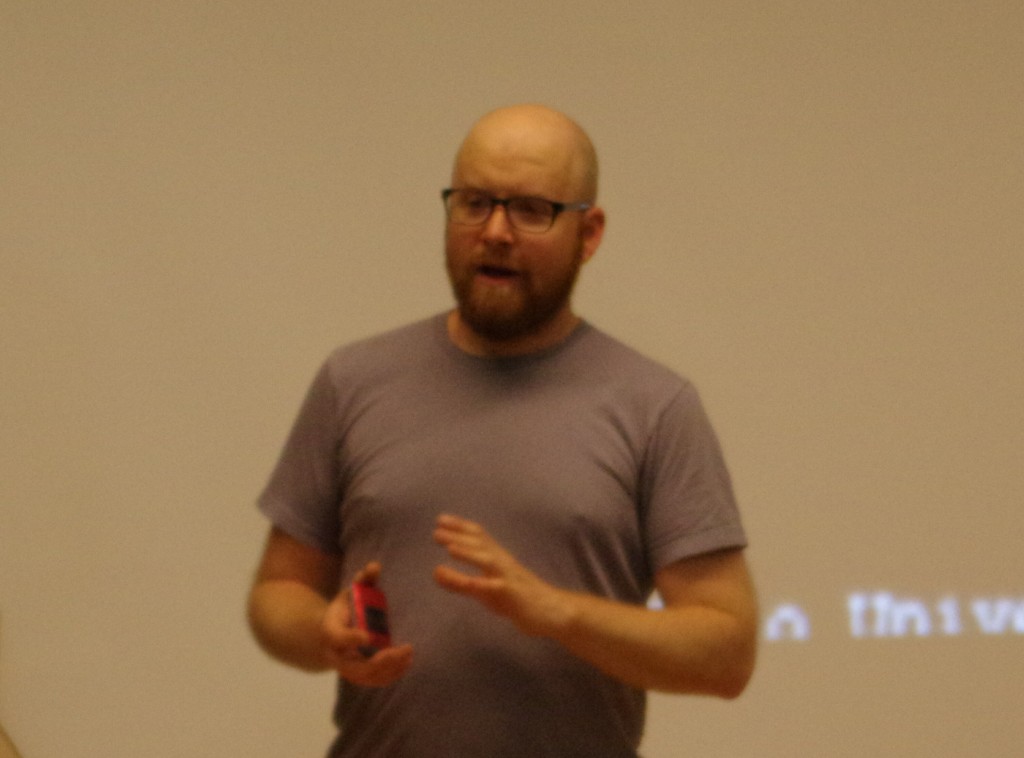
IMGP3062crp

Ben Turk, playwright/actor (Behind The Badge)
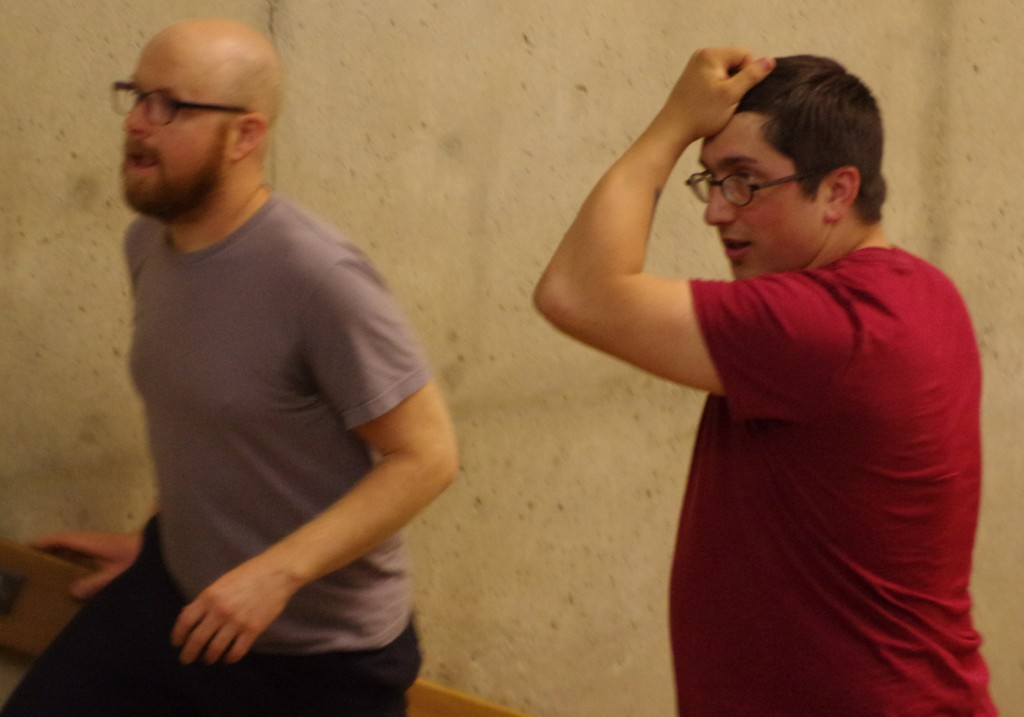
IMGP3064crp

Ben Turk w/Brad Collins, student organizer of TESC’s ACAP (Abolish Cops And Prisons)

Among the examples recounted were these:

• Six days into the riot, a front-page story in the Cleveland Plain Dealer, citing anonymous sources, reported that along with seven inmate deaths, 19 other people in the prison had been killed, including “some pretty barbarous mutilations of the dead.”

• A reporter for Channel 4 told viewers that as many as 172 bodies were piled up in the prison. This body count turned out to be a head count of inmates in one of the blocks not involved in the riot.

• The Akron Beacon Journal reported about the murder of Officer Robert Vallandingham “that his eyes had been gouged out, that his back, arms and legs had been broken, and that his tongue had been cut out.” Not one of these details was accurate.
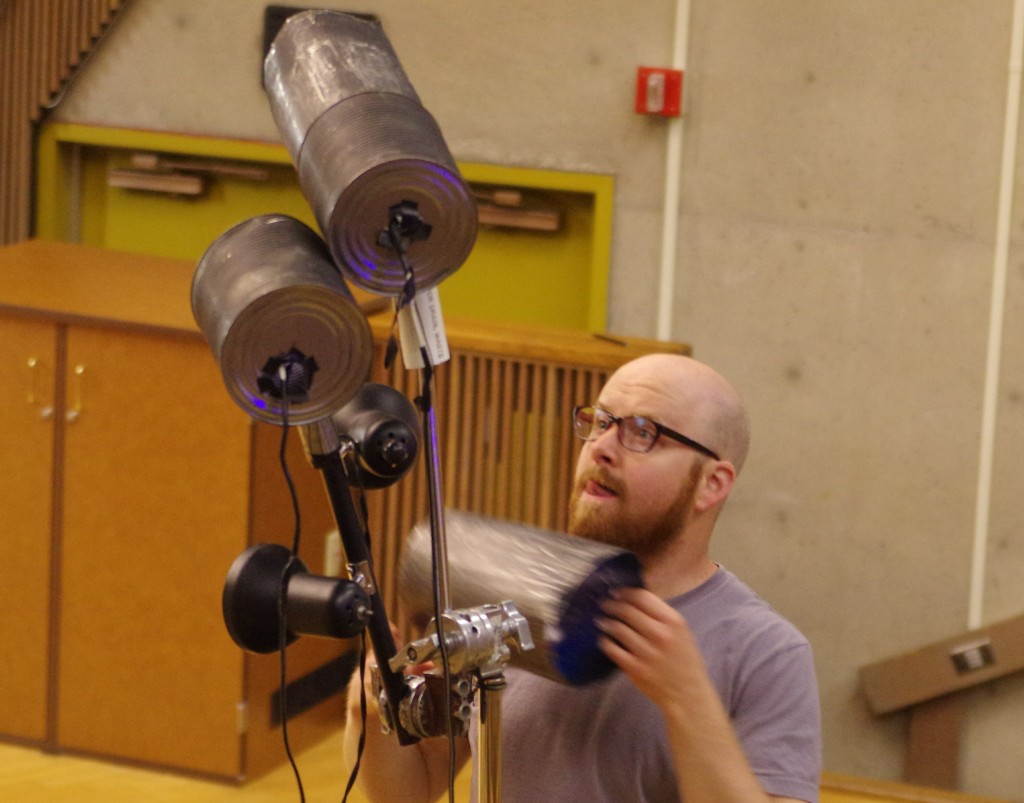
IMGP3066crp

Home Made Stage Lighting

IMGP3067crp

Brad playing a suspect being interrogated

Even on the tenth anniversary of the uprising, in April 2003, media coverage in Ohio dealt almost exclusively with persons outside prison. The highest award given to Ohio correctional officers for bravery was renamed for Officer Vallandingham; his widow, Peggy
Vallandingham, accepted the Vallandingham Gold Star Award for Valor in his name; and flags at Ohio prisons flew at half-mast. News stories conveyed next to nothing about the men [convicted killers] on Death Row.

This was not wholly the fault of the media. Applying what appears to be a permanent policy, in mid-February 2003 ODRC Director Reginald Wilkinson informed a reporter for the Columbus Dispatch that “no inmates convicted of riot crimes will be permitted
to speak to” reporters.
IMGP3068crp IMGP3069crp

Both historians and lawyers claim to be devoted to the search for truth. And because historians and lawyers commonly turn their attention to events after they have occurred, one might suppose that history and law would correct the mistakes of journalists reporting in the heat of the moment.

Yet from a historian’s point of view, official narratives about what happened at Lucasville are disturbing in many ways. For example, a historian writing about these events would almost certainly begin by exploring the causes of the riot. But as later explained more fully, in the Lucasville capital cases the defense was forbidden to present such evidence, while the prosecution was permitted to expand on this theme at length.
IMGP3070crp

Officer Friendly

IMGP3071crp

Pleading for Rapport

Indeed, one’s belief in the integrity of truth-seeking in the law might be shaken by the Lucasville judicial proceedings. The idea the adversarial process promotes truth-seeking may be as misleading as the assumption that the free-market competition of profit-maximizing corporations will produce adequate public health.
IMGP3072crp

Stockholm Syndrome

IMGP3073crp

Sympathy for the Devil

What follows are the facts of the Lucasville disturbance as best as can be discerned. This is the untold story that the State of Ohio doesn’t want you to hear.

A central thesis is the State of Ohio and its citizens need to face up to the State’s share of responsibility for what happened at Lucasville.
IMGP3074crp

Family Man

IMGP3075crp

Getting to Know Big Brother

It might be argued the authorities have already conceded their part in the sequence of cause and effect. Prisoners not involved in the disturbance later sued state defendants for negligence in connection with the rebellion. The prisoners’ suit alleged in part:

17. In 1990, following an investigation at SOCF, a State Senate Select Committee determined that the security policy and procedures at the institution were “woefully inadequate,” and recommended various reforms. . . .

18. Also in 1990, in order to rectify overcrowded conditions and to maintain proper security within SOCF, defendants … announced the implementation of “Operation Shakedown” pursuant to which the entire population of the prison was to be single-celled.

19. As of April 11, 1993, single celling had not yet been instituted at SOCF; one thousand eight hundred and twenty (1,820) inmates were still housed in the prison (a number far in excess of the institution’s design capacity).
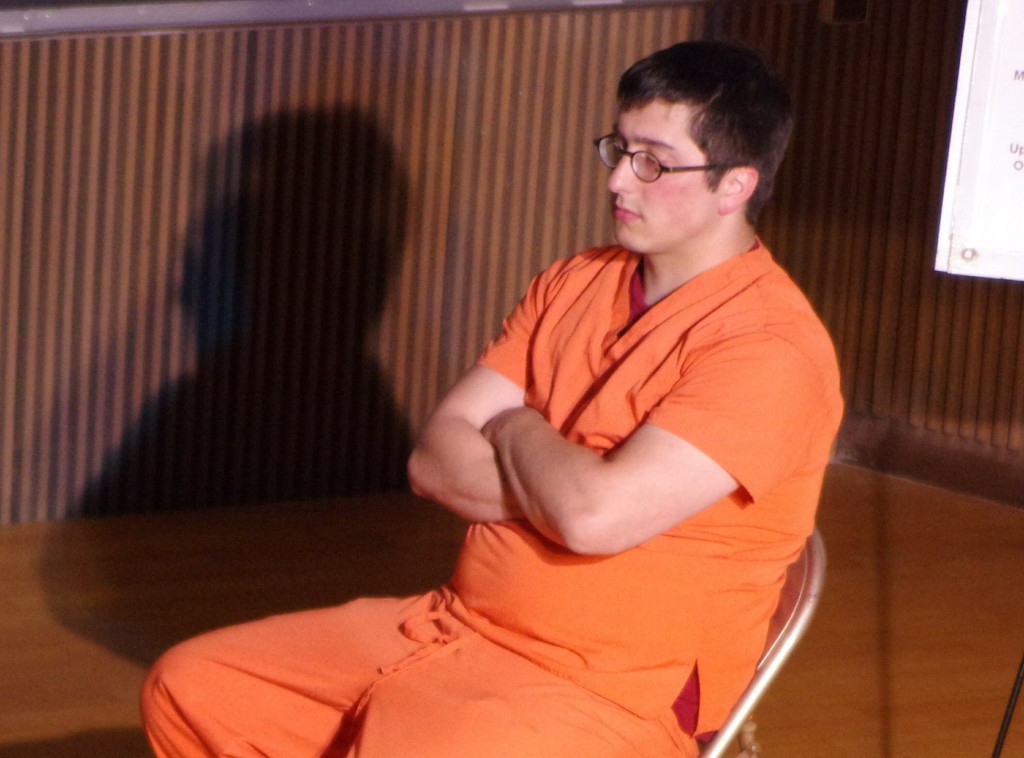
IMGP3076crp

In the Belly of the Beast

IMGP3077crp1

What Am I Doing Here?

Rather than defend against these and other allegations, the authorities settled with the prisoners for $4.1 million. The correctional officers taken hostage, together with the widow and son of Officer Vallandingham, likewise sued the authorities “for numerous torts before and during the siege.” The state once again settled, for more than $2 million.
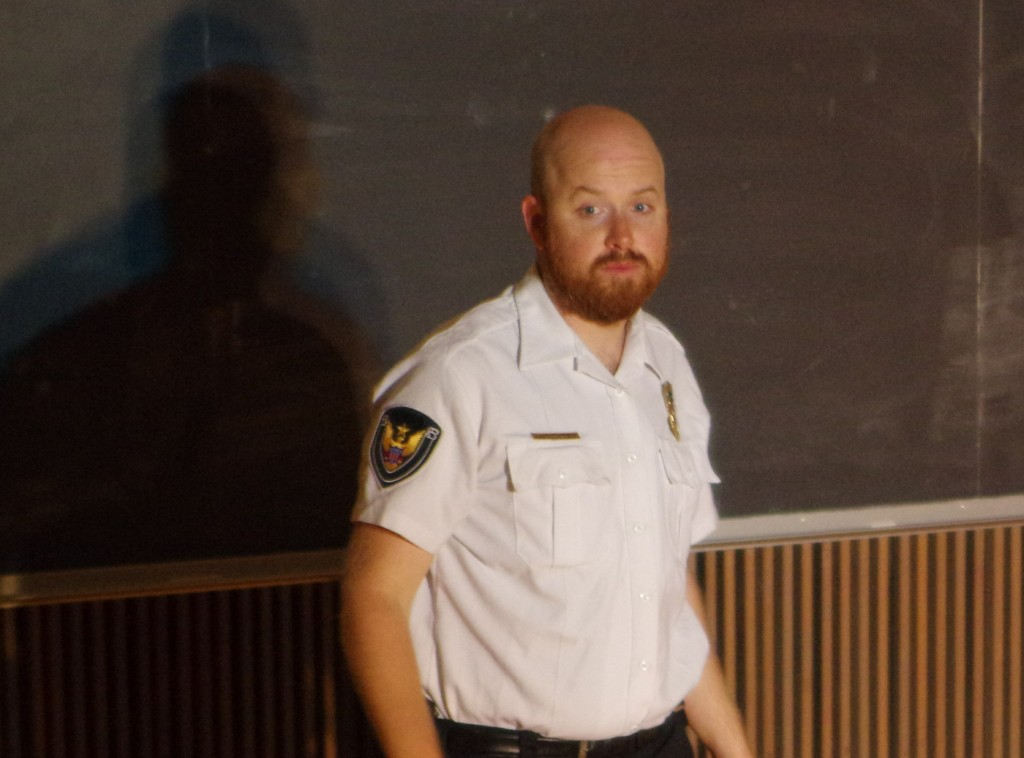
IMGP3077crp2

A Friend Who Searches Body Cavities

IMGP3078crp

Just Between You and Me–Off the Record

In addition to the state’s role in causing the riot, there were several ways in which its negotiators heightened the peril for the correctional officers held hostage in L block.

• Sergeant Howard Hudson, who was present throughout the negotiations, conceded that state negotiators deliberately stalled.

• On April 12, apparently in response to communication between prisoners and the media, Warden Arthur Tate cut off water and electricity in L block. This action unnecessarily created a new conflict between the occupiers and the authorities, and the failure
to resolve it was the occasion for Officer Vallandingham’s murder.

• On the morning of April 14, a state spokesperson named Tessa Unwin denigrated the prisoners’ demands and said that the prisoners’ threat to kill a guard was “just part of the language of negotiation.”

Officer Vallandingham was killed the next day while an anguished George Skatzes, negotiating over the telephone, pleaded with the authorities to restore water and electricity.
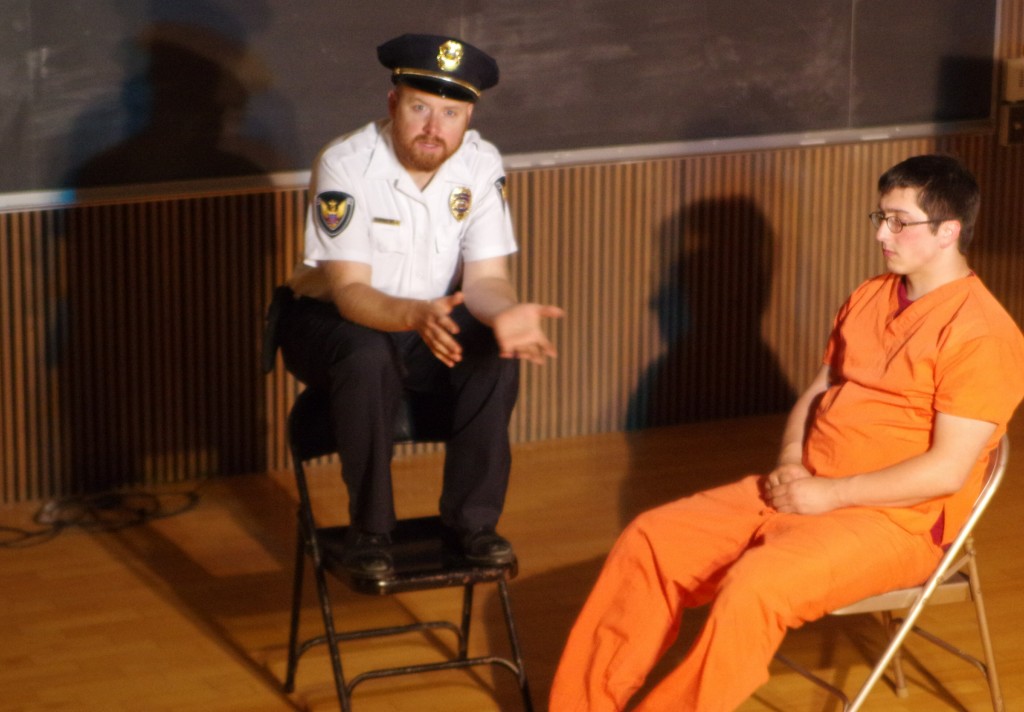
IMGP3079crp

Keeping It Light

IMGP3080crp

Directed by Kate Pleuss

None of this impressed the Supreme Court of Ohio. In affirming one of the death sentences, the court stated:

Nor was DRC’s alleged refusal to “negotiate in good faith” relevant in the guilt phase. Let us be clear: The authorities in lawful charge of a prison have no duty to “negotiate in good faith” with inmates who have seized the prison and taken hostages, and the “failure” of those authorities to negotiate is not an available defense to inmates charged with the murder of a hostage.

Some believe these words to be profoundly misguided. To be sure, the authorities negotiated under duress. Moreover, if Sergeant Hudson and Ms. Unwin helped to cause the death of Officer Vallandingham, this does not mean the leaders of the uprising were necessarily free of guilt.
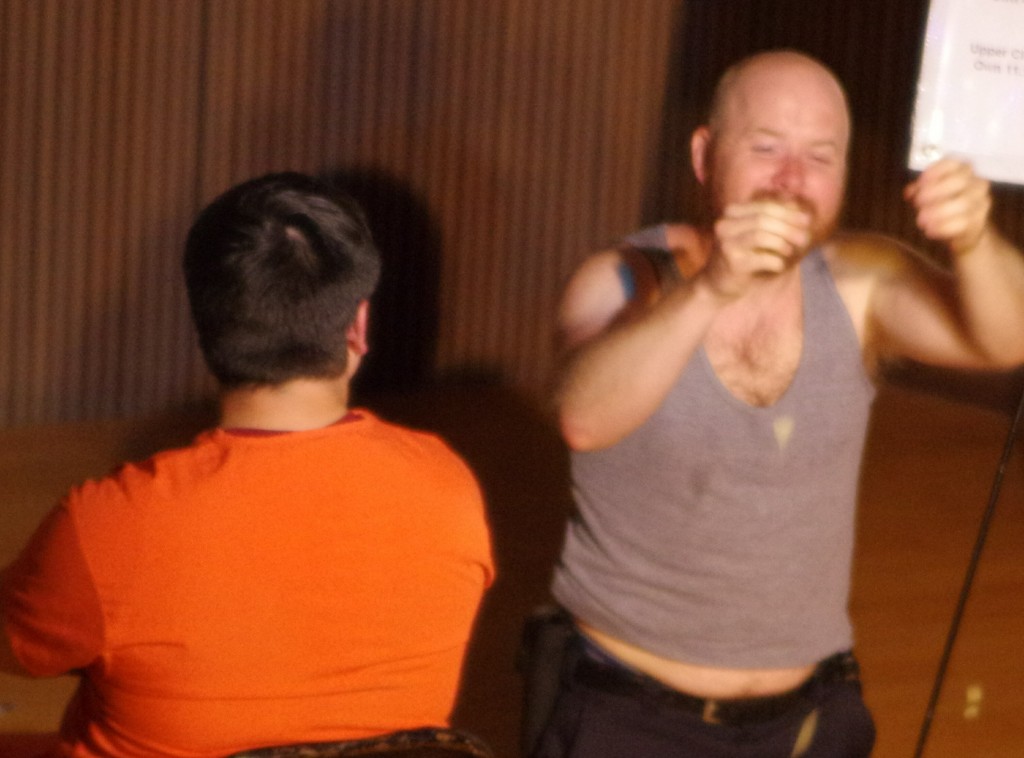
IMGP3082crp

You Won’t Look at My Family Pictures?
IMGP3083crp

Cop Losing It

What’s questionable in the decisions of the Ohio Supreme Court is the attitude that prisoners in rebellion are “enemy combatants” toward whom the authorities have no obligations at all. For example, one Court of Appeals held that under the plain language of the law existing in 1993, the state had illegally eavesdropped on the conversations of prisoners in L block, and that this crucial evidence should therefore have been excluded at trial. On further appeal, the Ohio Supreme Court held that enforcement of the
statute for the benefit of rioting prisoners would be “absurd”.

Such a holding, and the attitude prompting it, oversimplify a tangled sequence of cause and effect. Perhaps the law itself is prone to such rigidity. Perhaps legal practitioners are driven to view the world superficially by the desire to win. History, with its constipated analysis,
has serious problems of its own. But, history at least stands for the proposition that an event can have more than one cause, and sometimes what happens in life is not a melodrama, with clearcut villains and heroes, but a tragedy in which we all have played
a part. Is it too much to ask that before sending five more men to their deaths, we pause and seek to determine what really happened?
IMGP3085crp

The Perils of Power…and Being Hated

IMGP3087crp

Judge, Jury, & Executioner

Finally, there is the state’s misconduct after the prisoners surrendered on April 21. At that point the agency charged with investigating what had occurred—the Ohio State Highway Patrol (OSHP)— and the special prosecutorial team appointed to try the Lucasville cases were free to act calmly and with circumspection.

Instead, in the absence of physical evidence the State, through its various agencies, targeted those whom it believed to have led the uprising and built cases against them by cutting deals with prisoners willing to become informants. The government threatened prisoners with death if they declined to “cooperate.” It appears the prosecution put
witnesses on the stand to offer testimony the state knew to be false. Like Emile Zola in his celebrated exposé of the Dreyfus case, the State stands accused the of deliberately framing innocent men. [The chief prosecutor, while being interviewed for the film referenced above, fecklessly admitted he rolled up a newspaper and repeatedly whacked one of the State’s witnesses every time the inmate would start a sentence with, “I won’t lie to you…” The State’s prosecuting attorney seemed oblivious to the appearance of coercion, arguing this hardly amounted to ‘beating testimony out of a witness’ or witness tampering.]

Arguably, Ohio should be guided by the experience of the State of New York after the rebellion at that state’s Attica prison in 1971. During the years 1975–76 it came to light prisoners had been induced to present perjured testimony, and prosecutors were
intentionally suppressing evidence of misconduct by State personnel during the assault on the prison. In the end, New York Governor Hugh Carey declared an amnesty for everyone involved in the Attica tragedy—both prisoners and persons involved in the state’s assault on the recreation yard—and extended clemency to prisoners who had already been convicted or had previously entered into plea bargains.

Ohio should do likewise. The pattern of prosecutorial misconduct should cause Ohio’s governor to pardon all Lucasville defendants found guilty of rebellion-related crimes.

Some of those who helped assembled these researched facts include:

Frances Goldin, friend, literary agent, and negotiator extraordinaire, and Peter Wissoker, senior acquisitions editor for Temple University Press. There were a number of diligent lawyers, among them Niki Schwartz, who represented the prisoners in L block in settlement negotiations at the end of the disturbance; Dale Baich, who worked on the Lucasville cases while employed by the Office of the Ohio Public Defender; Richard Kerger, one of the lawyers for the supposed principal leader of the rebellion, Siddique Abdullah Hasan; Palmer Singleton of the Southern Center for Human Rights, which represents capital defendants in Georgia and Alabama; and Professor Jules Lobel of the University of Pittsburgh School of Law.

In addition to the five men condemned to death, at least eighteen prisoners contributed relevant memories, documents, and insights. They are not named lest doing so expose them to retaliation. They know who they are, and they will find their contributions in these pages.

In most cases, the information provided to me offered no benefit to the prisoner who shared it. In at least one instance, a prisoner conveyed information to clear his conscience at considerable peril to himself.

Like the women who attended Jesus at the cross after the disciples fled, three women—Jackie Bowers, sister of George Skatzes; Angela Merles Lamar, wife of Keith Lamar; and Vincenza Ammar, beloved friend of Namir Abdul Mateen—provided whatever assistance was in their power to give.

Attorney Alice Lynd, spent approximately three years poring over the transcript of the capital proceedings against George Skatzes, indexing and cross-indexing, and identifying issues for appeal. Later, her time was almost wholly taken up by litigation concerning conditions at the supermax prison that opened in Youngstown in 1998. Most of the prisoners who were found guilty of crimes or rule violations connected with the Lucasville uprising, including those sentenced to death, have been housed at the supermax.

The pool of prisoner witnesses to what happened in 1993 was thus near at hand. And Alice has had an uncanny ability to retrieve documents that had once examined but thereafter seemed to have disappeared.

The five men condemned to death—the “Lucasville Five”—have been extraordinary collaborators. Throughout the process, each of these men has been confined alone in a small cell, with little access to any of the others. A meeting including all five around
a table has never been permitted. Disagreements among the Five could not be ironed out face to face. Prison mail presented many frustrations. Despite these physical obstacles, all five have shared their legal papers with each other, responded to requests, and reviewed manuscripts in various stages of its preparation.

One at a time, probing their recollections, considering documents that very often they had provided, when it have came to conclusions different from what some of these men remember, those were discussed with mutual respect and effort to establish the truth.

Mumia Abu-Jamal has played a special role. He is probably the best-known prisoner in the United States, if not in the world. During the period in which I put this book together, Mumia and his attorneys were in the midst of cross appeals from the decision of a federal
judge who had for the moment set aside Mumia’s death sentence (although he remained on Pennsylvania’s Death Row), but left the jury verdict of guilt intact. Mumia stepped back from these pressing personal concerns to help with this book.

Mumia knew of George Skatzes, and there existed respect at a distance between the former Black Panther who has remained silent about the events surrounding the death of Officer Daniel Faulkner in Philadelphia, and the former member of the Aryan Brotherhood who has declined the state’s invitation to accuse other prisoners of murdering Officer Robert Vallandingham (see Chapter 5). Mumia said he felt a book was “doable.” Pennsylvania prison regulations prohibited direct correspondence between Mumia and the
Lucasville Five, but through correspondents, he offered encouragement.

In an unpublished essay on the Lucasville events, Mumia shares his views about what happened there:

Lucasville
The name is evocative. People who hear it, who may know very little about its recent role in Ohio history, seem to recognize its penal roots.

It has become a site etched upon the American mind that means prison, like Sing Sing, Marion, or Lewisburg. The name evokes an aura of fear, of foreboding.

In this essay Mumia contrasts what happened at Lucasville with the much greater loss of life at Attica in 1971. The Lucasville Five, he writes,

worked, against great odds, to prevent an Attica (where over thirty men perished when the state unleashed deadly violence against the hostages taken, and falsely blamed it on the prisoners). They sought to minimize violence, and indeed, according to substantial
evidence, saved the lives of several men, prisoner and guard alike.

Mumia is particularly struck by the extent to which these five men overcame “easy labels”—Muslim and Aryan, black and white—and began to perceive each other’s humanity.

They rose above their status as prisoners, and became, for a few days in April 1993, what rebels in Attica had demanded a generation before them: men. As such, they did not betray each other; they did not dishonor each other; they reached beyond their
prison “tribes” to reach commonality.

It is a sentiment appropriate to all persons, in whatever country, on Death Row for political reasons.

A Long Train Of Abuses

The uprising at the Southern Ohio Correctional Facility (SOCF) in Lucasville began on Easter Sunday, April 11, 1993. As prisoners returned from recreation in the yard at about 3 p.m., they overpowered correctional officers on duty inside L block. After the release of certain badly injured officers, eight continued to be held as hostages.

In the course of the occupation, two more hostages were set free, and one was murdered. Eventually, with the help of attorney Niki Schwartz, the State and the prisoners came to a 21-point agreement. On Wednesday, April 21, 407 prisoners surrendered and the five remaining hostages were released.

In subsequent legal proceedings, three negotiators and spokesmen for the prisoners—Siddique Abdullah Hasan, formerly known as Carlos Sanders (hereafter “Hasan”), Jason Robb, and George Skatzes—were found guilty of the aggravated murder of Officer Robert Vallandingham. So was Namir Abdul Mateen, also known as James Were (hereafter “Namir”). All four were sentenced to death, along with Keith Lamar, alleged to have organized a “death squad” that killed five supposed prisoner informants in the early hours of the uprising. Hasan and Namir are Sunni Muslims; Robb and Skatzes were at the time members of the Aryan Brotherhood.

At this time, the five capital cases are making their way through the courts. Hasan, Robb, and Lamar are at the last (federal habeas corpus) stage of appeals.

KING ARTHUR

What makes human beings rebel?

Often rebellion seems not to be in the personal interest of the insurgents. This was true in Philadelphia in 1776, where Benjamin Franklin is said to have joked about the need for the signers of the Declaration of Independence to hang together lest they hang separately. It was equally true in Lucasville, Ohio, in April 1993. At least two of the five men later sentenced to death for their alleged roles in the uprising were within sight of release from prison when the “riot” began. Hasan, the supposed mastermind of the rebellion, was in the SOCF honor block.

The words “a long train of abuses” come from the Declaration of Independence. The American Revolution is the rebellion about which we know most.  Why did some tenant farmers support the patriot cause while others hoped for a British victory? (Answer: It depended on the politics of your landlord. You opposed what the landlord was for, in the hope that if he lost you could obtain ownership of your farm.) Why did city artisans, who were radical Sons of Liberty before 1776, vote in 1787 for a constitution drafted by conservatives like Alexander Hamilton? (Answer: Before and after independence, the artisans were concerned to keep British manufactured goods out of America.) And how did it come about that these advocates of inalienable human rights set up a government that protected slavery? (Answer: Both northerners and southerners expected the population in their own part of the country to grow more rapidly than that of the other section, allowing it to dominate the Congress and resolve the issue of slavery in its own interest.)

In writing about the Lucasville uprising, it can be viewed it as a rebellion like the American Revolution. The comparison is encouraged by the following words from the country’s leading authority on prison riots, Bert Useem: “[T]he principles underlying collective behavior against authorities appear to be fundamentally the same whether one is examining revolution against monarchies and empires or riots against prison authorities.”

So what made prisoners at Lucasville rebel? What were the causes of the uprising?

To answer these questions, we must turn to studies conducted both before the disturbance and after it ended; to deposition and court testimony, especially in a subsequent civil suit by victims of the rebellion; and to the collective memory of the rebels themselves.

The drafters of the Declaration of Independence charged King George III with “a long train of abuses” against their rights. Similarly, prisoners at Lucasville had multiple grievances against Warden Arthur Tate, whom they called “King Arthur.”

The Southern Ohio Correctional Facility in Lucasville was opened in September 1972 to replace the old Ohio State Penitentiary in Columbus, where there had been riots in 1968.

According to John Perotti, who was a prisoner at SOCF, “Luke” acquired a reputation as one of the most violent prisons in the country. Prisoner Emanuel “Buddy” Newell, testifying in the trial of a fellow prisoner after the surrender, agreed. When he heard the commotion begin in L block on April 11, he said, he first assumed that it was a “normal fight.”

Q. When you say a “normal fight,” what are you talking about?
A. You know, just inmates, just some inmates fighting, maybe two or three inmates fighting.

Q. Okay.
A. Officers trying to break it up, like all the time.

Q. Is that uncommon at Lucasville?
A. No.

Perotti says that most of the guard-on-prisoner brutality took place in J block, which housed Administrative Control and Disciplinary control (“the hole”). In 1983, Perotti continues, 12 guards beat to death Jimmy Haynes, a mentally disturbed African American
prisoner. While nurses stood watching, one guard jumped on Haynes’s neck while another guard held a nightstick behind it. Two other black prisoners, Lincoln Carter and John Ingram, were alleged to have touched white nurses. They were beaten by guards and found dead in their cells in the hole the following day. No criminal charges were pressed.

A group of prisoners known as the “Lucasville 14” sought to give up their United States citizenship and emigrate to other countries. Three of these prisoners cut off one or more fingers and mailed them to President Carter and other officials to prove that they were serious. The United States refused to allow them to renounce their citizenship.

Some prisoners organized a branch of the Industrial Workers of the World to demand the minimum wage for prison labor, Perotti relates. The courts rejected this demand. Perotti also helped to prepare a 38-page petition to Amnesty International. The petition described
instances in which prisoners were chained to cell fixtures, subjected to chemical mace and tear gas, forced to sleep on cell floors, and brutally beaten, all in violation of United Nations Minimum Standards for the Treatment of Prisoners. The petition was confiscated as contraband, and its authors were charged with “unauthorized group activity.”

In 1989 Warden Terry Morris asked the Correctional Institution Inspection Committee (CIIC)—a body appointed by the Ohio legislature—to prepare a summary of concerns about SOCF to be used by him in discussions with unit managers and department heads. The CIIC based its response on letters from 427 SOCF prisoners received between August 21, 1987, and November 1, 1989. Many of these—180, or 42 percent—expressed concerns about personal safety. The CIIC report mentioned the murders of prisoners Tim Meachum in December 1988 and Billy Murphy in January 1989, and the stabbing death of prisoner Dino Wallace.

In more than a hundred subsequent interviews with CIIC staff, prisoners—years before April 1993—“relayed fears and predictions of a major disturbance unlike any ever seen in Ohio prison history.”

It was alleged that knives have been and can be bought or provided from staff, and that a staff person allegedly provided a gun that is reported to be hidden in the institution (whereabouts unknown). Inmates claimed staff were approaching them with suggestions or offering to make it worthwhile if they would stab another inmate. Certain inmates are reportedly allowed to stash or transport knives.

One victim of a stabbing claimed that he knew it was coming, because of a reported pattern in such matters. His cell was targeted for daily consecutive shake downs reportedly to ensure that he had no weapon when the inmates stabbed him. A security staff person reportedly apologized to him afterwards, explaining that he has a family. Incidents were cited in which staff reportedly were present when verbal death threats were relayed
from one or more inmates to another, (in one case when the inmate also displayed his knives by raising his shirt) yet staff were reportedly silent. In another case, after a stabbing, a staff person reportedly approached the inmate who stabbed the inmate and
said, “Why didn’t you kill the son of a bitch?”

Another prisoner at SOCF in those days, part–Native American “Little Rock” Reed, describes the events that led to the appointment in 1990 of a new warden, Arthur Tate.

Operation Shakedown was the extreme and unjustified result of a horrible incident in which a mentally unstable prisoner killed a young, beautiful school teacher who worked at the prison assisting prisoners to achieve their high school diplomas. Although the prisoner had a documented history of mental instability including violence against women, the administration carelessly assigned him to work as the teacher’s aide, where he would be in a room with her at times alone, with no supervision. The prisoner took her hostage and ultimately cut her throat with a coffee can lid, nearly ripping her head from her shoulders. Many prisoners thought highly of the young teacher, and were outraged at her senseless and brutal death. . . .

Nevertheless, immediately following the incident, the prison was placed on lockdown [“lockdown” means confinement of each prisoner in his cell]. The guards came into each cell block, armed in full riot gear, and systematically ransacked every prison cell while the prisoners could only stand helplessly and watch. . . .Meanwhile, local citizens banded together in front of the prison demanding that the prisoners be stripped of all privileges, holding placards with such proclamations as “Kill the killers.”

SOCF housed both maximum security prisoners and prisoners classified as “close security,” a status intermediate between “maximum” and “medium.” However, prisoners agree that once Arthur Tate became the warden, the whole complexion of the penitentiary changed for everyone imprisoned there.

One of the Lucasville Five, Keith Lamar, remembers that Tate “immediately scrapped all the programs, supposedly as a way to cut down on inmate traffic. Lines were painted on each side of the hallway floors, and we were ordered to stay within those lines as we walked—military style—to and from the kitchen, gym and work areas.”

Chrystof Knecht, another Lucasville prisoner, has similar memories: “Under Tate’s regime, SOCF prisoners were told how and when to eat, sleep, talk, walk, educate, bathe and recreate. Privileges were taken away on a regular basis. New rules were enforced daily, disregarded, then re-implemented weeks later.” Bill Martin, also a SOCF prisoner, thinks the “most bizarre” rule was the one “requiring prisoners to march to chow, recreation, chapel, work, school, commissary, etc.” King Arthur wanted prisoners not only to walk within the lines, “but walk in double-file formations. Prisoners who hated each other were
forced to march next to each other. Everybody deeply resented this.” According to Martin, there were repeated massive shakedowns of prisoners’ personal property and constant transfers of prisoners from one part of the facility to another.

SNITCH GAMES

A prisoner who becomes an informant is known behind bars as a “snitch.” In its report to Warden Morris, the CIIC concluded that the main concern of SOCF administrators should be “snitch games,”

the common denominator reported to be related in one way or another to past or present circumstances of the large majority of inmates. They spoke of the relationship between snitch games and unit management, violence, gangs, racial tension, drug, gambling, sex and extortion rings, job assignments, cell assignments, unit moves, lack of personal safety, fear of other inmates and distrust of staff.

Yet, according to Keith Lamar and an influential Muslim prisoner, Taymullah Abdul Hakim, also known as Leroy Elmore, after Warden Tate’s appointment SOCF continued to encourage “snitches”: “the only way you could work where you wanted to work, or cell where you wanted to cell, was to be in cahoots with the administration. This served to increase the snitch population exponentially.” Taymullah declares that Tate “promoted informing on guards and prisoners. Prisoners were fitted with ‘wires’ (recording instruments) and sent at guards to entrap them in criminal activities. Flyers were printed up instituting a ‘snitch line’ where prisoners and visitors could write to inform on criminal activities inside Lucasville.”

Warden Tate’s invitation to snitch was conveyed in a memorandum, a copy of which is before me as I write. It is dated May 31, 1991, and directed to “All Inmates And Visitors.” The memo states in part:

Due to my concern about violations of laws and rules of this institution, I feel it necessary to make myself available for persons wishing to pass this information on to this office concerning these things. . . . I have established a post office box at Lucasville, Ohio for information which could assist our departmental efforts in eliminating violation of institutional rules and criminal conduct. Your letter will be intercepted by this office and will not be processed through normal institutional mail. Your information
will be held in strict confidence. . . . The address is as follows: Operation Shakedown, P.O. Box 411, Lucasville, Ohio 45648.

Prisoners view snitches much as striking workers perceive scabs, only more so. It should not have come as a surprise that at least eight of the nine prisoners later killed in the uprising were perceived by others as “snitches.”

L’ÉTAT C’EST MOI (I Am the State)

What did Warden Tate intend? In a document entitled “Situation at the Southern Ohio Correctional Facility as it led up to the riot,” dated July 5, 1993, an anonymous prisoner states that he believes that Tate would have liked to lock down the whole institution permanently “and make it another Marion, Ill. supermax” (a prison in which prisoners are confined in single cells for 23 or more hours a day).

There is evidence for this theory. The most comprehensive of the post-uprising studies, Southern Ohio Correctional Facility: Disturbance Cause Committee Findings (sometimes called “the Mohr Report” after its chairperson, Gary Mohr) contains in its appendix a memorandum dated March 22, 1993—20 days before the uprising began. The memo, from Tate to Eric Dahlberg, South Region Director is entitled
“Request to Construct a Maximum Security Unit at SOCF.” Although Tate speaks of constructing a “maximum security” unit, SOCF was already for the most part a maximum security prison, and his request must be understood to seek supermaximum conditions of confinement. The memo states in part:

Over the past several months I have expressed my concerns relative to the need for a maximum security unit at this facility which is suitable to house those prisoners who are high security risks requiring maximum levels of supervision as well as a physical structure designed to effectively house them. . . . [I]nmates in the highly assaultive, predatory category requiring maximum security confinement, will continue to increase due to lengths of sentences. 

Recognizing that the department was unable to finance the construction of a new supermaximum security prison at that time, Tate asked permission to build a “high security unit” at SOCF.

Whether or not Warden Tate consciously wanted to turn SOCF into a supermax, it is certain that he insisted on absolute obedience. Like Bourbon kings before the French Revolution, he acted as if he believed that “I am the State.” Bill Martin offers an example of Tate’s mindset.

King Arthur followed Otto Bender’s advice of closing all the windows during the summer because SOCF was designed to have a flow-through ventilation system to keep the institution cool. Without any investigation, King Arthur signed Bender’s decree which ordered all the windows closed. . . . My supervisor, Pat Burnett, subsequently went into King Arthur’s office and inquired about his “window decree.” King Arthur .. . had the institution’s blueprints on his desk and, as he was gently patting them, he told Burnett, “I have it all right here. The institution was designed with flow-through ventilation. It will keep the institution cooler if the windows are kept closed.” Burnett then informed King Arthur that the flow-through ventilation will not work because most of the blowers on the roof are burnt out. . . . [You would think that King Arthur would have rescinded] his “window decree.” But he did not want to appear foolish–so all suffered through a very hot summer.]

Similar hard-headedness about the best way to test for tuberculosis would trigger the April 11 uprising.

Behind the Badge is on tour with The Shadow of Lucasville, a new documentary film by D Jones about the 1993 prison uprising in Lucasville Ohio.

Posted in Uncategorized | Leave a comment