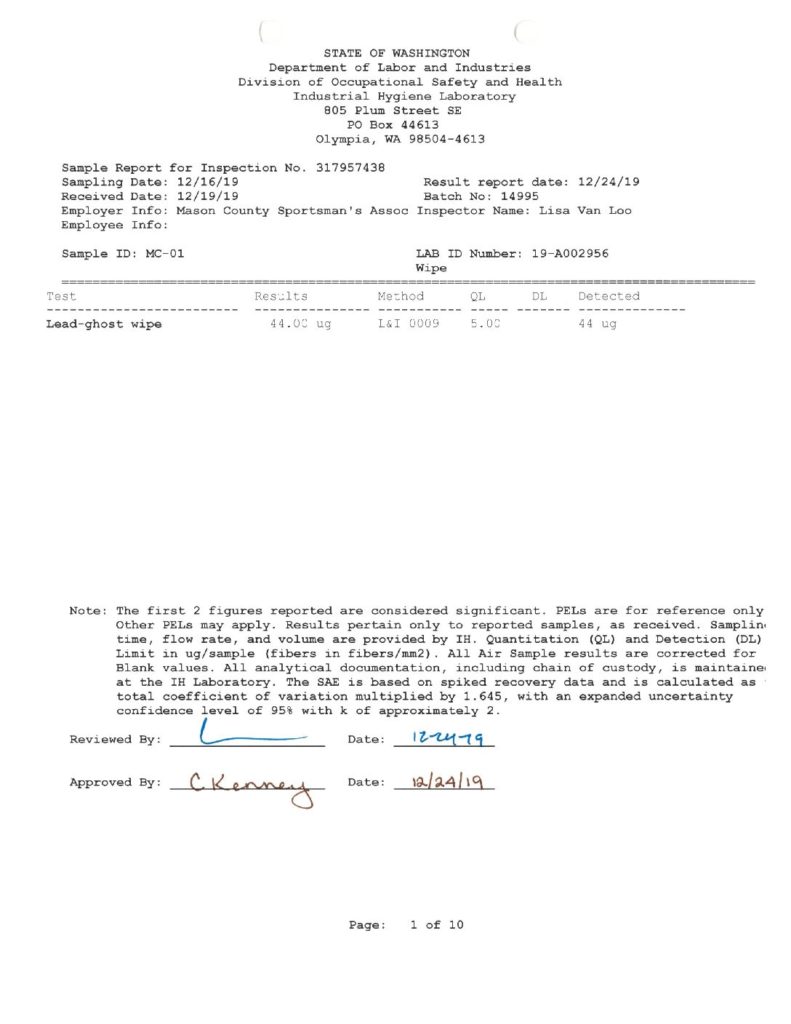
The MASON COUNTY SPORTMAN’S ASSOCIATION located on Port of Shelton property (a gun range) is on my mind due to the rumors they were too cheap to regularly change their air filtration or decontaminate the lead members and school children were exposed to while there. Is this true? Who has the lowdown on this?
Word has it that school children have exhibited symptoms (e.g. blurry vision) consistent with lead poisoning and members have been tested after being exposed to levels thousands of times the legal limit. If this is true, the Port, school that bussed the children there, and the Association had better have some deep pockets to pay the lawyers they’ll need in a class action lawsuit.
So what about it, folks? Who knows what and what is it? What was done to mitigate the lead contamination from all those rounds fired in that building? What are the test results of those afflicted?
They most likely did not inform the parents right away because of how lead is absorbed in the body. Lead has a half life of about 36 days. In children, it will be longer. After the half life is over the remaining lead travels to deep tissues. After that it goes directly into the skeletal system. There it will remain for several years. If the children were tested right away it would of showed up in the blood. Parents thinking their kids are safe because lead was not detected is a fallacy. Children’s bones have to be checked.
John, I don’t know what’s happening with the several motions that you were gonna help Bill get ready and file, but he’s really getting (as a caring partners here), he’s really getting depressed–About, about the whole thing, and he’s been depressed for so many years because he couldn’t find anybody to help him. And, please give him a call and let him know one way or the other wether anything’s gonna be going forward with this.
I hate to see him like this, and here comes Christmas. And, Yeah. Okay. Thanks, John.”
Olivia, a very public personality, has also brought a lawsuit in Multnomah County against a fellow journalist for publishing common public knowledge about her (including her address) which she argues is ‘doxing’ and ‘private’ information.
The claim is certainly legally dubious, but if the information ever was ‘private’, it certainly won’t be in the course of a very public trial. The fact her address is likely embossed on every check she writes and circulates among 3rd parties appears to have escaped her notice, along with her voter registration. As a public persona, she has no expectation of privacy derived from such mundane facts anymore than her hair/eye/skin color. A glance at the car she drives parked in her driveway reveals as much about her domicile as any publication. Neither ‘doxing’ nor photography is a crime–nor should it be. No tort arises from the recitation of such pedestrian facts. And, many are of legitimate public interest.
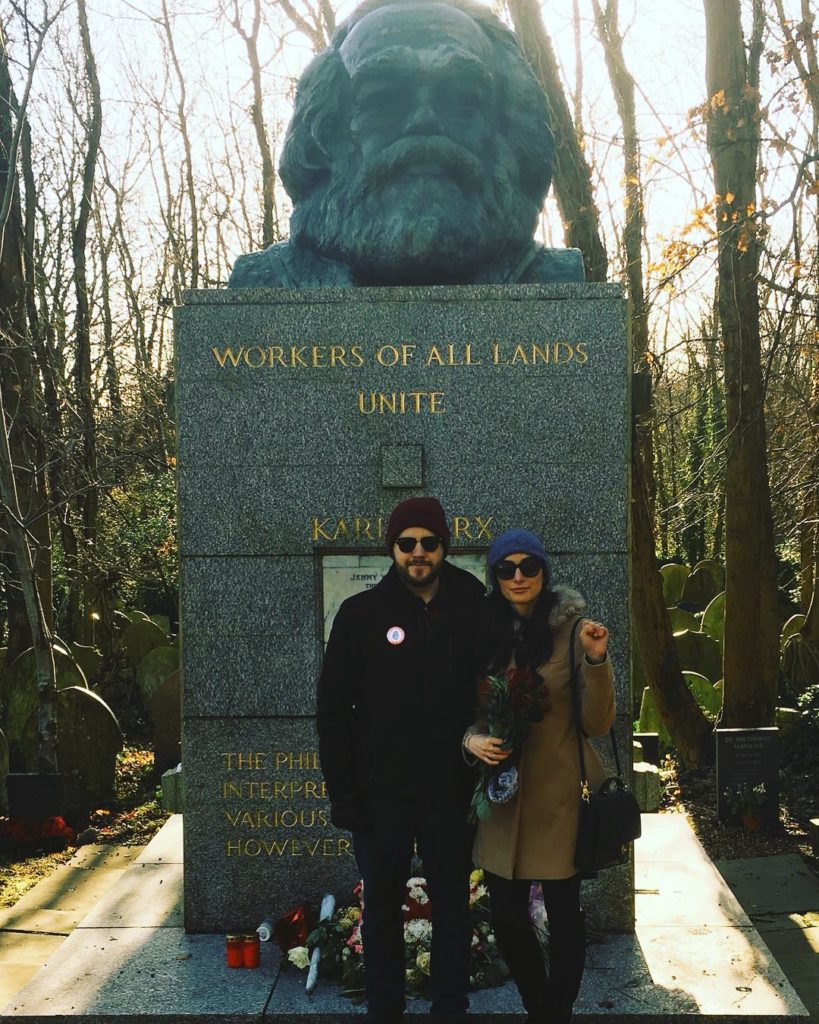
On November 19, 2018, Katbi-Smith posed for a group photo taken during the 2018 National SJP conference.
The 2018 National SJP conference was held on November 16-18, 2018 at the University of California, Los Angeles (UCLA). The conference was themed “Radical Hope: Resistance in the Face of Adversity.” The conference website stated: “[t]he reason we can have hope is that Zionism…can be destroyed.”
Katbi-Smith was a fellow at the John Glenn School of Public Affairs at Ohio State University (OSU) in 2016.
Candidate’s statement: I am an unapologetic Arab, Marxist, feminist who is running for re-election to be your chapter co-chair in 2020. I joined DSA immediately after Trump’s election, and I’m proud to have helped build the chapter and lead us to the place we are now. But our fight is only just beginning.
…I organized at my own workplace (and was fired for doing so), stood up against fascists in the streets, and helped our chapter build relationships with key faith, labor and community leaders and organizations locally, nationally, and internationally.
Olivia Katbi Smith, co-chair of Portland’s chapter of the Democratic Socialists of America, filed a lawsuit in Multnomah County Circuit Court on Nov. 19 accusing a North Carolina man of posting her private information online.
The complaint alleges Chadwick Jason Seagraves posted the home address of Smith and her family online this month and encouraged others to spread the information across far-right online platforms.
The lawsuit describes Seagraves as a member of the right-wing men’s group the Proud Boys and alleges he has a history of doxxing—that is, posting personal information about people to make their lives unpleasant. The lawsuit alleges that he intentionally targeted Smith because of her political views. Seagraves could not be reached for comment.
“Defendant has a substantial history of purposefully doxxing Portland residents on the internet based on their political viewpoints in hopes of silencing viewpoints that defendant disagrees with, and interfering in Oregon’s political process,” the complaint says.
Female flyweight prospects Colbey Northcutt and Putri Padmi lit up the ONE Championship stage at ONE: EDGE OF GREATNESS, delivering three rounds of explosive and entertaining mixed martial arts action!
Relive the best of this flyweight showdown — in slow-mo!
Plus, catch the full fight between Northcutt and Padmi! Subscribe to ONE Championship on YouTube: http://bit.ly/ONECHAMPIONSHIP
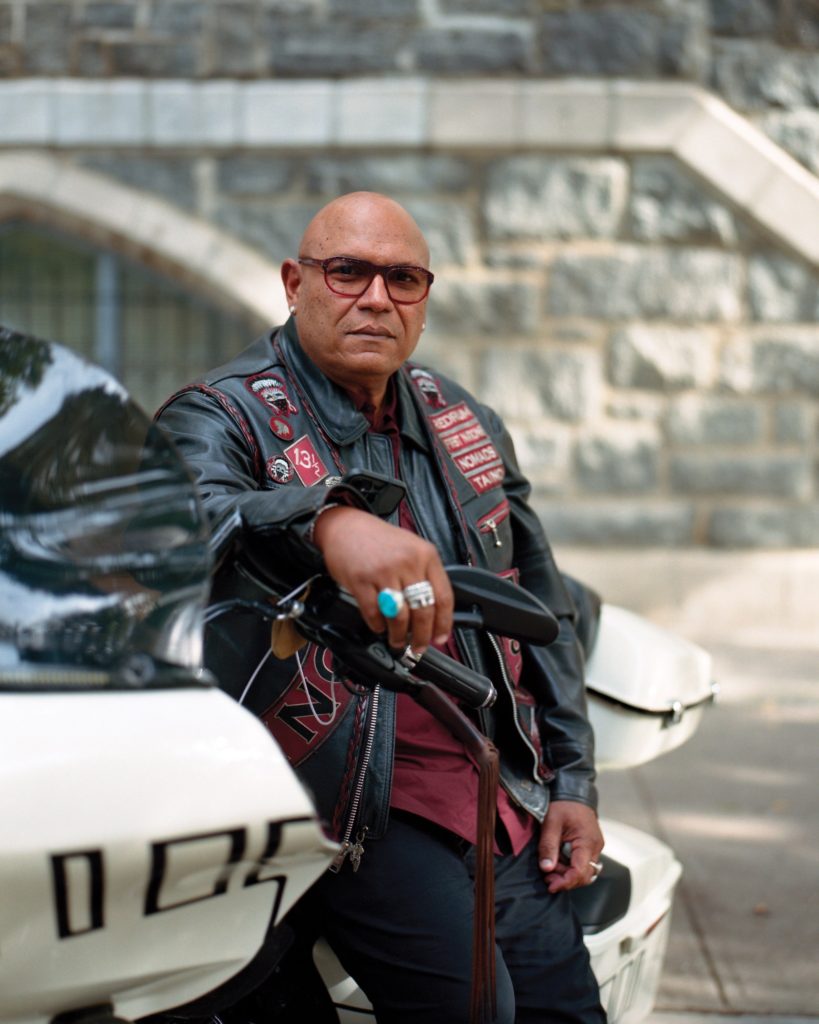
Sam Rivera outside the Castle, a residence for the formerly incarcerated.
“Don’t answer! When you come home and someone says, ‘How ya doing?’ it’s not a question. You just say fine. Every New Yorker knows that. If someone says, ‘How ya doing?’ and you start telling someone how you are, you might as well be wearing a big sign saying ‘I Have No Idea Where I Am.’ So. How ya doing?” Sam Rivera laughed, and his audience wasn’t quite sure whether to laugh with him or not. It was six o’clock on a Thursday evening last fall at the Castle, at 140th Street and Riverside Drive, and the weekly meeting was just beginning.
The Castle is the main residential wing of the Fortune Society, a nonprofit organization that has been helping people cope with the aftermath of incarceration since its founding, by the Broadway press agent David Rothenberg, more than fifty years ago. “Thursday meeting” is a mandatory, semi-sacred gathering of the Castle’s eighty or so residents, all of whom have been incarcerated, some as recently as earlier in the week, along with people who once lived there or who would like to live there. Various guests may appear, too, ranging from John Edward Wetzel, the secretary of corrections for the State of Pennsylvania, to Luann de Lesseps, the “Real Housewives of New York” star who once spent a night in jail. (Lesseps arranged a beauty day for the women of the Castle, which was broadcast on “Housewives.”)
Much of the language of the meeting is specific to the world of those who have been locked up. “I’m a reluctant veteran of the short bid,” someone might say gloomily—a short bid being a brief sentence. A language of elaborate indirection fills the room. “Justice involved” means that someone was arrested for or convicted of a crime; “been upstate” means imprisoned at northern-county places like Attica or Auburn (where license plates are made) or at Sing Sing (where the electric chair Old Sparky once stood). The catchall phrase for the totality is “lived experience,” the term having migrated here to mean, simply, “I’ve done time.” Either people have lived experience or they don’t.
Partly through the osmosis that teaches all of us our dialects—nobody has to tell a quarterback to say “It was a team victory”; he absorbs the words when he starts playing football—the residents use many cautious voices and tenses to narrate their movement through a hostile world. “I got involved in a bad situation” or “I found myself in a circumstance in which someone got hurt” segues into the first-person active: “I’m putting my life together and reconnecting with my family now.”
Sooner or later, though, the complicated language settles, for a newcomer, into a basic formula of introduction: “I’ve been away. I’ve come home.” At the Thursday meeting last fall, when a recent arrival said that he had been away—perhaps for ten or twenty or thirty years—there was a round of applause, and Rivera, officially the associate vice-president of housing at Fortune but in truth its resident guru and presiding demiurge, was there to say, gently, “Welcome home, brother.”
Rivera is a big man. Of Native American and Puerto Rican parentage, he has the build of the fullback he once was. With a shaved head and an earring in each ear, he had led the meeting for about two years, with good humor and discipline—like one’s ideal of a staff sergeant, who creates maximum morale but with minimal opportunity for goofing off. As a young man, in the eighties, he was arrested on gun and drug charges, and acknowledges significant lived experience himself.
The first-floor room where the Thursday meeting takes place is decorated with a plush rug and photographs of the Castle from back when it was a Catholic girls’ school, and a poster-size Times article about the Fortune kitchen, which has a reputation for seriously good cooking. Week after week, the same seats are almost always occupied by the same people. A longtime resident called E., a formidable Jamaican with the voice, and the authority, of Laurence Fishburne, sits in the far-left corner. (“The computer room is not a place to come to hang out,” he announced as one meeting began. “If that’s what you want, to hang out—that’s not the place for that.” After E. speaks, it would be a brave visitor to the computer room who tried to make it the place for that.) To the right, a line of older residents, looking a little worn out and a little wise, fill the chairs. One Thursday, Shawnta Montgomery, who loves to tease Rivera for his sincerity and self-seriousness, was on the right, too, closer up. An older resident, Ervin Hunt, known to all as Easy, sat in the rear, to the left. Lined up beside Rivera at the front of the room, facing the residents and guests, were Stanley Richards, the Fortune Society’s executive vice-president, and David Rothenberg, its eighty-seven-year-old founder. Upstairs, there are comfortable bedrooms for more than eighty residents, but at the moment they were, by the society’s rule, empty. Everyone has to come to the Thursday meeting.
The ostensible point of the meeting is to share announcements, discuss the events of the week, create new rules, and greet new arrivals. But its real point, Rivera confided, is “to conduct a group-therapy session for seventy-five people, which they say you can’t do.” His goal was to get the people in the room, having come home, to stay home.
Rivera can keep the room buoyant with a joke—usually at the expense of Rothenberg, who, as the household saint, can afford to have a few jokes told at his expense (and whose aura is very different from Rivera’s: small, high-strung, gay, and Jewish). Rivera and Rothenberg were like a couple who had been working in a hardware store for too many decades; they enjoyed each other and gibed at each other, and by now the enjoyment had become the gibing. “David’s idea of a whisper is putting his hands over his mouth and then yelling,” Rivera said in the middle of a meeting, after Rothenberg, doing just that, had urged him to move on from some stalled subject. “My kids do that,” Rivera said.
Rivera soberly restores order, often in response to an excess of “poetry” that the meeting has allowed itself. (“If you call someone’s bullshit ‘poetry,’ they won’t be that offended, even if you’re telling them you don’t want to hear it.”) On this evening, for instance, someone used a formula familiar from twelve-step programs: “You have to hit bottom before you can come back up.” This sentiment went around the room with echoing fervor. But Rivera let twenty minutes or so pass before he intervened.
“You know, I just want to come back to something that the brother was saying before,” he said. “About how you have to hit bottom to come back up. Now, I don’t believe that’s true. What’s bottom? Where’s bottom? How do you know you’ve hit bottom? There may be a bottom below the bottom you’ve hit already! There may be a thousand bottoms you could hit if you let yourself. So—say that this, wherever you are, is your bottom. You’re going to declare that it’s as low as you’re going to let yourself go. Then come back up. Don’t wait to hit bottom before you start working your way back up. Call this bottom the bottom.”
The crowd, including the original speaker, laughed at Rivera’s earnest repetition of “bottom,” but he had made his point: they couldn’t afford the indulgence of self-dramatization. Creating a certain kind of double rhythm was essential to his work: a difficult truth was followed by self-deprecating laughter. A balloon filled with the helium of unrealistic hope was emptied, and then refilled with the warm air of actuality.
On another occasion, Shawnta Montgomery mentioned meeting someone who had worked with Rivera in the past: “He said, ‘Sam tried to fix me, but he couldn’t.’ But he sends his regards.”
“I couldn’t fix him?” Rivera said, with some vehemence. “I can’t fix him. I can’t fix you. I can’t fix anyone. Nobody fixes you but you. That’s why I say, If you’re going around me—to smoke or get high or whatever—you’re not fooling me. I’ll accept you any way you are. The only person you’re fooling is you.” Rivera emphasizes that change happens only hour by hour and day by day—and that, nonetheless, you can wake up one day and find that the hours of work have accumulated into months and then years. “That’s the only way it happens. You’re always coming home.”
He has a favorite aphorism about those whom he always calls his “clients,” which on another afternoon he stressed more fiercely than his usually equable tone allows. “The quote is mine, so I’m gonna own it,” he said. “ ‘The crime is not who you are, it’s what you did.’ David said once, to a journalist who asked, ‘How can you work with these violent criminals?,’ ‘Well, how would you like to be identified for your entire life by the one worst thing you’ve ever done? If your editor made you put at the top of every column you ever wrote, Written by Tom the Bed-Wetter. Or by Tom, Who Drove Under the Influence.’ I’ve worked in D.C., where people identify themselves by their degrees—‘I went to this school’—and that’s what it’s about. And sometimes people of color introduce themselves that way—‘I was in prison.’ But that’s not you! The crime is what you did. The crime is not who you are.”
Like anyone who is naturally good at something, Sam Rivera got to be naturally good at his work by thinking constantly about his performance and being acutely aware of what he is doing as he does it.
“Part of what I have is the contradiction of my appearance,” he explained one evening. “I’m a big man, and I can look intimidating.” He crossed his arms and looked out at an imagined audience. “So, when I’m there, like this”—he became the man he is in meetings, hands relaxed by his sides, a half smile on his face—“then I’m sending the message that you can be both, a tough guy who is open and not frightened. ‘If Sam is like that, then I can be like that.’ It’s about me taking control of what my own experience is. I had a mentor once, and I was telling him everything I was doing, and he said, ‘Where is Sam in this?’ That was hugely helpful to me. Seeing yourself from outside.”
Rivera was sitting over dinner at Trufa, an eclectic little restaurant at Broadway and 140th Street. The neighborhood, which had been poverty-stricken, filled with abandoned buildings, and therefore affordable when the Fortune Society salvaged the place, in the late nineteen-nineties, is now, as Columbia University pushes north and west, an ever more desirable area, dotted with restaurants and the inevitable espresso joints. The former convent school would be unaffordable now.
“There’s an architecture of the room that I rely on—E. being firm in the corner, Easy kibbitzing from the side,” Rivera went on. What had seemed an accidental weekly arrangement was purposeful. “You can’t emphasize enough things that may seem superficial. The look of a room, the kind of food we serve, which doesn’t look or taste like institutional food. Remember, a lot of our residents are people who went from eating institutional food in school to eating institutional food in prison and that’s all they know. No one’s ever spoken to them empathetically. No one’s ever asked them how they feel.”
Rivera grew up on the Lower East Side. “My mother had me when she was fifteen,” he said. “But we were always working poor. My parents always had jobs.” He speaks with the ancient, “r”-less, broad-vowel speech of a New York working class. In prison, Rivera recalled, he helped care for sick inmates during the height of the aids crisis, and he has done the same sort of work ever since. Rivera first visited Fortune as a client, in 1991, and then began a career in various post-prison and advocacy groups, including a long stint at Exponents, a leading drug-rehab organization in New York. Since then, he has been back and forth between Fortune and another nonprofit. “I’m a four-time recidivist here,” he has joked. He lives in Teaneck, New Jersey, and has two teen-age sons and a daughter in her twenties.
“That you’ve got to hit the rock-bottom moment?” he said, reflectively. “It’s something I’ve been thinking about for a long time. I’ve looked at programs that were created around recovery protocols, and the theory was: If there was ten per cent left of your rock bottom, they would intentionally bring you down to that zero, and then build you back up. My view is just the opposite. If you still have ten per cent after being through prison and abuse of many kinds, then we can start.
“So, I tell the story. I was with my boys, watching a show where they’re imploding a casino, and I’m kind of into it. It’s all dramatic, and they hit the thing—old school!—you know, the box with the plunger? And at about the third floor it caved in and the guy said, ‘Wow! With all the dynamite we used to destroy this building, the foundation was so strong that it wouldn’t go down.’ And I’m, like, ‘That’s it! ’ If we can find your foundation, you won’t fall. You’ll lean! You’ll trip, but you won’t fall. So that’s my work, finding the foundation that remains. Let’s not make it about the dynamite. Let’s work on your foundation—what will keep you standing, even if you start to use drugs again, even if you went back to prison. So that’s the only bottom I want to hit. That foundation that’s still there.”
David Rothenberg founded the Fortune Society almost by accident. In the late nineteen-sixties, at the peak of his career as an extremely successful Broadway publicist, working with the likes of Richard Burton and Elizabeth Taylor, he produced a Canadian play about rape in prison called “Fortune and Men’s Eyes,” and realized that the men who were most stirred by the play were ex-cons, as they were called then. Almost as an afterthought, he began a help line for such people—“Really, only an extra desk in the office”—and watched it blossom into a lifetime’s work. Yet he remains spiritually on both sides of the doorway. This makes his conversation a singular braid of show-biz anecdotes and social-activist exhortations. Holding out his right arm, he might say, “This is the arm that Liz Taylor cried on at the opening night of Dick Burton’s ‘Hamlet’ in 1964,” and then avow, “The mistake you make is thinking that they’re ever honest about crime numbers. The city will bring them up and down as they want, according to the politics of the moment.”
The turning point, for him, took place on “The David Susskind Show,” in 1968. “Everyone watched Susskind on Sunday nights,” Rothenberg recalled. “They always had six of a kind—six ex-alcoholics or six prostitutes or whatever was coming in sixes that year. I called the producer and said, ‘Have you ever had six former prisoners?’ She said, ‘I want ’em but I can’t get ’em.’ I said, ‘I can.’ So we went on, and the next morning, after the show, I got call after call after call. It was overwhelming! There was an endless line of men snaking up the stairs of this theatrical building. And I began to transition from full-time press agent and part-time prison activist to full-time prison activist and part-time press agent. Well, no-time press agent.”
Rothenberg takes a late lunch or an early dinner most days at Trufa. “Thursday meetings are always essential—we realized that if we had rooms and no services we were just a hotel,” he said. “What Sam does at the meeting is he gets people talking who are comfortable talking, but sometimes he’ll say, ‘Hey, Joe—what’s happening with you?’ And Joe starts talking and doesn’t shut up. He had never been given permission. Joe’s never been asked how he is in his life!” Rothenberg chuckled.
“You know ‘The Green Pastures,’ the movie?” The 1936 film relates Bible stories as Black American folklore. “Yeah, there’s a line, I think it’s from there, that I always repeat. The Lord, who’s represented as African-American, says to an angel, ‘We have to take care of that planet, but don’t forget the wing of the sparrow over there.’ Sam is one of the people taking care of his portion of the planet by taking care of the wings of the sparrow.”
Housing programs for an offender’s reëntry into the community usually involve a bewildering array of bureaucracies, and often result in former inmates being placed in halfway houses and homeless shelters that replicate the conditions of prison. Almost three-quarters of the released population are arrested again within three years.
“The Castle began when we kept seeing that there was an urgent need for housing for people released who became homeless,” JoAnne Page, the president and C.E.O. of the Fortune Society, explained from her office at the society’s administrative headquarters, in Long Island City. “More than half the people coming out of state prison to New York City right now are being dumped in shelters. hud defines people who are coming out of incarceration as not homeless, so no hud-funded program can take them in. They have to be sleeping under a bridge before they can officially be classed as homeless.” In the late nineteen-nineties, Page came upon the empty Catholic girls’ school. “The city took it from the nuns and left it vacant, with the idea that it would become a TB hospital, but they gave up on that idea, and instead it became a magnet for drug dealing.” In 1998, Fortune bought it for $1.2 million.
Page emphasizes the society’s “open doors” policy. “We’re bound by laws about sexual offenders and proximity to schools,” she said. But applicants are screened for “current risk of violence, not a history of violence. We have some of the people with the worst records in New York City coming for active services, but no metal detectors. We offer people something they really want, and the condition is that they have to behave peaceably if they want it.”
The Fortune Society holds most of its job-training and vocational-education programs at its Long Island City offices, with the Castle offering its own approach to social services. “It’s valuable that Sam has lived experience,” Page said. “He knows prison faces. He can tell the difference between someone who looks tough and someone who’s a threat. And most of the people coming home will see somebody in that room they did time with. That changes everything.”
The residents of the Castle admired Rivera for being as reliable about small things as he was about big ones. E., the longtime resident with the basso-profundo voice, put it bluntly: “Sam is the difference between leadership and leadershit. If you have leadershit, everything’s going to be shit, and that’s the primary reason why the shelters are such hellscapes. Sam watches the simple things that improve the outlook, improve the humanity.” Hilton N. Webb, Jr., another long-term resident, sixtyish and intensely serious, who is studying for a master’s degree in social work, and writing a memoir titled “Dancing in the Midst of Nothing,” said, “Whatever Sam says is going to happen, it’s going to happen. I remember when I was having problems with my roommate and I had to move to a single room. Sam said, ‘You’re going to have the same river view,’ and, to make a long story short, it happened. The river view is a nice view. That it was a little thing didn’t mean he thought it was nothing.”
The residents recognized the difficulty of Rivera’s role. “I’m aware of the stresses on him,” Webb said. He described a man trying to get into the building, and screaming at Rivera. “Sam was talking back to him in this very mellow, in this Zen way,” Webb went on, “but I noticed that he was holding a radio, and it was physically impossible that he could have tightened his hand on that radio any harder than he was. Knot-tight! I couldn’t have stood there with this guy spitting in my face saying the things he was saying. Yet I know that Sam wasn’t afraid, and he could have whipped this guy’s ass. So he’s, you know, the whole deal—the warrior-monk kind of guy. Sun Tzu said if you know the outcome of the fight anyway, you have no need to fight. I know and you know, so why don’t we pretend the fight is over and move on?”
One critical part of transitioning is to help someone involved with the justice system get involved with the employment system. “I got my job and my apartment” is a motto of success. As the sociologist Erving Goffman wrote in the nineteen-fifties, “A status, a position, a social place, it is not a material thing to be possessed and displayed”; it is “something to be enacted and portrayed.” That idea is profoundly relevant to the work of the Fortune Society. Coming home means learning the language and the rituals shared by the society outside prison walls. Weekly workshops at Fortune prepare clients for job interviews, and, particularly, help them address the obvious question: Where have you been for the past four or five (or thirty) years? It is against the law in New York City to ask a job candidate about his or her criminal record, but it is legal, after a job has been offered, to run a search on the prospective hire.
People who have just come home meet interviewers in mock interviews. What is your greatest strength in a work situation? (The right answer is: “I love to work with others.”) What’s your greatest weakness. (“Uh, my greatest weakness? Females,” one newcomer says, a candid but very wrong answer. The right answer is Clintonesque: “I try too hard to get it right.”) A young man who wants to be a restaurant cook is guided through an interview in which it becomes apparent that he doesn’t know much about cooking. (“You get in the good habit of bullshitting white people,” Rivera remarked later. “And you start bullshitting yourself.”) Interviewers like detail: about work programs upstate, about roofing or custodial work or how to operate a forklift.
Near the end of one mock interview, the questioner said, “You seem like a fine candidate for the job. I’d like to offer it to you. But, of course, I’ll run a background check on you. Tell me, if I do will anything come up?” The candidate, trained in previous classes, struggled to recall the ideal answer, which is something like: “Yes, when I was younger and behaving stupidly, an unfortunate situation occurred and someone got badly hurt. This led to my becoming involved in the criminal-justice system. But I studied hard and attended several programs while I was in jail. That person I was is not who I am now.” That, the interviewer explained, is a version of the perfect answer, which the residents work to adapt. Among the central skills that the Fortune Society teaches is how, in a job interview, to tell the truth while putting the best face on a previous failure.
All of us, of course, have to learn to navigate the waters of such interviews by telling the truth while putting the best face on previous failures. (“I did get a C on that Spanish test, but it was the result of some issues in my personal life and, as you can see, I pulled it right up in the following term” is what a kid raised with good fortune learns to say.) The broader task, as Rivera sees it, is to instill new habits of response among the formerly incarcerated. “You have to relearn all your reflexes,” Rivera said. “When you feel threatened, don’t react. If I find myself threatened by the possibility of a confrontation on the street—just a car-cutoff thing, you know; happens every day—I’ve found myself literally running in the other direction to remove myself from those reflexes and that risk.” The aim is to learn a new language of performance in order to have a new chance at life.
The theatrical side of the Castle is self-evident to its sharper-eyed residents. “The Fortune face—that’s what I call what you see in the Thursday-night performance space,” E. explained. “I don’t say that in a disparaging way, but that’s what it is—people are auditioning for acceptance into the program and they’re bringing their A-game to be accepted. And then you get to know the person, as opposed to the audition. Sometimes it’s the same person. With some people, it was just a façade, a performance to get in. And those people really don’t last that long. They shouldn’t.”
Some more radical-minded social-justice advocates don’t like the idea that people who were incarcerated should be taught how to blend in with middle-class rituals and mores. Rivera considers this view the kind of luxury that only people who are not struggling to “stay home” can indulge in. “Obviously, we have to reform the system and end the problems, and put fewer people in prison,” he said. “Obviously. But my job is saving lives now. If I wait for the world to be better, then the whole society would have to change, and I don’t have a long enough life to wait for that to happen.”
At a Thursday meeting a couple of weeks later, a recent home-comer praised another Castle client for gently urging him away from a confrontation with someone who pushed him—or whom he perceived to have pushed him—on the subway. “I almost lost it,” the home-comer recounted. “I was ready to do something about it, but he told me, ‘Just let it go,’ and I did.”
Rivera seized the moment: “What do we mean when we say we’re going to lose it? I realize I hear it often, ‘I was gonna lose it on this guy.’ What’s it mean for you?”
“Lose control,” one person said.
“Rage,” another said.
“Rage!” Rivera echoed. “But you’re gonna lose it. You’re gonna lose your housing. You’re gonna lose your freedom. What causes it?”
One man tried to explain his suspicion that a bunkmate in a homeless shelter had taken money from his backpack. “It’s hard coming from doing a whole lot of time. You’re bunked with someone and you know you’re getting robbed,” he said. “And it’s hard, because, if you were upstate or in another situation, you would have acted in another way. We live in our own minds. Man is mind. We first get out—we’re getting that comfortability back—and it’s hard to lose it, because you live in a room with it. I spent more of my life in prison than free. It’s hard.”
Rivera grew gentler: “Can I talk about that? Your voice changed. I heard it.”
“It’s hard having something taken from you. My life style—I’m not proud of it—but I was a stickup kid my whole life. I’m not used to having anyone take anything from me. There’s nothing you could do.”
“Here’s the deal,” Rivera said. “There’s something you could do and you chose not to. Don’t dismiss that, man! You should be, like, this should be a celebration, man. Like, for real—‘I did that, and I didn’t do what I would normally do.’ We all know what we could do. Many of us have done it. Take the power—I chose not to do that this time.” He glided into the next thought. “Was anyone around this week when I got stepped to?”
“When you got what?” Rothenberg asked.
“David needs help—what is ‘step to’?”
“Someone came at him very aggressive,” one person explained.
“He had a brick!” someone else added.
When a client had confronted him, Rivera hugged the man, literally, until the confrontation ended. The possibility of violence in the building had shaken everyone.
Rivera hadn’t seen the brick, and was startled to learn about it: “He pulled out a brick? For real? Let’s hold that, because I definitely want to know about this brick. But I want to come back to you, brother. Sometimes doing nothing is the best decision we can make, right? Someone says to me, very glum, ‘I didn’t do anything.’ No! You did . . . nothing. That’s an action. You chose to handle it. Doing nothing is doing something. Ignoring someone is reacting to them.”
Afterward, Rivera looked bemused. “I’m interested in this brick. Nobody told me about the brick.” He paused. “I’m glad I didn’t know about the brick.”
The coronavirus pandemic hit the Castle hard. Rivera was like a captain approaching a storm, battening down the boat while planning to take the waves broadside. Several residents contracted covid-19, and the decision was made to stop accepting new residents—a painful departure from long-standing Fortune Society practice—and to shelter the entire population in place, with the positive cases self-quarantining. The Thursday meeting was moved to Zoom. To attend remotely was oddly reassuring in those first panic-stricken weeks of the pandemic in New York; having been through so much worse, and accustomed to enforced isolation, the Fortune community had a kind of unfazed gaiety unique among the difficult interactions of the moment.
Then, in late May, after the standard announcements of a Thursday meeting, Rivera said, as smoothly as he could, “So, I have an announcement. I submitted my resignation today.”
There was a brief pause. “Resignation not accepted!” E. called out, cutting through his usual cool with obvious pain.
“Resignation not accepted!” Easy called out, in turn. And the cry went around the gallery: “Resignation not accepted!”
Rivera tried to quiet them. “Now listen to me, it’s a decision I’ve made.”
E. was insistent: “You can’t just say this. You got to explain this shit, man.”
Rivera told them that he was leaving to become the executive director of a “harm reduction” group, an organization that promotes health among drug addicts and sex workers, providing condoms, clean syringes, training in overdose reversal, and the like.
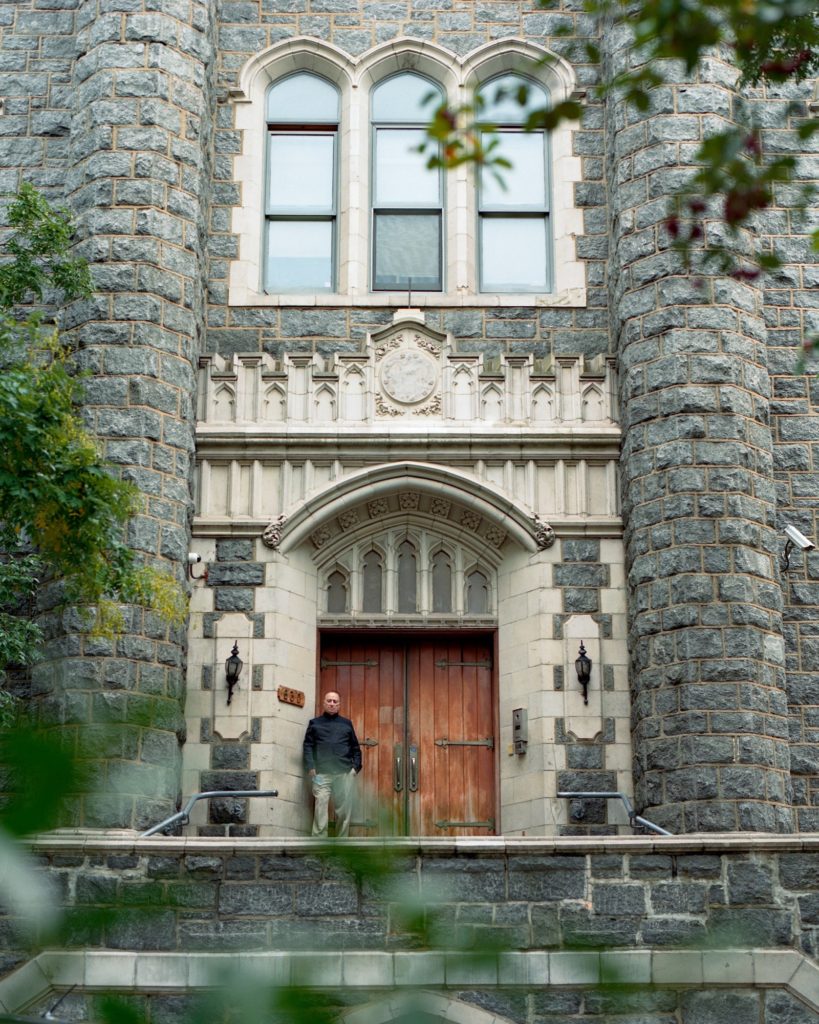
David Rothenberg, the Fortune Society’s founder and a former Broadway press agent, in front of the Castle.
Eventually, the residents surrendered, and began to congratulate him. “I’m grateful for all you have done to help me see the world more clearly,” one said.
Rivera was privately equivocal about the reasons for his departure. Although he disavowed any internal conflict, there clearly had been complicated feelings between him and some of the top people at the Fortune headquarters. “I would have loved to stay at Fortune,” he said in early June. He was at home, wearing a Che Guevara T-shirt and sitting in front of a picture of the Buddha—an accidental but telling juxtaposition. “But our values just aren’t well aligned anymore.”
Rivera cited the society’s response to the protests in New York and across the country. “In organizations, you have to be careful not to take a political stand—but this isn’t political. And Fortune froze.” He was frustrated that, even though the staff was almost fifty per cent Black, it took weeks for its leaders to speak out. (“I didn’t realize how important it was to make a statement because I thought our actions spoke for themselves,” Page said. “And that was a lesson learned. We’re now making statements.”)
Still, Rivera admitted that he had decided to leave long before the protests started. Conversations with others in the organization suggest that the issue was a familiar one, especially within nonprofits. Sam Rivera, the charismatic center of the operation, had little executive power within it, and over the years this had created some rubbed-raw feelings between him and the people who did. The same rule that holds in a small regional theatre holds in a nonprofit devoted to post-incarceration transitions: the charismatic figure wins the allegiance of his clientele, at the risk of alienating his colleagues, who, without any malice or even conscious envy, become mindful of what they see as his managerial deficits. Tension grows between the charismatic person and the administrators, who have a clear idea of the dogged and unglamorous work required to sustain the institutional structure.
Page insists that the organization will go on more or less intact. Angela Scott, an eight-year veteran of the society, has replaced Rivera. “I ran Thursday meeting for years, and then Stanley did”—the Fortune vice-president—“and then Sam,” Page said. “Now it’s Angela’s turn.”
As with anyone who has left an organization to which he was devoted, Rivera became more aware of Fortune’s flaws and fissures in retrospect. “We came across as participating in the punishment,” he said. “Our line was: If you smoke weed, and keep doing it, we’re going to discharge you. I’m not going to expel someone for smoking marijuana. I’ve never met anyone who O.D.’d on marijuana.” (Page said that Fortune would never force a client out just for smoking marijuana.)
Rivera returned to an image that haunted him. “I was driving by a playground once, near where I grew up. And I was with one of my mentors, watching these great little kids playing in this playground. And he said, flatly, ‘Sixty per cent of those kids are going to prison.’ We’re still not fixing the problem or even addressing it. What we’re doing now with policing, it’s as if we deliberately set buildings on fire, and then installed a fire station across the street. The thing is not to let the fires get started.”
David Rothenberg, who knew Rivera best, wondered if the coping mechanisms that had enabled Rivera to remake his life had been disabling to him in moments of professional friction. “Sam has gotten so adept at avoiding conflict that he avoids conflict when he needs to engage in it,” he said. “I keep telling him that—you just have to accept that, wherever you go, there will be friction between you and the people you work with, and you have to work through it. It reminds me of when I was in group therapy, years ago, and I strongly disliked another member of the group. ‘That’s the one who will do you the most good!’ the therapist said. And he was right.”
In early July, Rivera paid the Castle and its residents a final visit. “I want to say goodbye,” he said. He and Rothenberg drove together from Rothenberg’s apartment in the Village up to 140th Street.
“So, one night Miss Peggy Lee called me at midnight and said, ‘I want to do a show of Frank Loesser’s music,’ ” Rothenberg was saying in the car. “ ‘And you’re calling me at midnight about this because?’ I said. ‘Because I need the sheet music,’ she said. So I called the Loesser estate. God, she was good!”
He got no response. “You know who Peggy Lee is?” he asked.
Rivera furrowed his brow, as one who, knowing exactly who Peggy Lee was, was disinclined to admit it at just that moment.
As the car pulled up to the Castle, a group of residents, all masked, were waiting on the steps. But, where in the movie version the returning local hero would be surrounded by a crowd, Rivera quickly sought out one-on-one encounters. Hilton Webb was there, and, with the stoicism that betokens great pride in accomplishment, he narrated to Sam the sequence of certificates he was pursuing.
Instead of congratulating him, Rivera exclaimed, “You gotta accept that getting one degree is enough.” He reminded Webb that the point of the Castle was to get out of the Castle, and that the choice of when to leave would not always be left to the resident. “One of the issues for you is that you’re a brilliant motherfucker—no, no, you are!—but you have to be more than that. I never in my life thought that I’d think that ignorance is bliss. And now I totally respect it, because there are elements in my life right now that I wish I didn’t understand. There are Puerto Ricans in my life who are pro-Trump—I wish I didn’t understand them.” Webb was laughing. “So what I’m saying to you,” he added, more softly, “is that your intellect’s your intellect—you’ll always have it—but you only need one degree. And then you need to move and live.”
Later, sitting with Rothenberg for lunch outdoors at Trufa, Rivera said, “Anything can be an addiction, or a crutch. You can get addicted to education. You can even get addicted to recovery.”
A man careered down the street, obviously high. Rivera discreetly pointed him out to Rothenberg. “Remember him? He used to come to Fortune.”
“He looks bad,” Rothenberg said.
Recently, controversy had arisen about the release of long-term prisoners guilty of notoriously violent crimes, and Rivera and Rothenberg began discussing the difficulties of reconciling the work at Fortune with their sense of moral order. At the Castle, you never ask anyone about the reason for his imprisonment. But no one, as Rothenberg says, goes away for thirty years for jumping a turnstile, and many people at the Castle have been away for thirty years.
“It’s hard, I get it,” Rothenberg said. “There was this wonderful arts editor at the Times, who was always kind to me, helped me understand what worked and what didn’t. He was killed by a drunk driver on New Year’s Eve. Years later, I’m at Fortune, and someone introduces me to a woman. She had just come home after doing years for a D.U.I. ‘I think she killed some editor from the Times,’ they said.” He swallowed hard and said, “That was the moral test for me. Could I work with her? And, of course, I did.”
Rivera mentioned a friend of his who had seemed in good shape, and then suddenly committed a violent act against a former girlfriend and her new lover. “We hadn’t addressed his trauma adequately,” he said. “We’re all transitioning. You keep coming home. It’s like—you know, I’ve been thinking a lot lately about diets. Everyone has a diet. Monday’s O.K., you eat your soup and salad. Then Tuesday goes better than you hope, but then Wednesday is really hard—you’re hungry. Then on Thursday you go over to Mom’s and she makes fried chicken, and how can you say no? It’s Mom. So then you always say, ‘Well, I blew it, so I’ll start again on Monday.’ And you spend the weekend enjoying yourself. That’s the trick. You have to start again on Friday. That’s all it is. Everyone backslides or has a bad day. The key is going back on the diet on Friday, after you screw up on Thursday, and not to wait till Monday to start again.” He paused and waited for his food to arrive.
“Did I ever tell you about the time Edward Albee came to the Castle on a Thursday?” Rothenberg said, brightening the silence. “And one arrogant woman running for office who was there watching came up to me and said, ‘What was that old con in for?’ I said, ‘I don’t know, I guess for winning three Pulitzer Prizes?’ ” He smiled. “I told her, ‘Never assume.’ That’s a line from the Katharine Hepburn and Spencer Tracy movie ‘Desk Set.’ ” Rothenberg paused. “People say Hepburn and Tracy. Actually, Shirley Booth did the play on Broadway.”
Later that day, Hilton Webb texted Rivera, saying that he would begin to think less about education and more about independence. “I think I may have been delaying things because it’s been almost fifty years since I last lived by myself,” Webb explained. “Scary.” Rivera forwarded the text to a friend and added a comment: “This is why I do what I do.”
How long do COVID antibodies last? This study says they disappear after about 4 months
BY KATIE CAMERO
NOVEMBER 05, 2020 12:53 PM
Stanford Health Care gave us exclusive access to show how coronavirus antibody testing works.
The New York Times followed two caregivers and their blood, through the testing process.
BY THE NEW YORK TIMESA new U.K. study of more than 3,000 health care workers says that coronavirus antibodies decline by half in just under three months and disappear after about four and a half.
The findings suggest people may not be able to depend on antibodies as a form of protection from a second infection, as several studies still aren’t clear about what level of immunity they provide and for how long.
What’s more, antibodies last longer in people who had symptoms and fade quicker in those who never did.
The non-peer reviewed study was published Wednesday in the pre-print server medRxiv.“
These findings could be significant: current studies that are using antibodies to assess how many people have been infected in a population might have missed some who have been infected,” study co-author David Eyre, a professor at the University of Oxford’s Nuffield Department of Population Health, said in a news release.
The study tested 3,217 health care workers from the Oxford University Hospitals NHS Foundation Trust for current infection with the coronavirus and for its antibodies.Over six months, the researchers measured antibody response in the same people to see how the levels changed over time.
A total of 452 employees tested positive for COVID-19.Antibody levels peaked 24 days after the participants’ initial diagnosis but then fell by half at about the 85-day mark. Antibodies lasted an average of 137 days, or about four and a half months, before fading enough to ring in a negative test result.
The researchers were surprised to learn that antibody levels peaked lower and declined faster in younger adults.“The longer-lived antibodies in older people of working age are intriguing and not completely explained,” Eyre said.
“This is still a new disease and we are learning more and more about it all the time, but longitudinal studies like ours are needed to answer some of these important questions about how long and at what level antibodies last, and the extent to which they protect people from reinfection.”
The team also learned that people of Asian ethnicity reached higher maximum antibody levels than people of other ethnicities.
The new study adds to a handful of others that, collectively, have not found a consistent length of time antibodies remain in the body after coronavirus infection.A separate non-peer reviewed study published last week by the Imperial College London of more than 365,000 randomly selected people in England found that the number of people with antibodies dropped by about 27% over three months.
In this case, the antibody drops were largest in people over 75 compared to younger adults.
Meanwhile, another peer reviewed study published in October found that coronavirus patients produce antibodies for a “stable” five to seven months, suggesting protection from reinfection for at least that long.Experts warn much is still unknown about how long antibodies last and how effective they are at protecting people from contracting the virus again.
CELL.COM Orthogonal SARS-CoV-2 Serological Assays Enable Surveillance of Low-Prevalence Communities and Reveal Durable Humoral ImmunitySerological assays for SARS-CoV-2 exposures are challenging due to poor positive predictive values. Ripperger, et al, show that the combinatorial use of spike receptor binding domain and S2 eliminates almost all false positives. This serological assay is used to show durable antibody production for …
This documentary was CENSORED/removed from YouTube, hence its availability to you privately which you’ve been given through an alternate venue.
Don’t lose the link. Share it with friends/family you believe would benefit from it. It is the best hour long documentary on ANTIFA I’ve seen and 100% accurate.
Jack Posobiec & Citizen Journalism Presents: ANTIFA: Rise of the Black Flags. The true history of the anti-government extremist group’s century of violence.
The truth about ANTIFA is not widely known. Jack Posobiec delivers a movie showing all the underpinnings of the ANTIFA Movement.
ANTIFA has become a paramilitary arm of the democratic party and is very dangerous to the future of our American ideals and democracy. This is a must watch film. The truth must get out now more than ever.
Based on real events. Please share with your friends, stream to your FireTV stick using Silk and host a watch party to discover the truth about this deadly organization.
For More information: http://antifamovie.com/ David Lugo – Director Steve O’Rourke – Producer Raheem Kassam – Associate Producer Matt Schwartz – Cinematography Jon Du Toit – Editor
Nationalist Regimes Embracing War Criminals A toxic cocktail of masculinity, nationalism and violence is resulting in a growing number of regimes supporting war murderers.
by Pallabi Munsi (10-20-20)
From the U.S. to India, Sri Lanka to Saudi Arabia, democracies under nationalist leaders and authoritarian regimes are now embracing war criminals as symbols of support to the military.
The shift is a reflection of the marriage between masculinity and nationalism playing out in many of these countries, say experts.
At a February 2016 campaign rally in South Carolina, Donald Trump, then running for president, invoked a false story about Gen. John “Black Jack” Pershing and how he crushed a Muslim insurgency in the Philippines. Pershing took 50 bullets, dipped them in pigs’ blood and executed 49 Muslims in retaliation for Islamic terrorism, Trump declared at the rally. He even tweeted later: “There was no more Radical Islamic Terror for 35 years!”
Like many other elements of Trump’s campaign rhetoric, his embrace of war crimes wasn’t just hyperbole. As president, Trump pardoned Mathew Golsteyn, an Army Special Forces officer who claimed to the CIA in a job interview that he killed an Afghan detainee whom he believed was a bomb maker. He (Trump) prevented the demotion of Eddie Gallagher, a Navy SEAL who was acquitted of war crimes charges but was convicted of posing for photographs with a detainee’s corpse. He pardoned Clint Lorance, an Army lieutenant who ordered his unit to fire on unarmed Afghans. And in May this year, Trump pardoned Michael Behenna, a former Army lieutenant who was convicted of killing an unarmed Iraqi detainee.
WASHINGTON, DC – FEBRUARY 4: Matt Golsteyn, 38, is a former special forces officer that is now being investigated for war crimes committed in Afghanistan. He is pictured in his Washington, DC office. (Photo by Sarah L. Voisin)
Yet while Trump’s actions have sparked criticism from veterans and experts alike, they’re in keeping with a growing global pattern. Muscular, nationalist governments are increasingly demonstrating their support for their militaries by overlooking or even rewarding crimes, while others are turning to war criminals to replicate their brutality in other theaters of war.
In April, Sri Lankan President Gotabaya Rajapaksa pardoned Sunil Ratnayake, an army sergeant convicted of the murder of eight Tamil civilians during the country’s 26-year civil war. The U.S. has successfully pressured the Afghan government to release hundreds of Taliban prisoners, including some of the most brutal killers, whose victims include soldiers of coalition forces.
India’s Narendra Modi government has awarded a soldier who tied an innocent Kashmiri man to his jeep and paraded him through a town in 2018. And the United Arab Emirates, Saudi Arabia and others are hiring a militia known as the RSF, behind some of the worst crimes in Darfur, to fight in Libya and Yemen.
NATIONALISM, MASCULINITY AND VIOLENCE ARE ALL TIED UP TOGETHER
If the brutality of these war crimes is at variance with the more sophisticated — though no less dangerous — tools of 21st-century power, such as data and information, financial heft and technology, that’s no coincidence. Carolyn Nordstrom, professor emeritus of anthropology at the Kellogg Institute for International Studies, explains that modern nation-states are built on 19th-century political and economic foundations. And despite their technological advances, they’re in the midst of internal power struggles between old and new approaches. “The old power is using the only tricks it knows by institutionalizing the armed forces,” she says.
Politics is front and center. The White House insists the pardons are meant to “offer second chances to deserving individuals, including those in uniform who have served our country.” But Trump was blunt on Twitter: “We train our boys to be killing machines, then prosecute them when they kill!”
This pattern of reprieves and rewards for alleged or convicted war criminals is visible in nations with autocratic regimes or democracies that have witnessed an erosion in the rule of law under nationalist governments, acknowledges Ernesto Verdeja, a political scientist at the University of Notre Dame who has been a longtime war crimes watcher. But he points out that motivations across regimes vary.
For Saudi Arabia, for instance, the decision to use a notoriously brutal militia of mercenaries to support its overseas wars is little more than a pragmatic strategic choice. For democracies that formally subscribe to the rule of law, like the U.S. or India, “the audience is fundamentally domestic,” Verdeja says. And for that particular domestic audience, “nationalism, masculinity and violence are all tied up together.”
Charles Anthony Smith, associate professor of political science at University of California, Irvine and author of The Rise and Fall of War Crimes Trials: From Charles I to Bush II, concurs.
“When you get a leader of a country who has constructed a tough-guy image, the reality is, the very bad acts happen against people that these tough guys don’t care about,” Smith says. “They either don’t like their ethnicity or their country of origin, or something like that.” The ones who fail to get justice by such pardons are almost “never the tough guys’ constituents.”
Leaders such as Trump, Modi and Rajapaksa pitch themselves as their countries’ best hope for law and order. But in reality, they end up defending lawlessness. “By fanning the flames of bigotry, they feel good about what they’re doing,” Smith adds. “It gives them a sense of empowerment.”
Mathew Collett (left) and Kylie Kadeen Craig (right) are wanted for kidnapping and murder in the death of Rachell Rene Roberts. Courtesy MASON COUNTY SHERIFF’S OFFICE
Mason County Sheriff’s Office is looking for a man and woman suspected of kidnapping and murdering a woman whose body was found earlier this month.
On Oct. 2, deputies responded to a call of a body found in the Lake Cushman area, off U.S. Forest Service Road 24 near Highway 119, according to a department news release. The woman was identified as Rachell Rene Roberts after an autopsy on Oct. 5, according to KING TV.
“It was apparent from the evidence at the scene that this was a homicide,” the news release reads.
She had been assaulted, according to the release, and a medical examiner found signs of suffocation.
Mason County Sheriff’s Office, Washington State Patrol, and the FBI have been investigating the homicide, according to the release, and the Sheriff’s Office ultimately requested arrest warrants for two people on charges of murder and kidnapping.
The news release describes Collett as a white man who’s 5-feet, 9-inches tall and 180 pounds and bald with blue eyes. It describes Craig as 5-feet-3-inches tall and 180 pounds with brown eyes and “brownish/blond hair.”
They’re associated with a red 2013 Hyundai Elantra with a Washington license plate number of BTX1364.
Law enforcement are still working to determine where Roberts was killed, but detectives do not believe the crime happened where Roberts was found, Mason County Sheriff’s Office Chief Deputy of Investigations Jason Dracobly told The Associated Press. He said police believe there was a connection between Roberts and the suspects, but they haven’t identified it yet.
Anyone with information on the suspects’ location is requested to call 911, Crime Stoppers of South Sound at 800-222-TIPS, or Mason County Sheriff’s Office at 360-427-9670. Information also can be emailed to amercado@co.mason.wa.us.
The Sheriff’s Office advises the public not to confront the suspects, as they’re considered armed and dangerous.
A man and woman wanted in connection to a murder near Lake Cushman are in custody, the Mason County Sheriff’s Office announced Sunday morning.
2 suspects wanted for Rachell’s murder are in custody
by Rolf Boone (10-11-20)
A man and woman have been arrested in connection with the death of a woman whose body was found near Lake Cushman early this month, the Mason County Sheriff’s Office announced Sunday morning.
The two suspects, Mathew Collett, 37, and Kylie Kadeen Craig, 28, were found and arrested in the northern California’s Humboldt County.
“Due to the nature of this investigation, we cannot release any additional information at this time,” the Sheriff’s Office said in its announcement.
Collett and Craig were wanted for the kidnapping and murder of Rachell Rene Roberts, whose body was found this month near Lake Cushman in Mason County. Roberts’ body was discovered off U.S. Forest Service Road 24 near Highway 119 on Oct. 2.
The American Civil Liberties Union of Washington filed a lawsuit against the state Department of Licensing on Wednesday, arguing the state’s practice of suspending drivers’ licenses when they fail to pay traffic fines unfairly hurts people who can’t afford to pay.
The complaint, filed in Thurston County Superior Court on behalf of people whose licenses have been suspended, names the Washington State Department of Licensing and department director Teresa Berntsen as defendants, The Seattle Times reported.
Currently in Washington, when a driver gets a moving violation such as a speeding ticket, they can pay the fine or request a hearing. But if they don’t respond to the citation or fail to appear at a hearing, their license is suspended. If the person doesn’t pay or enter a payment plan, the court can refer the debt to a collection agency.
People who then drive without a valid license can be charged with a misdemeanor which at the lowest level can carry another $1,000 fine or 90 days in jail.
The ACLU argues this system unconstitutionally favors wealthier people, who can pay their tickets and keep their licenses, while stripping people with low incomes of their right to drive, trapping them with ballooning debt and making it more difficult for them to keep a job that could help them pay off their fines.
“License suspensions for those unable to pay fines, fees, and default judgments for moving violations are not about public safety,” the complaint said.
Licensing spokesperson Christine Anthony said in an email Wednesday, “We have just received the lawsuit and will be working with the Attorney General’s Office on our next steps.”
The ACLU claims the system violates state constitutional rights to due process and equal protection and against excessive fines. The attorneys ask the court to stop the Department of Licensing from suspending licenses for unpaid tickets or failure to appear.
“I beg you, master. Master!” That’s what a black Colorado woman, Shataean Kelly, 28, cried out to the police officer who had hog-tied her and thrown her in the back of his cop car after arresting her for being in a fight. She slipped off the seat and with her face to the floor, hands and feet shackled behind her back, she begged, “please don’t let me die back here!” as he drove her for another 21 minutes to the precinct.
The officer, Levi Huffine, later claimed he couldn’t see what was happening in the back seat, reports CBS Denver. But on camera footage of the ordeal, her words, crying, and prayers are very easy to hear, including, “Officer, please. I can’t breathe.”
The incident took place in Aurora, Colorado, in August of 2019, but the footage was just released this week. If it seems eerily reminiscent of the story of a Black woman who was also hog-tied by Aurora police, it should. Last week Diane Redleaf reported on the case of Vanessa Peoples, a mom whose toddler wandered away at a family picnic, prompting a passerby to call the police, who then called child services. When a caseworker came to Peoples’ home and she didn’t hear the knocking, the worker called for backup and three cops entered Peoples’ home, guns drawn. In the hubbub that ensued, they hog-tied Peoples, dislocated her shoulder, and took her to jail. This was during a “child wellbeing” visit in 2017.
Aurora has also been the focus of protests over the death of Elijah McClain, a 23-year-old who was walking home from getting his brother an iced tea on Aug. 24, 2019, when someone called 911 to report that he was waving his arms, wearing a mask and looking suspicious.
When the police found McClain, who was unarmed, they struggled to handcuff him, finally felling him with a “carotid hold.” McClain vomited, apologized for this, and told officers he couldn’t “breathe properly.” Emergency medical technicians injected him with the sedative ketamine. McClain had a heart attack on the way to the hospital and died six days later.
Upon the release of the video showing Kelly hogtied and upside down in the cop car, Aurora Police Chief Vanessa Wilson said she was sickened by what she saw and believed Huffine had hog-tied Kelly as “punishment,” not for any actual safety reason. Tied up and contorted this way, Kelly could have died of positional asphyxia, said Wilson. “[Huffine] is lucky she did not die in the backseat of that car. Because he would be—in my opinion—in an orange jumpsuit right now.”
A review board had recommended a five-week suspension, but Wilson overruled them and fired Huffine. He has appealed his termination.
In the meantime, Aurora has dropped all criminal charges against Kelly.